
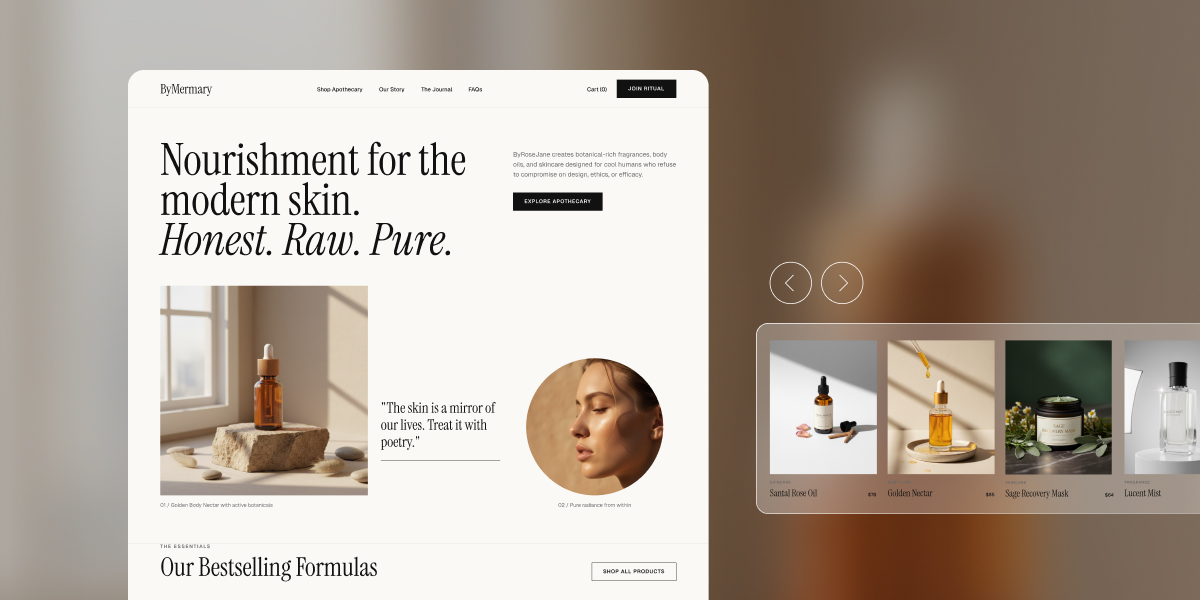
Choosing a skincare website builder is a bigger decision than it seems: get it wrong, and the cost shows up months later, not on launch day. Skincare has needs most generic “how to sell online” advice skips: ingredient transparency and allergen disclosure aren’t optional, and the photography this category relies on can quietly slow a site down if the platform isn’t built for it. Here’s how to choose one that actually keeps up.
Key takeaways:
- Ecommerce now accounts for 37% of global skincare sales in 2026, the highest share of any beauty category.
- A skincare website builder needs to do more than take payments. Ingredient lists, allergen disclosures, and credibility signals aren’t optional extras for this category.
- MoCRA registration and product listing aren’t optional for most skincare brands selling in the U.S.; confirm your status (or your small-business exemption) before you launch, not after.
- High-resolution product photography, the kind skincare shoppers expect for texture and ingredient close-ups, can quietly slow your site down if your platform wasn’t built to handle it.
- A side hustle, a growing brand, and an established line need genuinely different things from a skincare website builder, not just different budget levels.
Why the platform you pick now matters later
Skincare is the fastest-growing beauty category online: ecommerce made up 37% of global skincare sales in 2026, the highest of any beauty category, and Euromonitor projects that reaching 40% by 2030. Ingredient transparency and high search intent are driving that shift. Ingredient transparency and high search intent are driving that shift. Launch a skincare brand today, and most of your future customers already expect to find you online.
“Outgrowing” a website builder rarely looks dramatic. It’s page speed quietly slipping under new product photography, or a catalog and cost structure that no longer fits, not a crash: most platforms handle traffic spikes fine now. Those problems rarely show up on day one. They show up six months to a year in, right when you can least afford to rebuild.
Scale matters more here than raw power on day one. The right platform lets you grow without forcing a migration, a replatform, or three bolted-on tools just to keep functioning. That’s a different question than which platform looks best in a demo, and it’s the one this guide actually answers.
What a skincare website actually needs to sell
A skincare site has to do everything a general ecommerce site does, plus a handful of things that are specific to this category and that most generic “how to sell online” guides skip entirely.
1. Ecommerce features you actually need
At minimum, your platform needs:
- Real product pages, not just a photo and a price
- Inventory tracking across SKUs and variants
- Checkout that handles tax and accepts multiple payment methods
- Customer accounts with order history
- Room for ecommerce design that supports before/after comparisons and ingredient callouts, not a two-line description
- Appointment booking, if you offer skin consultations or other in-person services alongside your products
And ideally all of this without unnecessary complexity that makes handling your store a pain.

2. Speed and image handling for product photography
Skincare product photography runs heavier than almost any other ecommerce niche. Texture close-ups, ingredient macro shots, and before/after pairs are often shot at full resolution, and a single unoptimized image can run 4 to 8 MB. Put six of those on one product page without automatic compression, and that page is slow before a single customer even scrolls. Look for a platform that handles image compression and delivery automatically, rather than one that expects you to manually resize every photo before uploading it.
3. Ingredient and allergen transparency
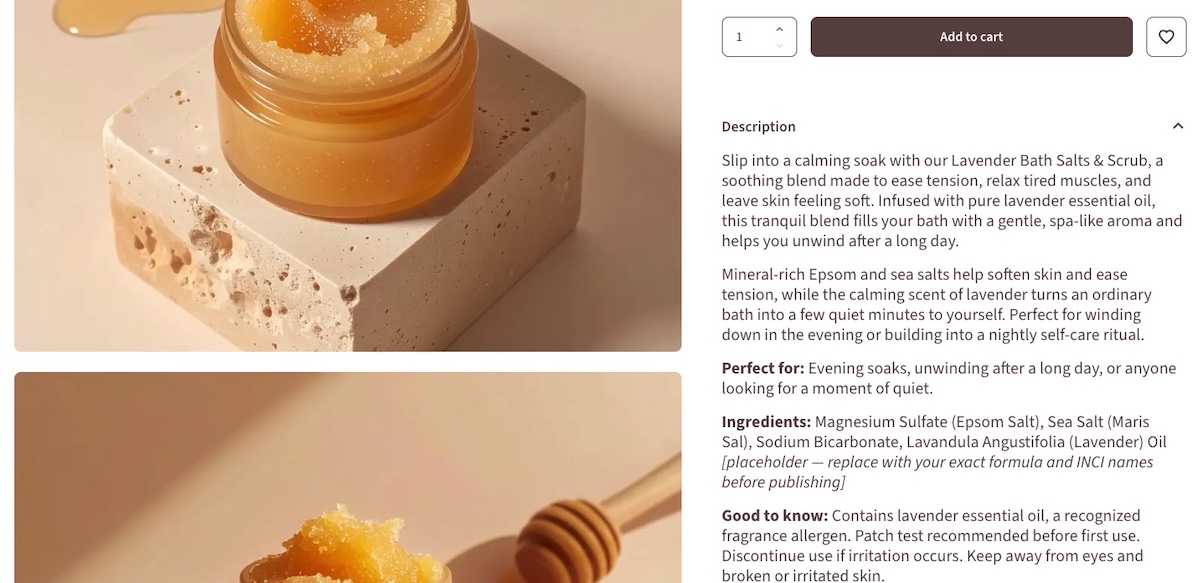
Skincare shoppers read ingredient lists before they read marketing copy, especially anyone managing sensitive skin, a fragrance allergy, or a specific skin condition. The real gap isn’t whether your platform has room for this: every product page has a description field. It’s whether that field gives you enough space and formatting control to keep a full ingredient list scannable instead of crammed at the bottom, and whether you have writing help to keep that wording consistent across every SKU instead of rewriting it from scratch each time.
4. MoCRA requirements met on your labels and product pages
The Modernization of Cosmetics Regulation Act of 2022 (MoCRA) is the biggest expansion of FDA authority over cosmetics since 1938, and most of its core requirements were already in effect by the end of 2024. Here’s what applies:
- Facility registration and product listing: Required annually with the FDA if you manufacture or process cosmetics sold in the U.S.
- Adverse-event reporting: Serious adverse events must be reported to the FDA within 15 business days.
- Small-business exemption: Brands averaging under $1 million in U.S. cosmetic sales over the prior three years can skip facility registration, product listing, and Good Manufacturing Practice requirements.
- Exceptions to the exemption: It doesn’t apply if your products touch the eye area’s mucous membrane, are injected, are intended for internal use, or alter appearance for more than 24 hours without the consumer removing them.
- Fragrance allergen disclosure: Still being finalized federally as of 2026 and not yet enforced, though California already requires disclosure of specific allergens, which is why many brands label consistently across every state.
None of this is legal advice, and the thresholds and deadlines above have already shifted more than once since MoCRA passed. Confirm your current obligations directly with the FDA or a cosmetics-focused attorney or regulatory consultant before you launch or make label claims, since your specific product type and sales volume can change what applies to you.
5. Trust signals that make shoppers comfortable buying skincare online
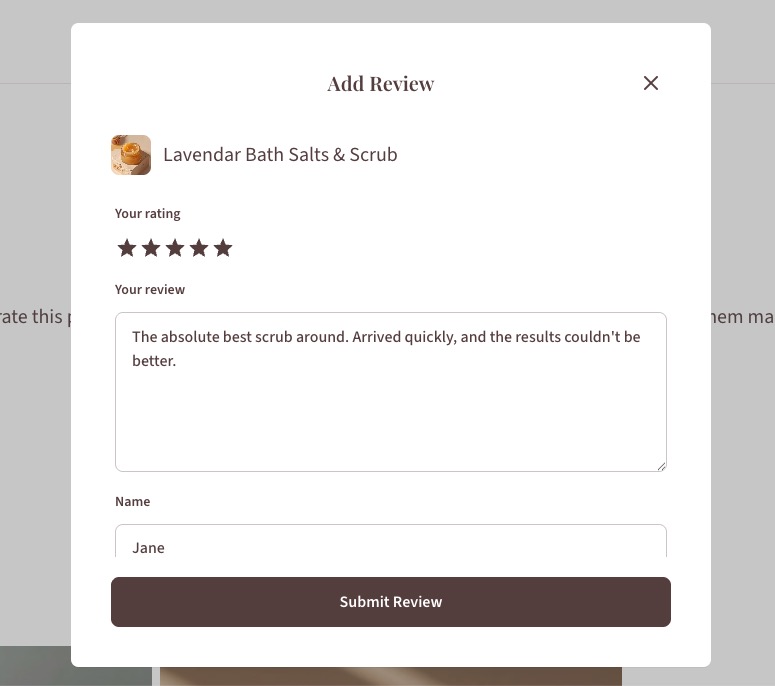
Skincare is a higher-trust purchase than most consumer goods, since customers are putting the product on their skin. Genuine social proof, such as customer reviews, dermatologist or esthetician input on formulations, and any relevant certifications all help close that trust gap. A short “why we formulated this” note from a real person on your team does more work than a polished mission statement.
How to choose the right setup for your stage and budget
Most comparisons start with a features list. Start with a decision framework tied to your stage instead.
You’re running a side hustle
You’re selling a handful of SKUs and still testing demand, probably alongside a full-time job or another business. At this stage, speed and low overhead beat any feature you’re not using yet. That cost shows up as apps: platforms like Shopify don’t include reviews, email, or SEO tools out of the box, and those add-ons commonly run $50 to $150 a month on top of the subscription. If you’re already paying for two or three of those, that’s your signal to consolidate into one platform now instead of waiting until you feel like you need to.
Your brand is growing
You’ve got repeat clients, a widening product line, and enough traffic that a rebuild would actually hurt. What matters most here is room to add SKUs and content without starting over. If a plugin conflict or a payment gateway issue has already eaten an afternoon this year, your current setup is already costing you more time than it’s saving.
You’re running an established line
You’re juggling wholesale accounts, multiple SKUs, and steady traffic that a smaller setup was never built to handle. At this point, the platform needs to manage real catalog complexity, even if that costs more than a simpler builder. If your catalog is already outpacing what your current platform can do, that’s not a future problem, it’s a current one.
Here’s the same breakdown at a glance:
| Stage | Watch for | Prioritize |
| Side hustle | You’re already paying for two or three separate apps, like reviews, email, or SEO, on top of your platform subscription | Fast, all-in-one setup over more features |
| Growing a business | A plugin conflict or payment gateway issue has already eaten an afternoon this year | Managed, built-in tools over DIY flexibility |
| Established line | Your catalog is outpacing what your current platform can handle | A platform built for that complexity, even at a higher cost |
Whichever stage you’re in, match the platform to where your business actually is today, not where you hope it’ll be in a year.
How to build your skincare website step by step
Once you’ve picked a platform for your stage and budget, the build itself follows a fairly consistent order.
- Choose and connect your domain. Pick a domain that matches your brand name and point it at your platform. On an all-in-one platform, hosting comes bundled in, so there’s no separate server or hosting decision to make here.
- Pick a template and customize your skincare website design. Start from a template built for product-heavy layouts rather than a generic blog theme, then adjust colors, fonts, and layout to match your brand.
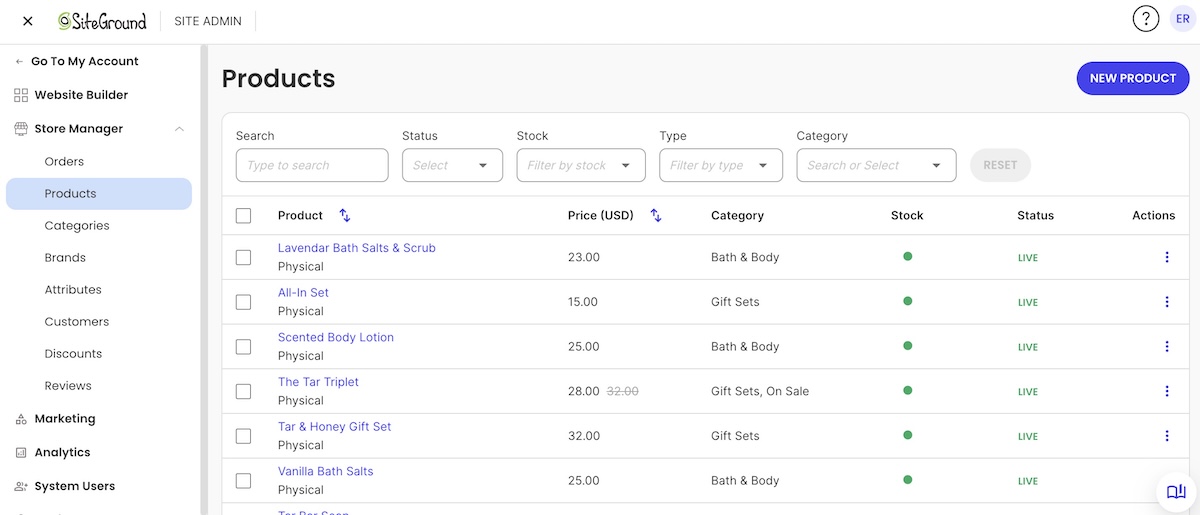
- Set up products, payments, shipping, and ecommerce sales taxes. Load your product catalog with full ingredient lists, connect a payment processor, and configure shipping rates and tax settings for the regions you actually sell into.
- Set your basic ecommerce SEO. Write a real title and description for each product page, add alt text to your images, and submit your sitemap so search engines can find your catalog before you start driving traffic to it.
- Test, launch, and promote. Check every product page on mobile, run a test order end-to-end, and confirm your checkout, tax, and shipping settings all work before you send traffic to the site.
Skincare website launch checklist
Run through this before you flip your site live:
- Domain connected and SSL certificate active
- Product pages include full ingredient lists and allergen notes
- MoCRA registration or exemption status confirmed for your business
- Product photography compressed and loading quickly on mobile
- Payment processor connected and tested with a real transaction
- Shipping rates and tax settings configured for every region you sell into
- At least one trust signal live: reviews, expert input, or certifications
- Legal pages published: returns policy, privacy policy, and terms of service
Getting this list right the first time is cheaper than fixing it after launch, and it’s a big part of starting an online store without blowing your budget on avoidable rework.
The bottom line: choose a platform that grows with your brand
Skincare’s real requirements, ingredient transparency, heavy photography, ongoing compliance, make the “which platform” decision matter. The brands that avoid a mid-growth scramble picked infrastructure built for where they’re headed, not just where they’re starting.
SiteGround Ecommerce bundles hosting, security, and store tools into one platform, so you’re not managing a host, a page builder, and a stack of apps separately as you grow. It’s quick to set up without a developer, it handles image-heavy product pages without a separate speed fix, and it skips the app-by-app cost creep of covering gaps the base platform left out, including booking appointments (via Calendly) for brands offering consultations or other in-person services. Add 24/7 expert support when something needs a real answer, and that combination, speed, simplicity, and help when you need it, matters more to a side hustle or growing skincare line than any single feature.
[103]
Frequently asked questions
Choose a platform that supports full ecommerce, ingredient and allergen disclosure, and fast image loading, then set up your domain, product pages, payments, and shipping methods before testing and launching. The full step-by-step process is covered above, and most platforms with built-in store tools compress this into a single setup flow rather than several separate purchases.
It can be, and skincare specifically is outperforming most beauty industry categories online: ecommerce made up 37% of global skincare sales in 2026, according to Euromonitor International. Profitability still depends on your margins, customer acquisition costs, and how efficiently your site converts visitors, not just the size of the online market.
Cosmetics don’t require FDA pre-market approval the way drugs do, but under MoCRA you likely need to register your facility and list your products with the FDA unless you qualify for the small-business exemption. Verify your specific obligations with the FDA or a regulatory consultant, since exemption thresholds and product-type exclusions can affect whether that applies to you.
Costs vary widely based on whether you’re stacking separate tools or using an all-in-one platform, with hosting, a page builder, ecommerce plugins, and security add-ons each carrying their own price tag if purchased separately. Bundled platforms that combine hosting, security, and store tools typically cost less in total than assembling the same stack piece by piece.
Outgrowing a platform usually means slow load times under traffic spikes, inventory tools that can’t keep up with a growing SKU count, or a plugin stack that starts conflicting with itself. Choosing a platform built to scale with your business stage from the start is generally cheaper and less disruptive than migrating everything mid-growth.