
Shipping is one of those things that looks simple until you’re actually doing it. Costs you didn’t account for, customers asking where their order is, checkout drop-offs you can’t explain — a lot of it traces back to shipping decisions made early that seemed fine at the time. I ran my own online store and made most of these mistakes myself. This guide covers what I wish I’d known before my first sale.
Key takeaways:
- How you present shipping matters as much as what it actually costs. Unexpected fees at checkout are the single biggest driver of abandoned carts.
- There are two separate decisions to make: how the order gets to the customer (delivery method) and how you charge for it (rate strategy).
- Free shipping doesn’t mean absorbing the cost. It means deciding where to hide it — in your product price, your margin, or behind a minimum order threshold.
- Carrier integration and carrier-calculated rates are not the same thing. You can connect to a carrier for discounted labels and tracking without showing live rates at checkout.
- Your shipping setup should match your volume and stage. What works at five orders a week breaks down at 50 (and breaks down again at 500).
What is ecommerce shipping and why does it matter
Ecommerce shipping covers every decision between “order confirmed” and “package delivered”: who carries it, how fast it gets there, what it costs, and who pays. For a first-time seller it can feel like a technical afterthought. But once you start scratching the surface, it becomes obvious that it’s one of the primary drivers of whether a customer completes a purchase — and whether they come back.
How ecommerce shipping affects conversion rates and customer satisfaction
Shipping has a direct, measurable effect on whether customers complete a purchase. According to Baymard Institute, 48% of US shoppers abandon their cart because of extra costs at checkout (shipping, taxes, and fees) making it the leading addressable cause of abandonment.
Two things drive this more than the cost itself:
- Visibility: A $6 fee stated on the product page feels different from a $6 fee appearing for the first time at checkout. Surfacing shipping costs early (in a banner, on the product page, or via a shipping calculator) reduces drop-offs.
- Predictability: Free shipping outperforms paid shipping on conversion not because customers are irrational, but because it removes a moment of calculation. A customer who sees “free shipping” never has to decide whether the total still feels fair.
Ecommerce delivery methods explained
When it comes to ecommerce, the delivery method is how an order physically gets from your inventory to the customer. This is a separate decision from how you price shipping. You need to decide both, and they don’t have to match one-to-one. Let’s break it down.
Self-fulfilled carrier shipping
Self-fulfillment means you store the inventory, pack the orders, and hand them off to a carrier for delivery. It’s where most first-time sellers start: no minimum volume, no contracts, no upfront infrastructure. The tradeoff is time: most sellers hit a natural ceiling around 20 to 50 orders per week before the packing workload outweighs the cost savings of doing it yourself.
For example, I ran self-fulfillment for up to about 50 orders and it worked fine. Until, of course, it didn’t. The breaking point wasn’t just the packing. It was the storage taking over my space, plus the constant juggle of either driving packages to the post office or coordinating carrier pickups. It gets messy fast.
Pro tip: if you’re doing self fulfillment, do yourself a favor and invest in a good thermal shipping label printer (no ink needed!), and make sure you always have extra labels on hand. It makes label creation, printing, and application so, so much easier (and the Pavlovian pleasure of that printing sound is genuinely one of the small joys of running a store).
Local pickup
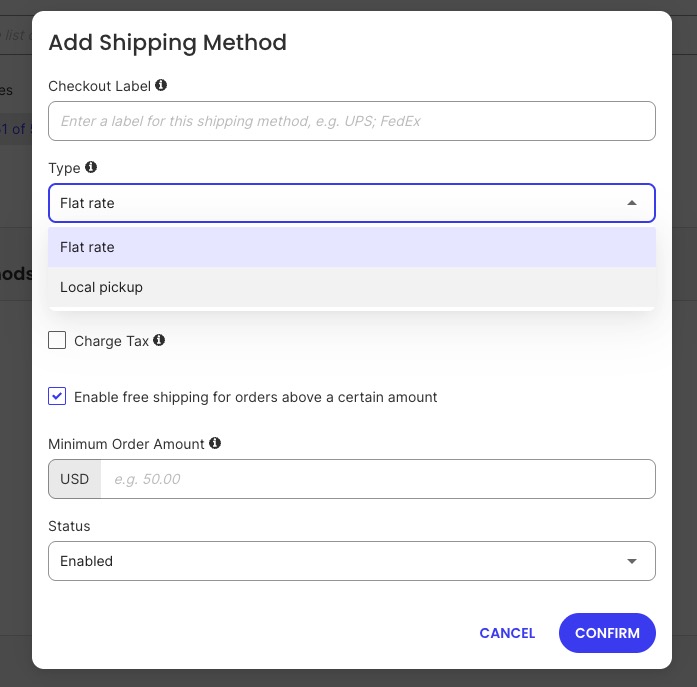
Local pickup lets customers place an order online and collect it in person, with no shipping involved. It suits stores with a physical location (a studio, a workshop, or a retail space) and customers who are local or prefer to avoid ecommerce shipping costs. This only works of course if you don’t also offer free shipping, otherwise there’s no real incentive for customers to make the pick up effort.
From a configuration standpoint, it’s one of the simplest options to offer. Most ecommerce platforms let you add local pickup as a checkout option alongside standard shipping, so customers who prefer it can self-select.
Local delivery
Local delivery is a step between shipping and pickup: you or a team member delivers orders directly to customers within a certain radius, rather than using a carrier. It’s common for food, flowers, furniture, and other categories where a carrier is impractical or where same-day service is a selling point.
For my ecommerce business this was a smart move. We offered free shipping over a certain price, so being able to handle local orders ourselves meant we weren’t eating carrier costs on nearby customers. Plus it removed the shipping process hassle entirely for that segment. And the bonus is that you can say hello to your customers face to face, which builds customer loyalty. Long story short: if you have a meaningful local customer base and the bandwidth, local delivery is worth the setup.
Dropshipping
Dropshipping is a fulfillment model where you sell products you don’t physically hold in inventory. When an order comes in, it’s forwarded to a supplier who packs and ships it directly to the customer under your brand or in a neutral box. You never touch the product.
The appeal is obvious: no inventory costs, no warehouse, no packing. The tradeoffs are real: lower margins, less control over quality and packaging, and dependency on a supplier’s stock levels and fulfillment speed. Dropshipping also requires a platform and supplier setup that supports it — not all ecommerce tools do.
Third-party fulfillment (3PL)
A third-party logistics provider, or 3PL, stores your inventory in their warehouse and handles picking, packing, and shipping on your behalf. You send them stock in bulk (often along with shipping materials), and they fulfill individual orders as they come in.
3PL made sense for me once volume was high enough — and that qualifier matters. That’s because most 3PLs require a monthly minimum spend or a minimum order volume, so if you aren’t selling enough, the numbers simply don’t pencil out.
I’d treat it as a growth-stage decision, not a launch-day one. Once you hit that threshold though, the per-order cost can actually come out lower than self-fulfillment once you account for your own time, packaging materials, and the deeper discounted carrier rates most 3PLs pass on.
Freight and international shipping
Freight applies when orders are too large or heavy for standard parcel carriers, typically above 150 lbs or for pallet-sized shipments. It’s most relevant for stores selling furniture, industrial equipment, or large quantities of a product to a single buyer. Freight requires a separate carrier relationship and is usually quoted per shipment rather than at a fixed rate.
International shipping of course means delivering orders to customers outside your home country. It introduces additional and sometimes frustrating complexity: customs declarations, import duties, variable carrier availability by destination, and longer delivery windows.
For stores just starting out, international shipping is worth supporting if demand exists, but it requires clearly communicated delivery estimates and a shipping policy that addresses duties and returns for cross-border orders. I offered international shipping as a one-off, but not as a main shipping option, simply because it was too complicated to set proper expectations and pricing.
Working with shipping carriers
Regardless of which delivery method you choose, most stores that ship physical orders will work with at least one parcel carrier. It’s worth understanding how carrier integrations work before you decide how to price shipping, because the two are related but not the same thing.
The main carriers and when to use them
- USPS — most cost-effective for small, lightweight domestic parcels; strong last-mile coverage including rural addresses
- UPS / FedEx — better for heavier packages, time-sensitive delivery, and reliable tracking at scale
- DHL — strong for international shipments, particularly to Europe and Asia
- Canada Post, Royal Mail, Australia Post — worth knowing if you have meaningful customer bases in Canada, the UK, or Australia respectively
Most stores use more than one carrier depending on package size, destination, and speed. At higher volumes, multi-carrier rate shopping (where your platform automatically compares rates across carriers per order) can meaningfully reduce shipping costs.
Carrier integrations vs. carrier-calculated rates
This is a distinction worth understanding clearly, because the two are often conflated.
Carrier integration means connecting your ecommerce platform to one or more carriers to access discounted label rates, generate labels in a few clicks, and automate tracking updates to customers — all from your store’s dashboard. It’s a back-end operational tool. You can be fully integrated with USPS or UPS while still charging customers a flat rate or free shipping at checkout. How you charge customers is a separate decision.
Carrier-calculated rates is a specific pricing strategy where real-time carrier quotes are displayed to customers at checkout based on their order’s weight, dimensions, and destination. It requires a carrier integration to work, but having a carrier integration doesn’t mean you have to use calculated shipping rates.
In short: integrate with a carrier to streamline label creation, automate tracking, and access better shipping rates. Use carrier-calculated rates at checkout only if that pricing model fits your store — more on that in the next section.
Delivery speed tiers
Most carriers offer standard (3–7 business days domestically), expedited (2–3 days), and overnight. Standard is the default for most stores. Expedited shipping is worth offering if your product has a time-sensitive use case — gifts, event items, or anything customers might need by a specific date. Overnight shipping is rarely worth the complexity at small volumes unless speed is a genuine differentiator in your category.
Pro tip: Make this easy by using a shipping integration platform that connects you to multiple carriers at once, and with discounted rates. That way you can always choose the absolute best shipping price for every package you send.
SiteGround Ecommerce comes with a built-in carrier integration powered by Shippo, giving you access to 16 carriers and over 150 shipping services from one place. Generate labels in a few clicks, display live carrier rates at checkout, and automate tracking updates — all from your store dashboard.
Start shipping now>>
Ways to price shipping for customers
The rate strategy is how you charge customers for shipping at checkout, independent of which delivery method you use. There are four main approaches, each with different implications for your margins and customer experience.
Flat rate shipping
Flat rate shipping charges every customer the same amount regardless of what they ordered or where they live. A common example is “$5.99 shipping on all orders.”
It’s simple to set up and easy for customers to understand. The risk is that you will undercharge on heavy or bulky orders and overcharge on lightweight ones, which can either erode your margins or make small orders feel expensive. Flat rate works best when your product catalog has consistent weight and dimensions, or when the variance in your actual shipping costs is small enough that a single rate covers it without frustrating customers.
| Scenario | Flat rate works well | Flat rate works poorly |
| Product weight | Consistent across catalog | Wide variation (such as small accessories + heavy equipment) |
| Order geography | Mostly local or regional | Wide national or international spread |
| Catalog size | Small, focused | Large, varied |
Free shipping
Free shipping means the customer pays nothing at checkout…but the cost doesn’t actually disappear. It’s either absorbed into your product pricing, covered by your margin, or activated only above a minimum order threshold.
The minimum threshold approach is the most common for small stores because it serves two purposes: it covers shipping costs on orders where the margin supports it, and it increases average order value. As a general rule of thumb, a free shipping threshold set around 30% above your average order value motivates customers to spend more while helping cover your actual shipping costs. At the same time, it doesn’t set the bar so high that customers give up and abandon instead.
Unconditional free shipping (no minimum) only makes sense when your product margins are wide enough to absorb it or when your average order value is consistently high. Offering free shipping on a $15 item with a $7 shipping cost and a 40% margin is a fast way to lose money.
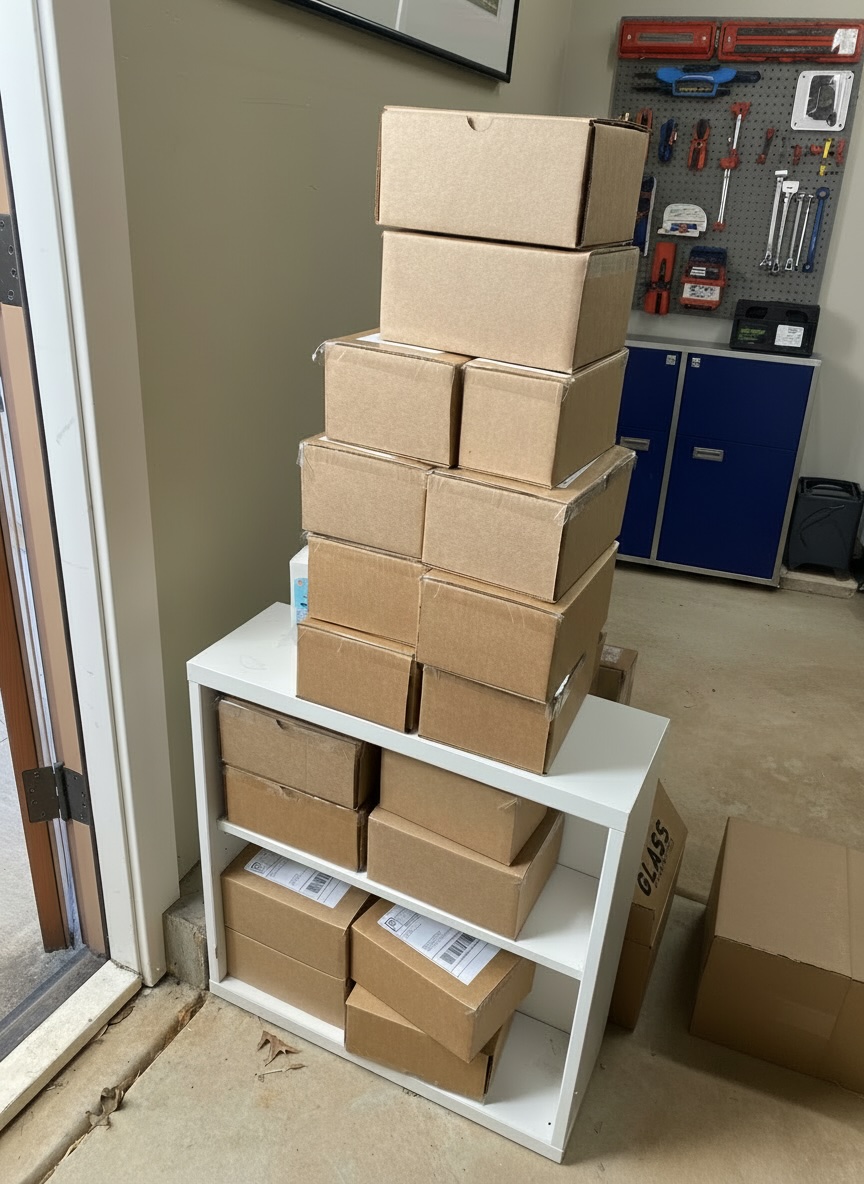
With my own online business, I took the minimum-threshold approach. I had my main products, and set the price threshold such that if people bought one product, they had to pay about $8 for shipping. If they bought a set (two products), the shipping was free. As a result, the vast majority of orders were for the set, and very few people bought only a single item (you can see how this worked out in reality in the shipping image above: almost all the boxes were two-product boxes, save for one box, which is smaller than all the others).
Carrier-calculated rates
Carrier-calculated rates pull real-time quotes from carriers (USPS, UPS, FedEx, DHL) at checkout based on the order’s weight, dimensions, and destination. The customer sees the actual cost of shipping their specific order.
This is the most precise approach, and it removes the risk of systematically undercharging or overcharging. It requires your products to have correct weights and dimensions set in your store (because without that data, the rate calculations will be wrong). It also produces less predictable checkout totals for customers, which can increase friction compared to a simple flat rate or free shipping offer.
Carrier-calculated rates are most useful for stores with varied product sizes and weights, stores shipping nationally or internationally, or sellers who want to offer multiple speed options (standard vs. expedited shipping) at transparent shipping prices.
The downside here is that it can get complicated when it comes to packaging sizes and product combinations. For my business, and many small businesses with a limited product offering, it may make more sense to simply base it on general weight ranges…which brings us to the next point.
Table or weight-based rates
Table rates let you define custom shipping costs based on order weight, total price, item count, or destination. For example: orders under 1 lb ship for $4.99, orders between 1 and 5 lbs ship for $7.99, orders over 5 lbs ship for $12.99.
This gives more granular control than flat rate without the real-time complexity of carrier-calculated rates. It requires a little bit of setup work and needs to be updated if your carrier costs change, but it’s practical for stores with a predictable range of order sizes.
For my small business, this was the perfect middle ground. It ensured I charged roughly the right amount for shipping on my orders without logistics getting unnecessarily complicated.
How to build your shipping strategy
Choosing a delivery method and a rate structure is only half the job. The other half is making sure those choices hold up as your ecommerce business changes. A shipping strategy that works at launch can become a source of margin leakage or operational strain within months if it wasn’t built with growth in mind. Here the key questions to address as you build your strategy:
What are you selling, and how heavy is it?
Your product characteristics set the outer boundary of what is practical. A store selling greeting cards has a different calculus than one selling hand-thrown ceramics.
- Lightweight and/or consistent products: flat rate or free shipping is manageable
- Heavy or fragile items: carrier-calculated rates protect your margins and set accurate expectations
- Products requiring custom packaging: factor that cost into your flat rate or product pricing — this is part of your shipping cost whether you account for it or not
Where are your customers?
- Mostly local or regional: a flat rate based on your average regional carrier cost is usually sufficient
- National or international: carrier cost variance by destination makes flat rate riskier — you will either overcharge customers near you or undercharge on distant orders
What do your margins allow?
Free shipping is an ecommerce marketing decision as much as a logistics one. Customers respond better to a $29 product with free shipping than a $23 product with a $6 shipping fee, even though the total is identical. Oftentimes, as was the case with my business, people will happily buy and spend more just to hit the free shipping threshold.
That said, before offering it, confirm your margin covers the actual shipping cost per order. If your margins are tight, a minimum order threshold protects profitability while still giving customers the incentive they respond to.
How many orders are you shipping?
| Volume | Recommended approach |
| Under 10 orders/week | Self-fulfillment + flat rate or free shipping threshold, consider multi-carrier rate shopping |
| 10–50 orders/week | Same, but start tracking actual shipping costs vs. what you charge, consider multi-carrier rate shopping |
| 50+ orders/week | Carrier-calculated rates, evaluate 3PL, implement multi-carrier rate shopping |
What do your customers expect from delivery?
Setting clear delivery expectations matters more than matching the fastest available option. That said, free shipping has become a baseline in many categories — if your competitors offer it and you do not, that gap shows up at checkout. Research the norm in your product category before assuming customers will accept a shipping fee.
In my case, apart from examining our own business expenses, I looked at competitors to see what they were doing. When I saw that several offered the free shipping threshold, it was the nudge I needed to do the same.
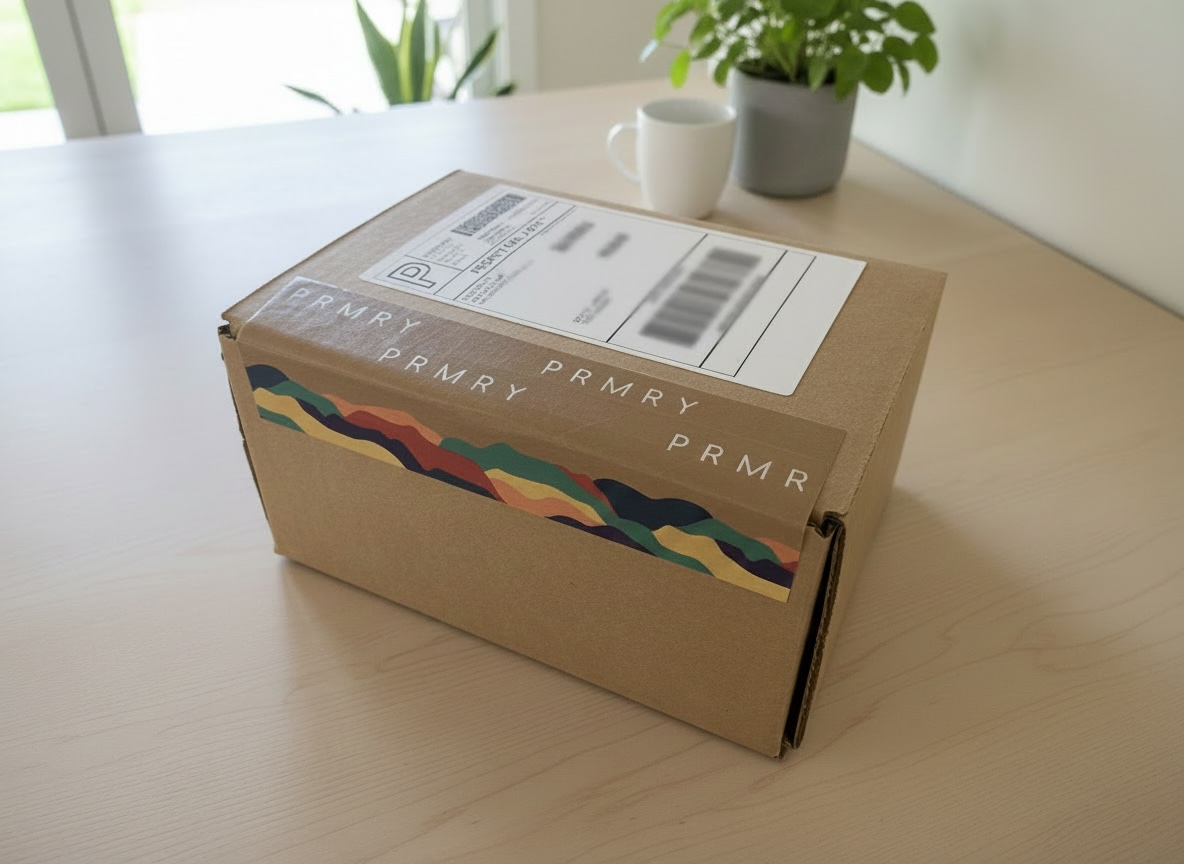
Pro tip: Don’t underestimate the packaging experience. At minimum, customers expect their order to arrive well-packaged and undamaged. But depending on your product type, price point, or simply how much you want to make an impression, it’s worth going further. Branded packaging, a handwritten note, a discount card, stickers — these are small touches that are disproportionately memorable. With my own store, I used branded tape on every box and included product usage cards and a discount inside every order. Sometimes stickers too. It cost very little and customers noticed. For a small business, that kind of detail is one of the few places you can genuinely out-experience a larger competitor.
Common shipping mistakes first-time sellers make
Most early shipping problems are not carrier problems or platform problems. They’re setup decisions that seemed reasonable (or at least manageable) at launch and became expensive as order volume grew.
1. Setting a flat rate without checking actual carrier costs. A flat rate set below your average shipping cost is a silent margin leak. Before publishing a rate, run sample orders through your carrier’s rate calculator using realistic weights, dimensions, and destination zip codes. Build in a small buffer for packaging materials.
2. Offering free shipping without adjusting product prices. Free shipping absorbs cost. It does not eliminate it. If you activate free shipping without either raising prices or confirming your margins can cover it, you are discounting your own margin on every order.
3. Ignoring dimensional weight pricing. Most major carriers calculate shipping cost based on dimensional weight (the space a package occupies) rather than actual weight, if dimensional weight is higher. A light but bulky item can cost significantly more to ship than its weight alone suggests. Stores that do not account for this undercharge on those products.
4. No tracking or confirmation emails. Customers who do not receive a shipping confirmation with tracking information contact customer support to ask where their order is. This is avoidable. Automated shipping notifications are a standard feature on most ecommerce platforms and take minutes to configure.
5. Writing no shipping policy — or writing one nobody can find. A shipping policy answers the questions customers have before they contact you: how long does fulfillment take, when does the order ship, what happens if something arrives damaged, how do returns work. I would also add key questions to your FAQ page, as this is often where people will go first to resolve doubts.
6. Setting international shipping to “same as domestic.” International orders involve customs fees, variable transit times, and carrier restrictions that domestic settings do not account for. Applying a domestic flat rate to international orders almost always results in undercharging. Set dedicated international rates or use carrier-calculated rates for non-domestic orders.
How to set up shipping on your online store
Once you’ve decided on your delivery method and rate strategy, setting up shipping in most ecommerce platforms follows the same basic pattern.
What to look for in your platform’s shipping settings:
- Shipping zones — define which regions or countries you ship to and assign different rates to each. Most platforms let you create zones by country, region, or postal code range.
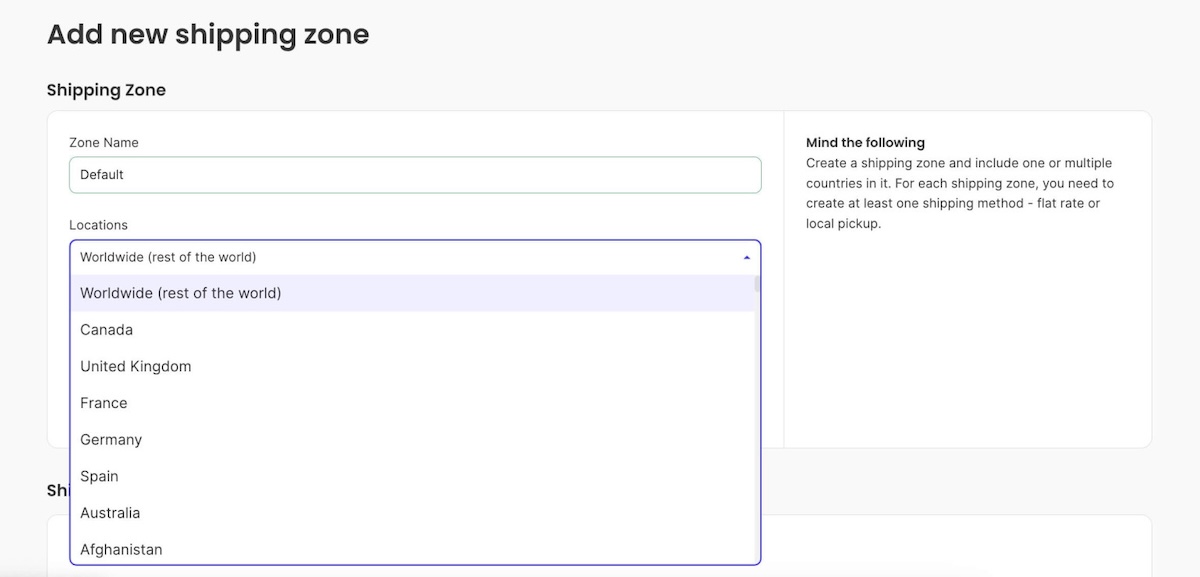
- Flat rate configuration — set a fixed shipping cost per order or per item, with the option to apply it globally or by zone.
- Free shipping triggers — activate free shipping unconditionally, or set a minimum order value threshold that customers need to hit.
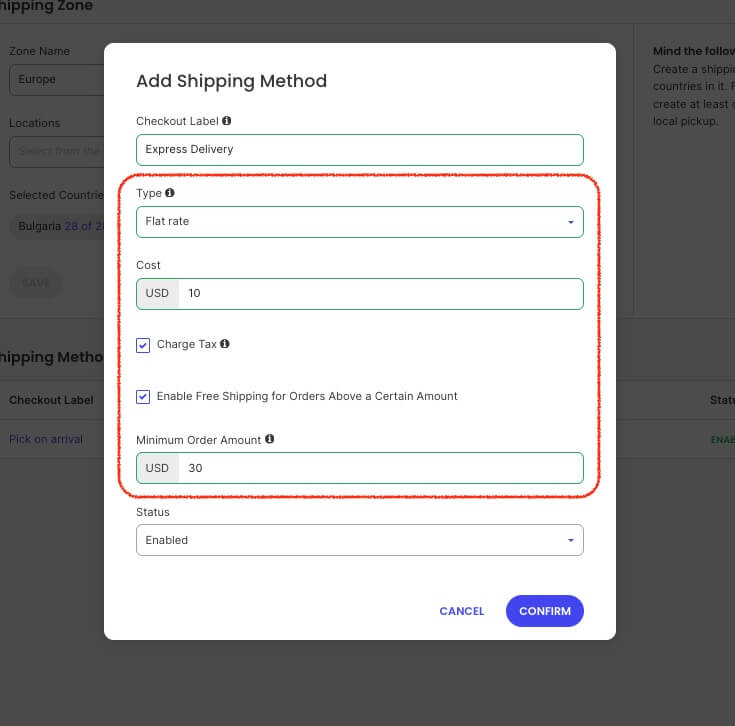
- Local pickup — add an in-person collection option at checkout so local customers can opt out of shipping entirely.
- Carrier integration — connect to one or more carriers to generate labels, pull live rates, and automate tracking notifications from your dashboard.
Shipping is generally pretty configurable without any technical knowledge — you just need to know what you want before you go looking for the setting. The decisions covered earlier in this guide should give you that clarity.
SiteGround Ecommerce makes shipping setup straightforward. Flat rate, free shipping with or without a minimum threshold, local pickup, carrier integration, and shipping zones by country or region are all configurable from one place — no technical knowledge needed.
Build your online store now>>
How to write a basic shipping policy
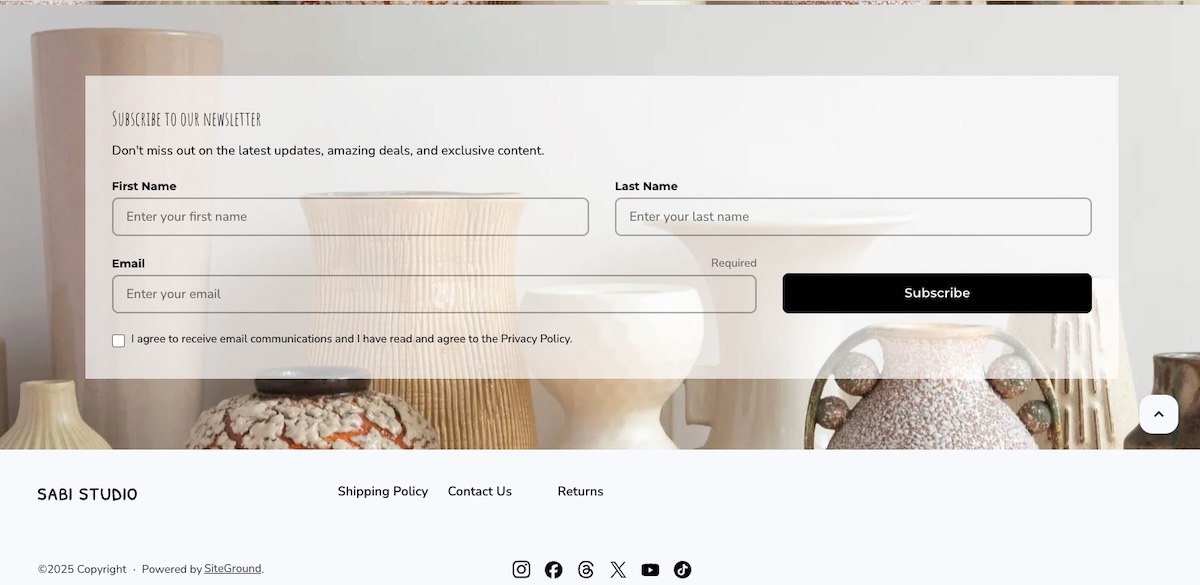
A shipping policy is a short document (typically just a page on your website) that sets customer expectations about fulfillment times, delivery windows, costs, and how problems are handled. It’s a standard step in creating your ecommerce website, and should link from your store’s footer.
A functional shipping policy covers six things:
- Processing time: How long between order placement and the order shipping. “Orders ship within 1–2 business days” is more useful than “orders ship quickly.”
- Estimated delivery time: Typical transit times by region or shipping method. Include a note that these are estimates, not guarantees.
- Shipping costs: How you calculate shipping fees, including when free shipping applies and any surcharges for remote locations or oversized items.
- International orders: Whether you ship internationally, which countries you serve, and who is responsible for customs duties and import taxes (typically the customer, but this must be stated clearly).
- Damaged or lost orders: What the customer should do if an order arrives damaged or does not arrive at all, and what resolution they can expect.
- Returns and exchanges: Whether you accept returns, how long the return window is, who pays return shipping, and how refunds are processed. This can link to a separate returns policy if you have one.
Keep the language plain. A customer reading your shipping policy has a specific question: answer it directly without legalese. The goal is to reduce uncertainty, not to protect yourself with disclaimers.
For stores using SiteGround Ecommerce, you can easily add a shipping policy page directly from your dashboard and link it in the footer and checkout flow without any custom code.
Choosing the right ecommerce shipping strategy for your business
There’s no single correct shipping setup. The right combination depends on your product, your margins, your customers, and where you are in your business. What’s important is to get clear about which combination works best for you, and choose an ecommerce solution that supports it.
SiteGround Ecommerce makes it easy to get your shipping set up and running. Flat rate, free shipping thresholds, local pickup, carrier integration, and shipping zones all come out of the box, configurable without any technical knowledge, and backed by expert 24/7 support. And as your business grows, the platform grows with you.
[103]
Frequently asked questions
Most stores offer a combination of two or three options rather than a single one — typically a paid shipping rate (flat rate or carrier-calculated), a free shipping threshold, and local pickup if relevant. The right mix depends on your product type, customer location, and margin structure. The goal is to give customers enough choice without overwhelming them at the final step of purchase.
Shipping methods can be categorized in two ways: by delivery route (self-fulfilled carrier shipping, local pickup, local delivery, dropshipping, 3PL, or freight) and by rate structure (flat rate, free shipping, carrier-calculated rates, or table-based rates). These are separate decisions: how you get the product to the customer and how you charge for it do not have to follow the same logic.
Most stores move through three fulfillment stages as they grow. Starting out, selling online typically means self-fulfillment — you pack and ship orders yourself. As volume increases, a third-party logistics provider (3PL) takes over storage, packing, and shipping on your behalf. At the largest scale, freight handles bulk or pallet-sized shipments that exceed standard parcel carrier limits. Each stage suits a different order volume and level of operational complexity, and as businesses scale it’s likely they’ll move through at least the first two.
Most small online stores follow a straightforward process: the customer places an order, the seller packs the item, prints a shipping label through their ecommerce platform or directly through a carrier, and hands the package off for delivery. At low volumes this is done in-house. As order volume grows, many sellers move to a 3PL that handles storage, packing, and carrier handoff on their behalf.