

Shopify’s sticker price is only part of the bill. Card processing, third-party surcharges, and even collecting product reviews can mean extra costs stacked on top of the subscription itself. Whether you’re just learning how to sell online or migrating an established store, the alternatives compared below vary just as much: on platform fees, on what ships built in versus what needs a separate app, on how their AI actually works, and on the support and infrastructure behind the storefront. Here’s how six real Shopify alternatives compare.
Key takeaways:
- Shopify’s real cost stacks three charges (subscription, card processing, and a surcharge for skipping Shopify Payments) and reviews now require a separate third-party app, since Shopify dropped its own tool in 2024.
- Most alternatives on this list ship native product reviews, while Shopify no longer does, a small but concrete reason plenty of sellers are already looking elsewhere.
- AI is turning into a real differentiator between platforms, but it splits into two separate jobs: some tools only build the store, while others also help run it afterward, and the more advanced tools are often reserved for higher-tier plans.
- Support is easy to overlook but shouldn’t be: not every platform includes real support beyond self-service help, and phone support isn’t always a direct number to call.
- Infrastructure matters just as much, even though it’s invisible until something goes wrong: a slow host can quietly cost you sales no matter how good the storefront looks.
Why sellers are looking beyond Shopify in 2026
It’s become increasingly more clear that Shopify’s advertised sticker price is only the start of the bill. The Basic plan costs $29 a month billed annually ($39 a month if you pay monthly), but there’s a lot more to it than that:
- There’s the subscription itself: $29/month on Basic (billed annually), rising through Grow, Advanced, and Plus as your store grows.
- Plus card processing: 2.9% + 30¢ per transaction on Basic, with lower rates on higher tiers.
- Plus a surcharge for skipping Shopify Payments: up to 2% extra if you use a different payment system.
- Plus apps for ecommerce features ranging from basic to advanced.
About those apps, reviews are the clearest example. Shopify retired its native product reviews tool in 2024, so any store built since then needs a separate third-party app just to collect star ratings on new products. It’s a small line item on its own, but it’s one more subscription stacked on top of a platform fee that already scales with every sale you make.
What to look for in a Shopify alternative
This is the comparison worth running before you commit to a platform: not “which one feels cheaper,” but the actual stack of subscription, processing, and app costs at the order volume you expect to hit. If you’re mapping out how to create an ecommerce website for the first time, that math is worth doing before you pick a platform, and not after you’ve built the store and started migrating products.
Five things actually predict whether a platform will work for your store, and price is only one of them.
- Fees. Check the platform fee at every tier, not just the entry price. The strongest ecommerce platforms lower or drop that fee entirely as your store grows, so what you pay on day one isn’t what you’re stuck paying once you’re scaling.
- Setup time. No-code builders can go live in hours. Open-source platforms like WooCommerce take longer, because you’re also setting up hosting and security.
- What’s actually built in. Reviews, email marketing, abandoned cart recovery, and ecommerce sales tax calculation either ship with the platform or require a separate app subscription. That list of need-to-haves adds up fast.
- Support. Look for real human support hours and response times, and not just a chatbot buried behind a help center search box.
- Infrastructure. Uptime and page speed affect conversion rates directly. A cheap plan on a slow host isn’t actually cheap.
The best Shopify alternatives compared
The six alternatives below get judged on that same basis: what they charge, how fast you can launch, what’s built in versus what needs a separate app, and how their AI tools actually hold up. Here’s the breakdown, followed by what each platform is actually built for.
| Platform | Price | Reviews built in | AI | Support |
|---|---|---|---|---|
| Shopify (for reference) | $29/mo (Basic, billed annually), plus 2.9% + 30¢ card rate and up to 2% third-party surcharge | No: third-party app required since 2024 | Build-stage (partial) and run-stage | Live chat on every plan (enhanced on Advanced); priority support on Plus |
| SiteGround Ecommerce | $18/mo (Sell, 3% platform fee); $24/mo (Grow) or $36/mo (Scale), both 0% platform fee | Yes | AI Wizard for building, plus run-stage AI Store Agent (store insights and tasks via Power Mode), on AI Studio’s multi-model workspace | 24/7 chat, phone, and tickets |
| WooCommerce | Free, plus hosting (varies by provider) and standard card processing | Yes, basic | No built-in assistant; early support for connecting outside AI tools | Not included: depends on your host or community forums |
| BigCommerce | $29/mo (Core), $79/mo (Growth), or $299/mo (Scale); 0% platform fee with embedded providers like Stripe and PayPal, otherwise 2% (Core), 1% (Growth), or 0.6% (Scale) | Yes | Product-description AI; no store-building AI listed | Core: 24/7 chat and email; Growth and up: 24/7 live phone and chat |
| Squarespace | $16/mo (Basic) to $99/mo (Advanced); 0% online-store fee from Core ($23/mo) up, though digital content/memberships carry a separate fee schedule | Yes | Build-stage and run-stage (run-stage gated to mid-tier+ plans) | Email 24/7; live chat weekdays only; no phone support |
| Wix | Around $29/mo; 0% platform fee | Yes | Build-stage, plus run-stage analytics and product edits | 24/7 chat, ticket, and phone by callback only |
| GoDaddy | $9.99/mo (Starter, billed annually); no separate platform fee, plus 2.7% + 30¢ card processing | Not listed | Build-stage, plus run-stage content edits (pages, blog posts, listings), not order or catalog data | 24/7 phone, chat, and text, plus tickets |
Pricing, plan names, and features across every platform in this comparison reflect what was publicly available as of September 2026. Prices are for each platform’s lowest-priced plan that lists selling products online, billed annually, in USD. This space moves fast, with plans renamed and prices changed with little notice, so confirm current details directly with each platform before making a decision.
SiteGround Ecommerce: easy no-code launch, with AI and reviews built in
- Price: $18/mo on the Sell plan (3% platform fee), or $24/mo on Grow and $36/mo on Scale (0% platform fee) — all prepaid annually, on top of standard card processing.
- Setup: fast and no-code.
- What’s built in: reviews on every plan (five-star scale, approval step before anything goes live), plus basic tax calculation and shipping tools included, with advanced shipping on Grow and up and optional paid Advanced Tax via Stripe Tax. There’s no large third-party app marketplace, but the native feature list covers enough ground that you’re less likely to need one.
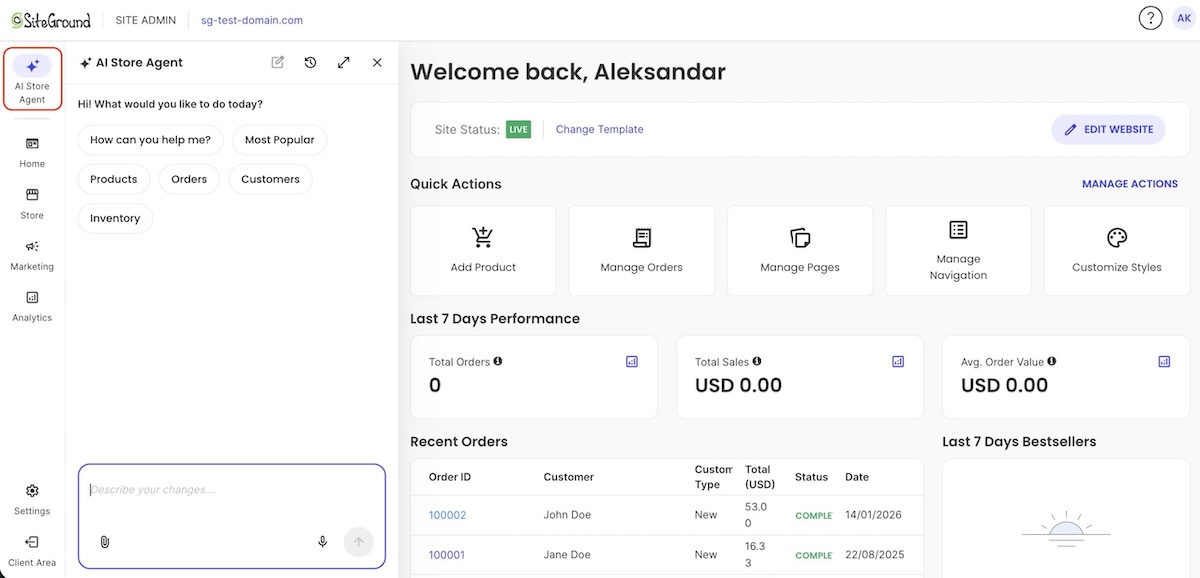
- AI: the AI Wizard builds the store from a description; the AI Store Agent runs it afterward, answering questions about your actual order, product, and customer data, and executing bulk catalog edits. Both run on AI Studio, a broader AI workspace included free with every plan, up to 20,000 tokens a month, with multi-model chat access to Claude, ChatGPT, and Gemini plus 15+ specialized agents for marketing tasks like social posts, ad copy, and SEO.
- Support: 24/7 via chat, phone, and ticket.
- Infrastructure: premium hosting is included on every plan, run by a company that has been in web hosting for years rather than a design tool with ecommerce added on top.
- Best for: sellers who want a fast, no-code launch with reviews, AI store management, and solid infrastructure all included, without stacking plugins to get there.
WooCommerce: full ownership, no platform fees
- Price: a free plugin that turns a WordPress site into a store, not a standalone platform on its own. You need WordPress, and hosting for it, before WooCommerce does anything.
- Setup: the most hands-on option here — you’re managing hosting, updates, and security yourself, not the platform. Full control means more technical skills are required.
- What’s built in: basic reviews you turn on in settings. Core WooCommerce supports manual tax rates, but email marketing, abandoned cart recovery, and automated tax calculation come from extensions you add, some of them paid.
- AI: no built-in AI assistant or store builder. WooCommerce core has early support for connecting outside AI assistants to your store (still in developer preview, and technical to set up); other AI features come from plugins.
- Support: not included with WooCommerce itself. You’re relying on your hosting provider’s support team or community forums, not a built-in help desk.
- Best for: sellers who want full ownership of their store’s code and data, and either have technical support in place or want to build that control themselves. For a deeper breakdown against Shopify and AI-built alternatives, see our Shopify vs. WooCommerce vs. AI-built store comparison.
BigCommerce: multi-storefront and B2B options
- Price: $29/mo (Core), $79/mo (Growth), or $299/mo (Scale), billed annually, each with a revenue cap before the next tier is required. Platform fee is 0% on orders through BigCommerce’s embedded payment providers, including Stripe and PayPal; on other gateways, a surcharge applies that steps down from 2% on Core to 1% on Growth to 0.6% on Scale.
- Setup: a steeper learning curve than the no-code builders on this list.
- What’s built in: native reviews, unlimited products and users, and abandoned cart emails and customer groups from Growth up. Multi-storefront support is available as a paid add-on, and B2B capabilities sit on its custom-priced Performance plan.
- AI: BigCommerce’s AI is about product content, not store building. BigAI Copywriter writes product descriptions now, and you start from a theme. More advanced tools are still rolling out, reserved for its Performance and B2B plans.
- Support: 24/7 chat and email support on Core; 24/7 live phone and chat on Growth and above.
- Best for: multi-storefront or B2B businesses that can absorb that learning curve in exchange for the extra power.
Squarespace: best for design-first, boutique catalogs
- Price: $16/mo (Basic) to $99/mo (Advanced), billed annually. Core ($23/mo) is where most sellers land, since that’s where the online-store fee drops to 0% (Basic still carries 2%). Card processing rates step down by tier too (2.9% + 30¢ on Basic and Core, down to 2.5% + 30¢ on Advanced), and digital content/membership sales run on their own steeper schedule (7% down to 0%).
- Setup: fast and no-code.
- What’s built in: native product reviews. Its extension marketplace is small and curated, covering shipping, inventory, marketing, and finance.
- AI: Blueprint AI builds the store from a few brand questions. Beacon (run-stage AI) and its composer tools for products, FAQs, and discounts are included only on mid-tier plans and up, not the entry tier.
- Support: email support 24/7; live chat Monday to Friday, with no phone support at any tier.
- Design: a library of designer-made templates, customizable with a block-based editor.
- Best for: boutique or brand-first sellers where design carries the store.
Wix: large app marketplace
- Price: around $29/month for its entry ecommerce plan, with a 0% platform fee on top of standard card processing.
- Setup: fast and no-code.
- What’s built in: native abandoned-cart recovery and product reviews, plus the largest app marketplace on this list if you need more. Most of those apps carry their own separate cost, so it’s a paid ecosystem, not a free one.
- AI: Aria builds the store, then keeps working after launch, monitoring performance, generating analytics, and helping edit products. A separate AI Site Chat tool answers visitors’ questions on your storefront.
- Support: 24/7 in English via chat, ticket, and phone, though there’s no number to call directly. Phone support works by requesting a callback instead.
- Best for: sellers who already know they’ll need a specific app or integration, and don’t mind paying for it separately instead of getting it built in.
GoDaddy: budget-friendly entry point
- Price: $9.99/month on annual billing (Starter, GoDaddy’s entry tier), with no separate platform fee. Standard card processing (2.7% + 30¢) applies on top.
- Setup: fast and AI-generated. Describe your business and GoDaddy’s AI produces a starter site in minutes, similar to the other no-code builders here.
- What’s built in: unlimited products and services and multiple payment and delivery options on every paid plan, with tax and shipping settings available in its store setup.
- AI: generates the site and store from a description, then keeps working afterward through the same chat interface. It can update pages, blog posts, or product listings over time. It also handles AI-driven SEO and automated responses in its web chat tool.
- Support: 24/7 phone, chat, and text, plus a ticket system for specific product issues.
- Best for: very small or first-time sellers on a tight budget who want the a simple, chat-based setup.
Which Shopify alternative actually fits your ecommerce store
Different platforms solve different problems, and no single one is perfect for everyone. Here’s a quick way to match what matters most to you with the platform that actually covers it.
| You value… | Consider |
| A large ecosystem of paid apps and plugins to build exactly what you need | Wix, WooCommerce |
| Extensive support across phone, chat, and tickets | SiteGround Ecommerce, GoDaddy, BigCommerce (phone on Growth and up) |
| AI assistance for both building and running the store | SiteGround Ecommerce, Wix, Squarespace (mid-tier plans and up), GoDaddy |
| Reviews, AI, and store tools included standard, without adding extra apps | SiteGround Ecommerce |
| Managing multiple storefronts, or selling B2B | BigCommerce |
| Boutique, design-first branding | Squarespace |
| A lower monthly subscription price | GoDaddy |
Is SiteGround Ecommerce the right Shopify alternative for you?
The right platform here depends on what you’re optimizing for: a wider marketplace over what ships built in, or a lower monthly price over deeper features. None of that makes one platform objectively best, just better suited to a specific kind of seller.
One option shows up across several rows above: support, AI, and what ships built in. SiteGround Ecommerce launches fast without code, includes reviews and store management tools standard rather than behind a paywall or a separate app, and runs on SiteGround’s own hosting infrastructure, not a design tool with ecommerce added on afterward. You can try it free for 14 days, no credit card required.
[103]
FAQs about Shopify alternatives
WooCommerce is free to install, though you’ll still pay for hosting somewhere. Most other Shopify alternatives, including SiteGround Ecommerce, offer a free trial instead of a permanently free tier, typically 14 days.
It depends on your order volume and plan tier. WooCommerce charges no platform fee, and BigCommerce charges none with embedded payment providers like Stripe and PayPal, while SiteGround Ecommerce and several others only reach 0% platform fees above their entry plan. Compare the plan-by-plan breakdown above rather than the advertised sticker price alone.
Sometimes. Product data, images, and customer information typically export as CSV files, though import options vary, so check each platform’s tools before you commit. Expect to manually rebuild theme customizations and app integrations, since those don’t transfer between platforms.