

Getting started in affiliate marketing in 2026 might feel a bit like arriving late to a party. Every niche is flooded with content, AI is generating articles faster than anyone can read them, and the classic advice to “just write reviews and add links” isn’t as effective as it was in the early days.
However, industry trends paint a different picture. Studies show that the vast majority of brands still actively use affiliate marketing and that the market continues to generate record revenue. This indicates that the industry is not in decline, but is instead undergoing a transformation. The affiliates losing ground are those who rely on volume without being authentic, while the most successful are those who create useful content and recommend products they really use and like.
So you haven’t missed the party, you’ve simply arrived at a time when building trust and delivering value are no longer optional, but essential for staying competitive. This guide will teach you how.
Key takeaways:
- Grand View Research values the 2025 global affiliate marketing industry at $22.6 billion, with projections reaching $35.7 billion by 2031. Supporting this growth, Rakuten Advertising finds that 81% of brands worldwide are running an active affiliate program.
- Select a niche that aligns with your genuine interests. Creating content consistently is much easier when you are personally invested in the topic.
- Prioritize “evergreen” channels like a blog, YouTube, or Pinterest. Unlike short-lived social media feeds, content on these platforms is indexed by search engines, allowing it to generate traffic and revenue years after publication.
- Seek affiliate programs with a long cookie window, a reliable payout history, and, most importantly, a high customer satisfaction rate, as every recommendation is a direct extension of your own brand and the trust you’ve built with your audience.
- Implement conversion tracking from day one. Understanding which content drives sales and which link placements perform best allows you to double down on what works and cut what doesn’t.
- Focus on your individual progress and milestones. Comparing your entry-level earnings to the revenue of industry veterans who have spent years building their brand is counterproductive to your success.
What is affiliate marketing?
Affiliate marketing is a partnership between you and a brand, in which the latter aims to reach new prospects, and pays you each time one of those prospects takes a specific action. Most commonly, that action is making a purchase, but programs may also pay per click, per lead, or for any other defined outcome.
You aren’t tied to a single brand or product category, either, so you can partner with as many companies and earn from all of them at the same time. However, just because you can, doesn’t mean you should. Affiliates who build trust with their audience by sharing products they believe in and actually use are more likely to get their viewers to act on their recommendations, and therefore receive commissions.
How does affiliate marketing work?
Once you apply to a company’s affiliate program and get accepted, you’ll receive a unique link to track your referrals, either through email or in your affiliate dashboard. That link is what connects your recommendation to the sale. You can embed it as hyperlinked text in an article, place it on a button, add it to an image, share it in your social media bio, or send it directly in a message.
Your link can also offer added value to the person clicking on it, whether it’s a coupon code for a physical item, or a free trial and discounted first year for a service-based platform.
How affiliate marketers get paid?
Affiliate marketers typically earn income through one of two primary commission models:
- One-time (flat) commission: you earn a fixed amount or percentage when someone completes the required action through your link once, regardless of whether they stay a customer.
- Recurring commission: you earn a percentage every month for as long as the customer stays subscribed.
To make the difference concrete, if you refer someone to a $40/month vibe coding tool that pays a 60% commission, you earn $24 every month that person stays subscribed. After 12 months, that single referral has earned you $288. In contrast, a one-time commission on that same sale would have only paid you $24 once.
The tradeoff: Programs offering recurring commissions build income over time, but your long-term earnings depend on the product’s quality and customer satisfaction. On the other hand, programs with flat-rate commissions often use tiers, where the amount you earn per sale rises as your referrals grow.
You should also consider the payout logistics, as these directly influence your cash flow. Many programs maintain a minimum threshold, meaning you must earn a certain amount, like $100, before you can withdraw your funds, or they follow a set schedule that only releases payments on a specific date once a month.
Beginner takeaway: Choose at least one program from each model. One-time commissions give you a nice quick win, while recurring commissions build steady passive income as you grow. SiteGround’s affiliate program, for example, gives you the opportunity to benefit from either model: you get tiered flat commissions for hosting referrals or recurring earnings on some of the other services for up to one year. Plus, the payouts are weekly with no minimum threshold, so you don’t have to wait around or hit high sales targets just to get paid for your work.
Types of affiliate products
The niche you operate in and the type of products you recommend are closely connected, and together they set the ceiling for how much you can earn per referral.
| Affiliate product type | Typical commission | Common niches | What to know |
| Physical products | 5–15% per sale | Home, fitness, fashion, beauty, outdoor | Easier to recommend because people recognize the brands, but lower earnings per sale mean you need significant traffic volume to earn meaningfully |
| Digital products and online courses | 20–50% per sale | Anything related to education and personal development | Higher earnings potential per referral; requires more trust-building because the buyer cannot touch or try the product before purchasing |
| Subscription services | Varies widely | SaaS (web hosting, email marketing, ecommerce, video streaming, creative software) | Some of the highest-earning programs available; buyers typically take longer to decide since they are committing to an ongoing subscription |
However, a high commission rate only matters if people act on your affiliate link. A 50% commission on a product you have never used and don’t believe in will almost always earn less than a 10% commission on something you sincerely recommend and your audience trusts enough to buy.
How affiliate links and cookies track your referrals?
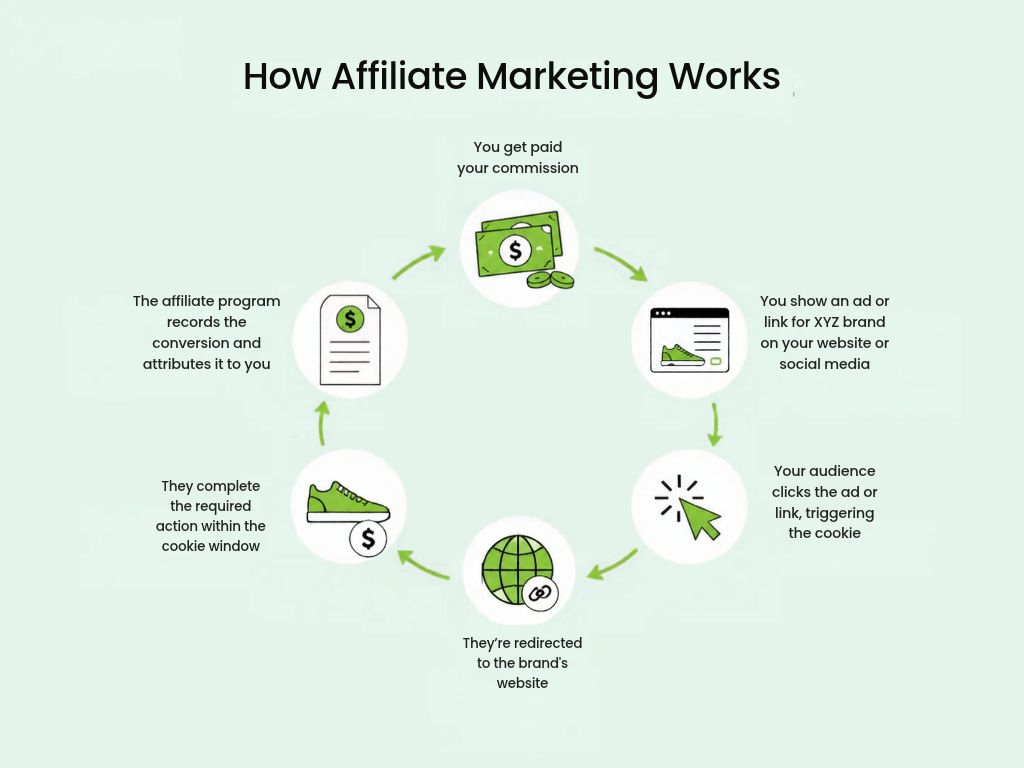
When someone clicks on your link, a small file called a “cookie” is stored in their browser. This cookie contains your unique affiliate ID and stays active for a set period of time, during which they need to buy, sign up, or complete whatever the program requires.
Cookie windows vary depending on what you are promoting. Physical products tend to come with shorter windows, sometimes just 24 hours, whereas digital products and subscription services can offer up to 60 days. The longer the cookie window, the more time your referral has to come back and complete the action while still crediting you.
How much can you make with affiliate marketing in your first year?
It varies enormously depending on where you’re starting from. A blogger with existing traffic who adds affiliate links to content they’re already publishing can start seeing commissions within weeks. A professional with an established reputation in their field recommending tools they already use can convert their credibility into income relatively quickly. But if you’re starting from total zero, your first year is less about earning and more about building the foundation that income eventually comes from.
Here’s roughly how the first year tends to go for a complete beginner:
- Months 1–3: You join a few programs, add links to your content, and focus on building your presence on your chosen platform; while it’s possible to make sales at this stage, it’s not really realistic.
- Months 4–6: You can expect a few sales here and there, but these will start to show you what content resonates with your audience and what products they actually want.
- Months 7–12: The most consistent affiliate marketers at this stage report earning between $200 and $500 per month, although these figures aren’t set in stone and may vary.
How to start affiliate marketing in 5 steps
Now that you have a solid understanding of the fundamentals, here’s a step-by-step guide to getting you closer to earning your first affiliate commission.
Step 1: Pick one niche you can sustain
Your niche is the main topic around which your affiliate content and online identity revolve, and this is why you need to choose it wisely.
You can take two main routes here: either target a high-commission niche if maximizing the affiliate income is your priority, or focus on a passion or hobby you’re really knowledgeable and enthusiastic about. Choosing the latter is often the smarter move, as leveraging existing expertise saves you time from learning an entirely new field and helps you stay consistent while waiting for the first affiliate sale to come.
To validate whether this is the best affiliate niche for you, you need to check the demand, to see if people are actively looking for related content. For example, if you want to specialize in “web hosting,” simply enter that keyword along with other similar terms into one of following tools:
- Google Ads Keyword Planner: It shows search volume data, competition levels, and keyword ideas directly from Google’s own database.
- Ubersuggest: It gives keyword search volume, competition level, and content ideas for any niche, but the free plan is limited to only 3 searches per day.
- Keyword Surfer: A free browser extension that shows search volume directly in Google results as you type.
- Ahrefs: A full SEO platform covering keyword research, competitor research, and site audits, however it requires a paid plan starting from $29/month.
Pro tip: When validating your niche, look at the total demand across a cluster of related keywords (the one you enter and the ones that pop up as suggestions) rather than judging it by a single term’s monthly search volume. Search interest varies widely from niche to niche and topic to topic, so the combined picture across several related terms is a much more reliable signal than any one keyword alone.
Step 2: Set up your content distribution platform(s)
Now that you have an idea of what you’ll be talking about, you need to understand where your target audience hangs out most. While you can post content whenever you want and use whichever format you feel most confident with, by placing it where you’re sure people will search for it, your efforts won’t be in vain.
The best way to figure this out is to put yourself in their shoes: search the topics you want to cover, watch what comes up, check the comments on popular YouTube videos in your niche, see who is engaging on LinkedIn or Reddit, and notice which platforms surface the most active conversations. You’ll spot patterns quickly. Start with the platform where your audience is most active and engaged, test a couple if you are not sure, and narrow it down to the one that gets traction.
Here’s a breakdown of the main platforms in which marketers promote affiliate products:
| Platform | Type | Content lifespan | Best for | Product types |
| Affiliate marketing website/blog | Search engine | Years | In-depth reviews, tutorials, comparisons, roundups | Software, SaaS, web hosting, financial products, electronics |
| YouTube | Search engine | Years | Product demonstrations, how-to videos, honest reviews, unboxing | Tech gadgets, cameras, software tutorials, fitness equipment |
| Visual search engine | Months to years | Inspirational and visual niches; repurposing existing blog content | Home decor, fashion, food, fitness, beauty, finance | |
| Community channels (Reddit, Facebook groups) | Search engine | Days to weeks | High-intent recommendations within niche communities | Niche gear, software tools, courses, anything with an engaged community |
| Social media (TIkTok, Instagram) | Discovery channel | Hours to days | Brand awareness, short-form demonstrations, driving traffic to primary platform | Physical products, lifestyle, beauty, fashion |
Pro tip: Some affiliate programs ask for proof of an online presence before approving you. Therefore, set up your account(s) and publish a few pieces of content early to increase your chances of getting accepted.
Should you use paid advertising or banner ads for promoting affiliate products?
While it’s not prohibited, most affiliate programs don’t allow you to send paid traffic straight to your affiliate link, and platforms like Google or Facebook might suspend your account if you try. To get around that, you’d have to set up a dedicated landing page first, which will cost you additional money. And even then, you’re paying for every click whether someone completes an action or not, which means your budget can disappear fast with very little to show for it.
Paid ads are most effective when you already have a steady stream of organic traffic that actively generates conversions, but they aren’t a good place to start with as a beginner.
Step 3: Find affiliate marketing program(s) worth joining
This is where things start getting exciting. Even though you might want to sign up for every program you come across (which will quickly become hard to manage), focus on finding a few solid ones with fair commissions and simple tracking.
Where to find affiliate programs?
One way is by typing “[brand name] affiliate program” directly into your browser for any company whose products you want to recommend, or “[niche] affiliate program” to search for available programs in your field. If a brand doesn’t list one on their site, don’t hesitate to email them directly. This way you can negotiate commissions from the start and build a relationship ahead of the competition.
Alternatively, you can join an affiliate network. This is a platform that brings together hundreds or thousands of brands in one place, allowing you to browse and apply to multiple programs from one place. If you run into any technical or administrative issue with your account, though, it might take quite some time since it has to go through the network’s support team rather than being resolved directly with the brand.
| Affiliate network | In-house program | |
| Examples | Awin, CJ Affiliate, Impact | SiteGround’s affiliate program |
| Program variety | Hundreds of brands in one place | Multiple products to promote (managed hosting, WordPress hosting, website builder, ecommerce, vibe coding, email marketing) |
| Commission rates | Varies widely by merchant | Up to $100 per hosting sale, scaling with monthly volume or 60% recurring commissions from any other SiteGround service; custom deals for top performers are available |
| Cookie duration | Varies by merchant | 60 days |
| Tracking | Varies by network; some offer SubID support | Track clicks, sales, and conversion rates by creating separate campaigns for each platform or piece of content |
| Support | Platform-level support | Dedicated affiliate manager |
| Payout | Varies by network | Weekly, no minimum threshold |
| Best for | Beginners exploring what’s available across a niche | Anyone |
How to evaluate if an affiliate program is worth it?
Not all programs are built the same. Before recommending a brand to your audience, take a moment to look over these key criteria to make sure the partnership is worth your time and effort:
- Cookie duration: at least 30 days for digital services and 1 week for physical products.
- Commission structure: recurring commissions or tiered commission structures that reward higher sales volumes with increased rates.
- Payment reliability: check how often the program pays, what the minimum payout threshold is, and whether there is a history of delayed payments.
- Brand reputation: recommend companies that have a high customer satisfaction rate, since a bad customer experience will reflect on you too, not just the brand.
- Support: some programs provide dedicated affiliate managers and marketing materials, making it easier for the affiliate marketer to promote the brand.
- Tracking and analytics: go for programs that allow you to create different links for different pieces and placements, and show you the number of clicks and sales generated by each, so you know what performs and what does not.
Step 4: Leverage content and traffic strategies
Affiliate marketing is a content marketing business after all. Your links mean nothing without content that people can find, read, and most importantly, trust, which is why what you publish and how you optimize it for both search engine and AI models matters as much as which programs you join.
How to know what to write about?
The content formats that convert most include product reviews, comparisons, “best X for Y” roundups, how-to guides, and tutorials. However, your choice of format should align with your target keyword and search intent. For instance, a user searching for “best email marketing software for small business” demonstrates transactional intent and is likely seeking a comparison. Conversely, someone searching “how to send a newsletter” has informational intent and prefers a step-by-step tutorial.
Here’s how to find the right keywords and topics on each platform:
- For a website/blog: use the same tools you used to validate your niche.
- For YouTube: type your topic into the search bar and note what autocomplete suggests, or use vidIQ. It’s a free browser extension that overlays keyword search volume and competition scores directly on YouTube pages as you browse.
- For Pinterest: you can either do the same trick with the search bar or look at Pinterest Trends. It’s a free tool showing you growing and seasonal trends you can hop on.
- For community forums: note the questions that come up repeatedly. The most upvoted unanswered questions are your best content opportunities
- For social media: search your niche hashtag (for example, #webhosting) to see what content people are engaging in.
How to drive traffic to my content?
Every platform has its own rules for getting content discovered.
- On YouTube, your keyword should appear in the video title, thumbnail, description, and even closed captions.
- On Pinterest, it goes in the pin title, description, and the text overlaid on the image itself, and if you add your pin to a board specifically named after this keyword, even better.
- For a website or blog, since search engine optimization covers a lot more ground, it’s best to follow a dedicated SEO checklist.
- In forums and communities, detailed and specific answers rank better in search results than short replies, and platforms like Reddit even allow you to publish longer, blog-style posts that can rank on their own.
- On social media, you should include your keyword in captions, on-screen text, and say it out loud in videos since TikTok transcribes audio for search indexing.
Where should I put my affiliate links?
People buy when they sense an authentic experience and your affiliate link should appear at the exact moment your recommendation feels most natural, not wherever it is most convenient for you.
- On a blog, that means linking within the text when you first mention the product, adding it to comparison tables and buttons where the reader is already in decision mode.
- On YouTube, most put it in the description with a clear call to action like “Try it now: [affiliate link]” or in a QR code in your video, for people watching on their TV.
- On social media, one way is a link in bio since there’s nowhere else to add it, and another is “comment [word] and I will send you the link,” which you can automate with a third-party tool.
- On Pinterest, you can add your affiliate directly to your post.
How to disclose affiliate links?
Disclosing your affiliate partnerships is not optional, it’s required by the FTC in the US and by the CMA and ASA in the UK. But there’s also a practical reason to do it: 57% of consumers name transparency as the most important value they look for in a creator.
Here’s what a compliant disclosure looks like on each platform:
- Blog or website: add a short statement at the very top of any post containing affiliate links, before the reader reaches any recommendation. For example: “This post contains affiliate links. If you purchase through them, I may earn a commission.”
- YouTube: check the “paid promotion” box when uploading the video, mention the affiliate relationship verbally at the start, and include a written line in the description. Doing all three keeps you fully compliant.
- TikTok: turn on TikTok’s disclosure setting and add hashtags like #ad or #affiliatelink at the beginning of your caption.
- Instagram and Facebook: use the built-in paid partnership label that Meta provides for affiliate and sponsored content, pair it with a short statement in your caption for maximum transparency.
- Forums and communities: add a brief note alongside every affiliate link you share; a simple (affiliate link) in parentheses next to the URL is enough and keeps you compliant without interrupting the flow of your answer.
Is AI helping or hurting affiliate marketers?
AI tools have made it easier to research keywords, generate first drafts, and handle other repetitive tasks that experienced affiliates now use as a regular part of their workflow. The problem, though, is that it has also flooded every niche with content where AI did all the thinking and the writer contributed nothing original. AI-generated avatars, voiceovers, and faceless video content are becoming increasingly common, raising valid concerns about whether AI is undermining the visibility of authentic content.
The good news is that search engines are getting better at spotting this kind of content, and readers are too. At the end of the day, people buy from people they trust, and you can’t build that trust if you’re not really there. The affiliates who use AI to work faster while still showing up authentically in their content, are the ones winning in this debate.
Step 5: Measure performance and fine tune whenever needed
Knowing that a conversion happened is useful, but knowing where it came from is what lets you repeat it. Some affiliate marketers use SubIDs: labels added to tracking links to identify the source of each click, including the platform, content piece, or specific placement. Others rely on performance metrics in their affiliate dashboard, though the available data varies by program.
SiteGround’s affiliate dashboard makes this straightforward with custom campaign tracking. You can create separate campaigns for each platform or piece of content, label them accordingly, and compare their total and unique clicks, number of sales and their conversion rate side by side. You can even create a branded short link like siteground.com/go/yourbrand, which is especially useful for creators who share links verbally with their audience.
Pro tip: Review click and conversion data monthly. High traffic with no clicks calls for a clearer call to action or link placement, while clicks without sales indicate a product-audience mismatch. If no one clicks, refine your content; if no one buys, adjust your offer.
The 3 affiliate marketing mistakes that can get you stuck
We’ve touched on some of these already, but they’re worth emphasizing one more time so you’re sure you’ll avoid them.
1. Trying to sell instead of solving a problem
The most common mistake beginners make is sharing their affiliate links everywhere and waiting for clicks. This approach almost never works. What really converts is content that addresses a specific problem and presents the product as the logical solution.
2. Recommending products you haven’t actually used
Reviews assembled from pricing pages and other people’s opinions all read the same, and AI can produce them faster than you can. What sets your content apart is proof you were there: screenshots of the actual dashboard, numbers you measured yourself, the thing that annoyed you in week two.
3. Failing to track where your conversions come from
Many beginners fail to set up tracking properly, relying only on total clicks and earnings. Without knowing which specific piece of content, link placement, or platform drove a sale, you won’t know what works or how to replicate your success.
30-day affiliate marketing action plan: how to not waste your first days
- Pick a niche and confirm there is both search demand and active affiliate programs in it.
- Set up accounts on the platform(s) where your target audience spends most of their time.
- Apply to a few affiliate programs in your niche.
- Conduct keyword research to plan your first ten content pieces.
- Optimize every piece of content for organic search.
- Place your affiliate links strategically where users are most likely to click.
- Configure tracking parameters before publishing your first link live.
- Commit to a consistent publishing schedule.
- Analyze your performance metrics monthly to identify effective tactics and adjust accordingly.
You’re now ready to begin your affiliate marketing journey
The journey of an affiliate marketer starts with one niche and one honest recommendation. Most beginners overcomplicate the process. In reality, showing up consistently, publishing, testing, tracking, and improving is what separates successful affiliates from those who give up early.
If you decide to focus on website building, ecommerce, email marketing or vibe coding, SiteGround’s affiliate program is an ideal place to start. It offers both tiered and recurring commissions, 60-day cookies, weekly payouts, and a dedicated affiliate manager to assist you every step of the way.
FAQs about affiliate marketing for beginners
Yes. All you need to start affiliate marketing is a niche you know well enough to create content about consistently, a platform where your target audience looks for recommendations, a few relevant affiliate programs, and the right keywords to reach your audience.
Yes, affiliate marketing is one of the most low-risk endeavors you can pursue. You can create content on virtually any platform simply by opening a free account, and affiliate programs are free to join. If you promote products you already use and like, you don’t need to spend money purchasing anything new. Additionally, you can generate content ideas using free search tools, meaning your primary investment at the start is simply your time.
Yes, but it’s not a beginner’s outcome. Getting there requires either significant traffic at modest commission rates, or a smaller but highly targeted audience and high-ticket programs where one or two sales a week is enough to hit the target. Affiliates who reach that level consistently have usually been publishing for at least a year or more.
Yes, you can start affiliate marketing without a website, though most affiliates eventually create one. Some of the main benefits are that you have full control over your content (no host can ban your account, limit your reach, or decide who sees your posts), and if something goes wrong you can restore it from a backup instead of waiting on a support team. A well-ranked blog post can also keep bringing in visitors and commissions for months or years after you publish it, with only occasional maintenance rather than the constant output social media demands. Some affiliate programs, particularly in the SaaS space, may require proof of an established website before approving your application.
An affiliate program can be hosted in-house or featured on a network. In-house programs are managed directly by the brand with their own dedicated team and dashboard, while affiliate networks are third-party platforms that host multiple merchant programs under a single login, allowing you to browse and apply to various brands from one place.
No, but only if you prioritize your audience over the commission. You should disclose clearly, only recommend products you would stand behind regardless of what they pay, and keep affiliate content to a reasonable share of your output.