
Search for what a website costs, and you’ll get answers ranging from nothing to $250,000, which can hardly help you. The number is that wide because the question should really be what your project costs based on the path you take to build it.
The cost to build a website in 2026 is about $200 a year on a DIY builder, $1,500 to $8,000 with a freelancer, and $6,000 to $35,000 or more at an agency. Web apps and MVPs start higher, from a few hundred dollars on no-code tools to $18,000 and up for custom development.
Key takeaways:
- Most small businesses spend under $10,000. 61% of small business buyers spent less than $10,000 on their most recent website and 84% spent under $20,000. Professional small business website costs cluster between $3,000 and $15,000.
- The cost to build a website or web app is set by the path, not just the project. The same brochure site can cost $200 a year on a builder or $12,000 at an agency. What changes is who does the work.
- A web app costs more than a website because it does something. Custom web app development starts around $18,000 for an MVP, against $3,000 to $15,000 for a typical small business site.
- AI and no-code builders are the cheapest entry. AI app builders start free, and no-code platforms now run roughly $36 to $69 per month at entry level.
- Ongoing costs are the line most quotes leave out. Budget roughly $600 to $6,000 a year for a small business site, and 15% to 25% of the build cost annually for a web app.
What determines website and web app development cost
Many cost guides start with features: how many pages, whether you need e-commerce, how complex the design is. Those are important details, but they’re actually second-order. The variable that moves the number most is who builds it and on what.
A five-page brochure site is a five-page brochure site whether you assemble it on a template, hand it to a freelancer, or commission an agency. The work is broadly the same. But that site is about $200 a year built yourself, around $4,000 from a freelancer, and $12,000 or more from an agency. You are not buying more website at the top of that range. You are buying more of three things.
- Time is the one people underestimate. What you don’t pay in money you pay in hours: learning the tool, writing the copy, resizing images, fixing what breaks. A DIY site isn’t free, it’s unpaid. If your hours are worth anything to the business, price them before calling the builder path cheap.
- Judgment is knowing which decisions matter and where projects like yours usually go wrong. Someone who has built dozens of these will skip the arguments you would have had. On the DIY path, that judgment is yours to supply, which is fine when the stakes are low and expensive when they aren’t.
- Accountability is the least visible line on any quote. It answers who fixes it when the contact form stops sending on a Tuesday. On a builder, that’s you. With a freelancer, it depends what you agreed and whether they’re free that week. With an agency on a retainer, it’s contractual.
That’s also why quotes from different paths aren’t directly comparable. A $3,000 freelancer and a $12,000 agency are often quoting different work, because content, photography, revisions, and post-launch support may be inside one number and billed separately in the other. Write down what you need first, then check each quote against the same list.
So the useful question isn’t what a website costs. It’s which path fits what your site or app has to do, and what that path costs in 2026.
How much does it cost to build a website in 2026?
It costs between roughly $16 per month and $35,000 or more to build a website in 2026, depending on the path. Most professional small business website costs land between $3,000 and $15,000. In the Clutch 2026 survey, 61% of small businesses spent under $10,000 on their most recent website. GoodFirms’ 2026 software development cost survey found 51.6% of web development agencies quoting $3,000 to $15,000 for small-scale sites.
| Build path | Typical 2026 cost | Best for | Watch for |
| DIY website builder (Wix, Squarespace) | $16 to $50 per month | Simple brochure sites, tight budgets, fast launch | Limited customization, and you build and maintain it yourself |
| AI website builder | Free to about $50 per month | Non-technical owners who want a fast first version | Output quality varies, and publishing or a custom domain usually needs a paid plan |
| Self-hosted WordPress (DIY) | $100 to $500 per year | Owners comfortable with a small learning curve | More technical than a hosted builder |
| Freelancer | $1,500 to $8,000 one-time | Custom branding without agency overhead | Turnaround times and limited post-launch support |
| Boutique or full agency | $6,000 to $35,000 and up | Strategy, custom design, and ongoing support | Highest upfront cost, and scope creep adds to it |
The builder prices are entry plans billed annually: Wix starts at $17 per month and Squarespace at $16 to $19, but the plan most small businesses actually need sits closer to $29 to $39 once you add selling or remove transaction fees. And the agency range is wide because it covers everything from a boutique studio’s $6,000 template build to a $35,000 custom project with strategy and content included.
AI website builders sit alongside the DIY tier rather than replacing it, and the sticker price is rarely the whole bill. Our guide to AI website builder pricing covers plans, renewals, limits, and the fees that appear when you try to publish.
How much does it cost to build a web app or MVP in 2026?
Web app development cost starts where website cost tops out. An MVP built with no-code tools can cost a few hundred dollars a year, while custom development for the same idea starts around $18,000. The cost to build a web app depends on the same build path question, with an extra tier at the top that websites do not have.
| Build path | Typical 2026 cost | Best for | Watch for |
| AI app builder | Free to about $300 per year to start | Validating an idea fast, cheapest entry | A complexity ceiling you may eventually outgrow |
| No-code platform (Bubble, Adalo, FlutterFlow) | About $430 to $2,400 per year | Founders needing more logic than a builder allows | You rent it, expect 100 to 300 hours to learn it, and per-seat costs climb |
| Hybrid no-code plus custom work | $1,000 to $5,000 | MVPs expected to scale to real users | Needs some technical help at the edges |
| Agency-built MVP | $5,000 to $25,000 with a productized or offshore team | Funded teams wanting a polished first version | US agencies commonly quote $25,000 and up for the same scope |
| Custom development (agency or team) | $18,000 to $60,000 for an MVP; $45,000 to $150,000+ for a full app | Genuinely complex or large-scale software | Most expensive by far, and typically three to six months |
No-code platforms are the tier most often misquoted in older guides. Entry plans currently run roughly $36 to $69 a month, with Adalo at the lower end and Bubble at the upper, and FlutterFlow’s Basic plan at $39. FlutterFlow raised that from $30 during 2026, so check current pricing rather than trusting a figure from last year’s roundup.
Note also how wide the agency MVP band is. Productized offers and offshore teams genuinely deliver at $5,000 to $25,000, while US agency quotes for a lean MVP commonly start at $25,000 and run past $100,000. If you are scoping an MVP, our guide to building an MVP with vibe coding covers what to include and what to cut.
“MVP” has no agreed meaning, which is why the quotes vary so much. One agency’s MVP is a landing page with a signup form. Another’s is a working product with accounts, payments, and an admin panel. When quotes for the same idea come back at $8,000 and $60,000, they are usually pricing different products, not the same product at different rates. Write the feature list yourself first, in plain language, and send the identical list to everyone. The spread shrinks immediately.
Why a web app costs more than a website
A web app costs more than a website because it does something, while a website mostly shows something. That single distinction explains most of the gap between the two tables.
A website presents information: pages, images, a contact form, maybe a shop. The work is largely design and content, and once built it mostly sits there. A web app has users who log in, data belonging to each of them, rules about who can see and change what, and logic that has to be right every time. All of that needs designing, building, and testing, and testing is where the hours go. Custom web app costs also carry a longer tail than custom website costs, because logic touching real customer data has to keep working as payment providers and integrations change around it.
What increases the cost
Within any path, five things move you from the bottom of the range to the top.
- Design originality. A template build and a custom design are different products. This is the single biggest gap between a $3,500 site and a $14,000 one.
- Page count and feature complexity. Bookings, e-commerce, and third-party integrations push toward the top of every range, because each one is a system that has to be configured and tested.
- Who writes the content. Writing it yourself is free and slow. Done-for-you copy and photography are often quoted separately, and they are a common reason a quote comes in higher than expected.
- User roles, data, and logic. This is the dividing line between website pricing and web app pricing. The moment people log in and the site remembers things about them, you have crossed into the second table.
- Ongoing costs. Hosting, security, backups, maintenance, and tool subscriptions are rarely in the headline quote, and they run for as long as the site does.
On the AI and DIY paths there is a sixth cost that does not appear on any invoice, which is your own time. AI builders produce a first version quickly, then you iterate, and the number of rounds is where the hours accumulate. Describing what you want precisely cuts that down, and our guide to writing better prompts for building is the practical version of that skill.
Which path is right for your budget
One question routes you faster than any feature checklist: how much of your revenue depends on this site or app? Not how much you like it, or how much you want it to impress people. How much money moves through it or because of it.
If the site is a low-cost small business site or an early test
Stay in the DIY and AI builder tier, free to about $50 per month. This covers a local service business that needs to be findable and credible, a portfolio, a landing page for something you are still validating, or a first version of an app idea. Paying $8,000 for a site that supports a business but does not drive it is a poor trade.
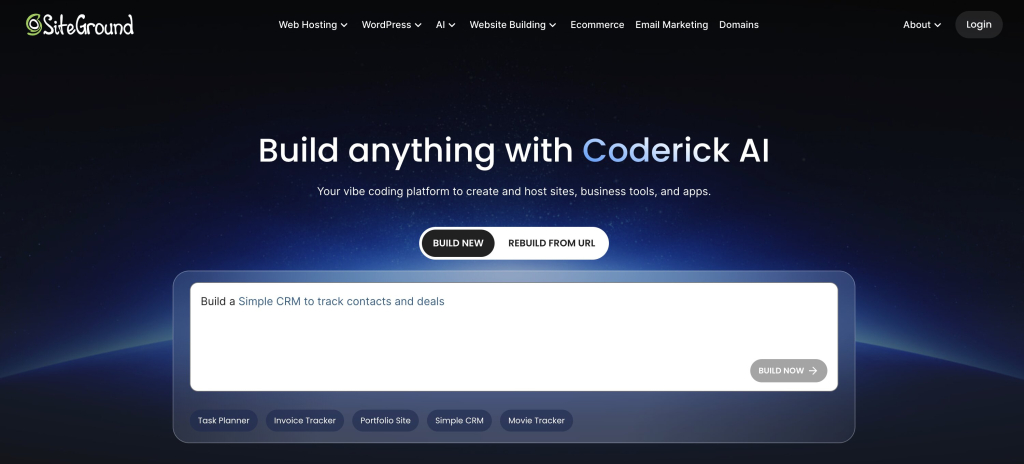
This is also where an all-in-one AI builder earns its keep on cost. For instance, SiteGround’s Coderick AI sits on this line: you describe what you want, and building, hosting, SSL, version control, and publishing come in the same plan rather than as five separate subscriptions you assemble and pay for individually.
If the site is one of several lead sources
Look at freelancers and small agencies, roughly $1,500 to $10,000. This is the tier where custom design starts paying for itself, because the site is doing real work in a real sales process and looking like everyone else’s template costs you something measurable. A freelancer at $1,500 to $8,000 gets you custom branding without agency overhead. A boutique agency from around $6,000 adds strategy and a process, which matters more as the site gets more complicated.
If the site or app is revenue-critical
Budget for an agency or custom website or web app development: $6,000 to $35,000 and up for websites, $18,000 and up for web apps. If the site is the storefront, if downtime costs money by the hour, or if the app is the product itself, the cost of getting it wrong is larger than the cost of building it properly. This is also the tier where the ongoing budget stops being optional, because software that carries revenue needs someone responsible for it.
Pro tip: Count the weeks, not just the money. A site built with an AI builder can be live in a few days. An agency project commonly runs eight to sixteen weeks, and a custom web app three to six months. If the site or app brings in customers, every month of delay is revenue you didn’t earn, and that rarely appears in any comparison. It can flip the maths entirely: a cheaper build that starts working in March may beat a better one that starts in July.
Ongoing website and web app costs to budget for
Ongoing website costs, including website maintenance costs, are the line most quotes leave out, and they are why a build that looked affordable becomes a problem in year two. Website maintenance cost covers:
- Hosting. The largest recurring line for most sites, and the one that scales as traffic grows.
- Domain renewal. Small and annual, and easy to forget until the site goes down.
- SSL certificate. Usually included with hosting now, but worth confirming rather than assuming.
- Software and plugin updates. Free if you do them yourself, billed if somebody else does.
- Security and backups. Sometimes bundled with hosting, sometimes a separate subscription.
- Content edits. The line that grows fastest if you cannot make changes yourself.
For a small business site, expect roughly $600 to $6,000 a year in total, with full-service maintenance plans commonly landing at $95 to $195 per month. If the site is simple and you handle updates yourself, you can run it for well under $100 a year in domain and hosting alone, but you are paying in hours instead.
Ongoing web app costs work differently and are higher. Web app maintenance costs are usually estimated as a percentage of the build rather than a flat fee, at roughly 15% to 25% of the original cost every year, because the code has to keep working as the services around it change. On a $40,000 MVP that is $6,000 to $10,000 a year, indefinitely. Add hosting, monitoring, and any AI or third-party services the app depends on. If you want to see how those separate subscriptions add up in practice, our breakdown of AI coding and hosting costs prices a full stack line by line.
Match the path to the job, not to the lowest price
The cost to build a website or web app in 2026 spans four orders of magnitude, and every number in that range is correct for somebody. What makes it useful is the question underneath it, which is what this thing has to do for your business. A site that has to be findable and credible does not need the budget of a site that has to sell. An idea you are testing does not need the budget of a product people will pay for.
Pick the cheapest path that can genuinely do the job, then add the ongoing costs before you compare quotes. The expensive mistake is rarely overspending at the start. It’s choosing a path that cannot do what you needed, and paying to build the thing twice.
If you are not sure which tier you are in, the cheapest way to find out is to build the simple version and see where it runs out. A month with a real site teaches you more about what you need than another week of comparing quotes, and it makes the next quote a better one.
[96]
FAQs
It costs anywhere from about $16 per month on a DIY builder to $35,000 or more at a full agency to build a website in 2026. Most professional small business sites land between $3,000 and $15,000, and 61% of small businesses spent under $10,000 on their last site.
Web app development cost is usually higher than website development cost because a web app does something rather than just shows something. Websites mostly present information, while web apps handle users, data, logic, and roles, which means more design, engineering, and testing. Custom web app MVPs typically start around $18,000.
The cheapest way to build a business website is a DIY or AI builder, starting free to around $50 per month. You trade customization and hands-off support for a low price, which suits simple brochure sites and early-stage testing.
You should choose based on how much of your revenue depends on the site, how much customization you need, and your website development cost ceiling. An AI or DIY builder fits simple needs and tight budgets, a freelancer suits custom branding at $1,500 to $8,000, and an agency fits complex, revenue-critical projects starting around $6,000.
MVP development cost can range from nothing to a few thousand dollars before hiring developers, depending on the build path. AI app builder costs start free to about $300 per year, no-code app builder costs run roughly $430 to $2,400 per year, and hybrid builds land around $1,000 to $5,000.
Custom website cost is usually lower than custom web app cost, because a web app requires more logic, data handling, user interaction, and testing. Custom websites run from around $6,000 to $35,000 and up, while custom web apps start near $18,000 for an MVP and reach $150,000 or more for a full product.
Ongoing website costs and ongoing web app costs include hosting, domain renewal, security, backups, updates, subscriptions, and support. Budget roughly $600 to $6,000 a year for a small business site, and 15% to 25% of the build cost annually for a web app.
Yes. Coderick AI can reduce the cost of building a website or web app by combining AI building, hosting, SSL, version control, and publishing in one plan, which removes several separate setup and subscription costs that a pieced-together stack would carry.