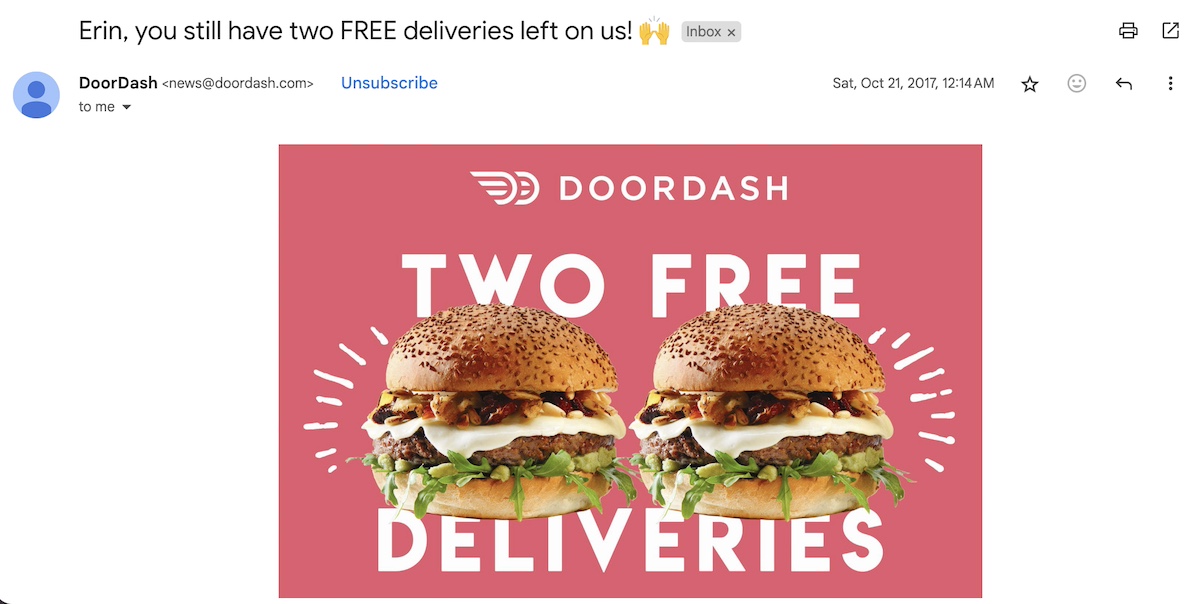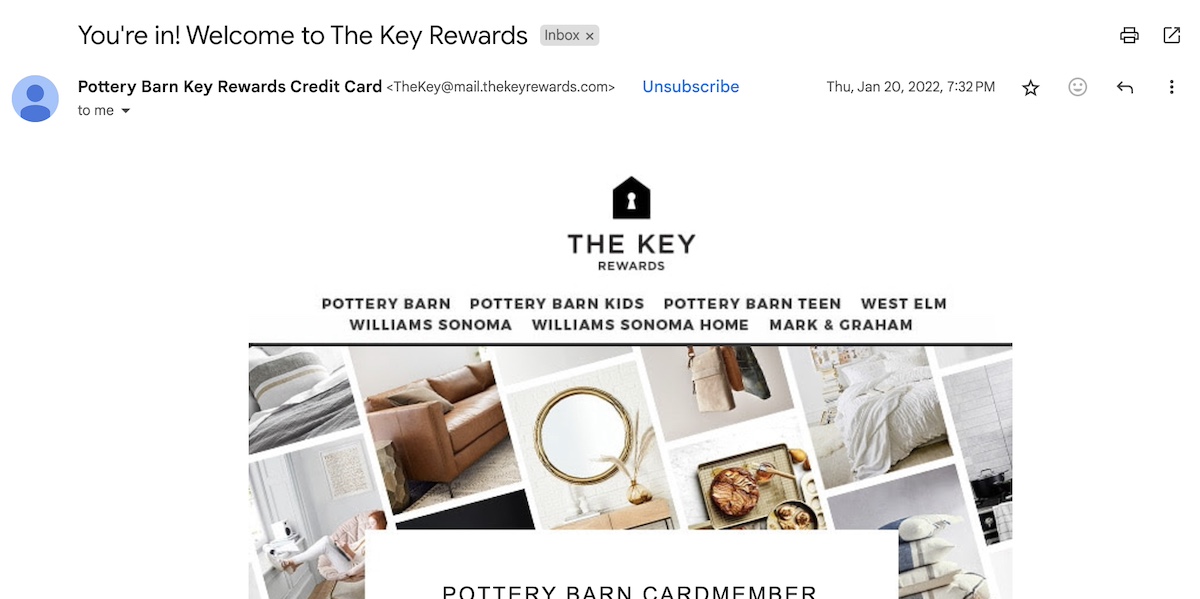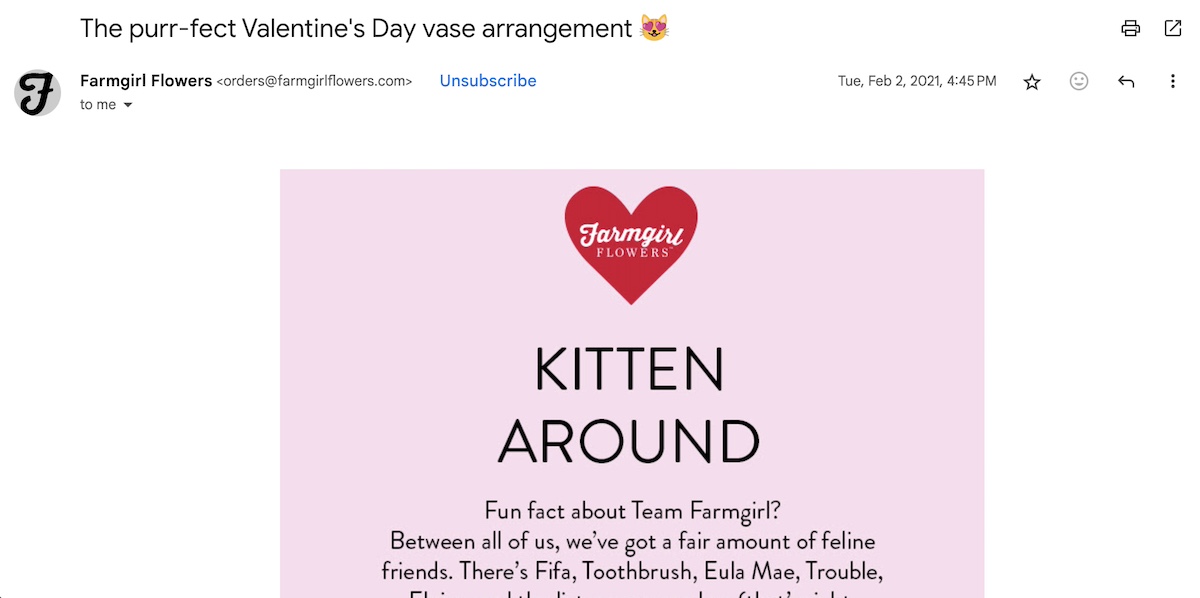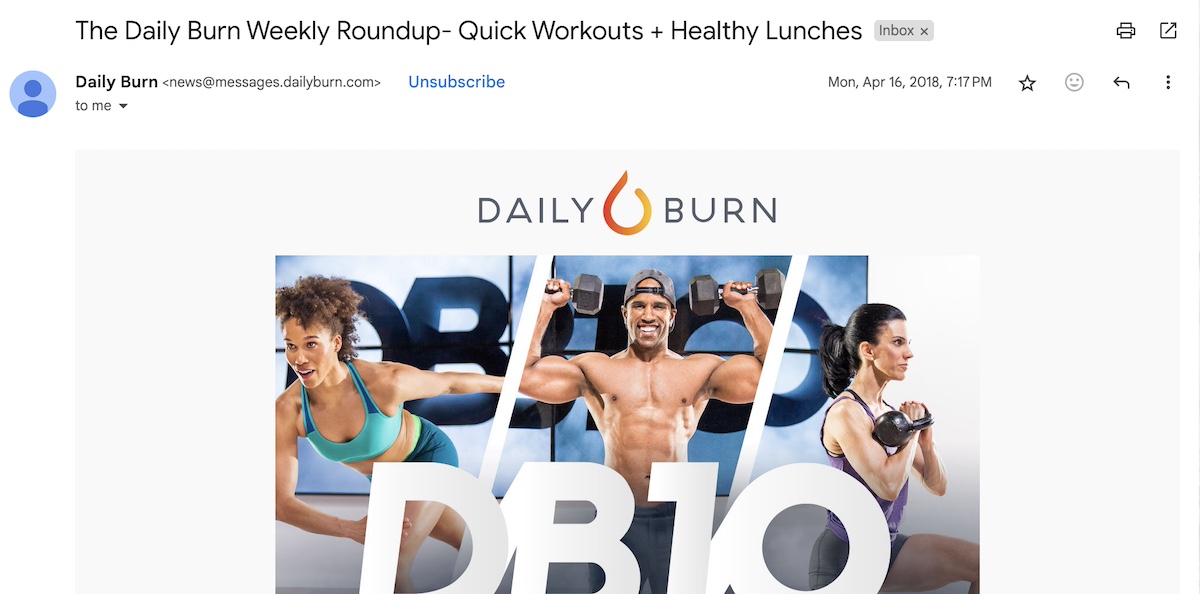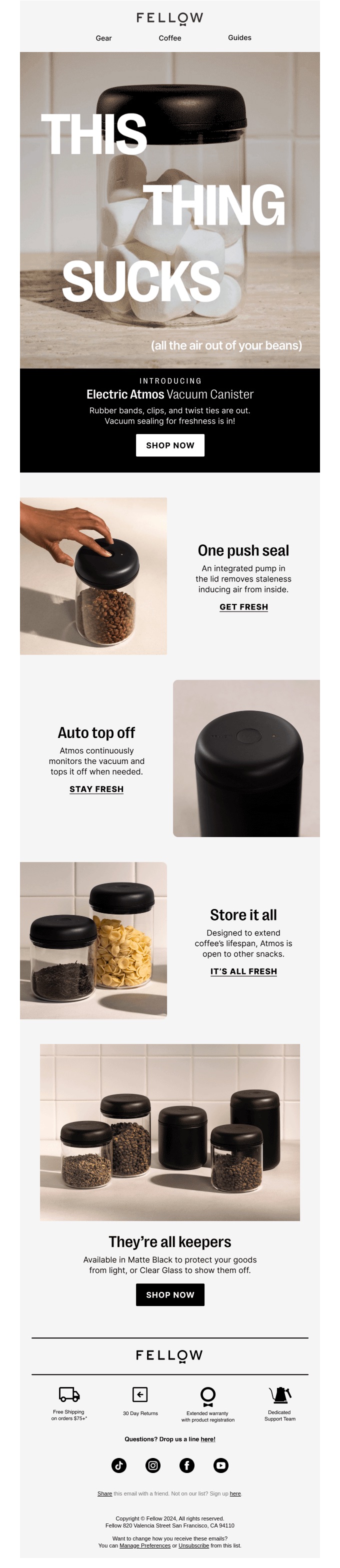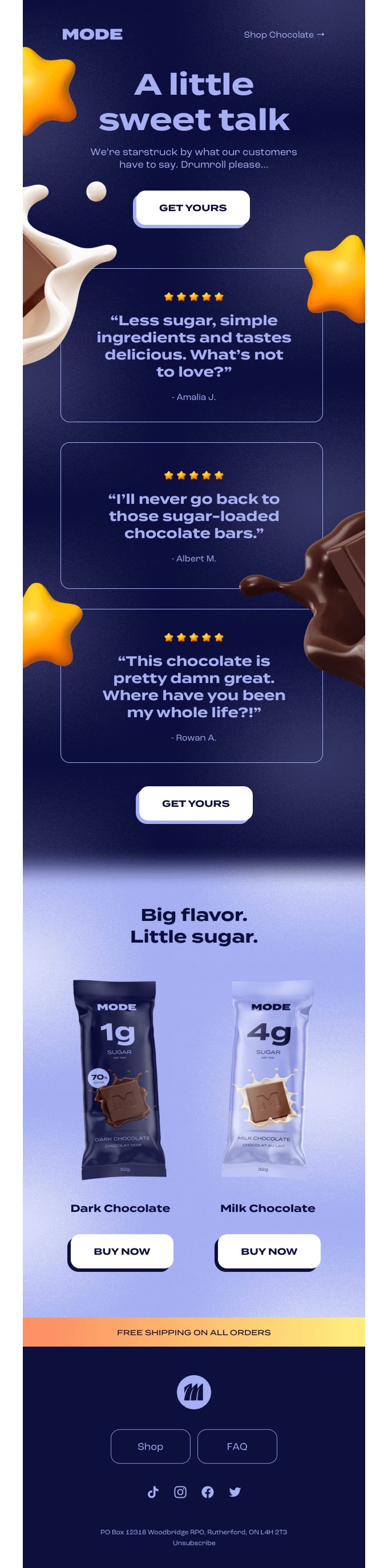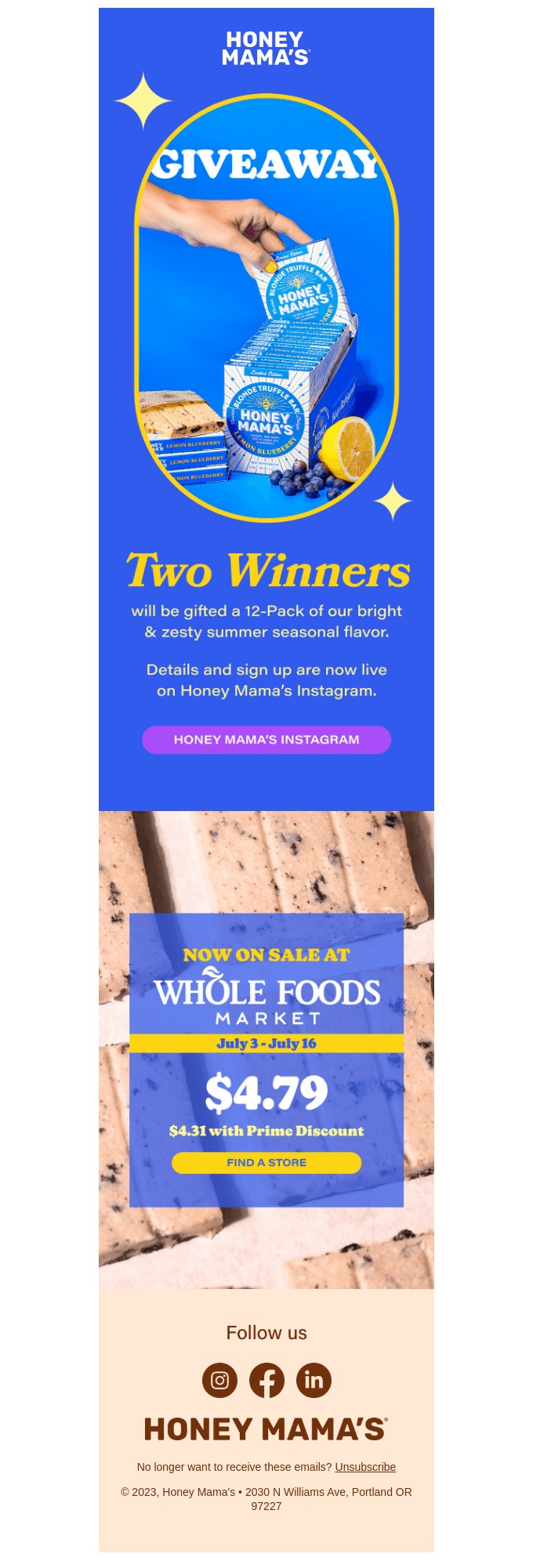
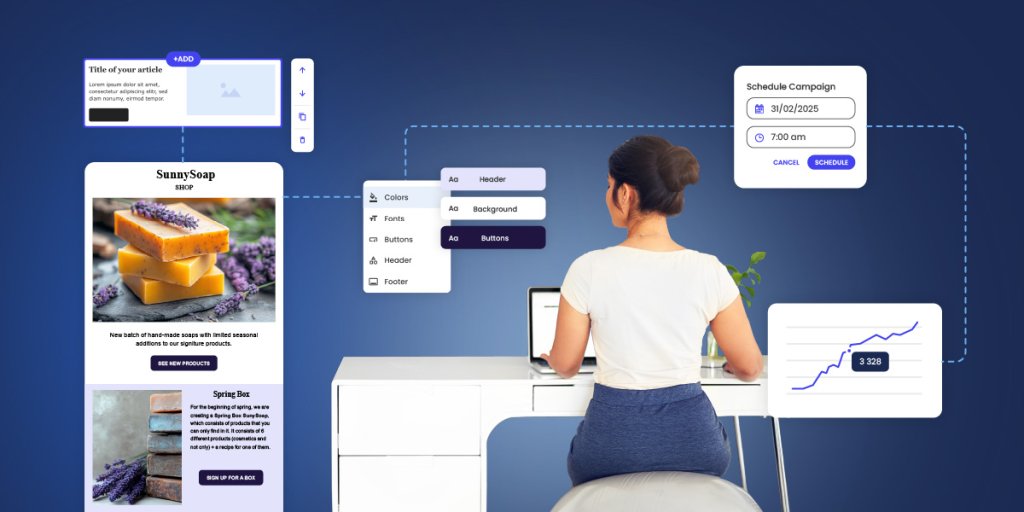
What Is an Email Newsletter: The Essentials You Must Know

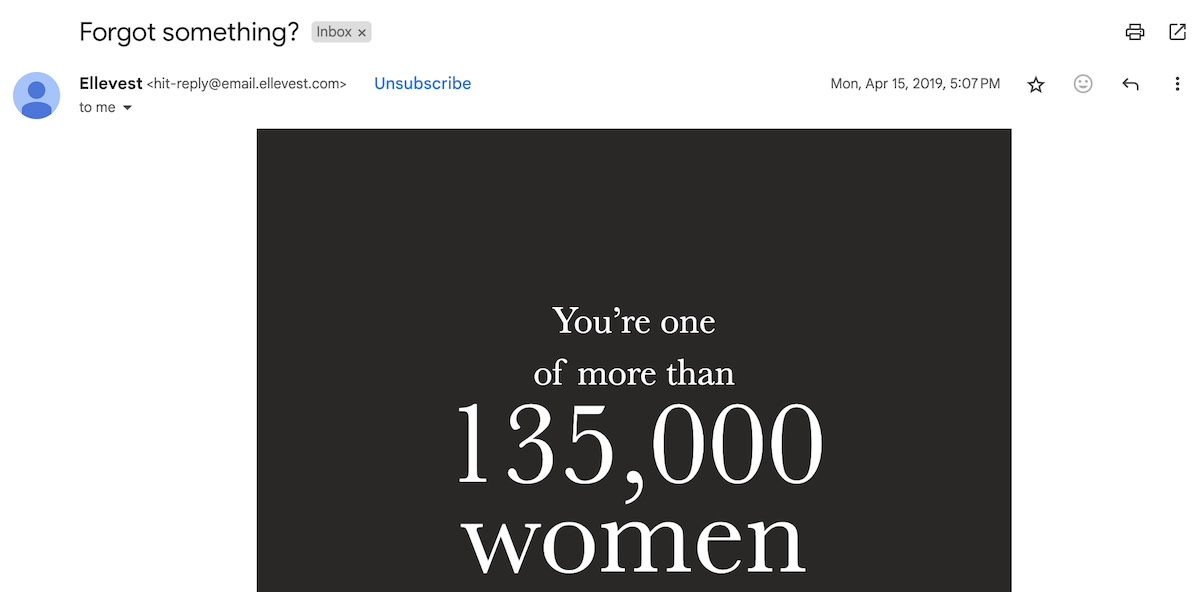
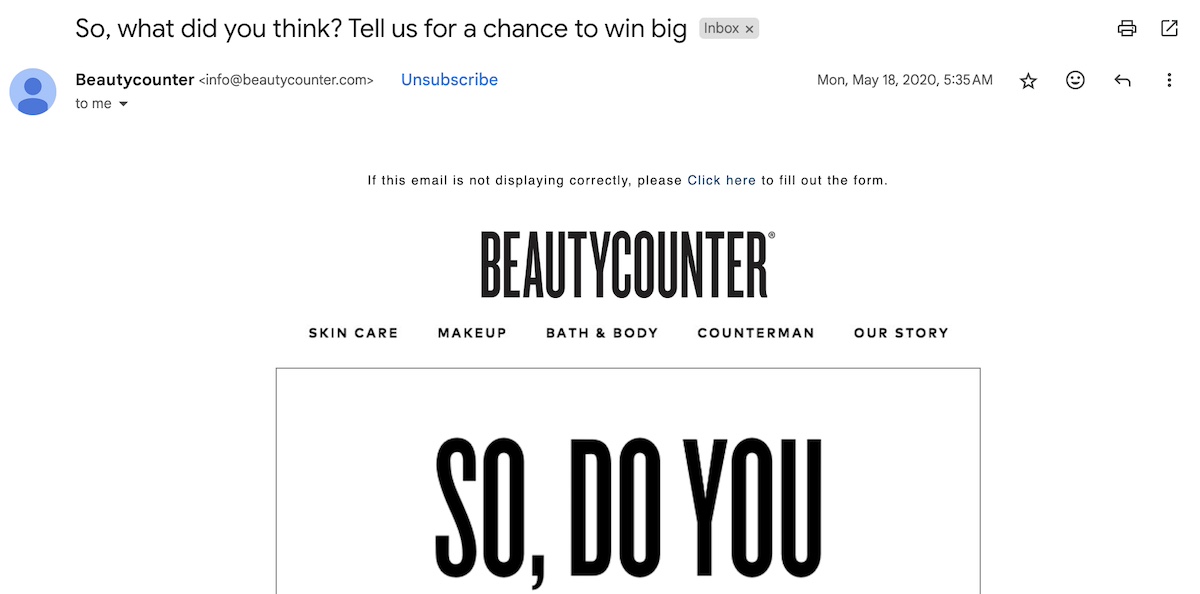
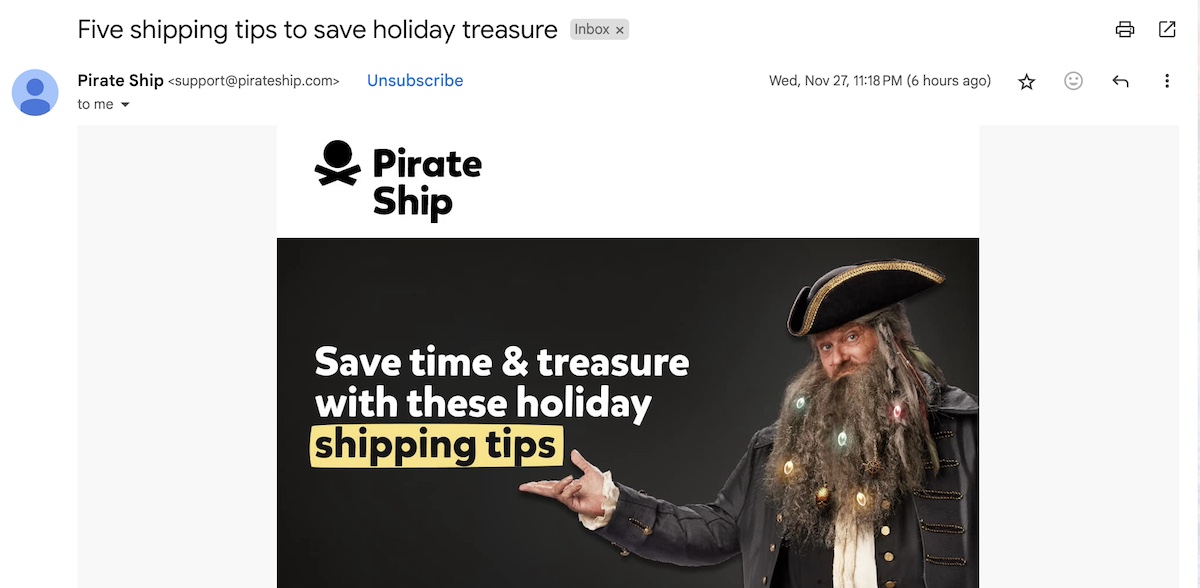
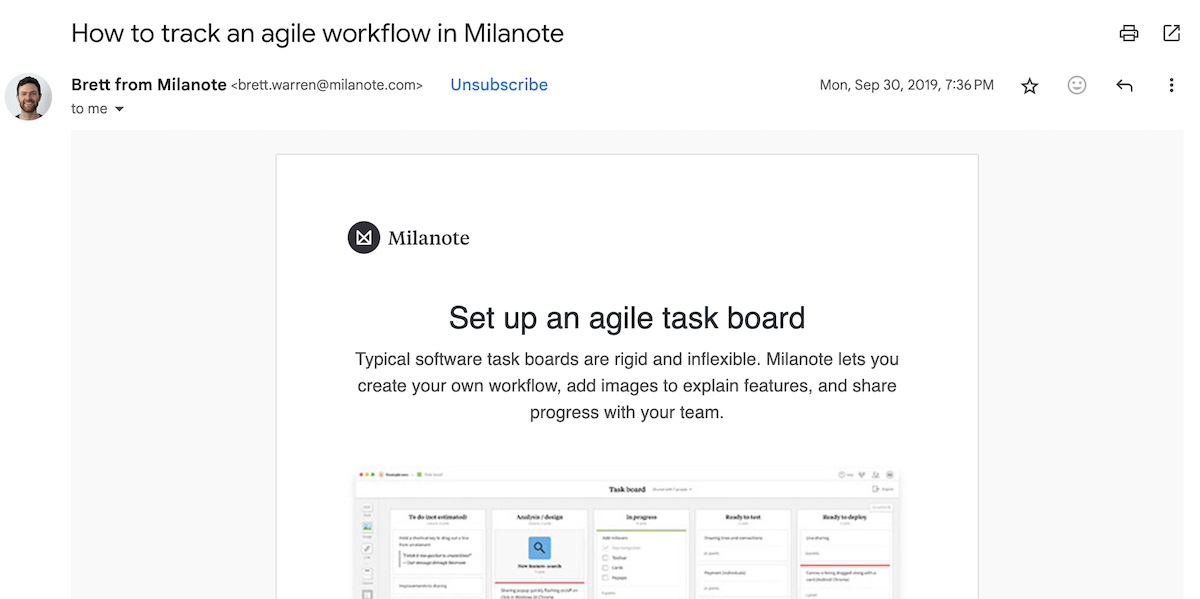
Ah, the email newsletter. Enter your inbox, and you’re probably swimming in them. But have you ever stopped to think: what is a newsletter? Is it just a boring list of updates, or is there more to it? Chances are, if you’re here, it’s because you have a sneaking suspicion that email newsletters aren’t as simple as they once may have seemed—and that’s why so many businesses are flooding your inbox with them.

So with that in mind, what really is the meaning of an email newsletter and what is its purpose? And how can you tap into its potential so that your message isn’t just another one of those ignored emails in recipients’ inboxes? It’s time to get to the bottom of this email marketing mystery.

What Is a Newsletter?

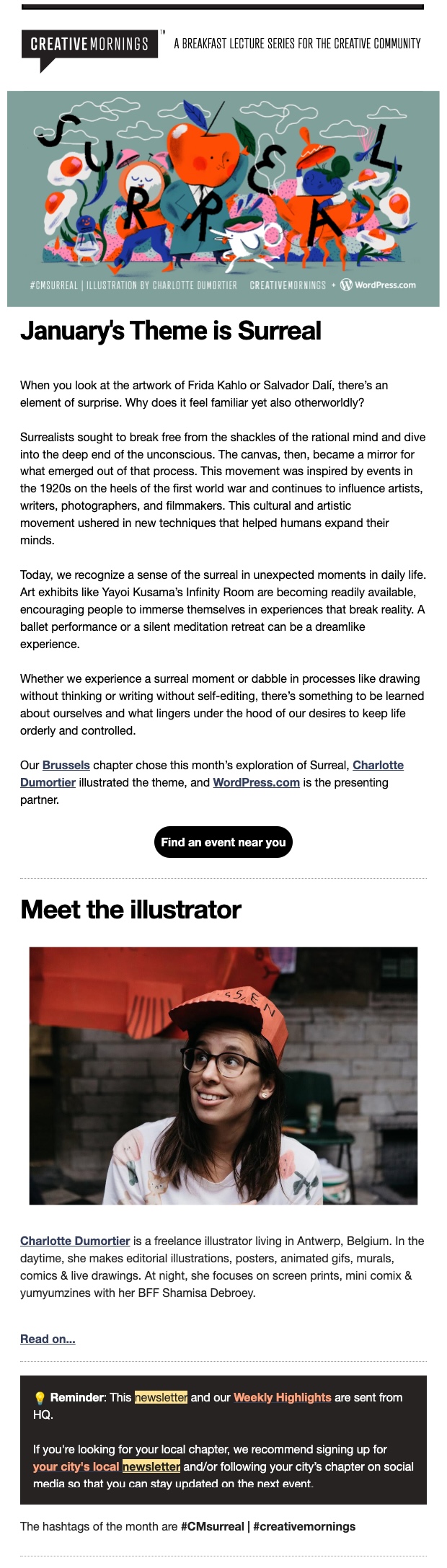
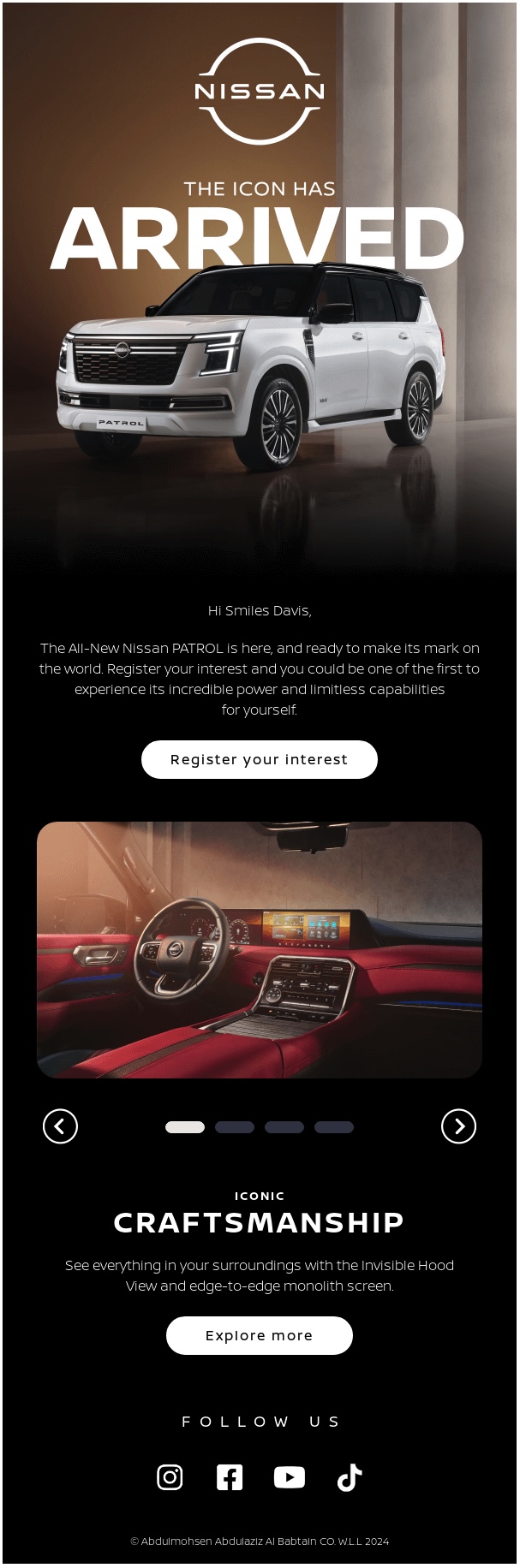
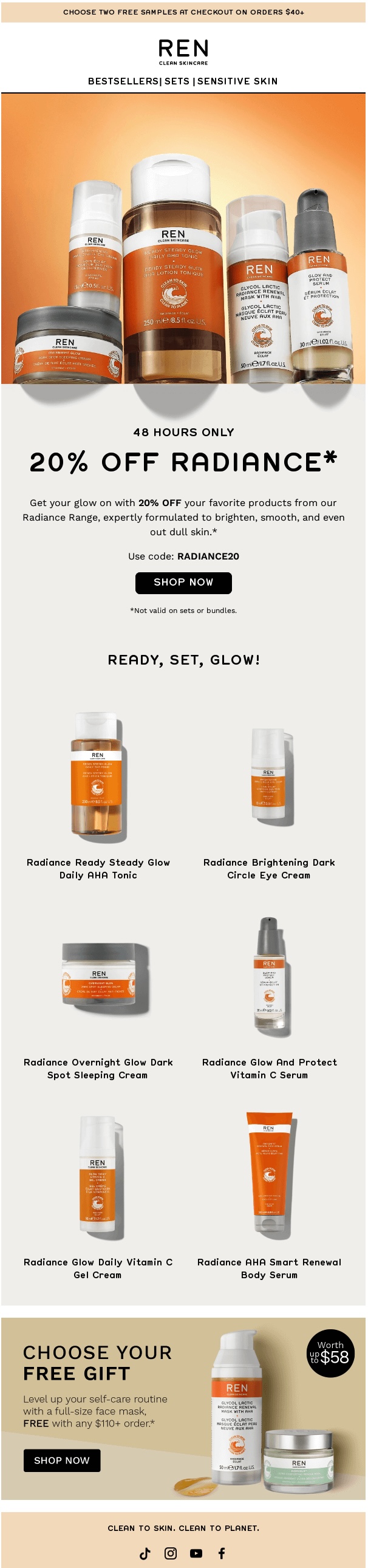
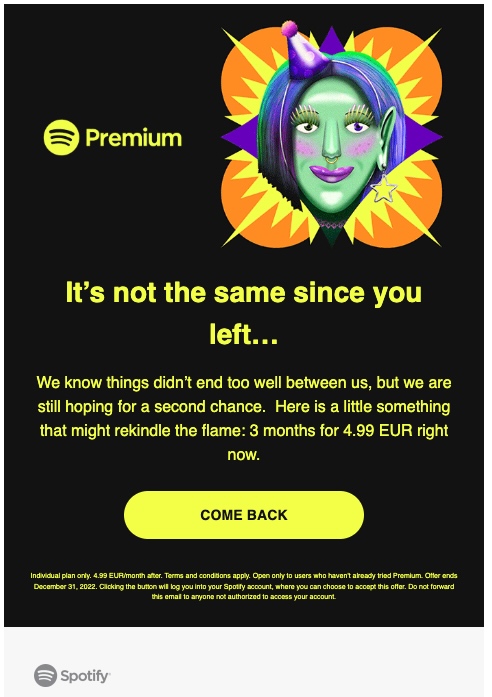
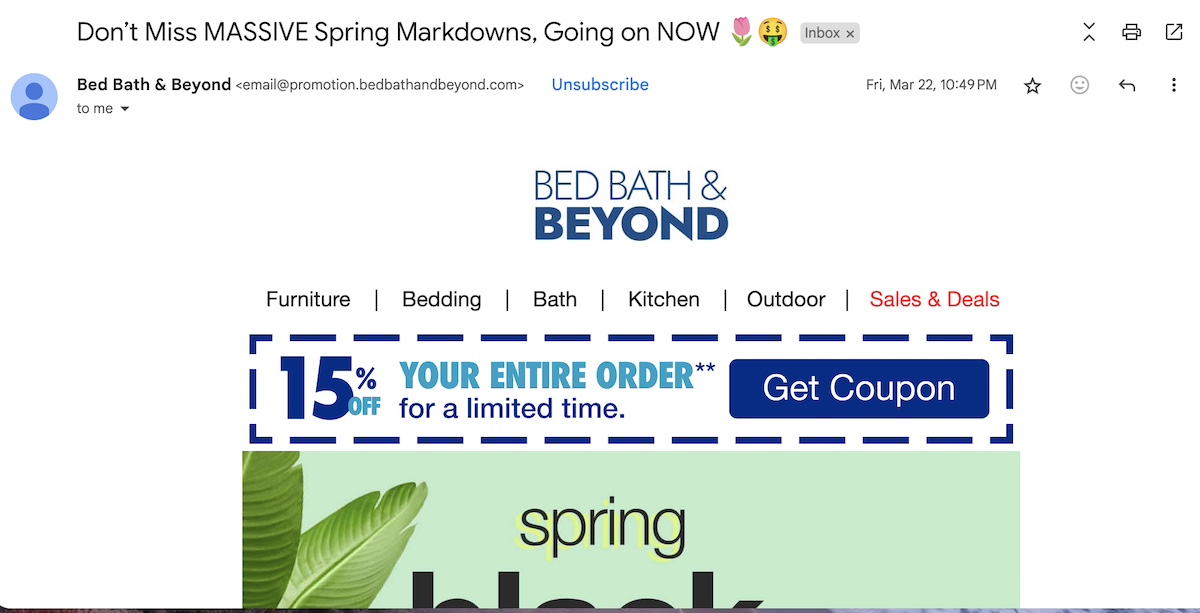
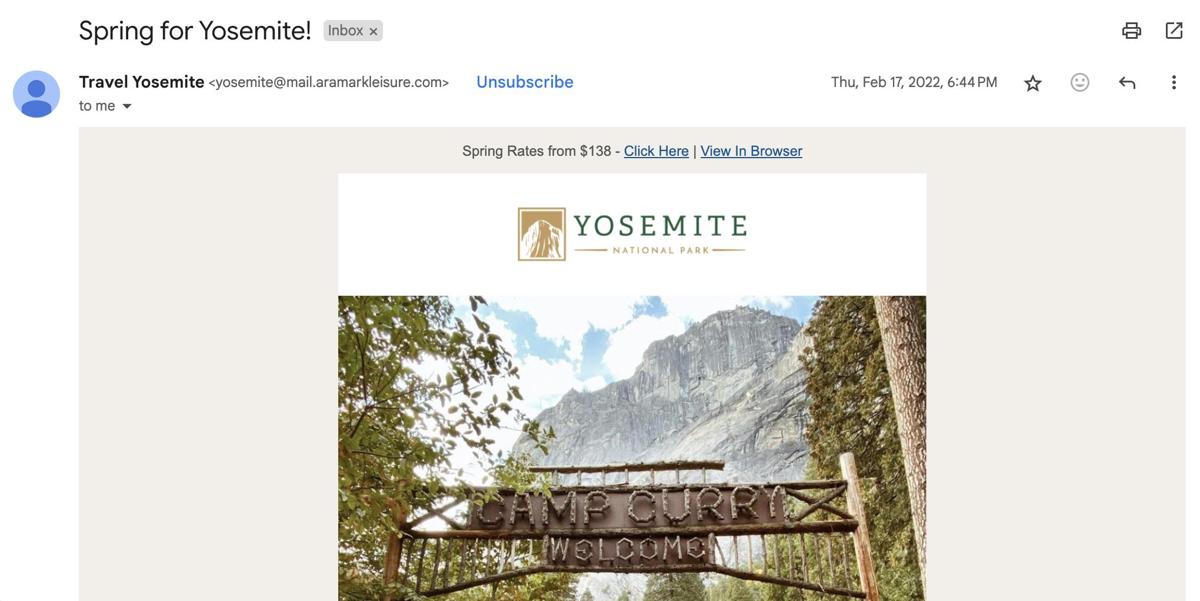
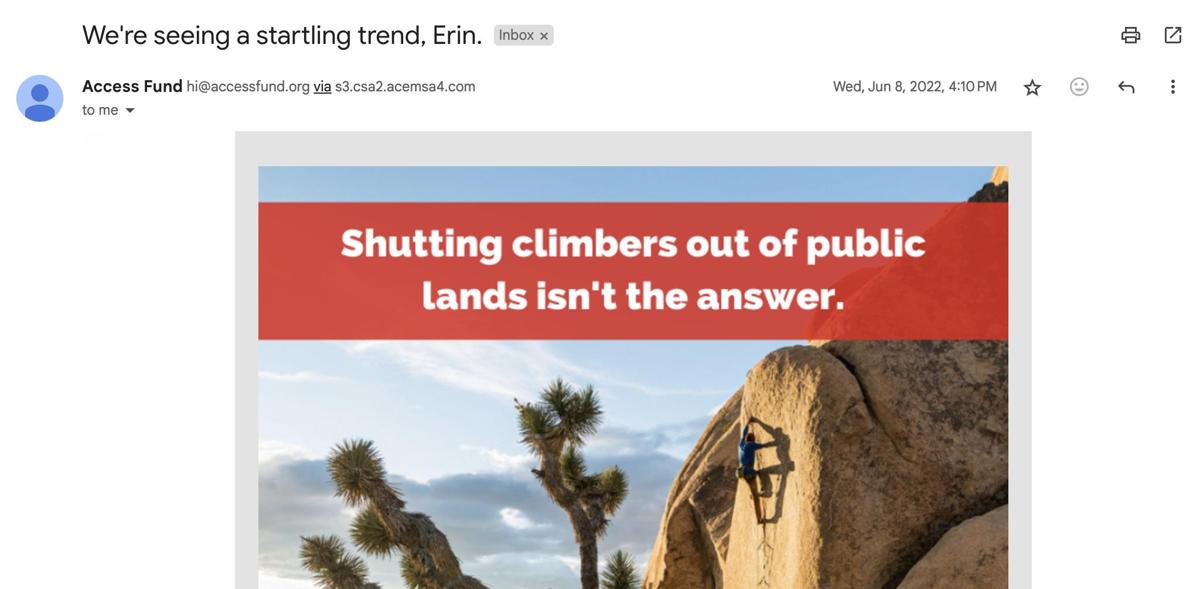
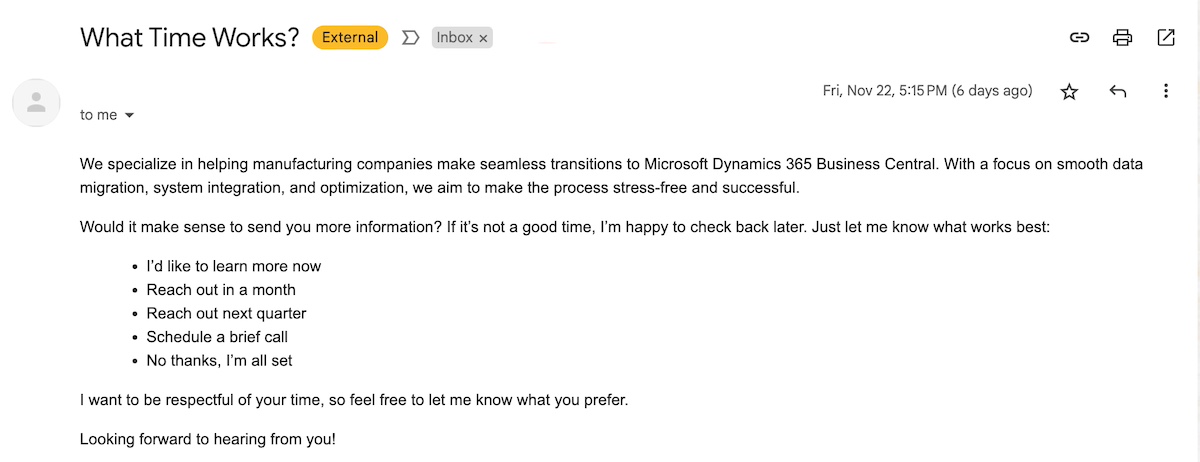
A newsletter is a form of communication sent to a specific audience via email. But what are newsletters used for? They serve to share updates, news, and valuable content catered to the recipients’ interests. Newsletters can be sent by anyone, but are most often used by organizations, businesses, and content creators to engage their audience, build relationships, and drive actions such as purchases.
The definition of an email newsletter

Newsletters can vary in style and content but are typically designed to be informative, engaging, and visually appealing. Whether sent weekly, monthly, or according to a specific schedule, they deliver value to the audience while supporting the sender’s objectives.

What Is the Purpose of a Newsletter?

We’ve covered what a newsletter is, but what’s its purpose? At its most basic, a newsletter aims to inform—to act as a line of communication between sender and subscriber. It might provide business updates, sale information, or product updates. 

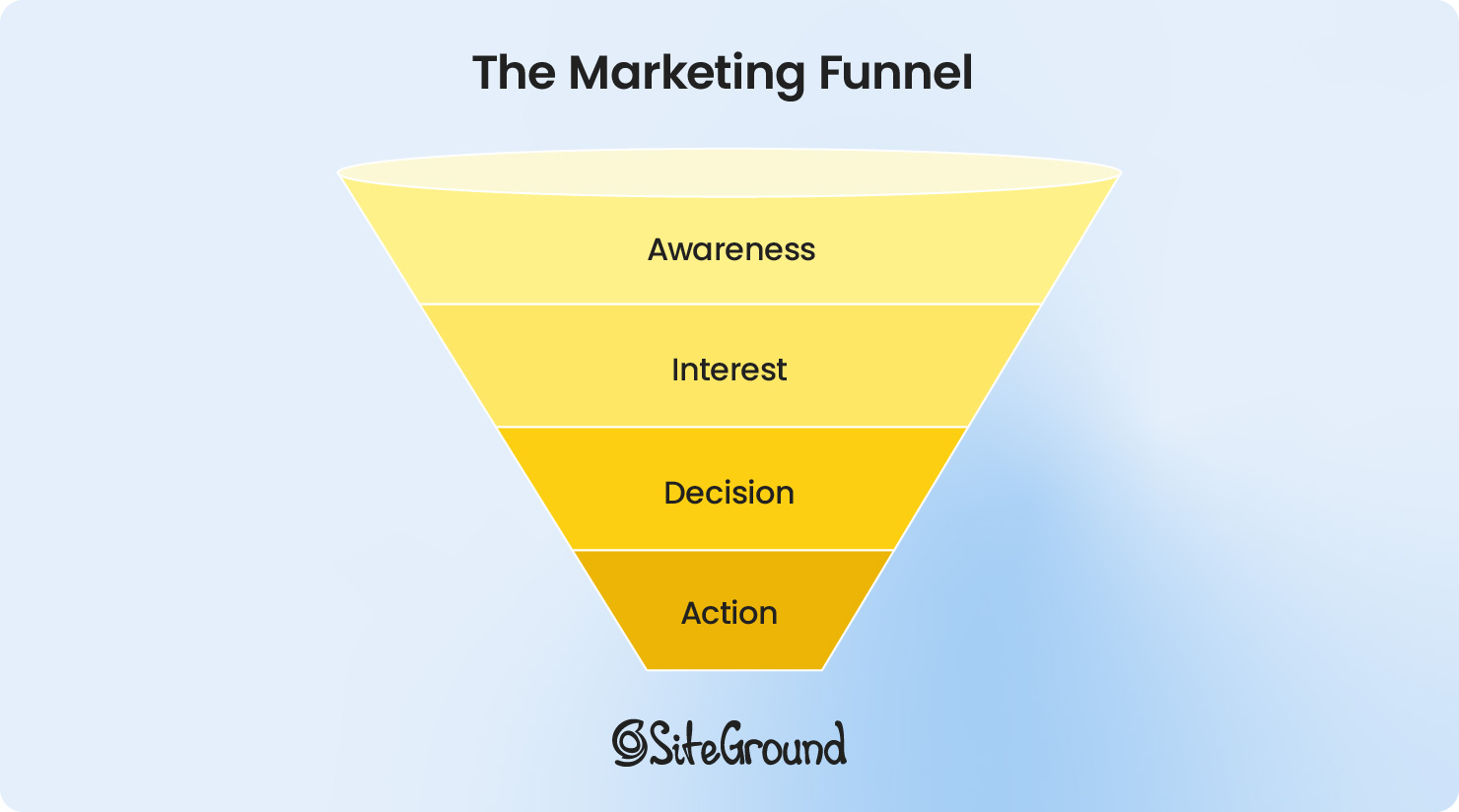
Its purpose is to do so much more than inform, though; it is the essence of what we call email marketing, and it’s one of the most important tools in your marketing toolbox. Not only does sending newsletters have an incredibly high return on investment, but doing so allows you to connect with your customers (often in a personal way), measure results, and ultimately drive conversions thanks to the ability to move your recipients through the funnel. 

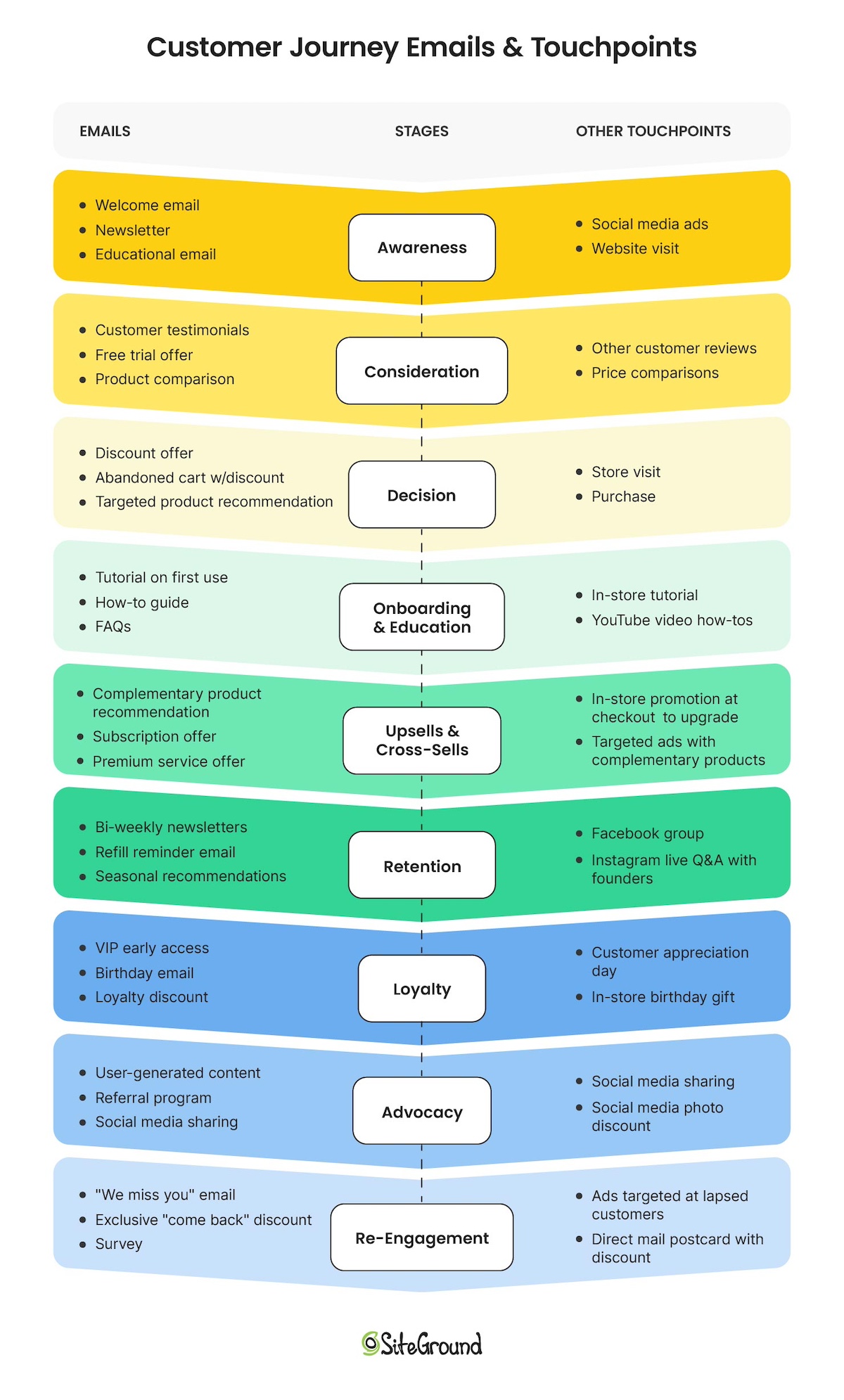
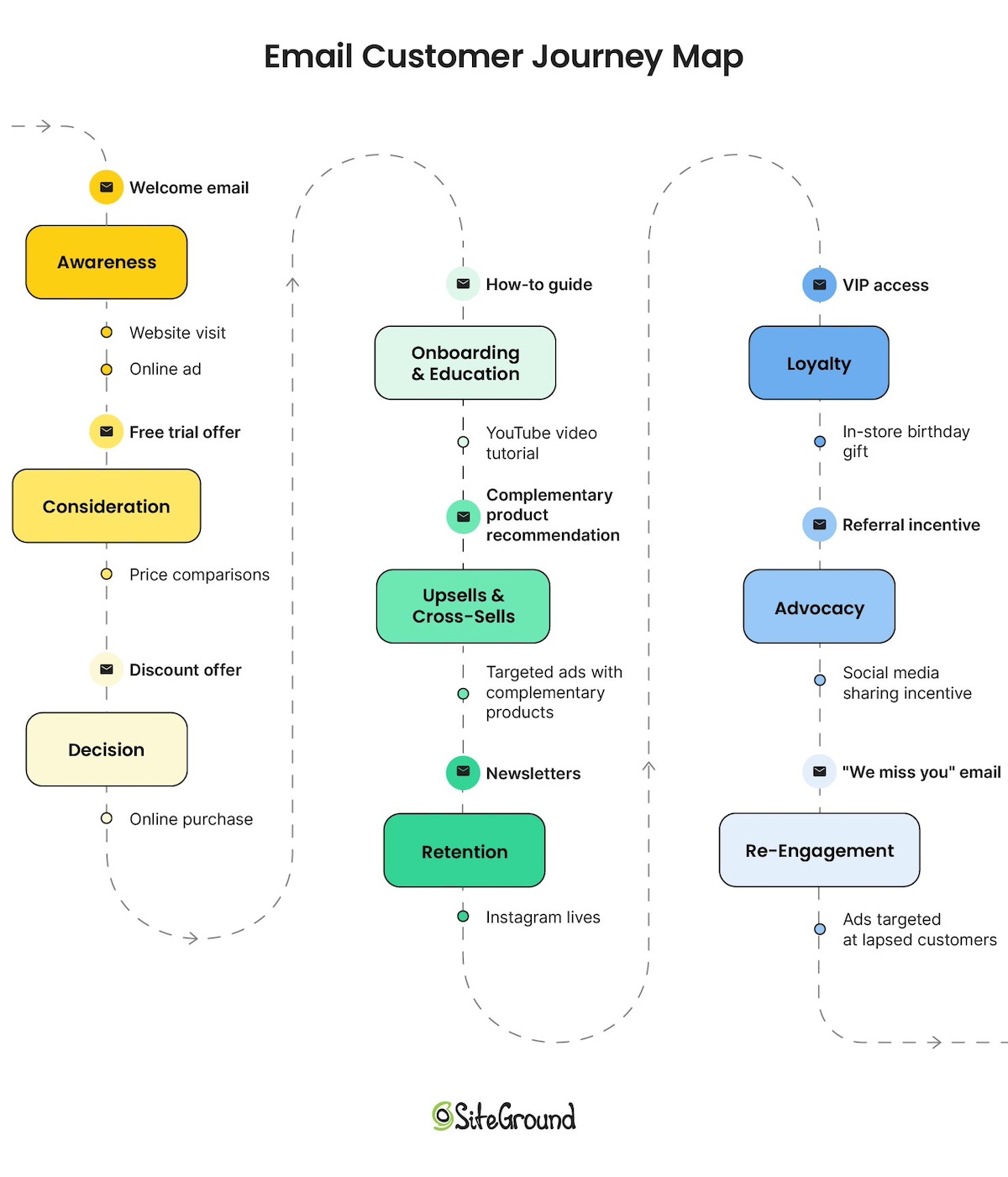
Indeed, when done properly, newsletters can strategically take their recipients on a journey, from awareness to decision, advocacy and more, turning curious new subscribers into long-lasting and loyal customers. Understanding how to use a newsletter to accomplish this is pretty powerful stuff! 

How to Create a Newsletter

Creating a simple, informative newsletter may not seem like rocket science, but there’s more to defining the art of email newsletter sending than might first meet the eye. And understanding the purpose behind this can make the difference between email production being a pain to do (with little success), and super easy and pleasurable to do (and with loads of success!). Let’s crack the code on creating a newsletter.

1. Choose an Email Marketing Platform

The first step in creating a newsletter is to select an email marketing platform. This platform serves as the foundation for designing and sending your emails, managing your subscriber list, and tracking your results—so choose thoughtfully! When evaluating options, consider the following features:

  • Ease of Use: Look for an intuitive interface that allows you to design emails and manage campaigns without a steep learning curve. Even better if the platform allows you to easily add lead-generation forms to your website so that you can collect emails. 
  • Customization Options: Verify that the platform offers a variety of templates and design tools so you can create emails that align with your brand identity and your messaging needs.
  • Automation Features: Email automation capabilities, such as scheduling emails and setting up the aforementioned customer journeys, can save time and improve efficiency.
  • Analytics and Reporting: To understand your email marketing success, or lack of success, it’ll be essential that your chosen platform has robust analytics tools. (We’ll dive in more below!) 
  • Compliance Friendly: Verify that the platform helps you comply with email regulations, such as GDPR and CAN-SPAM, to protect your reputation and avoid penalties. An example of this would be having unsubscribe options implemented by default. 
  • Scalability: Choose a platform that can grow with your needs, whether you’re managing a small list or scaling to thousands of subscribers. This means you should be able to get started for a reasonably low price, and only pay more as you grow. 

Having a competent, pleasurable-to-use email marketing tool will likely make the difference between you regularly sending your emails or not sending them at all. So take your time to pick carefully and make the right choice—it’s an important one!
Tap into email marketing success with SiteGround

2. Build a High-Quality Email List

Building a high-quality email list is truly the secret sauce to making your email endeavors effective. Without one, you may find that email open rates or click-through rates are low, or, worse, that your emails don’t even reach people’s inboxes in the first place.

The Importance of a High-Quality Email List

So first thing’s first: building an email list is about quality, not just quantity. Focusing on relevant, truly-interested subscribers helps augment your message’s impact. Meanwhile, sending emails to a broad, less-targeted audience can even harm your sender reputation (resulting in those undelivered emails), especially if recipients mark your emails as spam. By definition, this ultimately reduces your ability to reach genuinely interested people. So the goal here is to prioritize engaged and relevant contacts so that you can obtain the best results.

How to Ensure a High-Quality Email List

Right, so how to build a high-quality email list from the get go? Here are some general tips: 

  • Create a Clear Opt-In Process: Implement a double opt-in method to confirm subscribers’ interest and maintain list quality.
  • Keep Your List Fresh and Updated: Regularly clean your email list by removing inactive subscribers to enhance engagement rates. 
  • Avoid Purchasing Email Lists: Building your list organically means that you’re more likely to have subscribers that are genuinely interested in your content, leading to better engagement.
  • Provide an Easy Unsubscribe Option: Make it simple for subscribers to opt out, which helps maintain a positive brand image and complies with regulations.
  • Comply with Regulatory Standards: Speaking of regulations, adhere to laws like GDPR to build trust and avoid legal issues.
  • Offer Valuable Incentives: Encourage sign-ups by providing incentives such as exclusive content, discounts, or free resources.
  • Encourage Offline Sign-Ups: Collect email addresses during in-person events or at your physical store locations.
  • Host Webinars or Workshops: Offer educational sessions that require registration, allowing you to gather interested subscribers.

The truth is that these steps are easy to implement and make a meaningful difference, especially if you have a good email marketing platform in your corner. With just a little extra effort, you’ll see stronger engagement, higher open rates, and better overall results from your email newsletter campaigns. 

3. Create a Calendar

The importance of a proper content calendar can’t be understated. It helps you stay organized, maintain consistency, and align your email campaigns with your broader marketing objectives. Here’s how to create an effective calendar:

  • Identify Key Milestones and Dates: Start by marking important events on your calendar, such as product launches, seasonal promotions, or holidays. These dates will serve as anchors for your email campaigns.
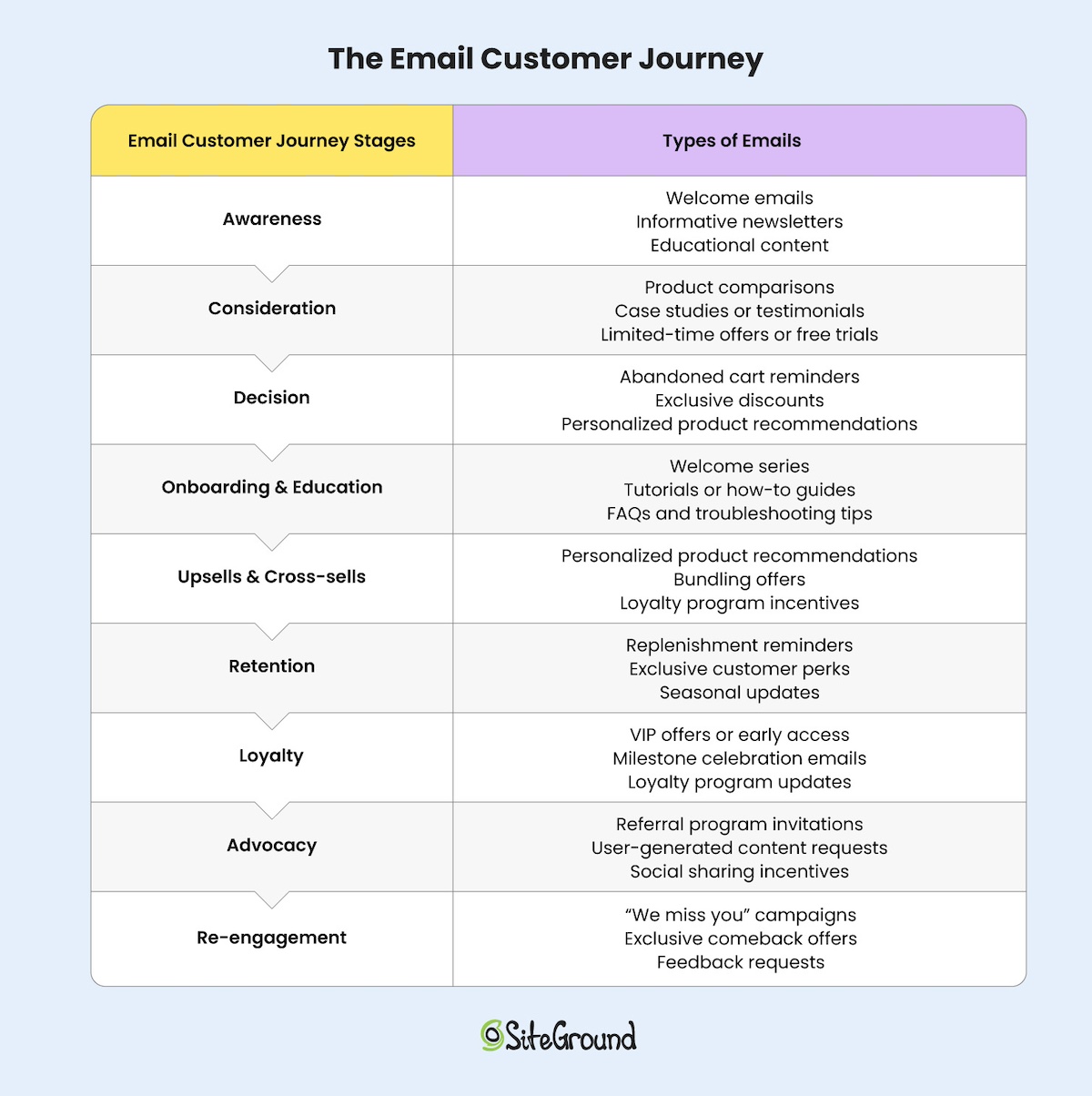
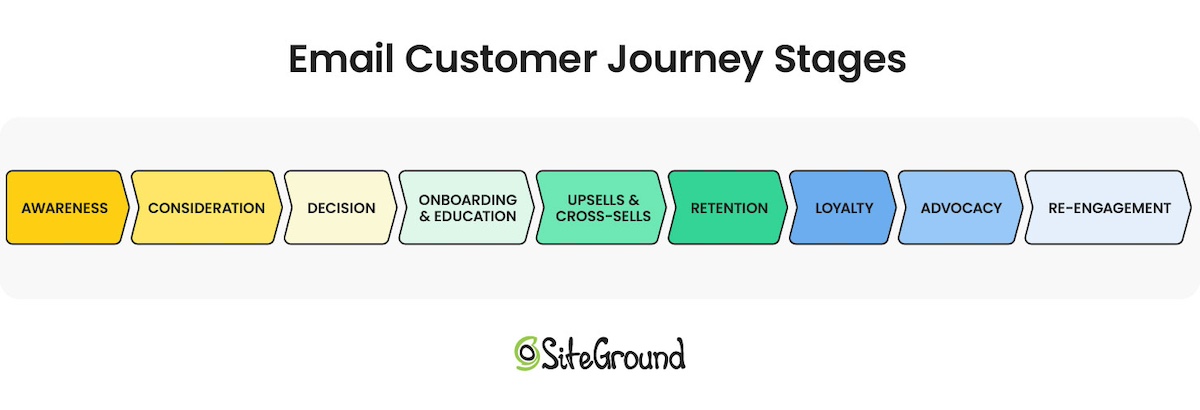
  • Align with the email customer journey: Map your email content to the various stages of the customer journey. For example:
    • Awareness Stage: Schedule welcome emails for new subscribers to introduce them to your brand.
    • Consideration Stage: Plan nurture emails that provide value through educational content, tips, or resources.
    • Decision Stage: Set up promotional emails to highlight discounts, special offers, or testimonials to encourage conversions.
    • Retention Stage: Schedule newsletters that keep your audience engaged with updates, exclusive deals, or loyalty rewards.
    • Advocacy Stage: Plan referral or shareable content to encourage subscribers to recommend your brand to others.
Email Newsletter Customer Journey Stages
  • Coordinate with Campaigns and Other Channels: Make sure your newsletter schedule integrates seamlessly with other marketing efforts, such as social media campaigns, blog posts, or ad campaigns. This consistency reinforces your messaging across all platforms.
  • Plan for Consistency: Decide on the frequency of your newsletters—whether weekly, biweekly, or monthly—and stick to it. Consistency helps build trust and keeps your audience engaged.

Creating a content calendar not only helps your newsletters be timely and relevant but also enables you to execute a thoughtful, well-structured email sequence that guides subscribers through their journey with your brand. Additionally, it helps keep you as the sender on top of where your customers are at, and what’s happening in your business, which promotes synergies across the board.

4. Develop Your Content

Now to the meat of the matter: newsletter content! It’s what will captivate your audience and get them engaging with your message—whether that’s as seemingly simple as opening your message, or as profitable as them making that much-desired purchase. Here’s a rundown on how to write and create email newsletter content that stands out, from subject line to sale: 
Measuring your email marketing metrics
  • Craft Compelling Subject Lines: Your email subject line is the first thing your subscribers will see, so make it count. Keep it short, intriguing, and relevant. Use action-oriented language or highlight a benefit to entice readers to open the email.
  • Focus on Audience Value: Write and deliver content that resonates with your audience’s interests and needs. This could mean how-to guides, industry insights, exclusive offers, or inspirational stories that align with your brand’s mission. Matching this up with your email customer journey will help keep your content fresh, and your customers moving through your funnel. To spark ideas, explore various newsletter examples that highlight effective ways to connect with your audience and meet your goals.
  • Implement Personalization: As one of the top digital marketing trends, personalization is one of the most important components of email marketing. Use segmentation and personalization techniques to purposefully create content for specific subscriber groups. Do this by grouping subscribers based on purchase behavior, email interaction, or any other criteria you wish to identify—and then send custom messages accordingly. Addressing a defined audience’s unique preferences and challenges can significantly increase engagement rates.
  • Incorporate Strong CTAs: Every newsletter should have a clear call to action (CTA). Whether you want readers to click through to your website, make a purchase, or register for an event, your CTA should be prominently placed and easy to follow. Write them using action verbs, and create a sense of urgency when appropriate.
  • Keep It Visually Engaging: Use design elements such as images, infographics, videos, or even email colors to break up text and keep the email visually appealing. Your visuals should complement the message without overshadowing it.
  • Stay Consistent With Your Branding: Ensure that your tone, style, and visuals align with your brand identity. Consistency helps your audience recognize your emails and reinforces your brand message.

Developing high-quality content takes effort, but at the end of the day, it’s what keeps your subscribers coming back for more. So don’t drop the ball here—make your words, design, and calls to action count.

5. Schedule Your Newsletters

You’ve got an email list, a calendar, and some killer content—now it just needs to get sent! While you could go the old-fashioned route and just hit send straight away, we advise a more strategic approach. But let’s discuss a bit more in depth.  

Send It Now or Schedule for Later

Timing matters. Depending on your audience, certain days or times may yield higher open rates and engagement. Research your subscribers’ habits or test different sending times to find what works best. Either way, lean on your email marketing platform so that you can schedule your send for the best day and time.

Create an Email Sequence

Instead of a single email blast, consider crafting an automated email sequence. As we’ve already touched on, sequences guide subscribers through a journey—whether it’s onboarding, nurturing leads, or promoting a product launch—all while building a stronger relationship with your audience. Tools for email automation let you define and set triggers for sending emails, ensuring content reaches subscribers at the most opportune moments. This helps move them along the path to conversion and loyalty. 
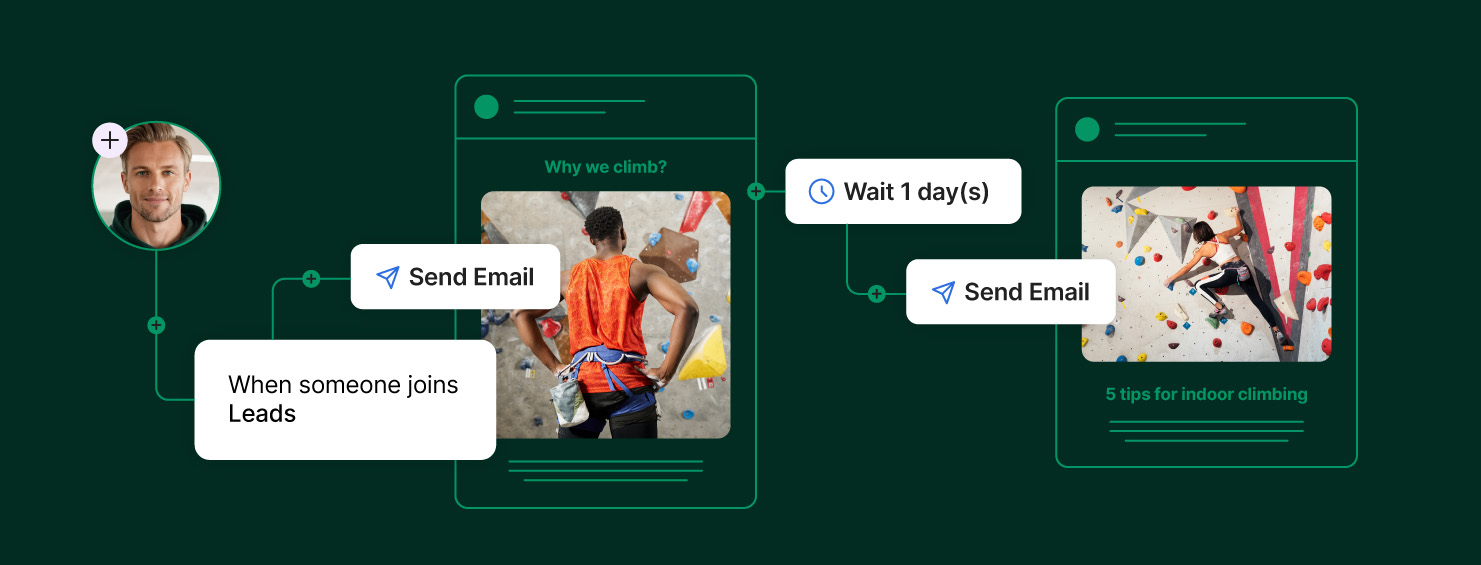
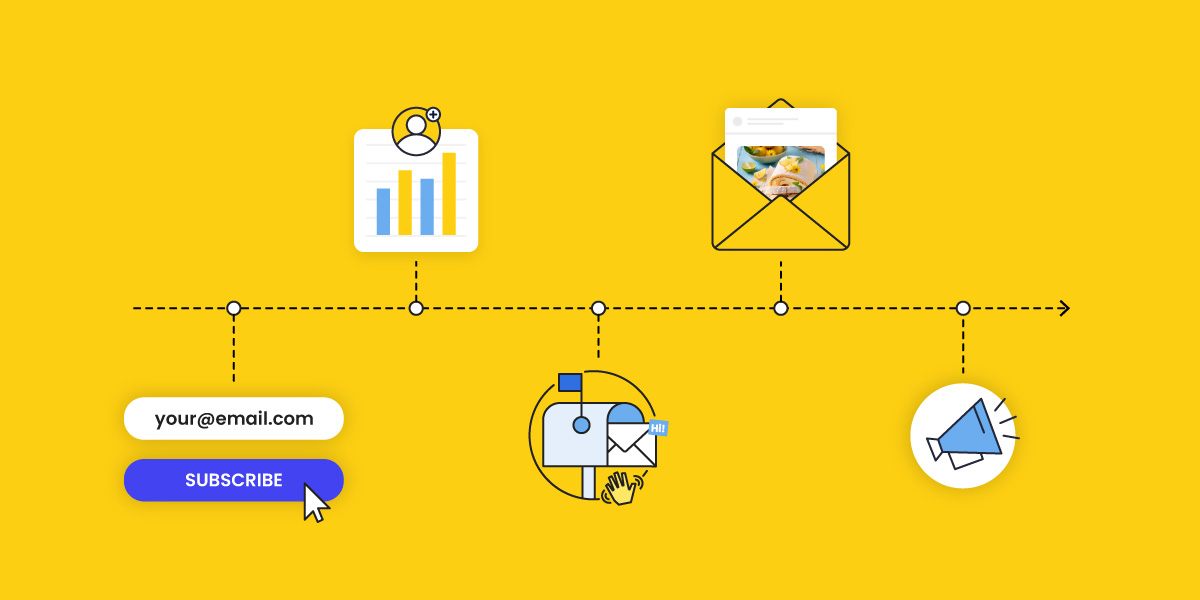
Email newsletter sequence diagram

6. Measure Success and Fine Tune

As we touched on earlier, when it comes to email marketing, the ability to measure your success—or lack thereof—is absolutely mission critical. We’re talking metrics, benchmarks, testing, tweaking, and more.
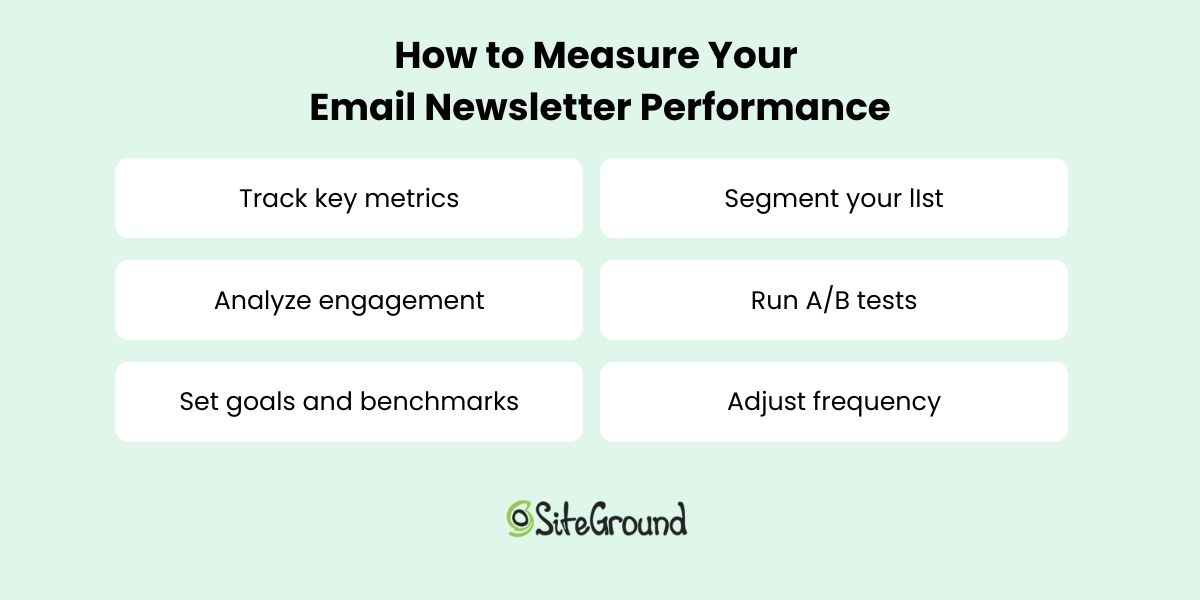
How to measure your email newsletter performance
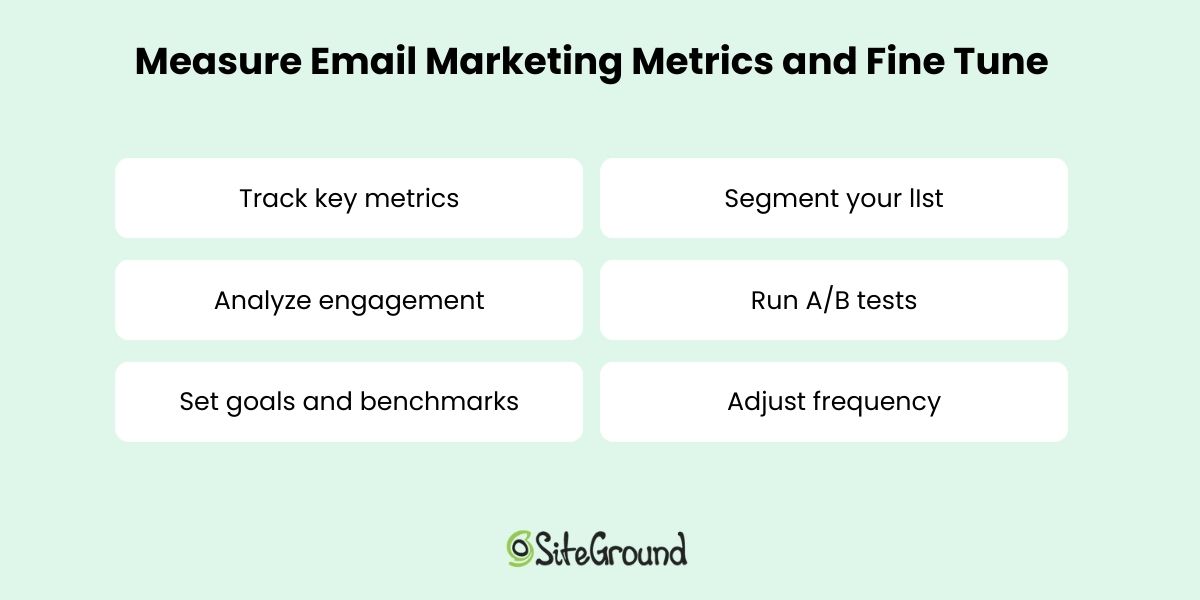
  1. Track Key Metrics: Monitor key email marketing metrics like open rates, click-through rates (CTR), bounce rates, and conversion rates to evaluate how well your campaigns are performing. For example, if certain emails have a higher open rate than others, examine their subject lines to figure out what you could improve.
  2. Analyze Engagement: Evaluate how recipients interact with your content, adjusting subject lines and CTAs based on these insights.
  3. Set Goals and Benchmarks: Establish and define clear, measurable objectives for your email campaigns (like, say, a 10% increase in CTR within three months) and compare your results against industry benchmarks or your past performance.
  4. Segment Your List: Use the data you gather to segment your audience further. For example, group subscribers based on behavior, demographics, or preferences to send more tailored and relevant content.
  5. Run A/B Testing: Experiment with different elements of your emails, such as subject lines, call-to-action buttons, design, and content, to see what works best. To do this, choose one element to test, such as the CTA, and send one email with one CTA and the other with another. Analyze the results, and modify future sends accordingly.
  6. Adjust Frequency: If your unsubscribe rate is high, consider whether you’re sending too many or too few emails. Test different frequencies to find the sweet spot for your audience.

The beauty of newsletters is that they are dynamic—if you test, track, and tweak, your results can continually improve. So keep a close eye on your metrics and don’t be afraid to try and test new techniques. 

What Is a Newsletter: Wrapping Up the Essentials

That’s a wrap on the humble newsletter. Whether you’re crafting captivating subject lines, building relationships through purposeful content, or leveraging analytics to fine-tune your strategy, newsletters are the unsung heroes of marketing. So next time you’re sifting through your inbox, give all those messages a second glance—you might just find a little inspiration for your own campaigns. 

Get your email newsletter sending off to the right start with SiteGround Email Marketing. It’s incredibly user friendly and easy to get going, offers robust features—such as email automation, segmentation, a built-in AI writer, and an intuitive builder—and all at a super accessible price. 

Start sending email newsletters now>>

This article was originally published in August 2020 and updated in February 2025.
Product Launch Email Must-Knows + Examples & Free Templates

Product-Launch-Email

You’ve gone to all the work to launch that much-desired new product, and now it’s time to build some excitement and make the big announcement to all your email subscribers. The secret to nailing it? A killer product launch email campaign that gets people buzzing, clicking, and buying.

In this guide, we’ll take you through everything you need to know to craft product launch emails that captivate and convert. From structuring your email sequence like a pro to tips for writing copy that packs a punch, we’ve got you covered. Plus, we’re throwing in examples and product launch email templates to inspire your creativity. Let’s make your launch a success!

[17]

What is a Product Launch Email?

A product launch email is a targeted marketing message sent to your audience to introduce a new product or service. While the basics of a product launch email might seem like they need little explanation, their success—or lack thereof—is more nuanced: these emails aim to inform, excite, and persuade your recipients, whether they’re loyal customers, prospects, or potential partners. 

The goal is to generate buzz and drive action, such as visiting your website, signing up for updates, or making a pre-order or purchase. And it’s not as simple as just sending one single email; it’s about having a thoughtful plan to build anticipation, announce your launch, and follow through. 

SiteGround-Email-Marketing

What is a Product Launch Email Sequence?

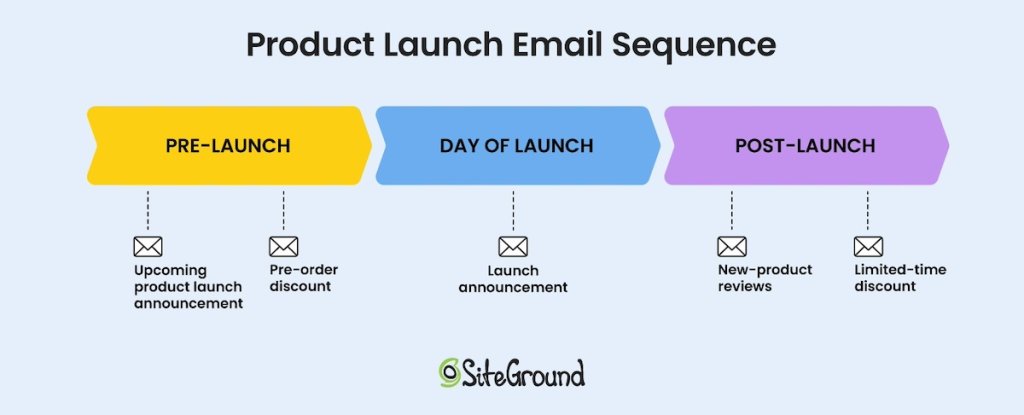
That’s right: the best product launch email is one that forms part of a proper sequence. A product launch email sequence is a series of emails designed to guide your audience through an email customer journey, from pre-launch emails that build anticipation, to day-of launch emails with the official new product announcement, and post-launch follow-ups that keep the momentum going. This approach helps you maintain consistent communication and it keeps your audience engaged at every stage of the process. 

Let’s examine the types of emails for each step of the way.

Product-Launch-Email-Sequence

Pre-Launch Emails & Examples

Pre-launch emails are sent before the official launch in order to build anticipation and curiosity. These emails might include teasers, sneak peeks, or countdowns to the big day. Given that a product launch is an event of sorts, leverage the build up to create buzz in all the ways possible.

There are heaps of ways you can get this done via your email marketing, whether it’s simply announcing the launch ahead of time, or getting more creative and coming up with contests or collaborations around the occasion. With that in mind, here are some best practices when it comes to your pre-launch emails. 

Best Practices for Pre-Launch Emails

  • Announce the new product or service
  • Share exclusive details or behind-the-scenes content
  • Highlight the benefits your product will offer
  • Use countdown timers or event reminders to create urgency
  • Offer pre-launch and/or pre-order sign-ups
  • Implement a pre-launch discount
  • Run contests, giveaways or promotions around build up to the launch
  • Collaborate with other brands or influencers

When to Send Pre-Launch Emails

While this may depend on the scope of your product launch (launching a new car model is quite different from launching a new bath soap), most products probably only require a few weeks heads up. That is, if you’re running a contest or pre-order promotion, you might want to send a few emails over the course of several weeks. Whereas if you’re just simply teasing the launch, with no extra bells and whistles, one email a week in advance may do the trick. Stay on top of your email marketing metrics so that you can see what’s working and not working, and then optimize for your following sends.

Pre-Launch Email Examples

What better way to come up with pre-launch email ideas than to examine those that have done the job well. So let’s dive into some real-world new product launch email examples that have worked.

product-launch-email- example-skims-pre-launch

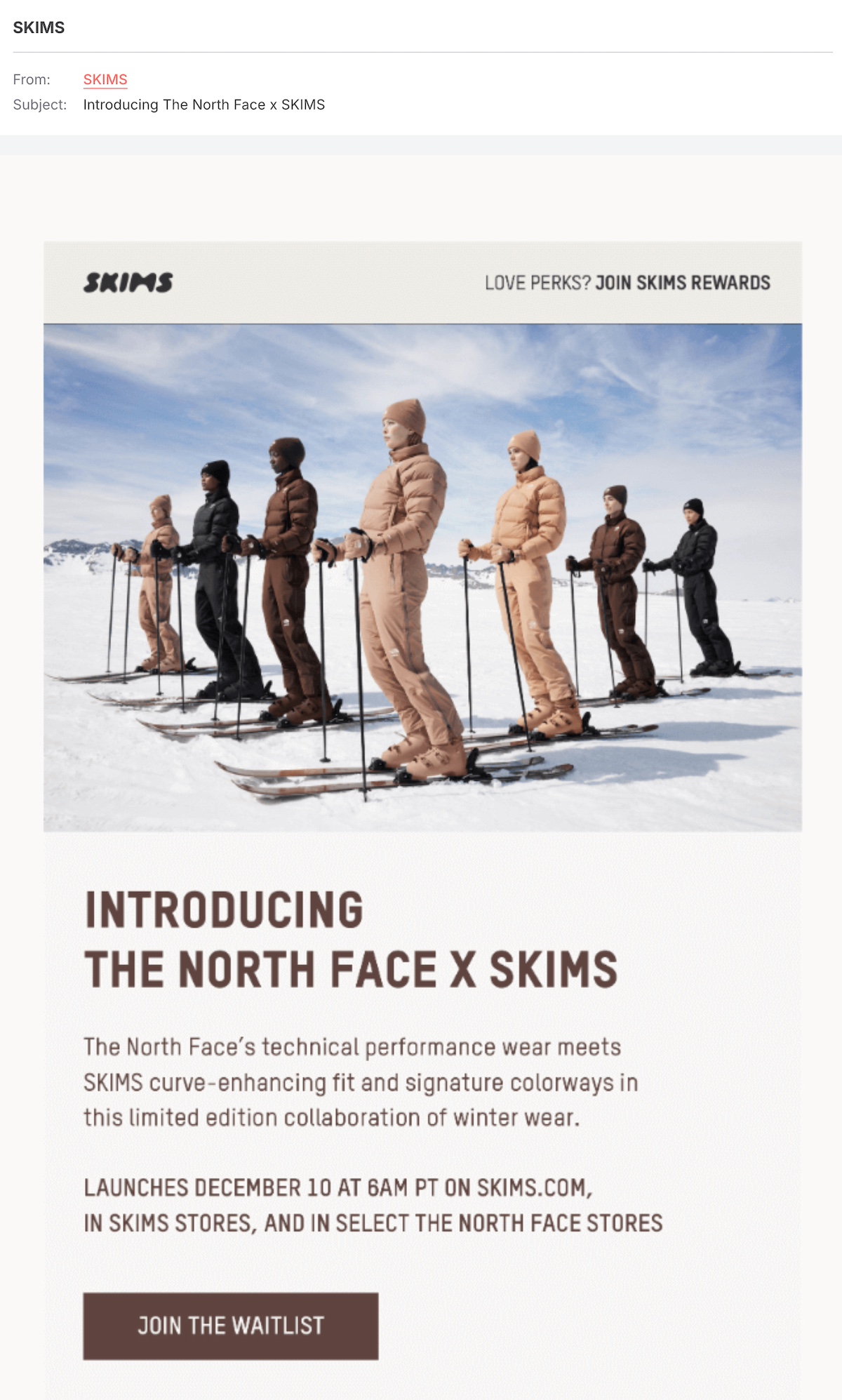
The above email builds excitement around the launch of a new-product collaboration. It not only gives all the necessary details—when the launch will happen, and where—but also product features (colorways and fit), and gives followers the opportunity to join the waitlist. So while sales can’t actually happen until the launch, Skims is able to move customers along in their journey.

product-launch-email-example-karst-pre-launch

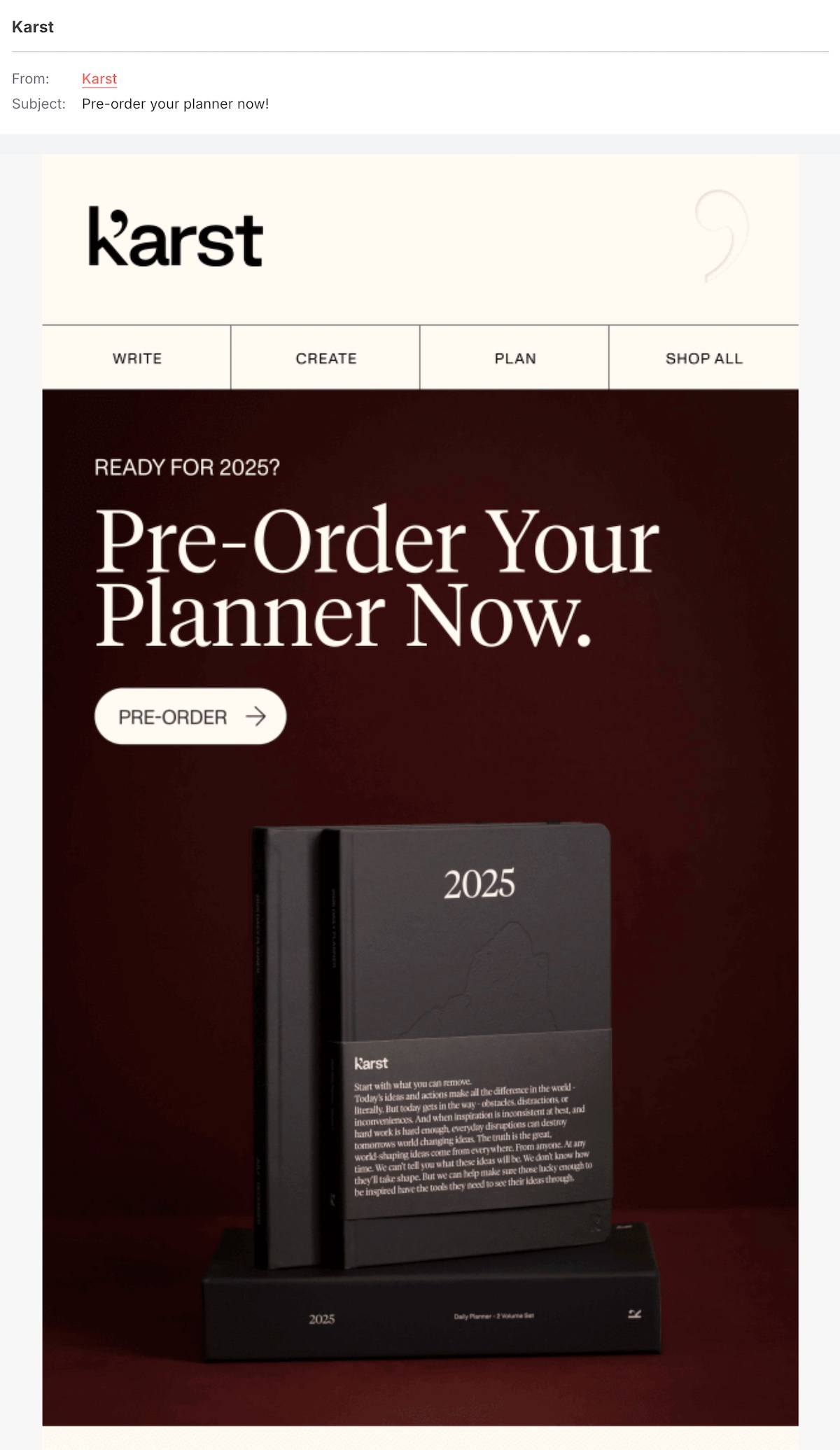
Karst leverages new-year energy to promote its soon-to-launch planner. More than just a new product announcement, it allows recipients to pre-order the planner, thus capitalizing on the pre-launch hype in order to start making sales.

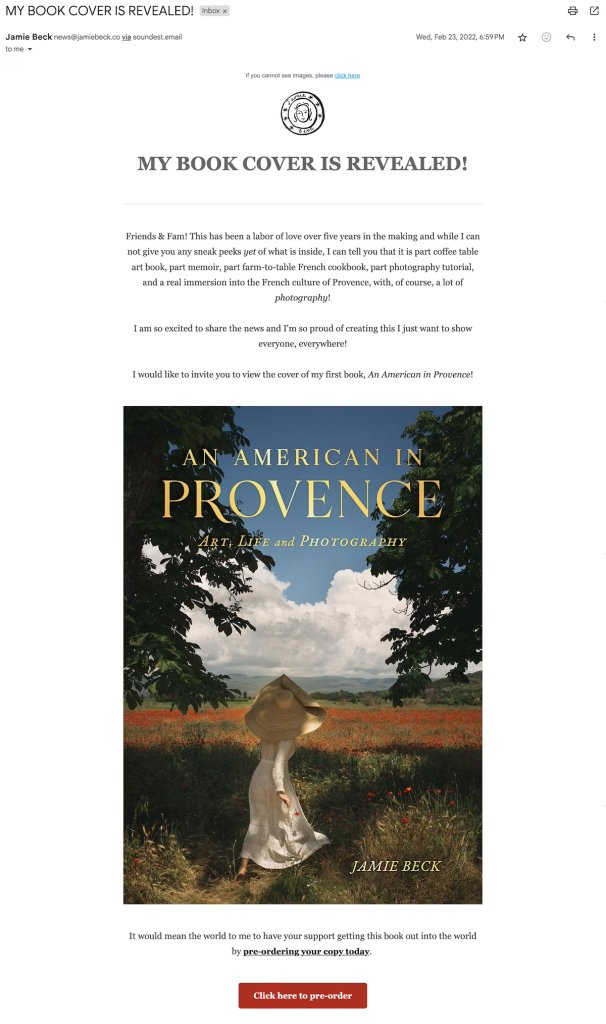
product-launch-email-example-pre-launch-jamie beck

In the above new product launch email example, recipients are given a sneak peak of the cover of the soon-to-launch book. The message employs personal and sincere language to start generating pre-orders before the book is even out. 

Day-Of Product Launch Emails & Examples

The day of the launch is when your emails shift to showcasing the product in its full glory. These emails should deliver a clear and enthusiastic message, emphasizing the value and unique features of the product while driving immediate action. Let’s examine what you might consider including.

Best Practices for Day-Of Product Launch Emails

  • Include bold visuals and product highlights
  • Provide a link to purchase, sign up, or learn more
  • Offer special launch-day discounts or bonuses
  • Create a sense of urgency with limited-time offers or stock warnings
  • Build and deliver on pre-launch efforts (did you run a contest? How about a giveaway or collaboration? Continue to leverage the hype, but also deliver on any promises)

When to Send Day-Of Product Launch Emails

This probably sounds like a silly question because the answer should seem obvious: the day of, right!? Well, yes, this is true. But like any other email blast, you’ll want to maximize sending time. That means sending out your email first thing in the morning, during your earliest customer time zone. You might also wish to align your product launch with a day of the week that is best for email sending. That is, send on a Tuesday, and avoid sending on a Friday or weekend when folks aren’t focused on their email inboxes. 

Day-Of Product Launch Email Examples

Need some day-of inspiration? Here are some product launch email examples to give you ideas.

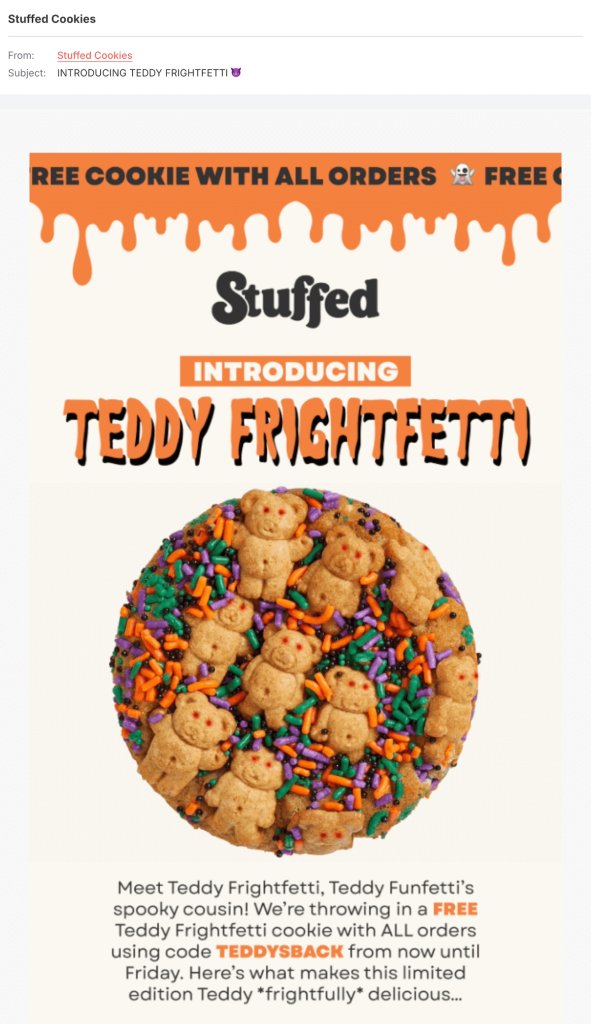
product-launch-email-example-day-of-launch-stuffed cookies

Tasty and festive visuals do a solid job of capturing recipient attention, and then a promotion for a free cookie for a limited time leverages that sense of urgency coupled with a discount. Colorful cookies are hard to resist, but a free colorful cookie is even harder to say no to.

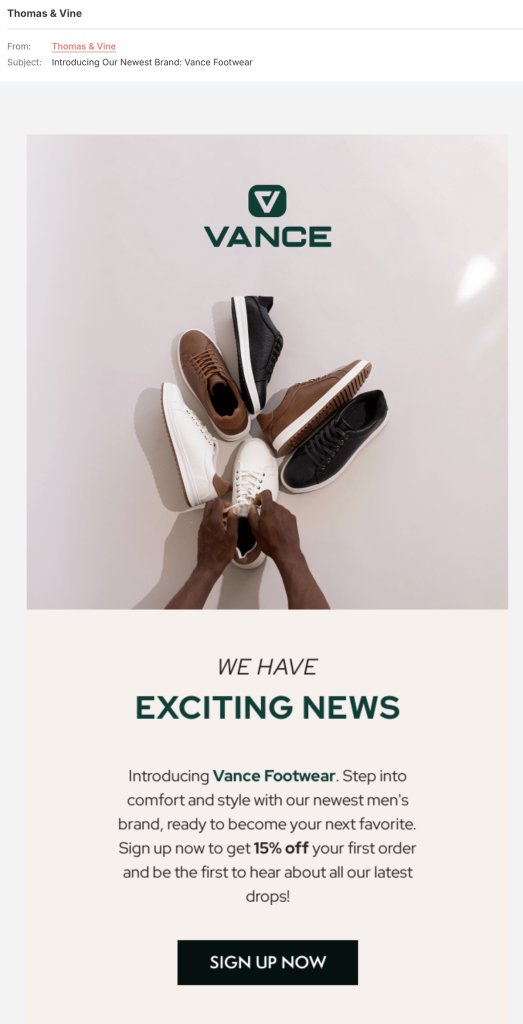
product-launch-email example-day-of-launch-Thomas-Vine

In the above email, Thomas & Vine launches its new footwear, and makes the offer more enticing with a discount. They’re also using this opportunity to encourage people to sign up so that they can receive more similar updates about new releases, thus closing this deal, and planting seeds for future ones.

product-launch-example-day-of-launch-colorverse

When it comes to bold and catchy visuals, Colorverse surely wins. The above effectively captures attention with a colorful email that seals the deal by clearly and attractively communicating product features and benefits. 

Post-Launch Emails & Examples

Post-launch emails focus on maintaining momentum after the initial new product announcement. They’re an opportunity to engage customers who haven’t yet acted, provide social proof, and encourage feedback or reviews. These emails are a great way to finally get that sale, and close the loop on the product launch process, setting the stage for future sales.

Best Practices for Post-Launch Emails

  • Share testimonials or early reviews
  • Highlight additional features or use cases
  • Thank your audience for their support
  • Encourage referrals or social sharing
  • Close the loop on any launch events, collaborations, etc. 

When to Send Post-Launch Emails

Post-launch emails can be sent during the weeks following your launch. For example, you might send one a week after launch, then another a couple weeks later. Perhaps one could highlight testimonials, and then another could offer an additional limited-time discount.

Post-Launch Email Examples

Post-launch emails require a little extra touch—a delicate balance between keeping the excitement alive, but not overdoing the new product announcement. So this is when you’ll need to get creative about how you keep the conversation going. Check out these examples for some ideas. 

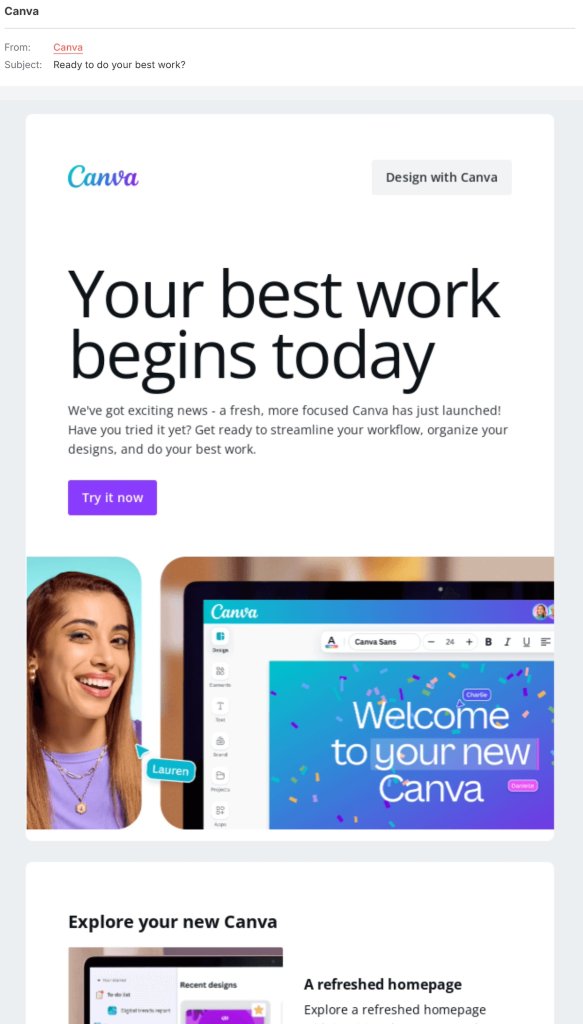
product-launch-email-example-post-launch-canva

Canva’s announcement above is essentially a re-announcement of the launch. It retells all the product features and benefits, but adds a cheeky “have you tried it?” since this product was previously launched. This is a creative and smart way to extend the launch announcement, capturing the attention of those who might not have purchased yet, or who perhaps missed the announcement altogether.

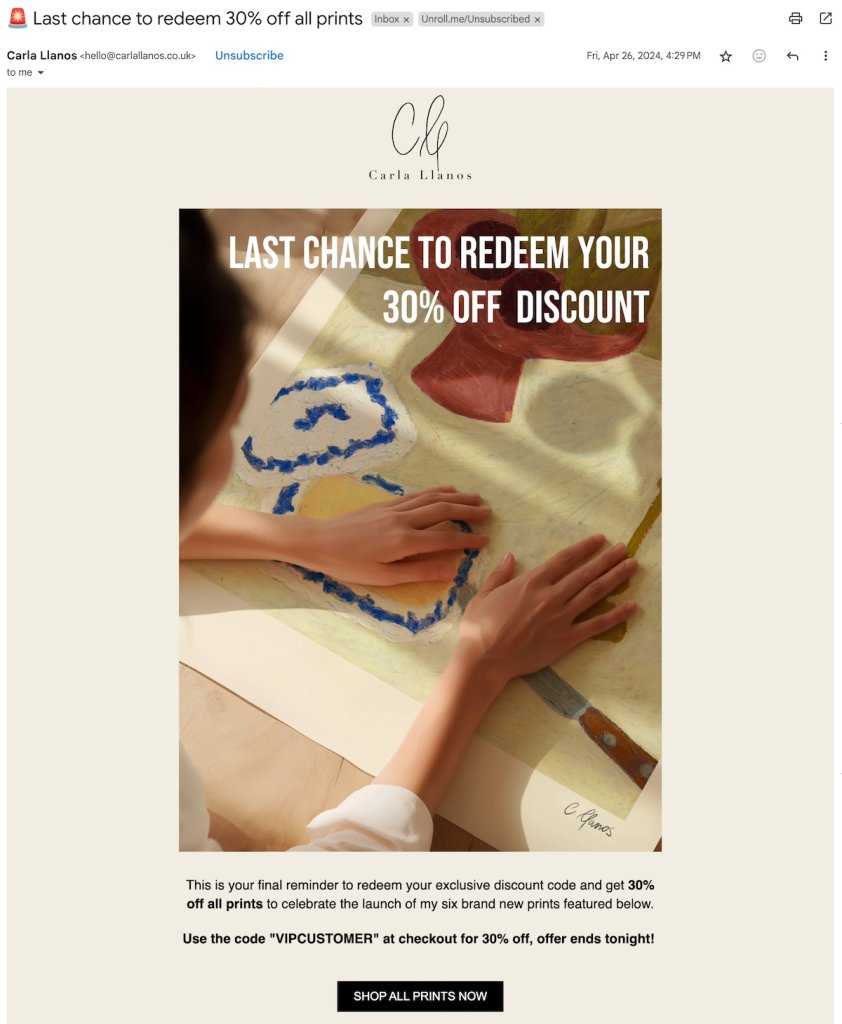
product-launch-email-example-post-launch-carla-llanos

This artist is using her launch as an opportunity to generate continued buzz. In this new product launch email example, she’s offering an extra discount, and highlights that it’s for valued customers.

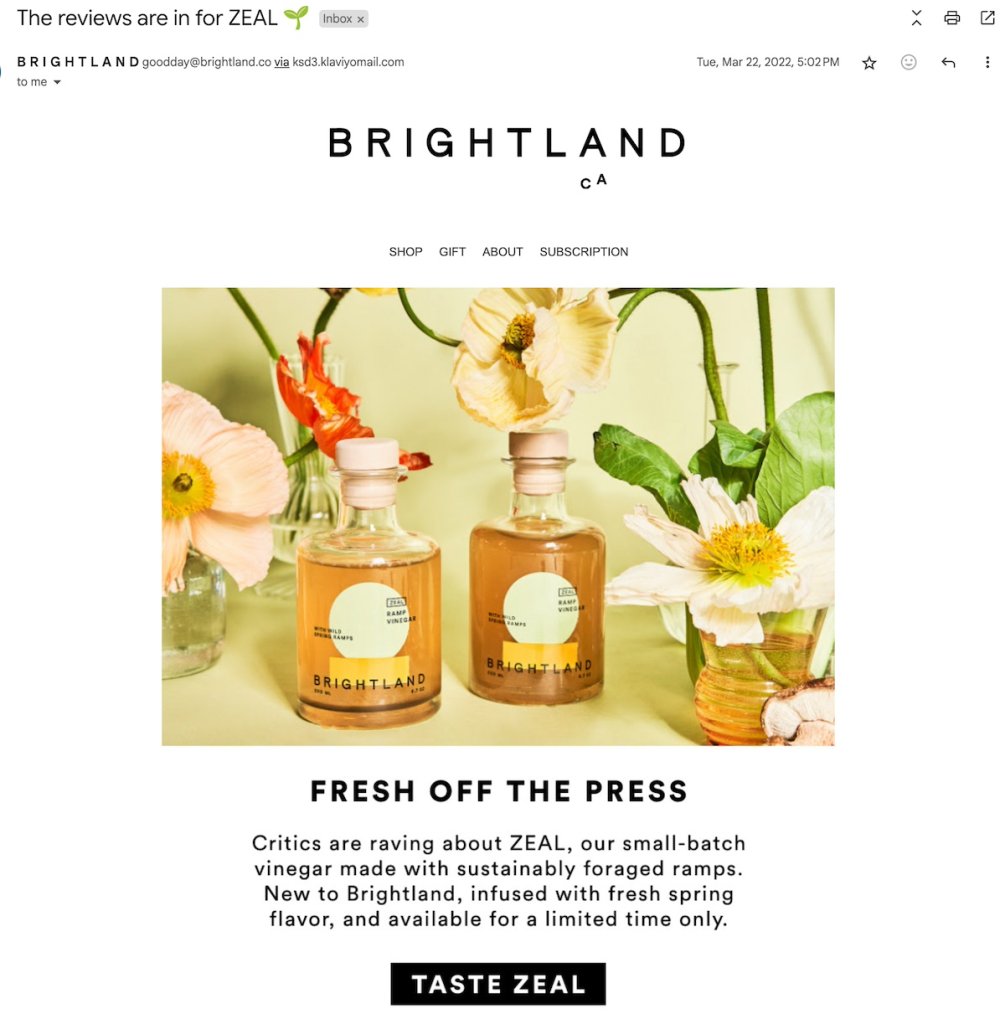
product-launch-email-example-post-launch-brightland

The above new product announcement revisits the launch by mentioning that the “reviews are in.” As such, the seller not only provides social proof (in the way of reviews) but can freshly talk about the launch, and therefore generate more sales.

The above new product announcement revisits the launch by mentioning that the “reviews are in.” As such, the seller not only provides social proof (in the way of reviews) but can freshly talk about the launch, and therefore generate more sales.

How to Write a Product Launch Email

Alright, now you’ve got some fresh inspiration for what you’d like to send. Maybe you’ve even started plotting out your email automation sequence. So it’s time to get down to the business of actually writing marketing emails for your product launch. Here’s how to nail each element for maximum impact:

1. Start with a Strong Subject Line

Your product launch emails aren’t just about the content within them; you need to get them opened in the first place. Indeed, your email subject line is the first impression your email makes, and it determines whether recipients will open it. A strong subject line should grab attention and immediately communicate the value of your product. Here’s what to keep in mind:

  • Use action words or power phrases to create urgency, such as “Don’t Miss This!” or “Just Launched!”
  • Include personalization if possible, like the recipient’s name or location.
  • Spark curiosity with phrases like “Your Next Must-Have is Here” or “We’ve Been Working on Something Big…”
  • Keep it short and punchy—best to aim for using 50 characters or less

2. Hook Your Audience Immediately

Once recipients open your email, the first line needs to hold their attention. This hook sets the tone for the rest of the email and should align with your subject line. Consider the following:

  • Use an attention-grabbing announcement, such as “The wait is finally over!”
  • Pose a question that resonates with your audience, like “Ready to revolutionize your workflow?”
  • Share a compelling stat or story related to your product.
  • Speak directly to your audience’s desires or challenges: “Looking for the perfect travel companion?”

3. Focus on Benefits

While it’s important to share details about your product, your audience cares most about how it will improve their lives. Shift the focus from features to benefits, explaining what makes your product valuable and unique. Here are some ways you can do this:

  • Translate technical features into real-world advantages. For example, instead of saying “10-hour battery life,” say “Stay connected all day without worrying about recharging.”
  • Address pain points your audience experiences and explain how your product solves them.
  • Use customer-focused language like “you” and “your” to make the benefits feel personal.

4. Include a Clear Call to Action (CTA)

Your email should always have a clear and compelling next step for the recipient to take. A strong CTA ensures they know exactly what to do after reading your email. Here a handful of tips when it comes to creating an effective CTA:

  • Use action-oriented phrases like “Shop Now,” “Learn More,” or “Sign Up Today.”
  • Make the CTA button stand out with bold colors and clear text.
  • Limit the email to one or two CTAs to avoid overwhelming the reader.
  • Include a sense of urgency if you’re offering a promotion: “Order now—offer ends soon!”

5. Keep It Visually Appealing
Email marketing design is just as important as the content. An attractive, well-structured email makes your message more engaging and easier to read. Design best practices you’ll want to keep in mind include:
  • Use high-quality images or videos that showcase your product. For example, a sleek photo of your new product in use can speak volumes.
  • Stick to a clean layout with plenty of white space to improve readability.
  • Ensure consistent branding throughout when it comes to logo, colors, and fonts
  • Make your email mobile-friendly since many users will view it on their phones.

By following these steps, you’ll create a new product launch email that not only informs but also piques your audience’s interest and motivates them to take action.

Maybe you’re not in the mood to write your email from scratch, though. Because we’re here to make your email sending as easy as possible, we’re providing you with a bonus list of free product launch email templates for each stage of your launch. Simply download the templates, copy and paste the product launch message examples, and make them your own by adding your details, or by modifying them to meet your unique needs.

Closing Thoughts on Product Launch Emails 

Launching a product is like throwing a big party (in this case, virtually!)—you want everyone buzzing with enthusiasm and eager to join in. With the right email strategy, you can build anticipation, steal the show on launch day, and keep the energy going long after the confetti has settled. Think of each product launch email as an invitation to the celebration: entice them, wow them, and leave them wanting more. 

Not sure where or how to get started? SiteGround Email Marketing makes getting going ultra easy thanks to attractive email marketing templates, audience segmentation, email automation, robust analytics, and a user interface that’s a breeze to use. Start your email marketing journey with SiteGround today.

email-marketing-course-for-beginners

What Is a Transactional Email and Why Send One? (+ Examples)

transactional email in the middle and icons around it

Email is the cornerstone of communication between businesses and their customers. Among the millions of emails sent daily, transactional emails stand out as essential tools for delivering timely and pertinent information. But what exactly constitutes a transactional email, and why are they so important for your business?

In this blog post, we will unravel the concept of transactional emails, exploring their definition and significance in the business landscape. We’ll guide you through the nuances of crafting impactful messaging and design, having your emails not only reach your audience but resonate with them. 

We’ll also delve into various types of transactional emails, from confirmation and welcome emails to cart abandonment and feedback requests, providing you with practical examples and best practices.

Transactional Email Definition

Transactional emails are automated messages sent to individuals based on specific actions or interactions they have with your business or platform. They are triggered by user behavior and are intended to provide essential information that the recipient needs or expects.

These emails are often initiated by a transaction or event, such as a purchase, subscription, or account update. Their primary purpose is to facilitate an ongoing process or transaction, ensuring that the user is informed and alert at every step. This makes them a vital component of customer communication, as they deliver content directly to the user’s inbox.

Some common characteristics of transactional emails include:

  • Timeliness – they are sent immediately or shortly after a triggering event, and deliver information promptly.
  • Personalization – they often contain personalized details, such as the recipient’s name, order details, or account information, enriching the user’s experience.
  • High open rates – due to their relevance and necessity, transactional emails typically have higher open rates compared to promotional emails.
  • Regulatory compliance – they are generally exempt from anti-spam regulations like CAN-SPAM in the U.S., and GDPR in Europe, as they are not considered marketing emails.

The Importance of Transactional Emails

Regular and reliable communication through transactional emails helps build trust with your customers. When users receive timely updates on their transactions, they are more likely to view your business as dependable and customer-focused.

Even though the primary focus of transactional emails is to convey essential information, they also present subtle opportunities for cross-selling or upselling. Including related product recommendations or special offers can add value without overshadowing the main message.

Transactional emails are not just a means of communication but a strategic asset that can improve customer satisfaction and loyalty. With that in mind, businesses can leverage  transactional email tools to optimize their email strategy, making sure that every interaction is meaningful and impactful.

Crafting Transactional Email Messaging

With the perfect transactional messaging you can not only deliver information, but also engage your audience and reinforce your brand. 

Here’s a guide on how to write a transactional email that resonates with your recipients:

Subject line writing techniques

The email subject line is the first impression your message makes, and it determines whether your email gets opened or not. To make it impressive enough to get the job done, here are a few rules to follow:

  • Be clear and concise when conveying the purpose of your email. For example: “Hooray, your Blue Bottle order is confirmed!” leaves no room for ambiguity.
  • Include personalization by using the recipient’s name or referencing their specific transaction to increase open rates. For instance: “Jane Davis, verify your email address with Eventbrite” adds a personal touch.
  • Highlight urgency (if necessary) when the email contains time-sensitive information, such as a password reset: “Reset your password before it expires.”

Body content writing techniques

Once the email is opened, the body content must communicate the necessary information while maintaining clarity and engagement:

  • Start with a friendly greeting by personalizing the opening with the recipient’s name to establish a connection.
  • Be direct and informative by stating the purpose of the email right at the beginning. For example: “Thank you for your purchase! Here are your order details.”
  • Use a conversational tone that’s friendly, not robotic, to make the message more exciting.
  • Incorporate a brand voice that aligns with your brand’s style and identity.
  • Include a CTA in case there’s an action the recipient needs to take, such as tracking a shipment, or confirming an email address—and make the CTA easy to follow.

Pro Tips for Transactional Messaging:

💡 Optimize for mobile because many users will open your emails on their phone devices.

💡 Test and analyze different elements of your emails to determine what works best.

Creating a Transactional Email Design

The design of your transactional emails is just as important as the content. Email marketing design is key because it enhances readability, reinforces your brand identity, and makes critical information easily accessible. Here are some design best practices to keep in mind:

  • Transactional emails should prioritize clarity and functionality over elaborate design elements. A clean and simple layout helps recipients quickly find the information they need.
  • Use a straightforward design with plenty of white space to avoid overwhelming the reader. This makes the email easy to navigate and highlights the essential information.
  • Maintain a consistent structure across all transactional emails. This familiarity helps users quickly locate important details, such as order numbers or action buttons.
  • Make sure to highlight important information – the most crucial elements of your email should stand out visually.
  • Employ headings, subheadings, and bullet points to create a visual hierarchy that guides the reader through the content.
  • Use contrasting colors and actionable text for call-to-action buttons to make them stand out. For example, “Track Your Order” or “Reset Password” should be prominent and easy to click.
  • Emphasize your brand identity even in routine communications.
  • Include your logo, brand colors, and fonts so that the email aligns with your overall brand aesthetic. This consistency helps build brand recognition and trust.
  • Maintain professionalism appropriate for transaction communications. That is, it’s important to reflect your brand’s identity, but not at the expense of compromising credibility.
  • Make it easy for recipients to reach out if they have questions or need assistance.
  • Include customer service contact information, such as an email address or phone number, in a visible location within the email.
  • Consider adding links to your social media profiles, providing additional channels for customer interaction.

Types of Transactional Emails

There are different types of emails––and indeed, one of the most commonly used ones is transactional emails. They come in various forms, each serving a distinct purpose in the customer journey.

Let’s explore some of the most common types of transactional emails, including confirmation emails, welcome emails, password resets, cart abandonment emails, and feedback requests. Along the way, we’ll share a transactional email example for each of these types and explain its best practices to help you optimize your emails for maximum impact.

Confirmation Emails

Confirmation emails provide customers with reassurance and clarity regarding their interactions with your business. They come in different forms, including subscription confirmations, order confirmations, and shipping confirmations. Here are some best practices for crafting each type:

Subscription confirmation

Subscription confirmation emails are sent when a user subscribes to a service, newsletter, or account. These emails are crucial for verifying the user’s intent and ensuring they have successfully subscribed.

  • Clear subject line – Use a straightforward subject line like “Welcome! Confirm Your Subscription” to convey the email’s purpose.
  • Concise message – State that the user has subscribed and outline any next steps. For example, “Thank you for subscribing! Click the link below to confirm your subscription.”
  • Include a CTA – Provide a prominent call-to-action button for confirmation. It should be easy to find and click, especially on mobile devices.
  • Reinforce value – Highlight the benefits of subscribing, such as exclusive content or special offers.

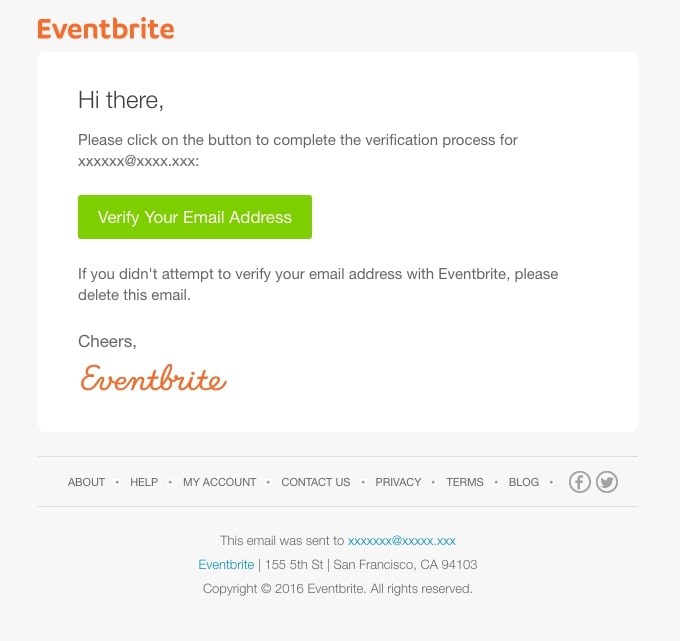
Here’s an example of a best practice subscription confirmation transactional email:

Order confirmation

Order confirmation emails are sent immediately after purchases are made, providing customers with details about their order. These emails are essential for building trust and making customers feel secure about their transaction.

  • Detailed order summary – Include a comprehensive breakdown of the order, such as product names, quantities, prices, and total cost.
  • Personalization – Address the recipient by name and include any specific details related to their purchase, including order number and estimated delivery date.
  • Contact information – Provide customer service contact details in case the customer has questions or needs assistance with their order.
  • Cross-selling opportunities – Consider offering recommendations for related products, but don’t overshadow the primary purpose of the email.

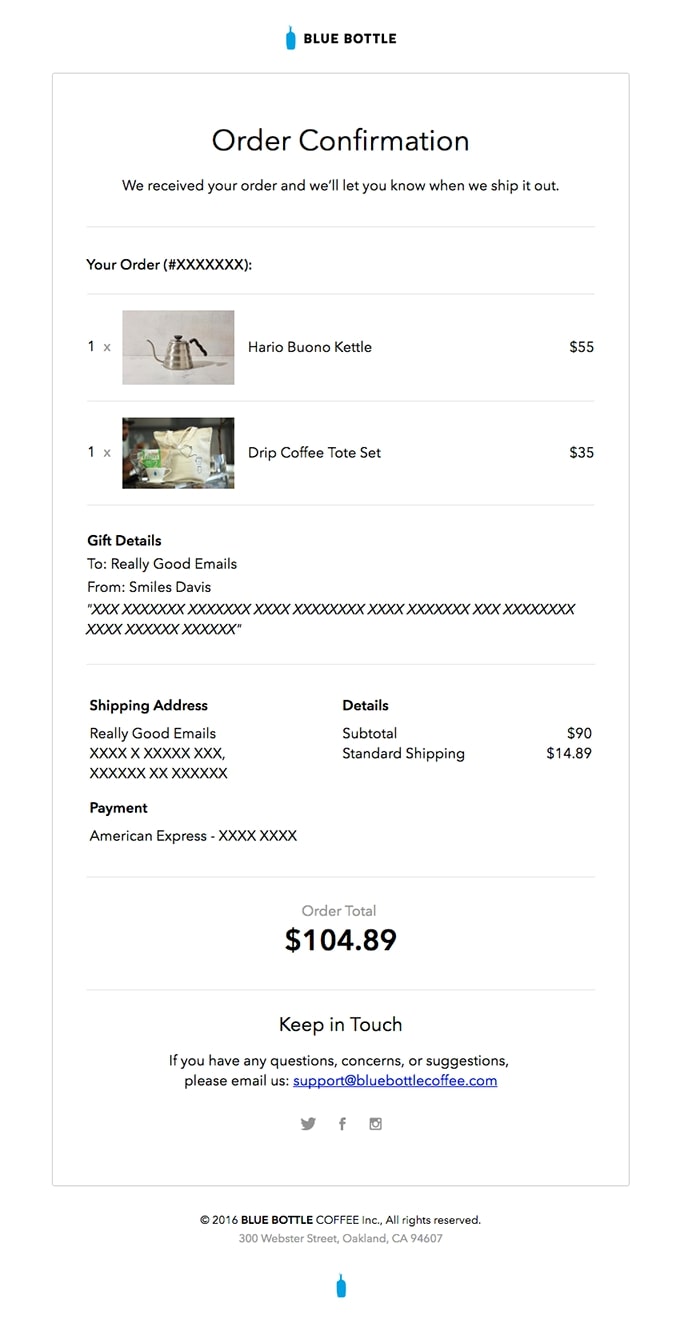
Here’s a good example of the above-mentioned practices:

Shipping confirmation

Shipping confirmation emails inform customers when their order has been dispatched, providing tracking details and delivery expectations.

  • Tracking information – Include a tracking number and a direct link to the carrier’s tracking page, making it easy for customers to monitor their shipment.
  • Estimated delivery date – State the expected delivery date to manage customer expectations and reduce inquiries.
  • Reassuring tone – Use a friendly and reassuring tone to convey excitement about the order being on its way, such as “Your order is on its way! Track it here.”

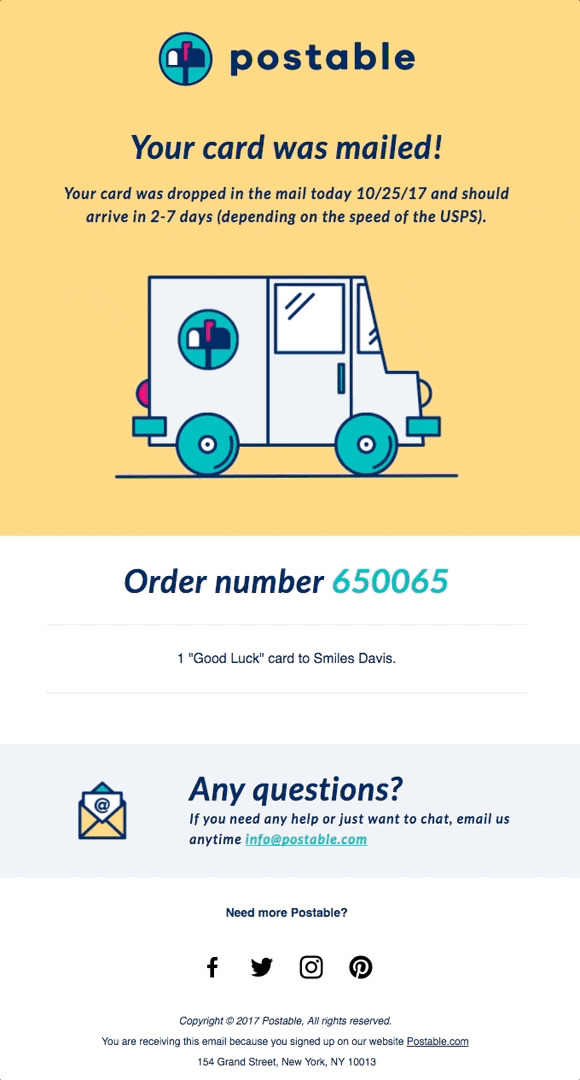
Here’s a nice example of the above-mentioned practices:

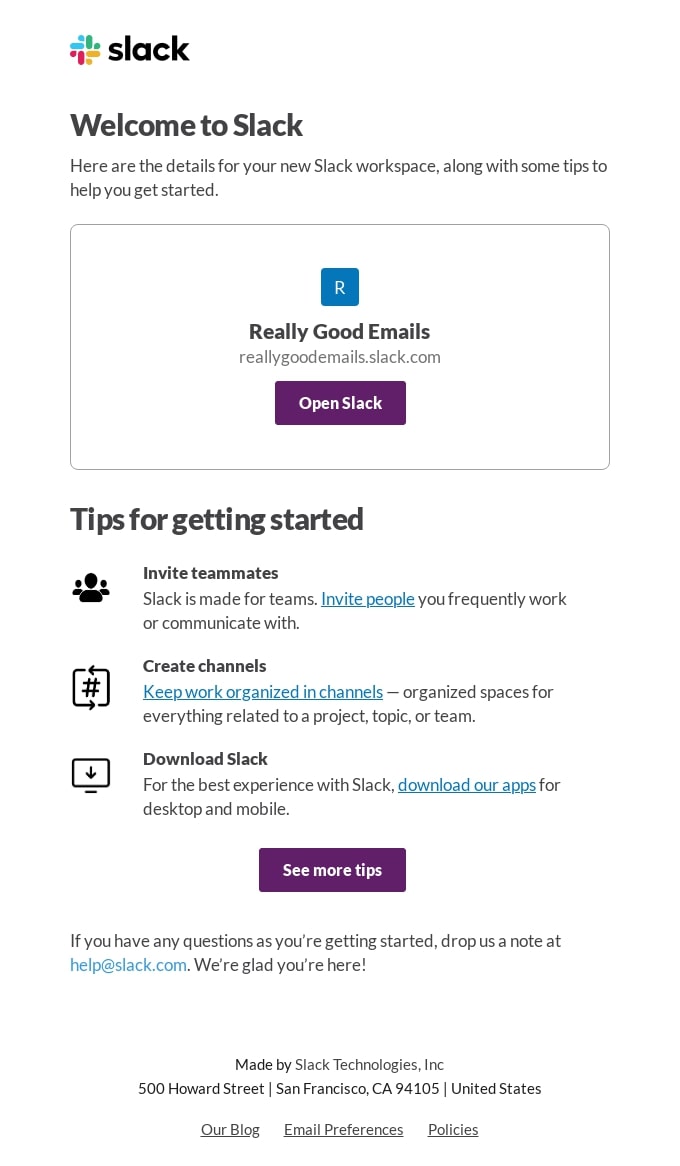
Welcome Emails

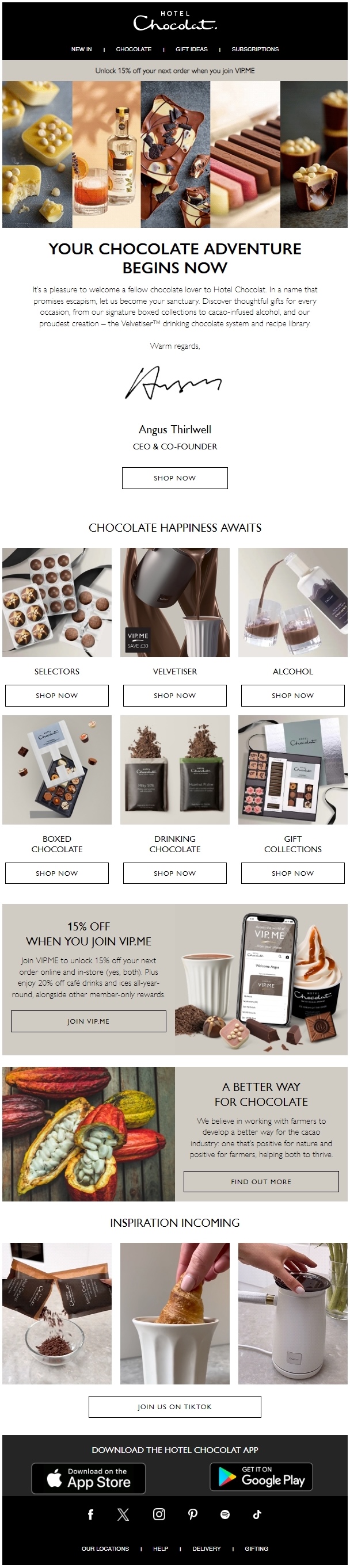
Welcome emails are the first impression your business makes on a new subscriber or customer, setting the tone for your future relationship. These emails bridge the gap between transactional and marketing communications, especially when an email contains both commercial and transactional content. Understanding the balance between transactional email versus marketing email is key to crafting a successful welcome message.

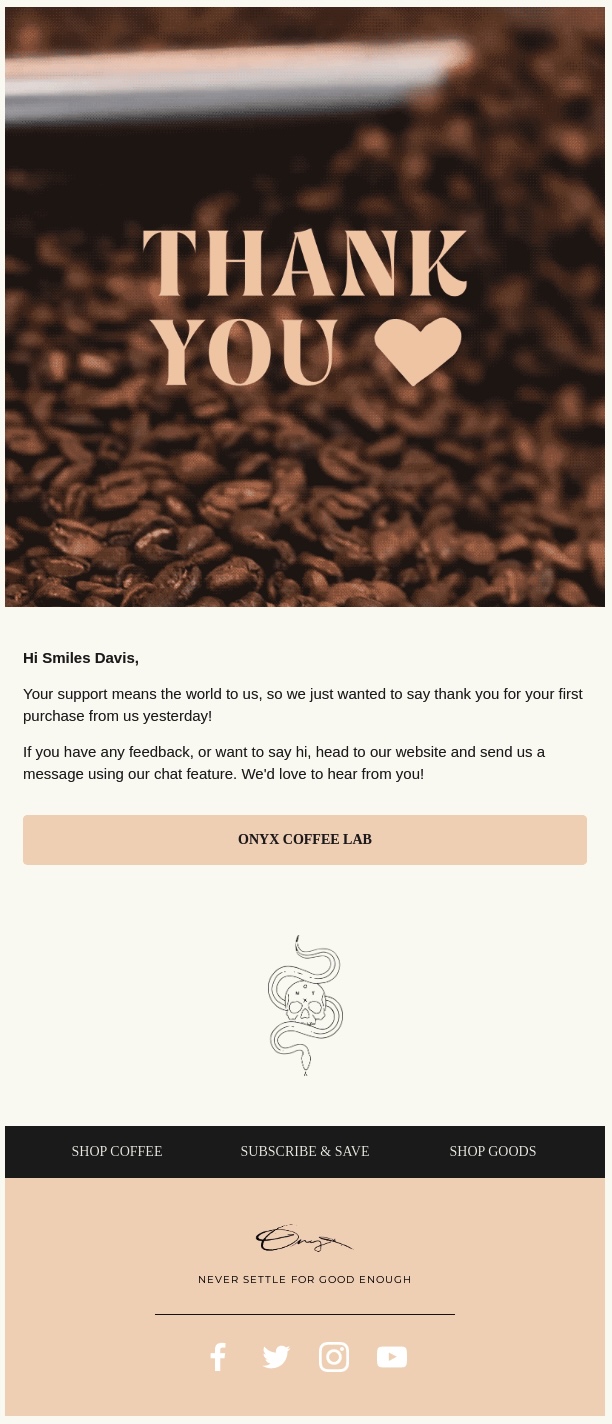
When a user signs up or makes their first purchase, a welcome email provides an opportunity to introduce your brand, highlight key offerings, and guide them through their initial experience. Let’s explore some best practices for welcome emails:

  • Prompt delivery – send the welcome email immediately after the user signs up or completes a transaction. An email platform can help you with the email automation process and deliver the message in a timely manner.
  • Personalization – address the recipient by name and tailor the content to their specific interaction with your brand.
  • Inviting subject line – use a subject line that encourages the recipient to open the email, such as “Welcome to [Your Brand]! Here’s What to Expect.”
  • Introduce your brand – provide a brief overview of your brand and what sets you apart. Highlight your values, mission, and any unique selling points.
  • Guide them to next steps – outline what the recipient can do next, whether it’s exploring products, setting up their account, or accessing exclusive content. Include clear calls to action (CTAs) to guide them.
  • Mix of content – when an email contains both commercial and transactional content, the primary focus should remain on the transactional aspect. However, you can subtly introduce related products or services.

Leverage a Reliable Email Marketing Tool

Using a transactional email platform like the SiteGround Email Marketing Tool can streamline the process of sending personalized and automated welcome emails. SiteGround Email Marketing offers features that allow you to craft engaging welcome messages, track their performance, and integrate them seamlessly with your overall email strategy.

TRY SITEGROUND EMAIL MARKETING

Here’s an example of a best practice welcome email:

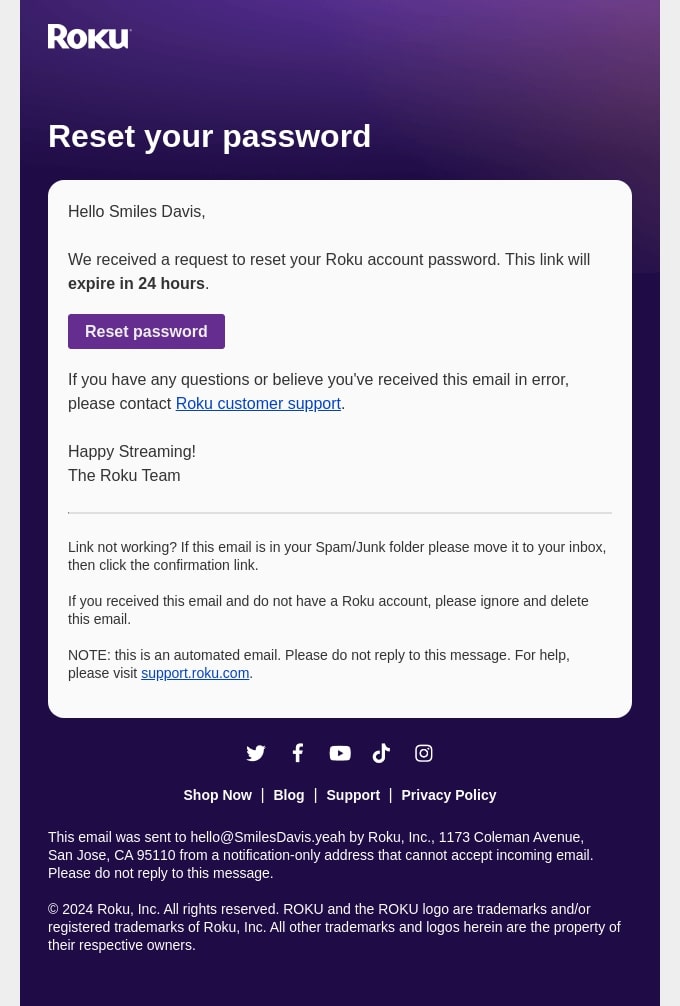
Password Resets

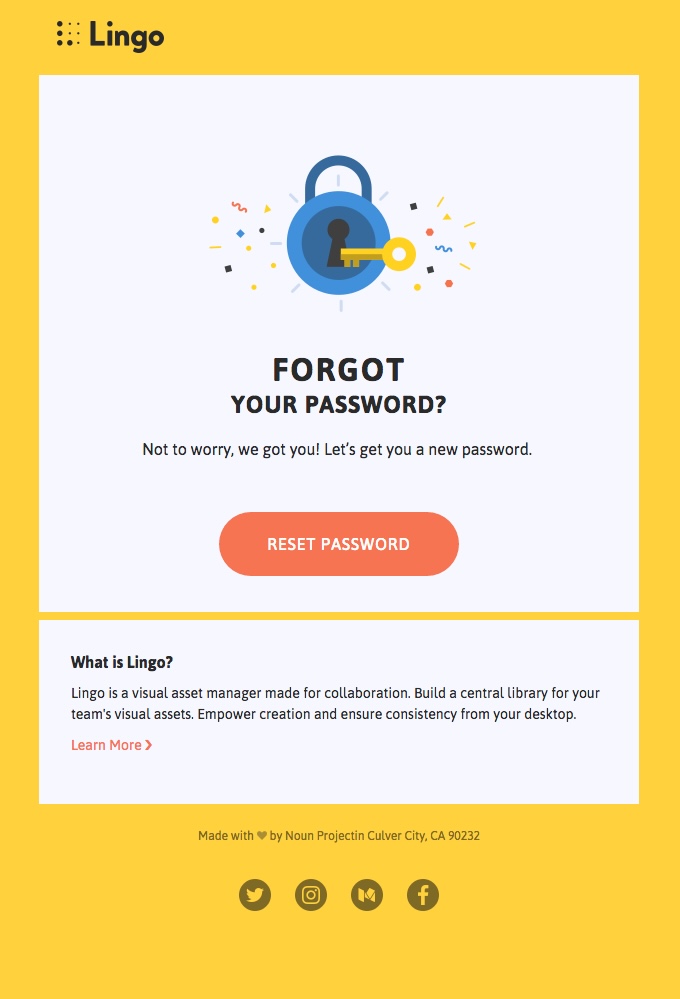
Password reset emails provide users with a secure and straightforward way to regain access to their accounts with minimal disruption. Creating password reset emails requires a focus on security, clarity, and ease of use. Here are some best practices to consider, along with an example:

  • Prompt delivery – password reset emails should be sent immediately after the user requests a reset. Delays can lead to frustration and potential security concerns.
  • Clear subject line – use a subject line that indicates the purpose of the email, such as “Password Reset Request for Your [Brand] Account.” This helps users quickly identify the email in their inbox.
  • Simple content – start with a direct statement acknowledging the password reset request: “We received a request to reset your password for your [Brand] account.”
  • Include a secure link – provide a prominent, single-use link for resetting the password. Ensure the link is secure (HTTPS) and expires after a certain period to enhance security. Indicate the expiration time, such as “This link will expire in 24 hours.”
  • Highlight security – reassure users by emphasizing the security measures in place: “If you did not request a password reset, please contact our support team immediately.”
  • Minimal design – keep the design simple to avoid distractions. Focus on the essential information and the call-to-action button for resetting the password.
  • Contact information – include customer support contact details in case users encounter issues during the password reset process. This builds trust and provides a safety net for users needing assistance.

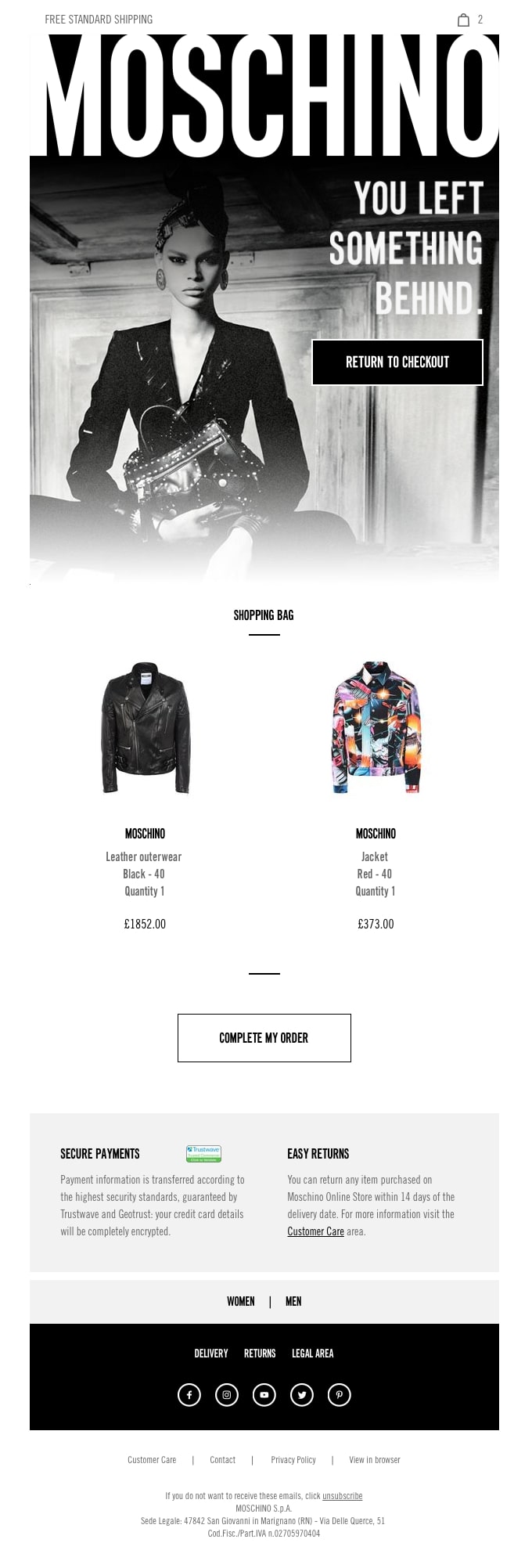
Cart Abandonment

Cart abandonment emails help recover lost sales and re-engage potential customers who have shown interest in your products but left without completing their purchase. These emails serve as gentle reminders for users to return to their carts and finalize their transactions. 

Here are some best practices for crafting impressive cart abandonment emails:

  • Timely follow-up – Send the first cart abandonment email shortly after the user leaves the site, typically within a few hours. This keeps your brand fresh in their minds and increases the likelihood of conversion.
  • Compelling subject line – Use a subject line that captures attention and prompts the recipient to open the email. Phrases like “You Left Something Behind!” or “Your Cart is Waiting for You!” can entice users to revisit their carts.
  • Personalization – Address the recipient by name and include specific details about the items left in the cart.
  • Persuasive content – Remind users of the items they left behind, including product images, descriptions, and prices. Highlight the benefits of the products to reignite interest.
  • Strong CTA – Include a prominent CTA button that directs users back to their cart. Use action-oriented language such as “Complete Your Purchase” or “Return to Your Cart.”
  • Incentives and offers – Consider offering incentives to encourage completion of the purchase, such as a discount code, free shipping, or a limited-time offer. Communicate any conditions or expiration dates.
  • Multiple touchpoints – If the first email doesn’t result in a conversion, consider sending a series of emails. A second or third reminder, spaced a few days apart, can increase the chances of recovery.
  • Mobile optimization – The email should be mobile-friendly, as many users will check their emails on smartphones.
  • Include contact information – Provide customer service contact details in case users have questions or require assistance. This can help alleviate any concerns that may have led to cart abandonment.
  • Analyze and optimize – Regularly review the performance of your cart abandonment emails. Use analytics to track email metrics, such as open rates, click-through rates, and conversion rates, and adjust your strategy accordingly.

Here’s an excellent example for a cart abandonment email, following the best practices described in the section above:

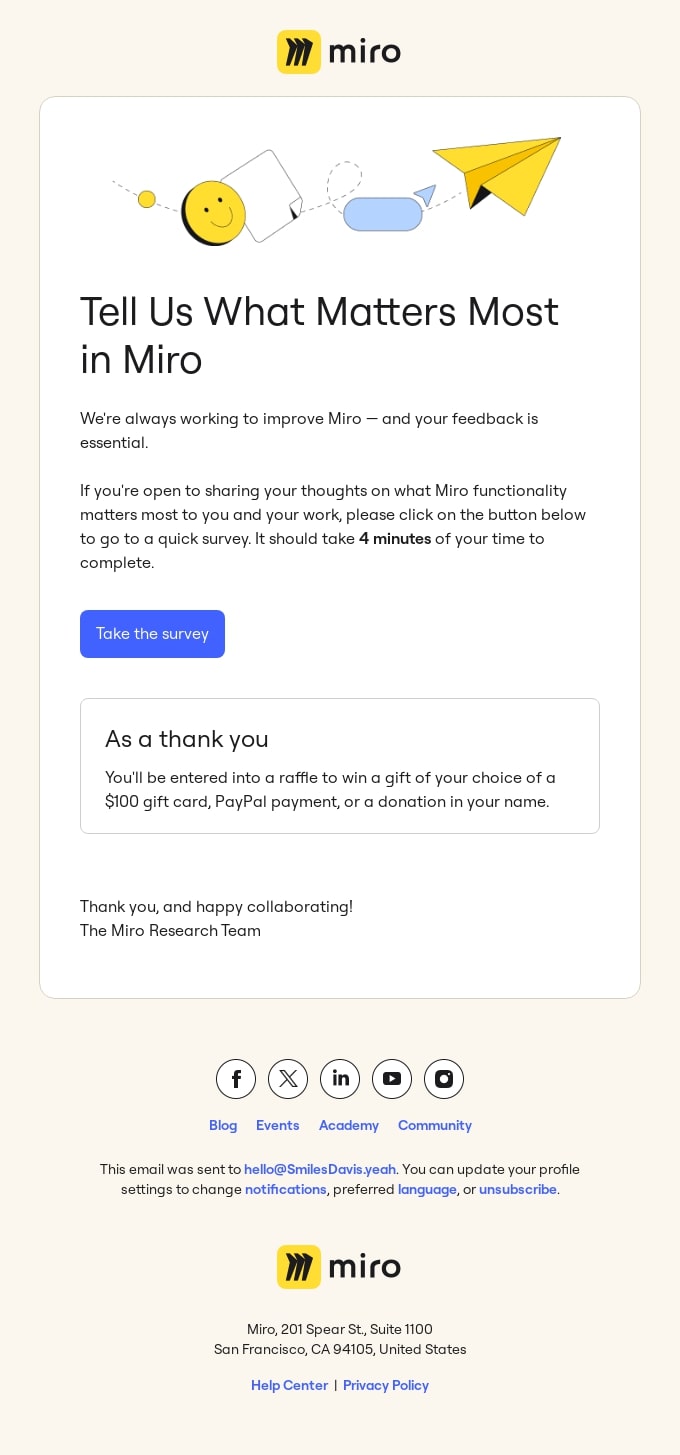
Feedback Requests

Feedback request emails are tools for gathering insights and improving your products, services, and customer experience. Unlike an email blast, which targets a large audience with a general message, feedback request emails are typically more personalized and targeted, aiming to elicit specific responses from individual customers.

Here are some best practices for writing effective feedback request emails:

  • Engaging subject line – Use a subject line that piques interest and makes the recipient want to open the email. For example, “We Value Your Opinion!” or “Help Us Improve Your Experience.”
  • Personalized approach – Address the recipient by name and reference their recent interaction or purchase. Personalization makes the request feel more genuine and increases the likelihood of a response.
  • Easy-to-understand purpose – State the purpose of the email at the beginning. Let the recipient know why their feedback is important and how it will be used to improve your offerings.
  • Focused content – Keep the email brief and to the point. Avoid overwhelming the recipient with too many questions. Instead, focus on a few key areas where you seek feedback.
  • Easy-to-complete format – Use a simple and user-friendly format for collecting feedback. Consider including a direct link to a short survey or incorporating a feedback form within the email itself.
  • Incentives for participation – Offer a small incentive to encourage participation, such as a discount code, entry into a giveaway, or loyalty points. Communicate the incentive and any terms associated with it.
  • Timely request – Send the feedback request shortly after the customer’s interaction or purchase, while the experience is still fresh in their mind. To increase the accuracy and relevance of the feedback, make sure to send the request when you know they have had enough time to try your product or service and see that it works well.
  • Express gratitude – Thank the recipient for their time and input. Acknowledge that their feedback is valuable and appreciated, reinforcing a positive relationship with your brand.
  • Follow up – If applicable, follow up with respondents to let them know how their feedback has been used. This demonstrates that you value their opinions and are committed to making adjustments.
  • Analyze and act – Review the feedback you receive and use it to identify trends and areas for development. Implement changes where necessary and communicate these enhancements to your audience.

Here’s an example of a feedback request email that follows best practices:

Start Sending Transactional Emails

Transactional emails offer a direct and impactful way to communicate with your customers at crucial moments. From order confirmations to feedback requests, these emails provide timely and relevant information that elevates the customer experience and builds trust. By integrating transactional email marketing into your overall strategy, you can improve customer satisfaction and drive business growth.

To effectively send transactional emails, it’s important to use a platform that gives you reliability and scalability. The SiteGround Email Marketing Tool offers an intuitive interface and powerful features to help you automate and personalize your transactional emails with ease.

Start leveraging the power of transactional emails today and watch your customer relationships flourish.


What Is an Email Blast and Should You Send One?

Header image showing a girl surrounded by emails

You’ve come across the term “email blast,” and now you’re wondering if it could be the key to increase your brand’s visibility or, even better, skyrocket your conversion rates. 

Historically, email blasts were a go-to strategy for reaching large audiences quickly and efficiently. However, in today’s digital landscape, this approach can sometimes backfire, leading to messages being flagged as spam.

In this article we’ll uncover what “blasting” is all about, discuss whether it deserves a place in your email marketing strategy, and explore effective ways to implement it if you choose to do so.

What Is an Email Blast?

An email blast refers to a uniform message sent to your entire email subscriber list simultaneously. The main goal of email blasting is to disseminate information quickly and on a large scale, much like “blasting” a message with a loudspeaker.

Email blasts gained popularity in an era when technology didn’t support the personalization and segmentation of emails. Today, however, the email marketing approach is more nuanced.

On one hand, numerous regulations have been introduced, like the EU’s GDPR (General Data Protection Regulation) and California’s CAN-SPAM Act, which govern customer consent and data privacy, impacting email marketing practices. On the other hand, companies now prefer to create more targeted and personalized email campaigns, as they see better results. 

💡 Email blasts are also known as “e-blasts,” “broadcast emails,” or “mass emails.”

Some articles might suggest that “email blasts” and “email campaigns” are the same, but that’s not entirely true. Sending a well-targeted email is different from blasting everyone with the same content.

An email campaign involves sending either a single email or a series of emails to your subscribers as part of a broader marketing strategy. Some campaigns, like drip campaigns, are designed to guide recipients through an email journey, often involving multiple touchpoints and interactions. Whereas, an e-blast is a broad, one-time message.

Here are the key differences between an email blast and an email campaign:

Email BlastEmail Campaign
TargetingLess targeted; not sensitive to recipients’ past behaviour and preferencesMore targeted; often involves segmentation based on user behavior, demographics, or preferences
AudienceOften sent to everyone on the mailing listSent to specific segments of the mailing list
FrequencyUsually a one-time communication, without a follow-up emailPart of a border marketing strategy, often includes a sequence of emails (e.g. welcome series)
PurposeUsed for company-related topics or general information that is relevant to a broad audienceAims to engage recipients more deeply and drive specific actions (like conversions, sign-ups, or purchases)
EffectivenessMay have lower engagement rates due to lack of personalizationTypically includes tracking and analysis of email marketing metrics to measure engagement and effectiveness

When to Consider Sending an Email Blast?

Email blasts can be effective when you need to quickly deliver a single, important message. For example, updates or changes to your business’s privacy policy or terms and conditions are critical updates that all your customers need to know about. Similarly, announcements like the opening of a new store can be communicated through an e-blast.

It’s less about the “blast” itself and more about how you carry it out. If your content is valuable and your subscribers are engaged, occasionally sending a uniform email to everyone won’t be harmful.

However, if you send e-blasts without a clear purpose and just for the sake of sending emails, you may encounter:

  • Damage to your sender reputation: today, it’s easier than ever for emails to be marked as spam. If your emails have a high spam complaint rate, email providers might block them from reaching subscribers entirely.
  • Decrease in website traffic and sales: when your emails end up in spam, subscribers are less likely to open them. This means the links inside your emails won’t get clicked, making  it harder to drive traffic to your website and reducing the chances of making a sale.

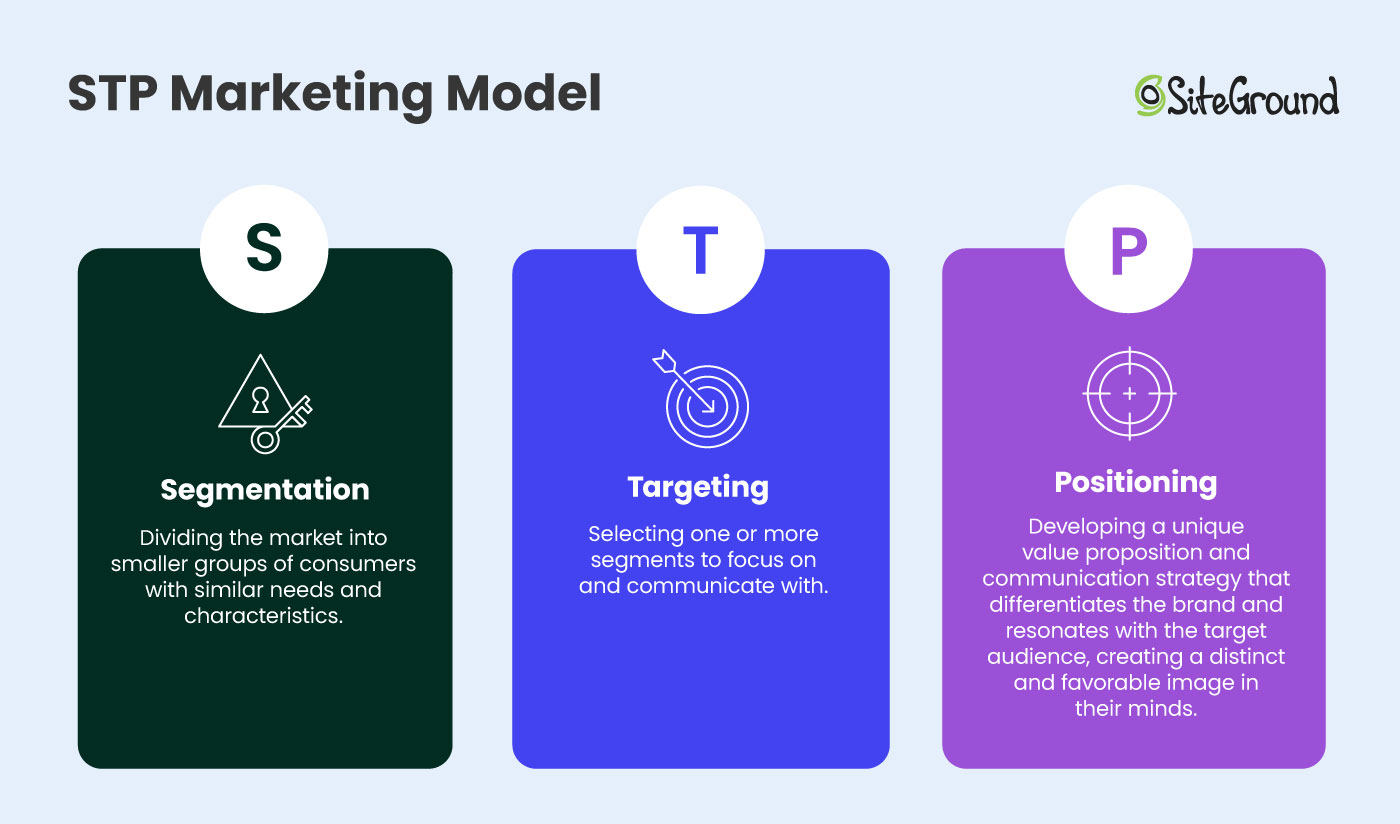
This can happen because when blasting your subscribers, you won’t follow the STP (Segmentation, Targeting, and Positioning) marketing model. 

The three-step model involves analyzing your products or services and tailoring your communication to meet the needs of specific customer segments. Without following this approach, e-blasts risk being too generic, leading to lower engagement and higher spam complaints. 

That’s why it’s important to be cautious when sending an e-blast. We’ll provide some tips on how to do this effectively in the next sections.

Email Blast Examples 

We’ve compiled a short list of email blast examples to help you see how they work in practice.

  • Company-Related Information

As we’ve already pointed out, e-blasts are often the go-to for spreading the word about important announcements. Some are must-sends, while others are optional—as we’ll explore in the next example. But regardless, your email should never come across as generic or dull.

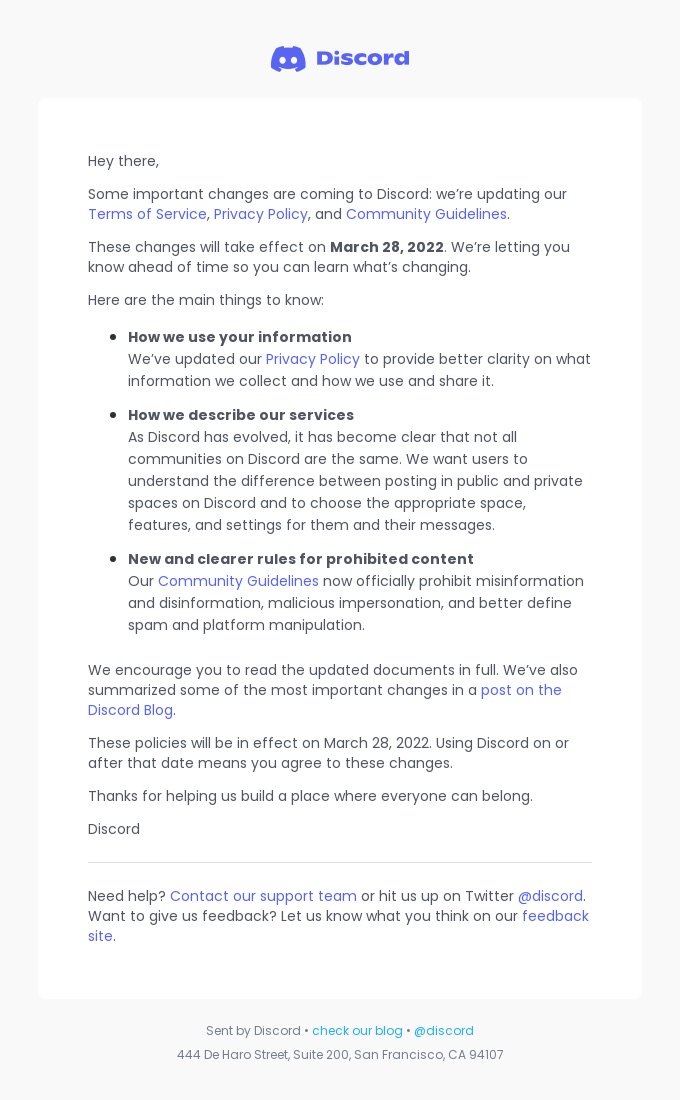
Take a cue from Discord – they masterfully use clear and concise messages to explain upcoming policy updates, detailing how these changes will affect users. The instant messaging platform ensures the details are a breeze to digest by spotlighting key changes with bullet points and offering links for more information.

  • New Features/Products

A product or feature release email is your chance to share exciting updates about recent changes to your product or service, whether it’s new features or entirely new product lines under your brand.

By directly emailing your email subscribers, you can captivate a larger segment of your users, instead of just posting updates on your website, which many people might miss.

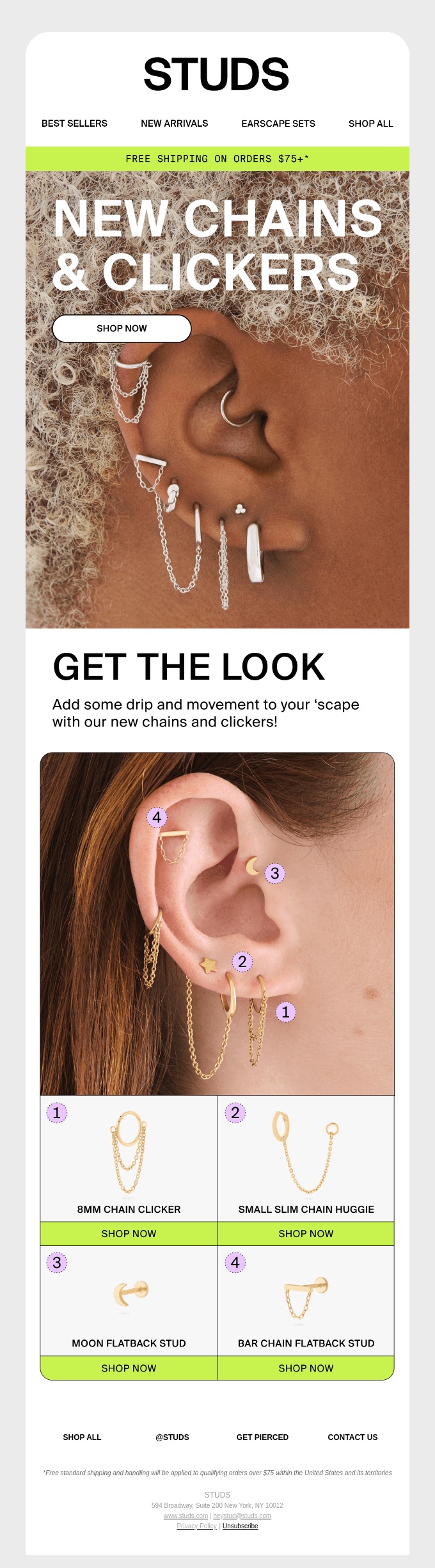
You can whip up excitement with a full-scale email campaign, or simply craft one captivating email and send it to your entire list—just like Studs, the jewelry brand, does with flair!

  • Flash Sales

Promotional emails are all about turning subscribers into customers or enticing existing customers to buy more. You can run various email campaigns, like one targeting new email subscribers or another focused on upselling with a tempting discount code.

If you’re aiming to sweep out unsold inventory or offload out-of-season products, a well-timed email blast to your subscribers might be just the magic wand you need.

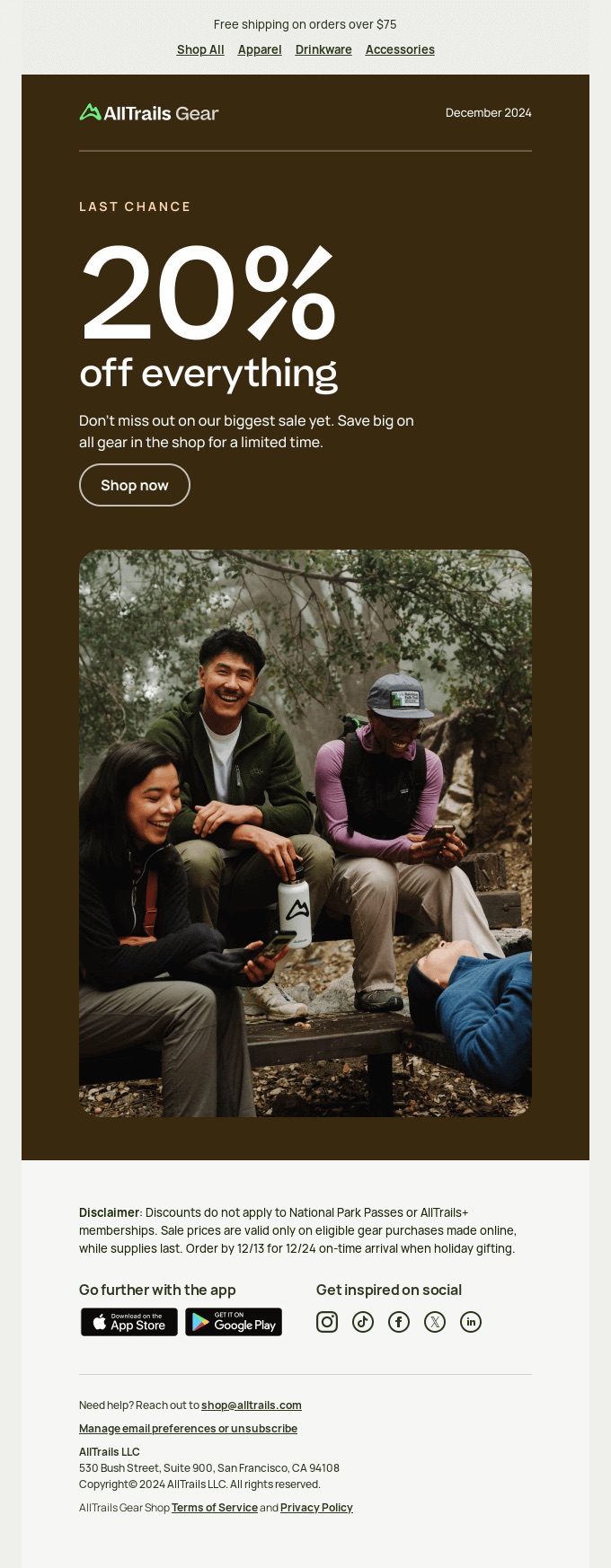
Take AllTrails’ all-product sale email, for instance. It employs a straightforward yet effective visual hierarchy that clearly conveys the main message, stirs up a sense of urgency, and features an easy-to-find CTA button. No fluff, no fuss—just straight to the point.

  • Surveys and Feedback

E-blasts are also a fantastic tool for gathering feedback and conducting surveys since they’re relevant to your entire audience. Plus, they allow you to collect valuable insights for segmenting your list for future targeted campaigns.

Additionally, these surveys can provide insights into customer preferences, helping you refine your products or services and improve customer satisfaction. They also offer a chance to engage with your audience, strengthening the relationship and building brand loyalty.

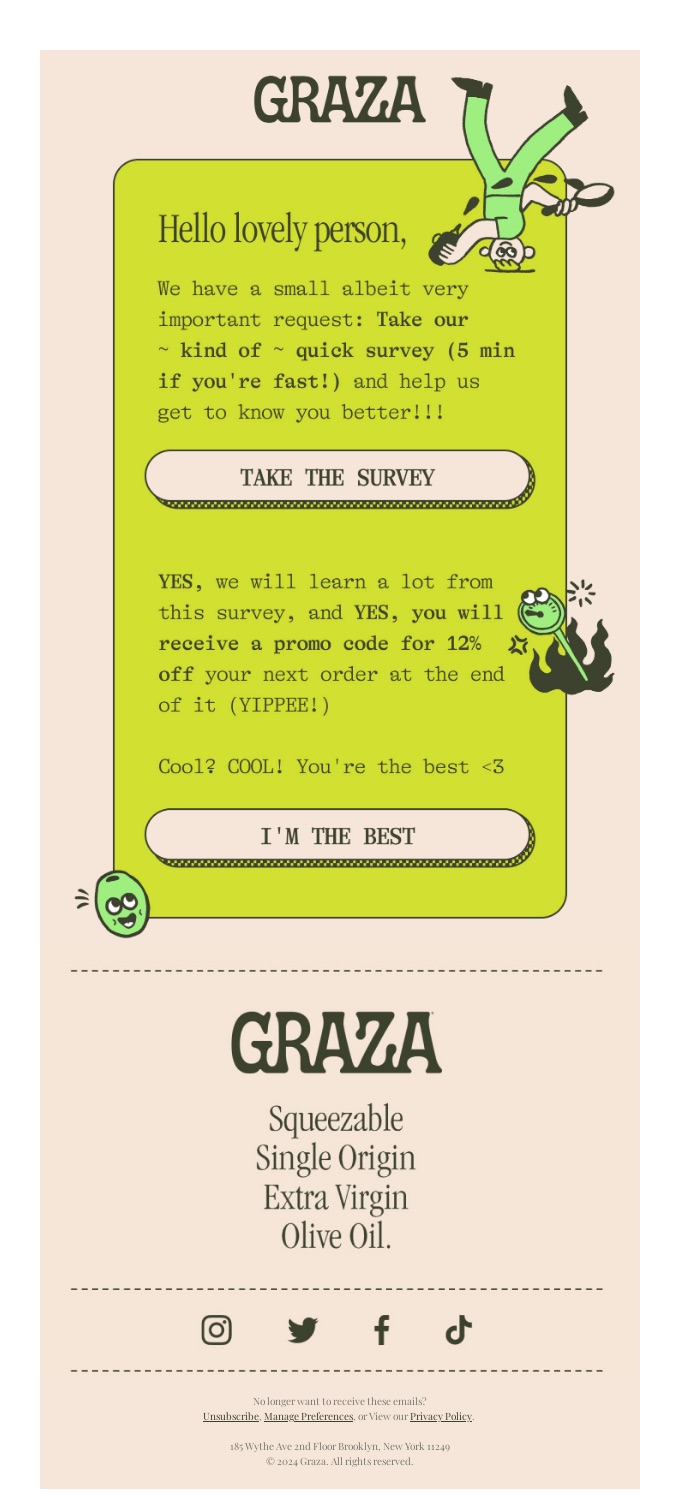
To spark participation, consider offering incentives like a discount code, entry into a giveaway, access to exclusive content, or a promise to share survey results—just like the olive oil producer Graza successfully did in their survey email.

How to Send an Email Blast?

Now that you’re in the know about when it’s appropriate to send an email blast to your subscribers, we’re here to lend a hand with some common email mistakes to avoid. This way, your emails will be welcomed with open arms, not eye rolls. 

1. Use Double Opt-in

You might think, “If people sign up to receive my emails, isn’t that enough?” Well, not necessarily. While a single opt-in can grow your email list quickly, a double opt-in option ensures that the list consists of real, engaged subscribers. 

By requiring people to confirm their subscription through email, you reduce the number of incorrect or bogus addresses (often added by bots), which will lead to a good sender reputation and high email deliverability. 

2. Include a Dynamic Element

Dynamic content allows you to send the same email to your subscribers but personalize emails based on different factors. Such content can be changed automatically based on the audience receiving the email. 

You can sprinkle in dynamic elements like first name fields to personalize the subject line or body content with each subscriber’s name. 

You can enhance this approach by customizing it for different audiences based on factors like location, gender, age, or even their previous interactions on your website. However, this would no longer qualify as an email blast.

3. Remember Your Subscribers Are Real People

If you’ve done a good job building your buyer persona, you’ll understand your subscribers’ concerns and interests.

When launching something new, go beyond simply informing them about it. Explain how your offerings meet their needs. In surveys, highlight how their feedback can help improve their satisfaction with your brand. Even in company-related updates, skip the jargon and use clear, direct language to explain changes and their impact—just as you’d want it explained to you.

4. Use a Reputable Email Service Provider

As your email list expands, it’s essential to rely on a reputable email provider. Without one, you’ll encounter limits on the number of emails you can send and will have to track email metrics, run spam checks, and verify whether your sender IP or domain has landed on a denylist—all of this manually. 

Fortunately, many email providers offer analytics tools to help you monitor email performance. They can also track your sending IP and alert you to any issues that might affect your email deliverability.

SiteGround Email Marketing can assist you with that too! Our platform automatically sets DKIM and SPF records to validate your email’s authenticity and runs AI-powered spam checks. Plus, you can take advantage of professional, fully customizable email templates, email automation features, and analytics reports—all within a user-friendly and intuitive interface.  

5. Respect Unsubscribe Requests
You’ve likely encountered emails from organizations you never signed up for, or from ones you thought you’d unsubscribed from. So, you know how annoying this can be. An unsubscribe request is a clear indication that the recipient is no longer interested in your messages.
Even though it’s hard to watch your email subscribers go, it’s best to respect their decision and stop bombarding them with further emails. Ignoring such requests can damage your sender reputation, and even result in legal troubles, especially under regulations like GDPR or the CAN-SPAM Act.

The Final Verdict: To Blast or Not to Blast?

The power of email blasts depends on the context. As we’ve explored, mass emails are perfect for important announcements or quick updates, and they can also shine in promotional and feedback scenarios.

However, to ensure your e-blasts reach your subscribers, remember to use a double opt-in, incorporate dynamic elements, write in natural and relatable language, use a reliable email provider, and always respect unsubscribe requests.

That said, for long-term success, blasting shouldn’t be your go-to strategy. Instead, focus on crafting tailored, strategic campaigns that build relationships and boost engagement.

The Email Customer Journey – 5 Simple Steps + Examples

The-Email-Customer-Journey

Email marketing can be a scattershot endeavor if you don’t have a strategy. What kinds of emails should you send? And when? The reality is that you need to have a plan – and understanding the email customer journey is absolutely essential to making sure your email marketing efforts are a success. 

So let’s tease out the email customer journey, including each of its stages, as well as email marketing campaign examples to suit every step of the way. 

What Is an Email Customer Journey?

The email customer journey refers to the experience a customer has with a brand through email communication, from their first interaction to becoming a loyal advocate and returning for more. It encompasses every touchpoint where email plays a role in guiding, informing, and engaging customers throughout their lifecycle.Email journeys aren’t just about delivering promotions or newsletters; they are strategic tools designed to nurture relationships, build trust, and drive action at various stages of the customer experience. When done well, email marketing can be a powerful channel for creating meaningful, personalized connections that resonate with customers at the right moment.

What Is a Customer Journey vs. An Email Customer Journey?

A customer journey represents the complete path a customer takes when interacting with a brand, spanning all channels and touchpoints, from initial awareness to long-term loyalty. It includes everything from discovering the brand on social media to making a purchase in-store or online and receiving post-purchase support.

An email customer journey, on the other hand, is a subset of the overall customer journey. It specifically focuses on how email communications guide and support customers through different stages of their interaction with the brand. So while the customer journey encompasses a wide range of channels, the email marketing customer journey – with the help of email automation, which we’ll discuss below – zeroes in on the role of email as a strategic tool for nurturing relationships and driving conversions.

Understanding how the email customer journey fits within the overall customer journey helps brands create cohesive, omnichannel strategies that enable consistency and improve the customer experience across every touchpoint.

What Are the Stages of the Email Customer Journey?

Email-Customer-Journey-Stages

It might seem like the customer process is rather simple – a customer needs something, learns about your brand, likes what they see, buys it, and then end of story, right? But a customer journey is so much more nuanced than this, and understanding its stages can reveal heaps of new marketing opportunities, especially when it comes to email. 

Just like the overall customer journey, email journeys can be broken down into the same key stages, each addressing specific customer needs and behaviors. 

Also, it’s important to note that customer journeys – and email journeys – aren’t necessarily linear. A customer might jump back and forth between these stages, or pass through multiple stages at once. So it’s important to keep this in mind as we dive deeper.

Without further ado, here’s a closer look at these stages and how email plays a critical role in each.

email-customer-journey-types-of-emails

1. Awareness

The awareness stage is where potential customers first learn about your brand, products, or services. Maybe they see a friend using your product, or perhaps they come across your brand at the store. They don’t know much – in fact, they may not even know that they need or want a product like yours. So it’s at this stage that you’ll want to paint the picture for them – one that identifies their pain point, and that positions your business as a possible solution.

In this stage emails can be used to capture attention, generate curiosity, and provide value – and all without being overly promotional. That’s one of the great benefits of email marketing. It’s about helping these potential customers understand that they have a pain point, and – wink, wink – you’ve got a possible solution.

Emails at this stage might include:

During this stage, a brand might send an email with a free guide titled, “10 Tips for Better Time Management,” targeting individuals struggling with productivity. The focus is on providing value and showcasing expertise rather than making an immediate sale.

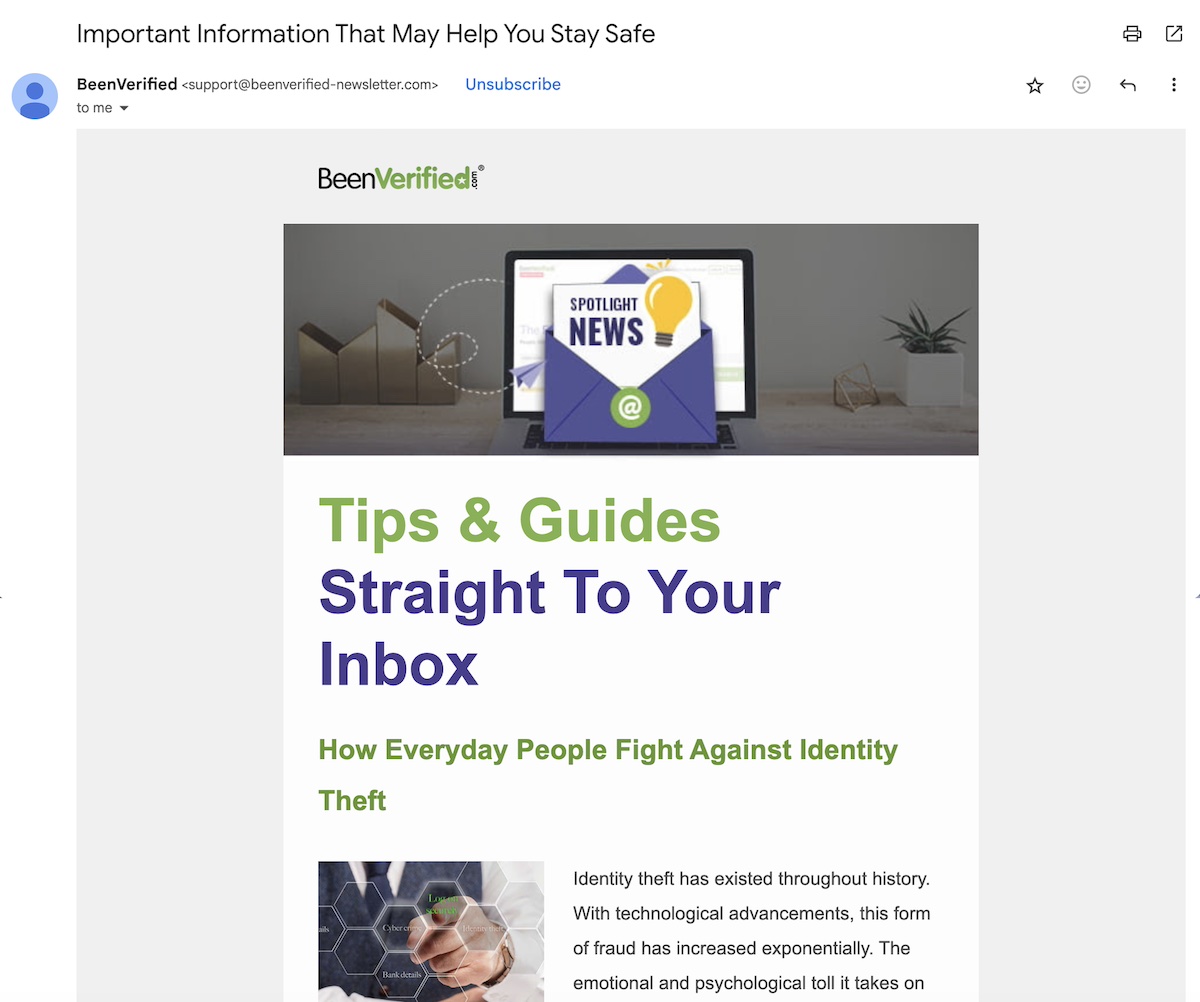
As you can see in the email journey example below, BeenVerified creates awareness around a specific issue – in this case, identity theft – without specifically promoting the brand itself. This email could have been preceded by a welcome email triggered by someone signing up for the email list. Then this email could be followed by a newsletter that shares industry updates and top tips. The goal is to help the email recipient understand that there’s a problem that needs to be solved – and begin to position BeenVerified as the solution, which will be tackled during the next stage.

email-journey-example-awareness-stage
SiteGround-Email-Marketing-Welcome-Emails

2. Consideration

So you’ve created a bit of awareness. Customers know that a problem exists, and that you might have some solutions. This is the consideration stage – when those potential customers begin evaluating their options and comparing solutions. With that in mind, emails at this stage should provide compelling reasons to choose your brand while more concretely addressing pain points and answering questions as they relate to your own offering.

Emails at this stage might include: 

  • Product comparisons
  • Case studies or testimonials
  • Limited-time offers or free trials

An email at the consideration stage might showcase customer testimonials with a subject line like, “Why Professionals Choose Our Productivity App,” which can help sway hesitant leads by offering social proof and highlighting unique benefits. 

See how at this stage the message has become more promotional? It’s not simply about speaking to the customer’s problem, but how and why you as a business can solve it.

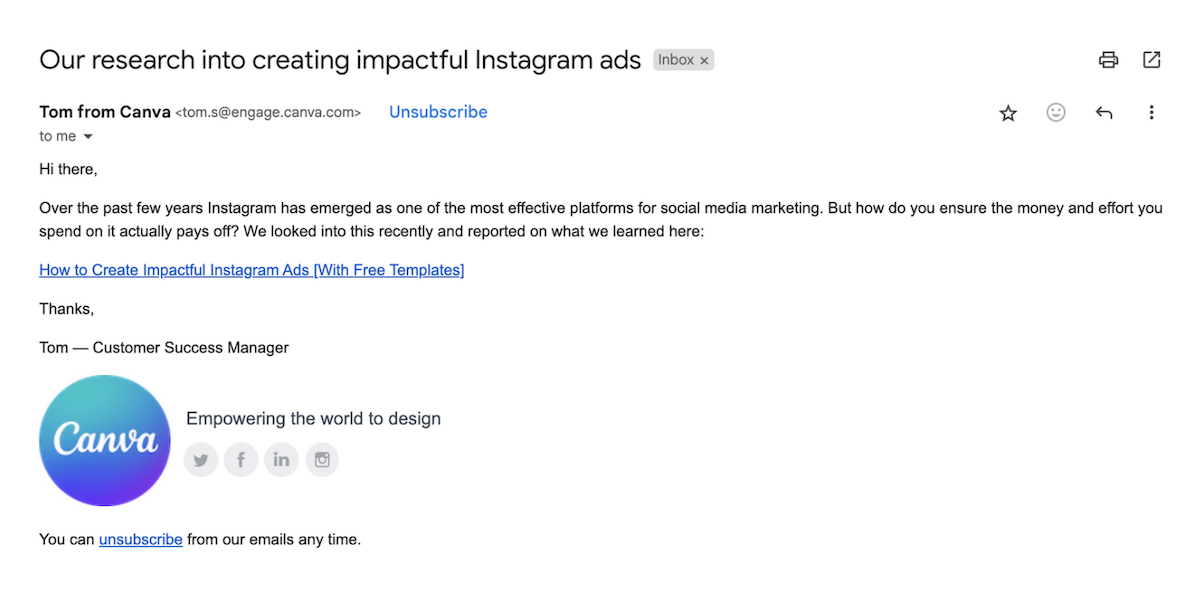
In the example below, the simple text email from Canva taps into the consideration stage by offering up helpful, but not promotional information when it comes to creating ads. Canva could then follow this email with an offer for a free trial of their premium service, encouraging further consideration by the customer.

email-journey-example-consideration-stage

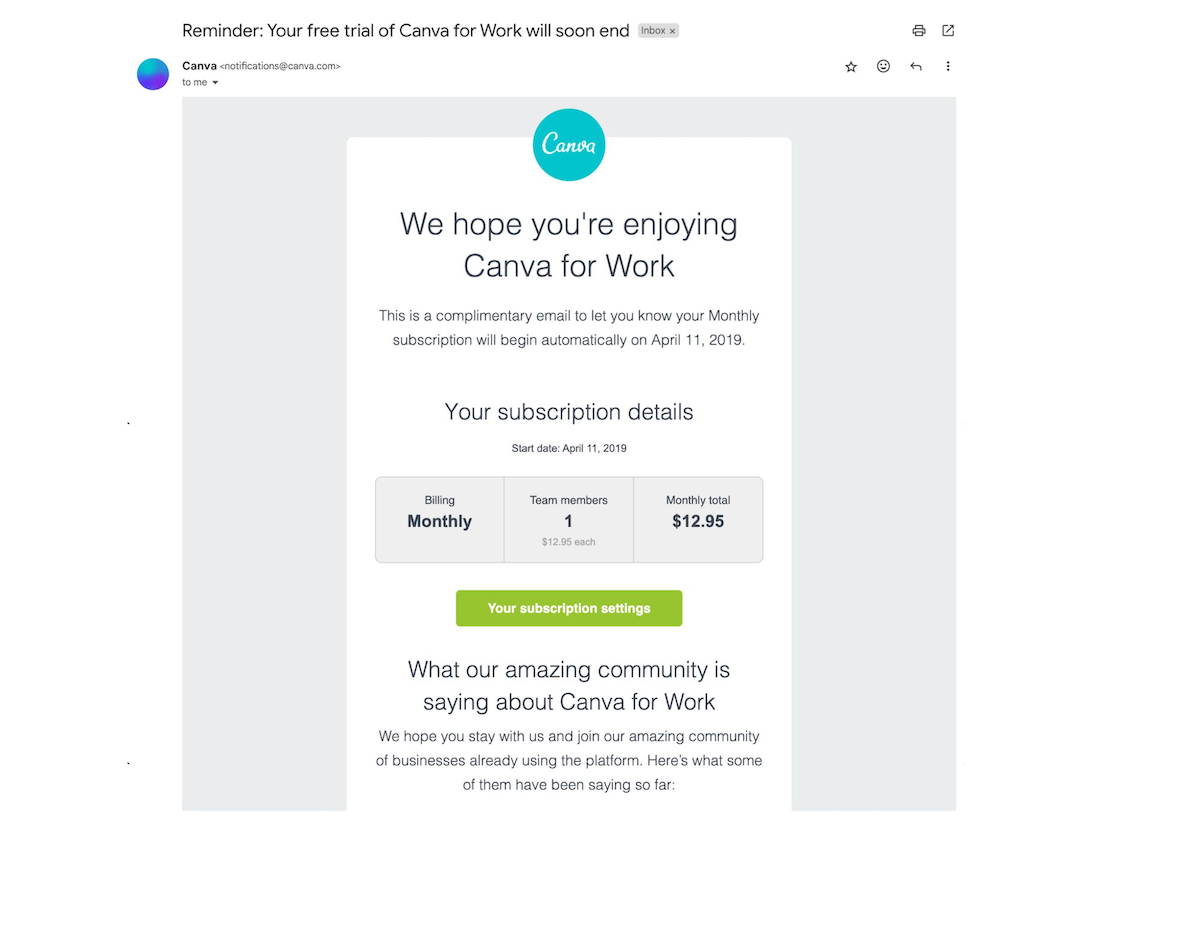
Then, let’s say the customer participates in a free trial. In the below customer journey email example, Canva builds on the free trial by offering testimonials from their community, helping an uncertain customer inch closer to a decision.

email-customer-journey-example-consideration-stage

3. Decision

In the decision stage, customers are ready to make a purchase but might need that final little nudge. Emails here should aim to reduce friction, instill confidence, and encourage immediate action. It’s a step past the “consideration” stage, where you go beyond comparisons, but add that extra touch to make your offer stand out as the best. 

Emails during the decision stage might include: 

  • Abandoned cart reminders
  • Exclusive discounts
  • Personalized product recommendations

So it’s at this point that a retailer might send an abandoned cart email saying, “Your cart is waiting! Complete your purchase today and get 10% off.” This combines urgency and value to drive conversions – and, importantly, it helps that indecisive customer finally tip the decision scale toward a purchase.

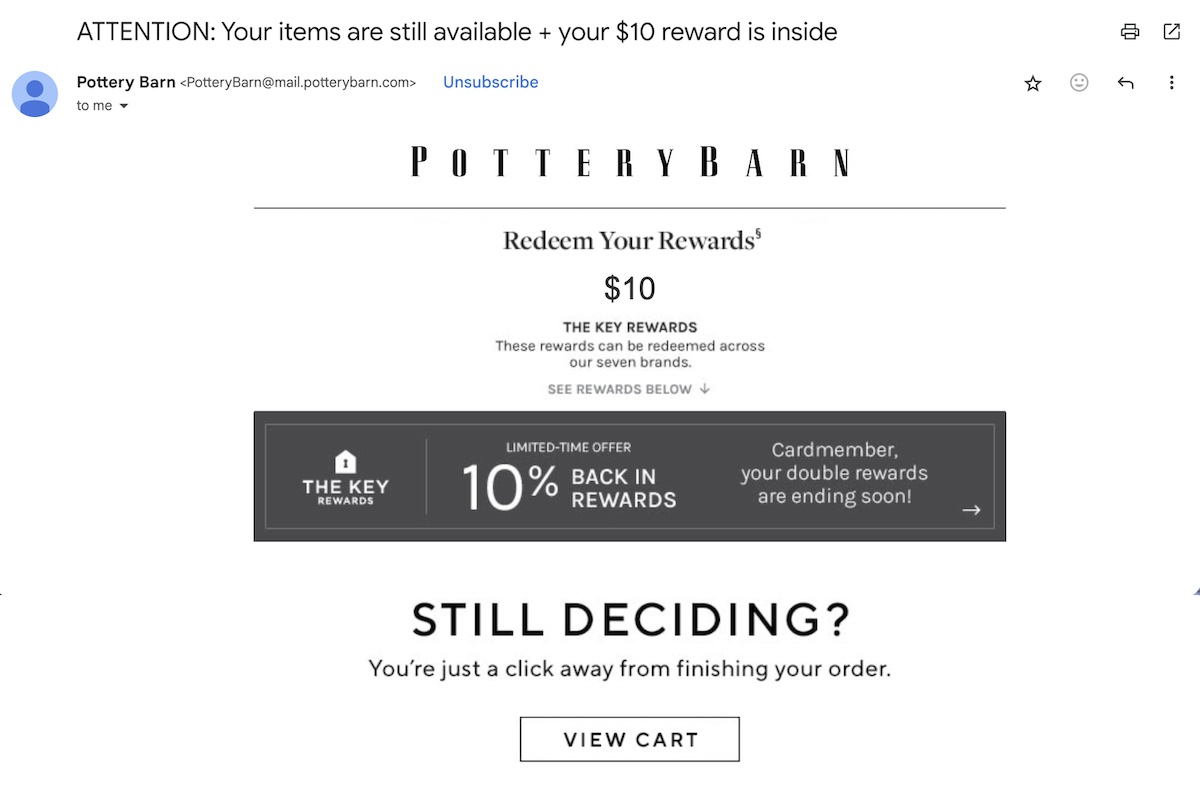
In the case of the below email journey example, Pottery Barn reminds this customer of products they’d been eyeing. The goal? To make the decision hard to pass on by offering extra rewards. 

This email could be followed by other decision stage emails, such as one emphasizing that rewards are about to expire. Or perhaps even another email increasing the reward amount.

email-journey-example-decision-stage

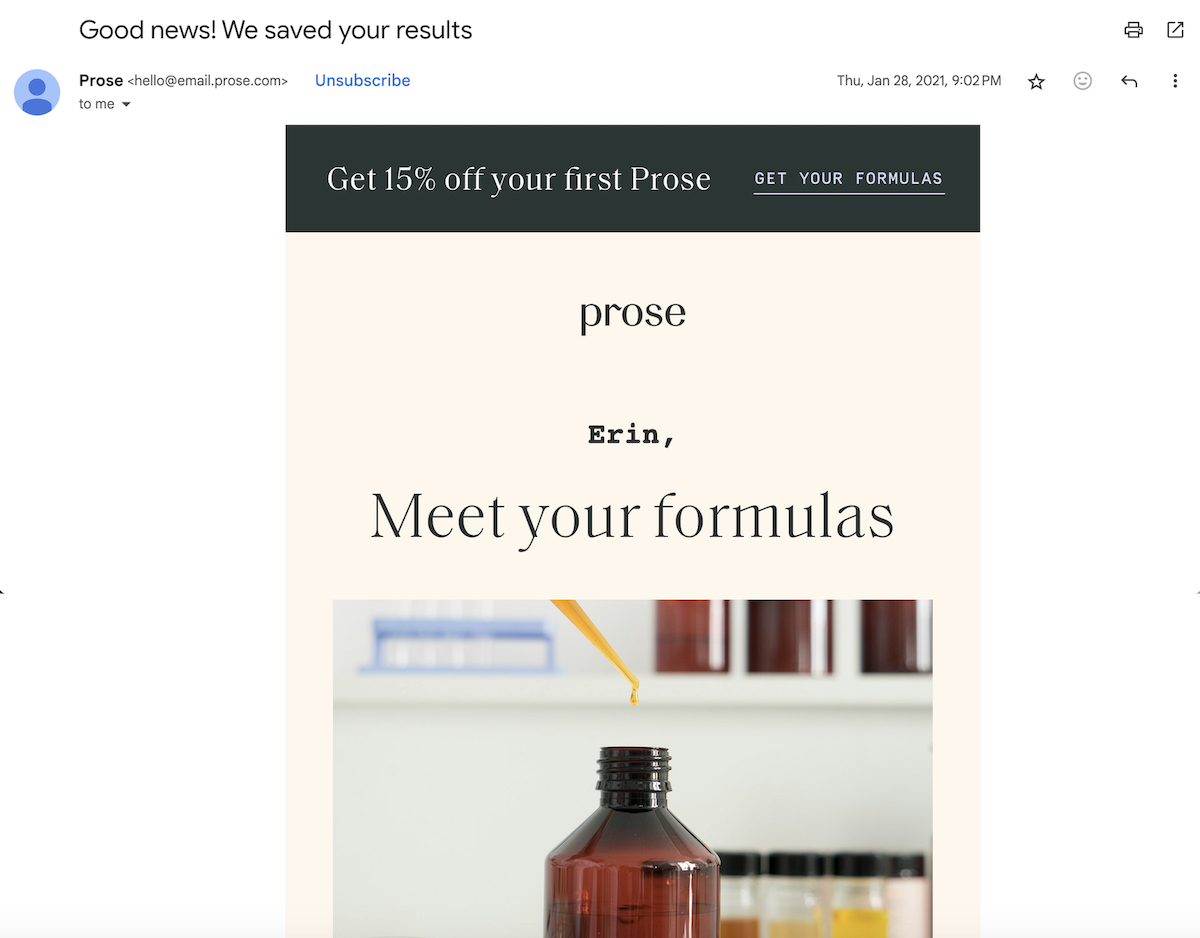
In the below email journey example, the haircare brand Prose aims to turn already-captured customer information (customized shampoo formulas) as a selling point to urge purchase. Then if the customer doesn’t bite, they might then send another decision-stage email with an exclusive discount offer.

email customer journey example decision stage

4. Onboarding & Education

A customer has made a purchase – that’s great! But the journey doesn’t even come close to ending here. Keeping this customer happy and coming back for more is one of the most important parts of the customer journey. 

Indeed, once a customer has made a purchase or signed up for a service, the onboarding and education stage ensures they know how to get the most out of their investment. These emails help set the stage for a positive experience and reduce churn.

Onboarding and education emails could include: 

  • Welcome series
  • Tutorials or how-to guides
  • FAQs and troubleshooting tips

So, let’s say you work for a SaaS company. You might send a series of onboarding emails showing users how to navigate the platform, starting with “Getting Started: Your First Steps to Success.” This makes their experience with your service more successful and rewarding, ensuring that they get the most of your product and, you guessed it: it keeps them coming back to you as a customer.

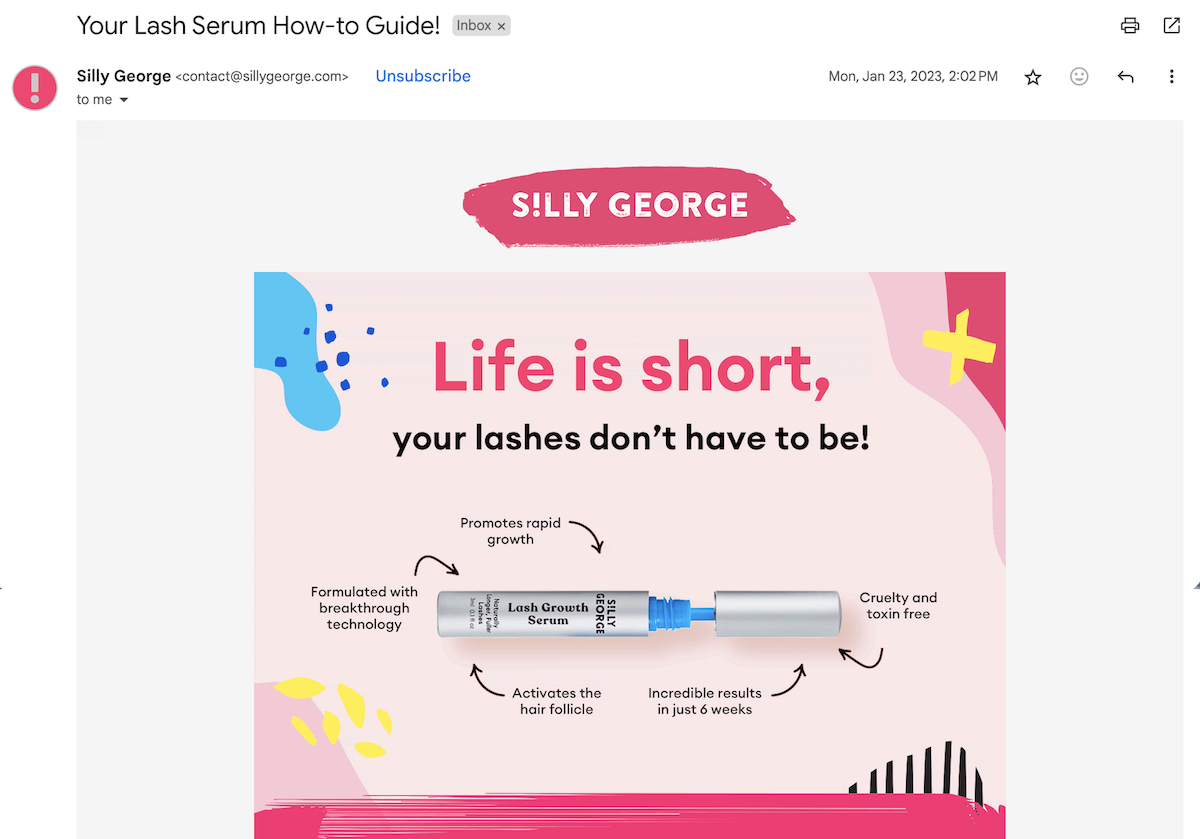
In the below email marketing campaign example, Silly George sent out a post-purchase how-to guide in order to educate the customer on how to get the most out of the product. They could follow this with an FAQ email, and then another email that features different video tutorials. This helps make the customer experience more seamless and enjoyable.

email customer journey example education stage

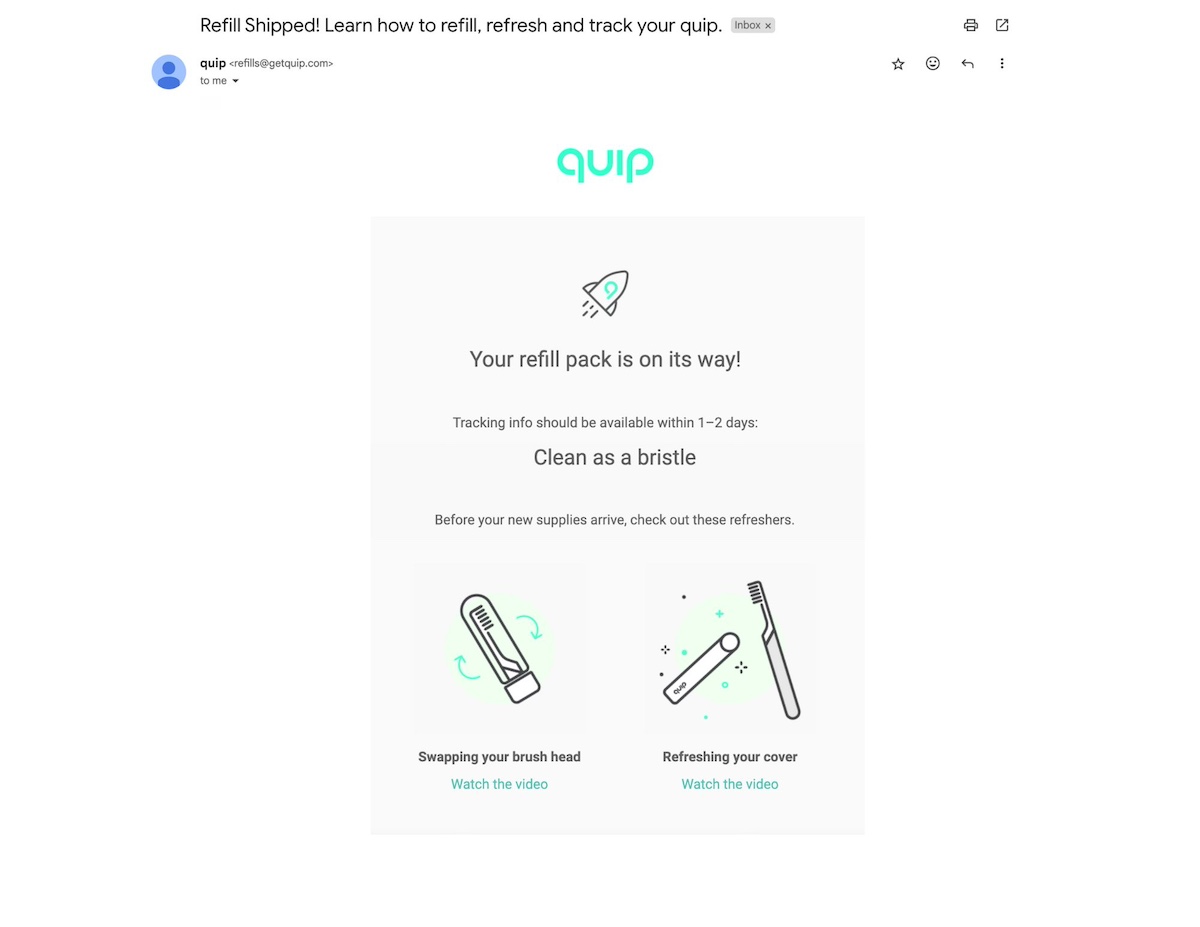
In the below example, quip sends a post-purchase email that includes tutorials on how to refill, refresh, and track the product, making sure that the customer purchase flows from start to finish. They might send other emails during this stage with video tutorials on how best to brush.

email-journey-example-education-stage

5. Upsells & Cross-Sells

With trust established, the upsell and cross-sell stage focuses on encouraging customers to explore additional products or services. This is ever so important, as existing customers can be one of your greatest sources of business, and they ensure ongoing success. 

Since you’ve already convinced these customers to buy a specific product, now’s the time to leverage your emails to highlight complementary items or premium options that not only might address other customer pain points, but that can even enhance the initial purchase.

This also means that this is when you’re really going to want to get especially strategic about email marketing personalization and segmentation so that you can make targeted recommendations. 

With that in mind, these kinds of emails might cover:

  • Personalized product recommendations
  • Bundling offers 
  • Loyalty program incentives

For example, after a customer buys running shoes, an email offering “Top-rated Running Gear to Complete Your Kit” can introduce related products like socks or water bottles. They’re already using one of your products, and have been educated on how to get the most out of it, so now’s the time to capitalize on the relationship you’ve established to get them coming back for other products. 

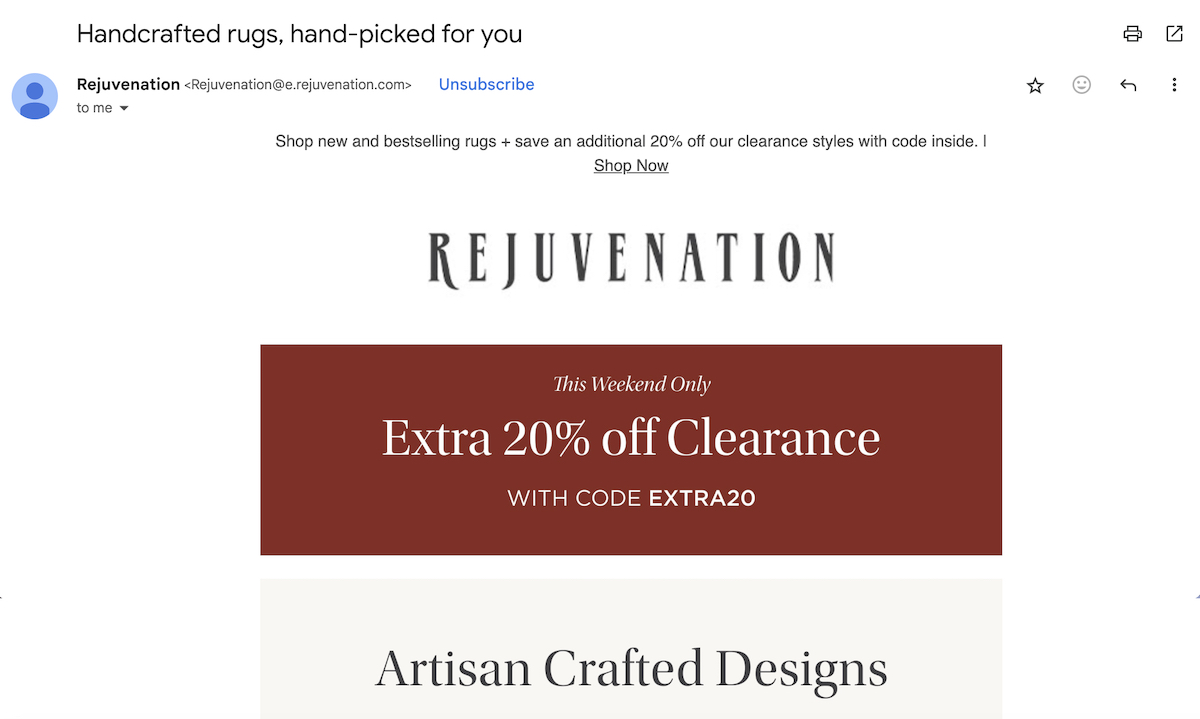
The below email journey example leverages a personalized recommendation in order to cross-sell the customer on a related product. Perhaps the customer previously bought a sofa, so now a “hand-picked” rug seems like a logical complement. During this stage, Rejuvenation might send a “buy one, get one” offer, or perhaps a different product recommendation in order to get the customer to buy more.  

email-customer-journey-upsell-stage

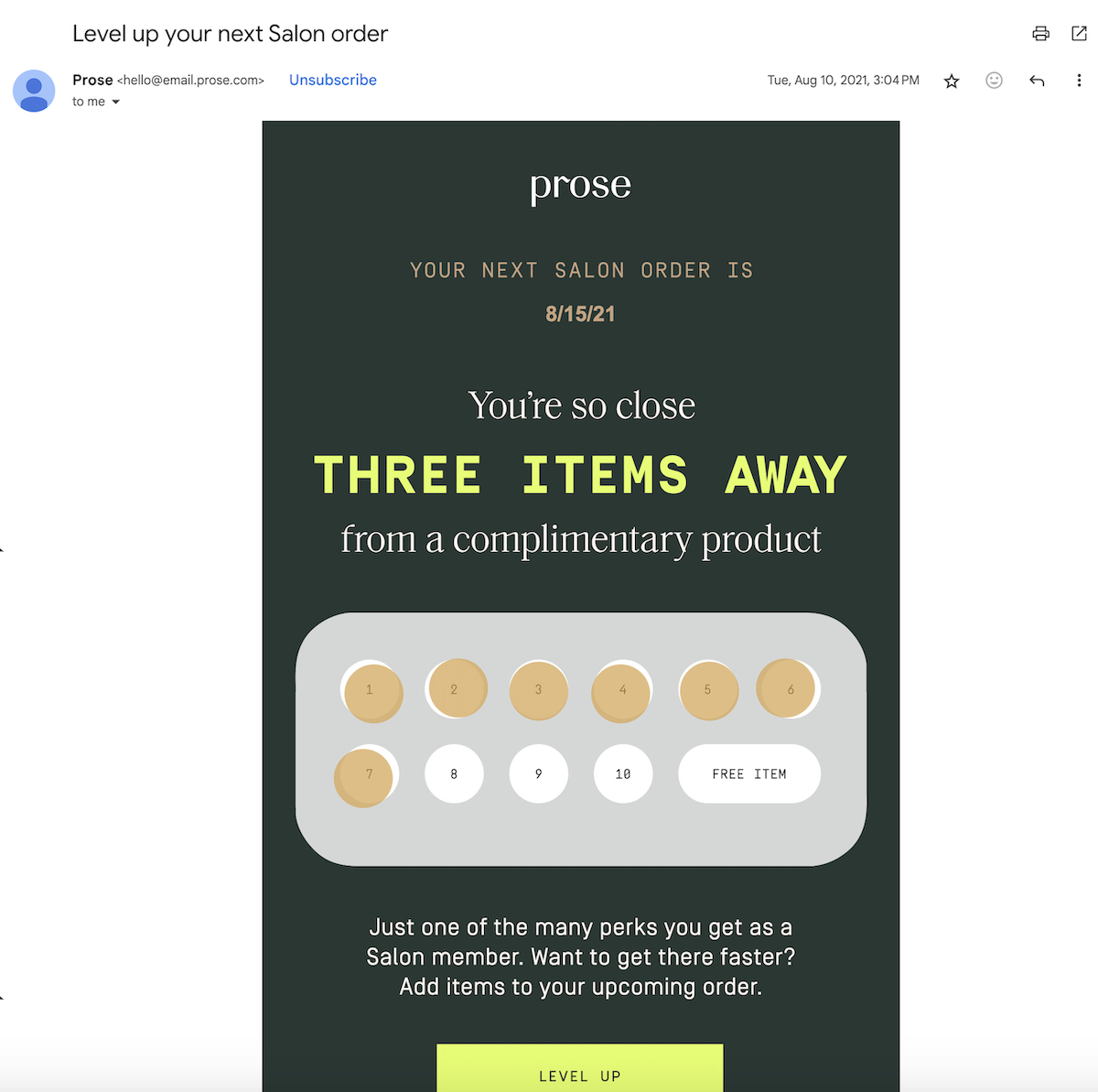
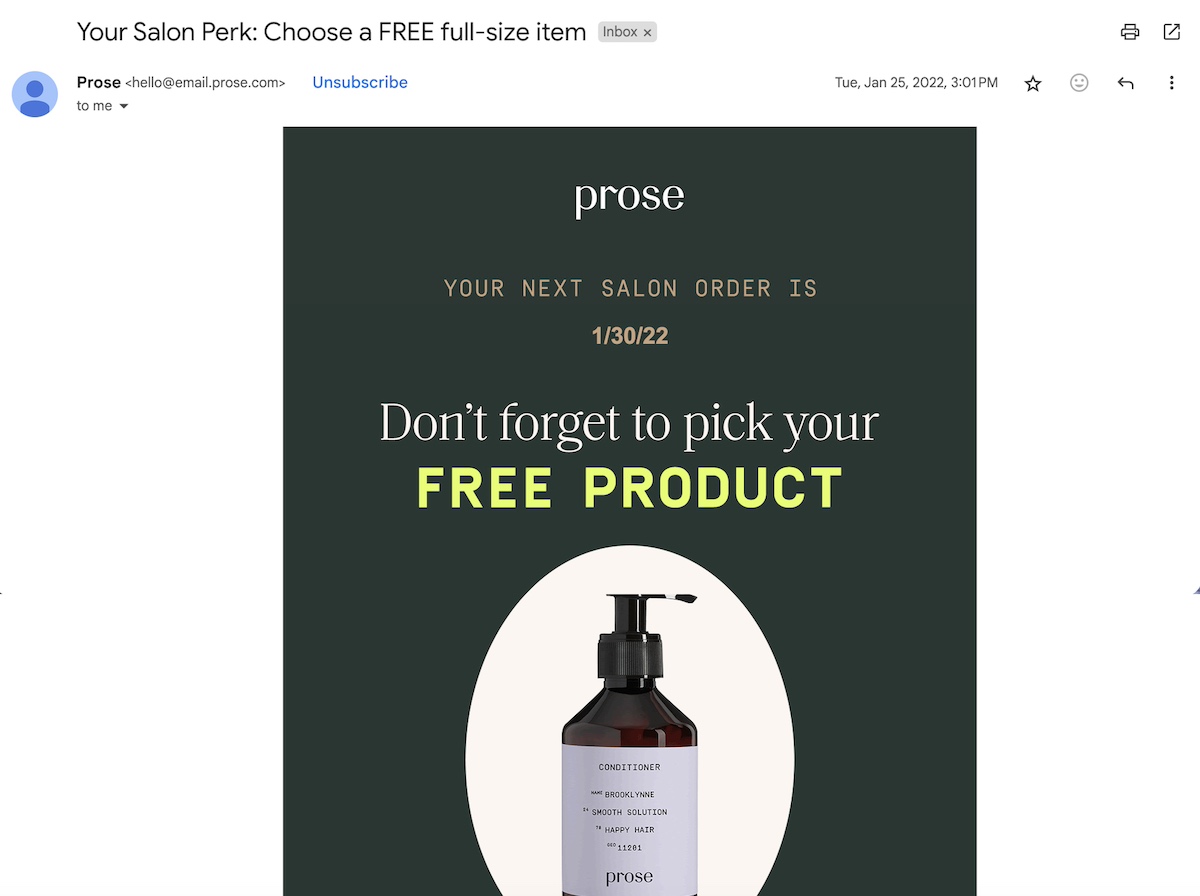
In the below example, Prose reaches out to existing customers, encouraging them to buy more so that they can get a free item. This classic upsell and cross-sell is incentivized by the temptation of a free product down the line. During this stage, they could also promote a hair mask that goes with the shampoo the customer already bought, or send an email offering a limited-time shampoo and conditioner bundle.

email-customer-journey-example-cross-sell-stage

6. Retention

Retention emails aim to keep existing customers engaged and prevent churn. By staying top-of-mind and adding continuous value, brands can encourage repeat purchases and maintain strong relationships. 

Indeed, like any relationship in life, you want to make sure your customers know that you’re around, interested in them, and available to address their needs. 

Retention campaigns benefit from visually appealing email marketing design that highlights customer perks, such as exclusive discounts or personalized recommendations, in a way that’s easy to digest.

Here are few email types you might consider sending:

  • Replenishment reminders
  • Exclusive customer perks
  • Seasonal updates

So let’s say you run a skincare brand. You might send a reminder email like, “Time to restock your favorite moisturizer” to encourage repeat orders and maintain engagement. The customer who’s running out of moisturizer could have waited until the last minute and bought the product from another brand that was readily available, but because you checked in, reminded them of their need and just how great your product is, they buy from you instead. You retained that customer!

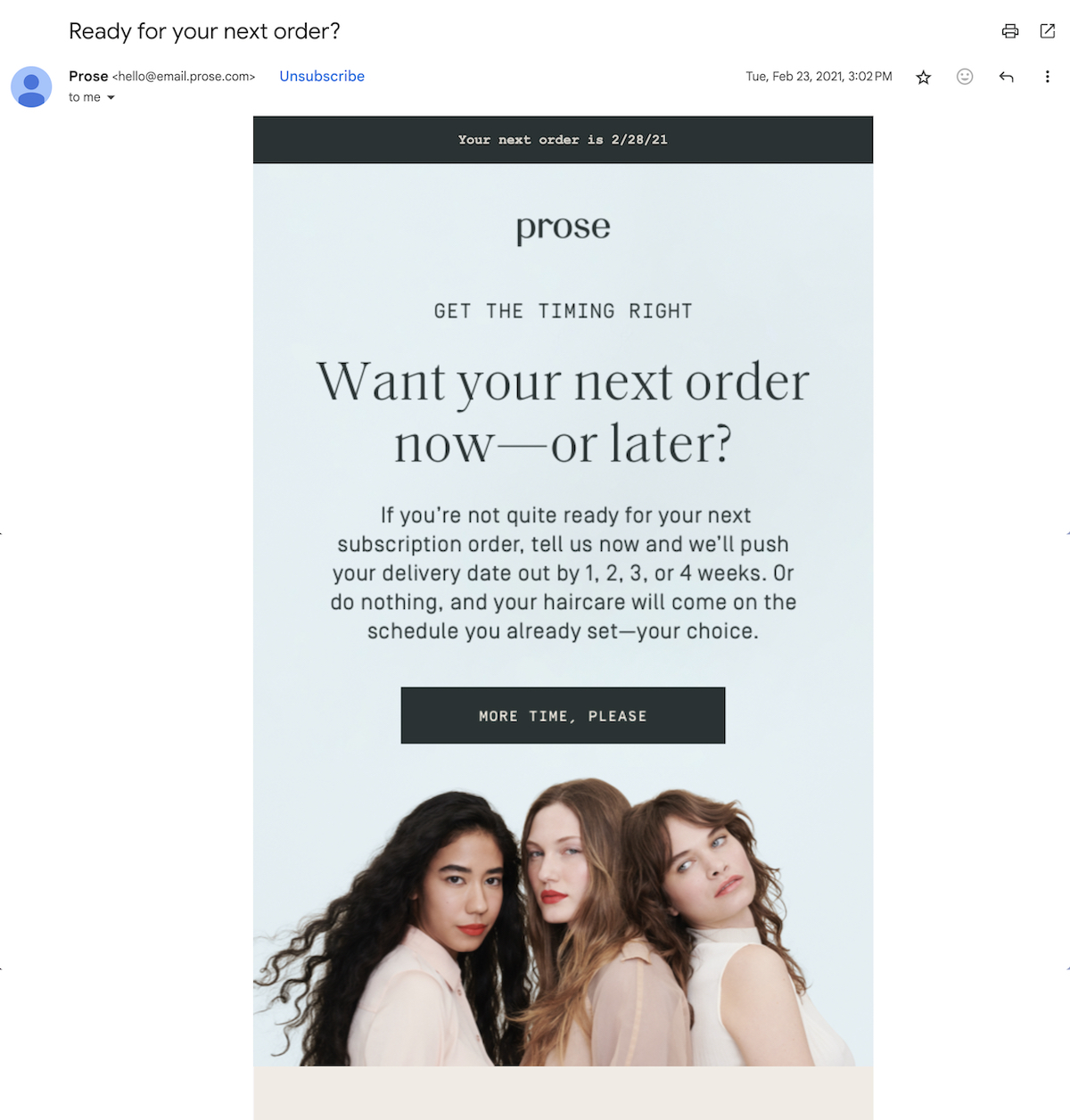
In the below email, Prose continues to move their subscriber along – this time to the retention stage. They remind the customer that they may need more product, and also that they can modify their shipping frequency. As part of retention, Prose might also send newsletters with tips and tricks, and perhaps emails with hair tutorials – all aiming to enrich the experience and maintain the relationship between company and customer.

email customer journey example rentention reminder

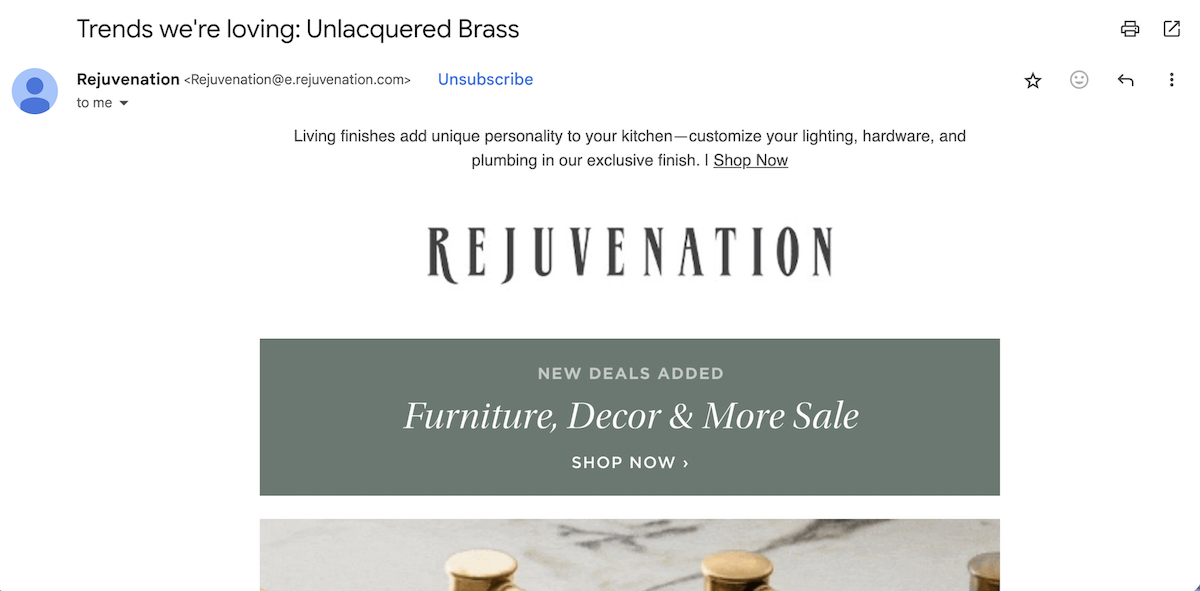
Below, Rejuvenation stays top of mind by sending out regular informational emails that might be of interest to their subscriber base. By adding constant value, they nurture their relationship with customers, and thus remind them to come back for more. As part of this stage, they might also send a “holiday favorites” guide, as well as special offers.

email-customer-journey-example-retention-stage

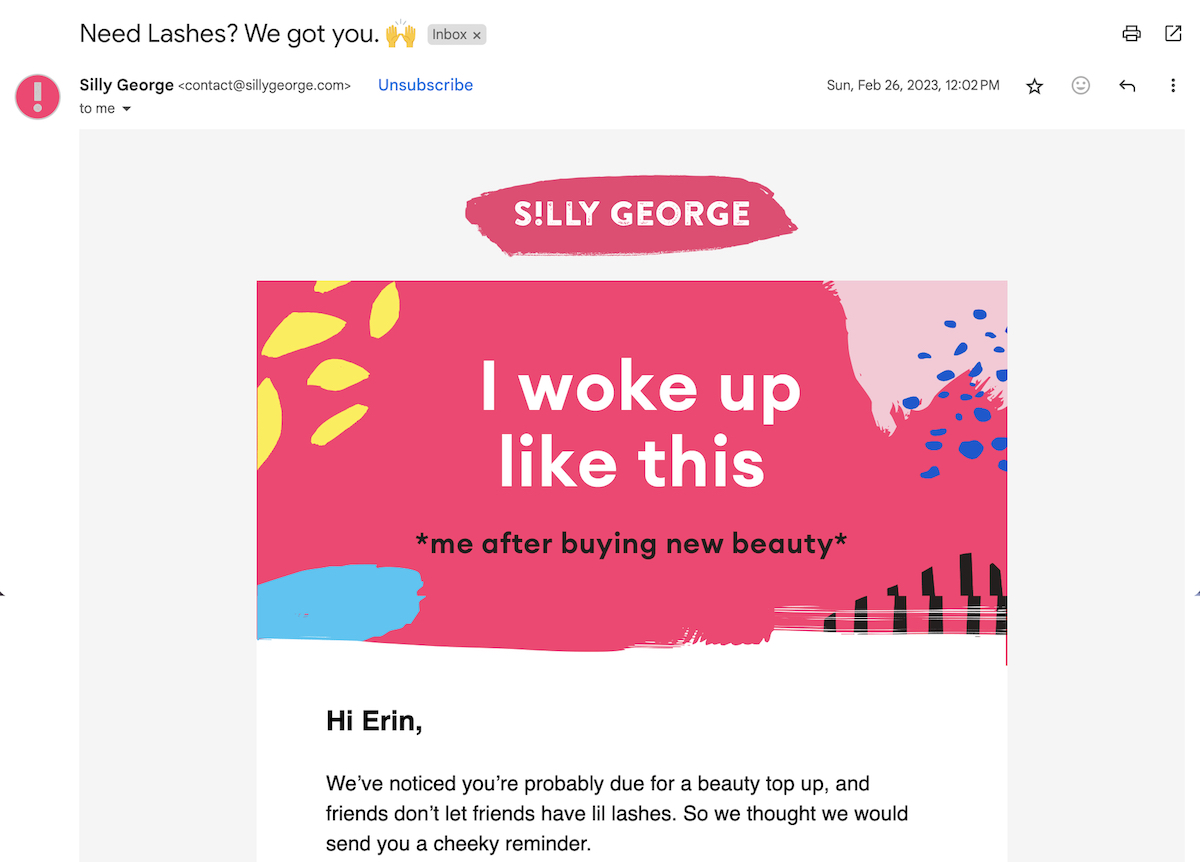
In the below retention email, Silly George reminds the customer that they’re probably due for a “top up.” This inspires the recipient to take action and make a purchase – and therefore remain a customer. During this stage Prose might also send emails with tips on lash care, as well as how-tos with other beauty advice.

email journey example retention stage reminder

7. Loyalty

Loyalty is a stage that often gets overlooked because it can feel a bit abstract. But it’s in this stage that you create repeat customers.

In the loyalty stage, emails focus on rewarding long-time customers and reinforcing their positive experiences with your brand. This is the phase where you can deepen connections and encourage advocacy.

Key loyalty email types include:

  • VIP offers or early access
  • Milestone celebration emails
  • Loyalty program updates

Once again, think of this as a proper life relationship, where you want to show gratitude so that each person (that is, each customer) knows that they are appreciated, and therefore they will hopefully appreciate you in return (buy continuing to do business with you!). So if you own, let’s say, a coffee subscription service, you could send an email thanking a customer for their one-year anniversary with an email subject line saying “Here’s a special gift for being with us: $10 off your next order.”

Not only have we tackled the loyalty stage here, but also retention. Check and check!

The below email journey example goes the milestone route, making the customer feel extra special. The company does so by wishing the customer happy birthday and offering them a special discount. As part of the loyalty stage, Cuyana could also send an in-store event invite or a special product perk for long-time clients.

email-journey-example-loyalty-stage

Prose moves on to the loyalty stage in this customer journey email example, which offers an extra gift as part of the loyalty program. These kinds of rewards build an ongoing relationship with the customer – one in which the customer feels appreciated and returns as a buyer again and again. To generate loyalty, Prose might also send emails with special loyalty program discounts, as well as early-access emails for new products.  

email-customer-journey-loyalty-stage

In the below example, quip feeds customer loyalty by offering app users various rewards. Not only does it generate dedication from the customer, but motivates them to download and use the app (and therefore add yet another valuable touchpoint with the brand). They could also send an email offering loyal customers a free dental floss, or an email with exclusive access to a new limited-quantity toothbrush. The goal: make these loyal customers feel valued.

email customer journey example loyalty stage

8. Advocacy

Advocacy emails empower satisfied customers to share their positive experiences with others. Because repeat customers are important, but customers who bring in more repeat customers are even better – the benefits are exponential! This stage helps turn loyal customers into brand ambassadors who actively promote your products or services. 

How can you tap into this magic? Consider implementing the following types of emails: 

  • Referral program invitations
  • User-generated content requests
  • Social sharing incentives

To do this, you might send an email with the subject line, “Love our products? Share the joy and earn rewards!” offering a discount for every friend referred. Or, you could offer a discount if customers post on social media and tag you. 

In the below customer journey email example from quip, the company uses a fun play on words to offer a reward to happy customers that spread the word. They could also send an email with an Instagram hashtag contest, or a special discount for providing a product review. 

email-journey-example-advocacy-stage

Who doesn’t want 20% off their next order? During the advocacy stage, Primary uses a compelling discount to get its subscribers to reach more potential customers. Advocacy unlocked – it’s as simple as that.

email-customer-journey-example-advocacy-stage

9. Re-Engagement

It’s probably clear by now the importance of returning customers – so, not surprisingly, if the customers aren’t returning, it’s time to re-engage. As such, re-engagement emails are a type of email designed to win back customers who have become inactive or disengaged. These emails should grab attention and offer hard-to-pass-up reasons to return.

Re-engage with customers with emails such as:

  • “We miss you” campaigns
  • Exclusive comeback offers
  • Feedback requests

In this re-engagement stage, an ecommerce store might send an email with the subject line, “We miss you! Here’s 20% off to welcome you back,” enticing lapsed customers to come back and see what the store has to offer.

The below email journey example from Ritual lets the customer know they’ve been missed, and tempts them to return with a 40% off discount. To further reignite engagement, Ritual could send an email asking for feedback (maybe the customer’s disappointed in the product or service), or an even steeper discount. 

email-journey-example-re-engagement-stage

Below, Cuyana reconnects with the customer to remind them to take advantage of an already-sent discount, hopefully bringing them back for another purchase. If the customer doesn’t make a purchase, Cuyana might send a bigger discount, or perhaps pique the recipient’s interest with an intriguing new product, plus an extra-special offer. Anything reasonable to get the customer back in the loop.

email-customer-journey-example-re-engagement-stage

The truth is you could have a whole email journey about awareness or have a journey that covers multiple stages, such as awareness, consideration, etc. 

So whether you move the lead through the stages with one or multiple journeys will depend on the complexity of your product, business, etc. 

With that in mind, let’s see how to create an email customer journey.

How to Create an Email Customer Journey

Alright, you’re now convinced that you should start paying attention to these email customer journey stages, but how and where to get started? Let’s break it down, step by step.

Customer-Journey-Emails-and-Touchpoints

1. Complete Your Email Journey Mapping

The first step in creating an effective email marketing customer journey is to do customer journey mapping. To do this, you’ll want to identify all the existing touchpoints where a customer interacts with your brand. This includes not only email but also website visits, social media engagement, and in-store experiences. Understanding the full customer experience helps pinpoint opportunities to integrate email effectively into your email customer journey map.

Email-Customer-Journey-Map

2. Identify Gaps in the Customer Journey

Once you’ve done your customer journey mapping, identify gaps in both their overall experience with your brand, and when it comes to your email marketing. Ideally, your email marketing will not only support and enhance the stages of the overall customer journey, but your emails will hit each of the stages as well – making for a complete email customer journey map.

To make this happen, assess where people may drop off or encounter challenges in their email customer journey. Maybe you realize that all of your emails go straight into full-on “consideration” mode – that you’re selling and promoting your product hard from the start, with no real education around the pain point.

Or maybe you make the sale, and then just push your customers out of the metaphorical nest. Off they go with your product, never to hear from you again. You’ve left the entire second half of the customer journey untouched, and lost many customers and potential customers in the process. 

So in going through the process of email journey mapping, take note of those gaps where you either haven’t addressed a stage, or haven’t done so in a thoughtful and thorough manner.

3. Address Customer Journey Gaps

With a clear understanding of your touchpoints and gaps, it’s time to start creating emails and email journeys that cater to different stages we’ve discussed. 

There are two ways to go about this. Either slot in an email to accommodate an unaddressed stage (like, say, an abandoned cart email to get people to make a decision), or create an automated email journey that more thoroughly walks subscribers through a specific stage or even multiple stages.

Review your map and determine where and with what types of messages you can support and nurture each customer through their email marketing journey.

4. Create Automated Email Journeys

As we’ve just discussed, a part of effectively moving your customers through their journey is by implementing automated email journeys. For this, you’ll want to really lean on email automation tools in order to schedule your emails, segment your audience, and deliver personalized content that aligns with their needs. 

This is an integral part of how to do email marketing, as it allows you to guide your audience through the customer journey with minimal effort. It also permits timely delivery, as well as personalized messages triggered by customer actions (and in many cases, these actions represent stages!), such as signing up, making a purchase, or abandoning a cart. 

So, in a basic automated customer journey, you might create a welcome series, where a person signs up for your emails, receives a welcome email (awareness), which is followed by an email with testimonials (consideration), and then an email with a limited-time discount and additional selling points (decision). 

Another journey might be triggered by a customer purchase, which is followed by a how-to guide (education), then by complementary product recommendations (cross-selling), then an email newsletter with brand and product updates (retention), after which you send a “we appreciate you” email with a discount (loyalty), and finalize with a “share with your friends and get a discount” email (advocacy). 

You could bounce back and forth between these stages, reinforcing steps like education, upsells, loyalty, and advocacy. The main goal is to make sure you’re not neglecting any of these stages, and therefore keep your customers moving through them (even indefinitely!).

Effortlessly create automated email journeys with the easy-to-use SiteGround Email Marketing platform. You get everything you need to run successful email campaigns, and at an unbeatable value. It includes features that make it easy to grow your audience, design attractive emails, and run targeted campaigns – and all without advanced skills, thanks to a no-code email builder, AI email writer, free customizable email templates, automated email sequences, high email deliverability, and more. 


Get started now with SiteGround Email Marketing>>

5. Measure & Optimize Email Customer Journey Success

To make sure your email marketing customer journey is effective, you’ll want to track key email marketing metrics. These include open rates, click-through rates, unsubscribe rates, and conversion rates. 

Not only is it important to evaluate each email send, but if you notice that subscribers are falling off at a certain stage – that is, perhaps a certain email is getting fewer clicks than others in your workflow – then you’ll know that this is a possible roadblock in your email customer journey and, therefore, an opportunity for improvement. 

Not sure which changes to make or what will work? Consider A/B testing to experiment with subject lines, content, and design. Continuously analyze performance data to refine and optimize your campaigns, and to make sure that your emails and workflows are moving customers through their journey successfully. 

Final Thoughts on Building an Effective Email Customer Journey

No matter your business, your sales and success depend on a customer journey – and a strategic email customer journey is a critical part of this process. By applying these aforementioned strategies as well as practical email marketing tips, you can build an email customer journey that builds engagement, loyalty, and results. With thoughtful email journey mapping, and ongoing optimization, your email campaigns can form a foundational part of your business’s success.

Start building your email customer journey today with SiteGround Email Marketing. Beautifully designed templates, a built-in AI writer, robust segmentation and automation tools, and easy-to-understand analytics, all will enable you to create a successful email customer journey in no time.

11 Proven Tactics for Effective Lead Generation

lead generation tactics

The importance of mastering lead generation has never been more important for businesses aiming to thrive. With consumer behaviors shifting and technology advancing rapidly, companies must adapt to new strategies to successfully capture and nurture potential clients.

In this blog post, we’ll explore 11 lead generation best practices that will empower you to attract, engage, and convert leads.

Whether you’re an experienced marketer or new to the field, these strategies are designed to build up your efforts and drive sustainable growth.

What Is Lead Generation?

Lead generation is the process of identifying and attracting potential customers (leads) for a business’s products or services.

It involves a variety of marketing strategies and tactics to capture interest and gather contact information from prospects, typically through online channels such as websites, social media, and email lead generation campaigns.

The goal of lead generation is to attract potential customers who show interest in your products or services, with the aim of eventually converting them into paying customers.

There are two main types of lead generation: inbound and outbound. Inbound lead generation involves creating valuable content and experiences tailored to attract prospects organically, such as through SEO, content marketing, and social media.

On the other hand, outbound lead generation takes a more proactive approach, reaching out to potential leads directly via methods like cold calling, email campaigns, and targeted advertising.

Why Is Lead Generation Important?

Lead generation serves as the bridge between attracting potential customers and actually converting them into loyal clients.

You can have a steady flow of potential customers entering the marketing funnel by strategically capturing and nurturing leads. At its core, a well-structured lead generation plan is essential for guiding prospects through the different stages of the marketing funnel – awareness, interest, decision, and action. Moreover, a lead generation plan allows you to target your efforts more precisely, guaranteeing that resources are allocated to the most promising opportunities.

However, if you’re generating leads that don’t fit your perfect customer profile, it will likely be more difficult to guide them through this marketing funnel. That’s why it’s important to put attention on lead quality rather than quantity. Make sure to attract prospective customers who are genuinely interested in your brand, as they are more likely to convert and become loyal customers. 

On the other hand, if you get more unqualified, i.e. cold leads, they will have less interest in buying your products or services. For instance, if you purchase email lists often results in generating leads that won’t become customers.

A targeted approach not only improves the efficiency of the sales process but also helps in building lasting relationships with customers, fostering brand loyalty and long-term results.

How to Generate More Leads?

Generating more leads is a fundamental goal for any business looking to expand its customer base and drive revenue growth.

In this section, we’ll cover actionable lead generation tactics to enrich your strategy for attracting and engaging potential clients more efficiently.

Let’s explore key insights and techniques designed to improve your lead generation efforts and maximize your marketing impact.

1. Optimize Landing Pages

Optimizing your landing pages is crucial for converting visitors into leads and enhancing the overall effectiveness of your lead generation strategy.

  • A well-designed landing page should be clear and focused on a single call to action (CTA) that aligns with your lead generation goals.
  • Start by checking that your landing page has a compelling headline that immediately captures the visitor’s attention and articulately communicates the value proposition.
  • Use engaging visuals and concise copy throughout the page to highlight the benefits of your offer, making it easy for visitors to understand why they should take action.
  • Next, streamline the user experience by minimizing distractions and ensuring that the page loads quickly.
  • Additionally, implement A/B testing to determine which elements, such as button colors or headlines, are most effective in driving conversions.
  • Remember to optimize for mobile devices, as nowadays a significant portion of web traffic comes from smartphones and tablets.

Here’s an example of a landing page that has a clear CTA, which is encouraging users to sign up for an email marketing course. The headline is compelling and convincing, using words like “master”. The visuals and copy throughout the page are straight to the point and lead the user to the final CTA button.

Focus on these landing page best practices to significantly increase your conversion rates and generate more high-quality leads.

2. Improve Sign-up Forms

One of the best lead generation tips is to improve your sign-up forms, as these forms are often the gateway through which potential customers express interest in your offerings.

To maximize conversions, keep your forms simple and straightforward, asking only for essential information that you need to initiate a meaningful correspondance, such as first name and email address. Consider using smart forms that adapt based on user interactions, progressively collecting more information over time as trust is built. You need to find the right balance between asking enough questions, so you can qualify your leads, but not so many that you overwhelm them.

Make sure that your form is visually appealing and the call to action button is prominent and enticing. Use clear, action-oriented language that communicates the benefits of signing up, and eliminate any unnecessary friction points, such as complicated captchas or excessive mandatory fields.

Here’s an example of a well-thought-out sign-up form, which catches the users’ attention with a straightforward question, followed by a few explanatory sentences. The form asks only for the name and email address of the user, too.

3. Create Valuable Content

Valuable content is the cornerstone of lead generation, as it serves as a powerful tool to attract your target audience. You can establish your brand as a trusted authority and nurture leads through informative and compelling content. Here are some techniques to implement:

  • Identify the needs and pain points of your audience

These are the specific challenges, problems, or desires that your target audience experiences. To identify these, conduct surveys or interviews, and also consider interacting with your audience on social media to gather insights. Analyze industry trends and competitor content to figure out common issues. Understanding pain points allows you to create your content to address their concerns effectively.

  • Craft content that provides solutions and insights

Consider different formats like blog posts, ebooks, case studies, and white papers. Each serves a unique purpose. For example, blog posts are ideal for regular updates and sharing quick insights, while ebooks allow for in-depth exploration of a topic, and are valuable for lead magnets. On the other hand, case studies showcase real-world applications and success stories, and white papers offer authoritative reports or guides on complex topics.

  • Leverage SEO best practices

SEO refers to a set of strategies that improve your content’s visibility on search engines like Google. To improve rankings, research and use proper keywords that your audience is likely to search for. Also, optimize elements like titles, headers, meta descriptions, and images for even better search results. To boost authority and search engine rankings, acquire backlinks from reputable sites.

All these are meant to capture the interest of your audience, build relationships, and convert prospects into leads, all while reinforcing your brand’s credibility and expertise.

4. Include Downloadable Assets and Email Courses

Incorporating downloadable assets and email courses on your website can significantly upgrade your ability to capture and nurture leads.

Offer valuable resources, such as ebooks, white papers, templates, or guides to provide potential customers with tangible benefits and encourage them to share their contact information in exchange. These downloadable assets not only serve as lead magnets but also help establish your authority in your industry by showcasing your expertise and insights.

Email courses, on the other hand, provide a structured way to attract prospects over time, delivering valuable content directly to their inboxes. Design a series of informative and actionable lessons to build a deeper relationship with your audience, guiding them through the stages of the lead generation process.

Both downloadable assets and email courses are resourceful lead generation methods that can be tailored to address specific needs or interests of your target audience, ultimately driving higher conversion rates.

5. Incorporate Live Chat

Having live chat on your website not only enhances customer experience but also serves as a direct line of communication between potential leads and your business. 

A live chat can improve your lead generation strategy because it provides immediate interaction with visitors who might have questions or need assistance. This allows chat operators to adjust their communication to address specific needs, making the interaction more relevant.

By communicating with visitors through live chat, you can reduce bounce rates, an important website metric. If a visitor is about to leave, a well-timed chat invitation can re-engage them, providing the information or assistance needed to keep them on your site longer.

It’s also an excellent tool for gathering valuable data about your prospects. Ask the right questions during the chat, so you can collect contact information and insights into the visitor’s needs and preferences. 

At the end of the day, live chat allows you to qualify leads in real-time. Ask targeted questions, so that you can quickly determine if a visitor is a good fit for your products or services.

6. Use Email Marketing

Email marketing remains one of the most effective strategies for lead generation due to its direct and personalized nature.

It allows you to craft tailored campaigns with which you can nurture potential leads through the sales funnel, delivering value at every stage.

  1. To build a profitable email marketing strategy, start by segmenting your email list based on demographics, behaviors, or past interactions to ensure that your messages are targeted.
  1. Then, create compelling subject lines and engaging content to capture attention and encourage recipients to take action. Make sure to incorporate clear calls to action that guide leads towards desired outcomes, such as signing up for a webinar, downloading a resource, or scheduling a consultation.
  1. Additionally, by leveraging automation tools, you can manage follow-ups and maintain consistent communication, making certain that no lead is left unattended.

With SiteGround Email Marketing, you get everything you need to send successful email campaigns in a few clicks. It allows you to easily build and grow your subscriber list with the user-friendly Lead Generation plugin for WordPress. To nurture your leads, it has an built-in AI writing assistant and free AI-generated image gallery that help you create impactful and beautiful emails in minutes. Plus, its analytics tools provide you with insights on your email campaigns and audience behavior, which eventually help improve your marketing efforts and your sales.

7. Create a Referral Program

Another powerful strategy for lead generation is creating a referral program. It leverages the trust and satisfaction of your existing customers in order to attract new prospects.

People are more likely to trust recommendations from friends, family, or colleagues than traditional advertising. That’s why referral programs are a highly effective way to generate quality leads.

Incentivize your current customers to refer others and you’ll not only expand your reach but also enhance your customer base, turning them into active advocates for your brand.

A well-structured referral program can lead to a steady stream of leads, as these prospects come with a pre-established level of trust and interest in your brand. On top of that, referral programs can enhance customer loyalty, as participants feel more connected to your brand and appreciated for their role in its growth.

As a result, a referral program can amplify your marketing efforts, reduce acquisition costs, and drive sustainable business growth.

8. Advertise on Social Media

One of the most lucrative online lead generation strategies is advertising on social media. Social media provides extensive reach, precise targeting capabilities, and an interactive experience.

Platforms such as Facebook, Instagram, LinkedIn, X, and TikTok host billions of active users, providing you with access to a vast audience.

The advanced targeting options available on these social media platforms also allow you to hone in on specific demographics, interests, behaviors, and even life events, securing your lead generation campaigns to reach the most relevant potential leads. This precision reduces wasted ad spend and increases the likelihood of attracting high-quality prospects.

Social media ads are designed to be visually engaging and can incorporate various formats—such as carousel ads, video ads, and interactive stories—that capture attention and drive communication. These ads can include compelling calls to action that encourage users to take specific steps, like signing up for a newsletter, downloading a free resource, or registering for an event.

Advertising on social media allows for robust analytics and insights, as you’re able to track performance in real-time and make data-driven adjustments to optimize your campaigns. You can continually refine your strategies to improve conversion rates and lower acquisition costs by leveraging A/B testing and audience insights.

Social media not only broadens your reach but also strengthens your ability to connect with the right audience, making it an indispensable tool for lead generation.

9. Run Contests and Giveaways

Running contests and giveaways taps into the innate human desire for rewards and competition. These promotions create excitement and urgency, encouraging participants to interact with your brand and share the opportunity with their networks. As a result, they increase visibility and attract new prospects.

To generate leads through contests and giveaways, you should align the prize with your target audience’s interests. This alignment not only attracts the right participants but also increases the chances of converting them into long-term customers. For instance, offering a product or service you sell as a prize will drive entrants who are genuinely interested in what your business offers.

Capturing leads requires participants to provide their contact information, such as an email address, to enter the contest. This allows you to build a list of potential leads who have already shown interest in your brand. You can further elevate lead quality by incorporating additional entry options, such as following your social media accounts, sharing the contest with friends, or signing up for a newsletter.

To maximize participation and reach, promote your contest across various channels, including social media, email, and your website. Use engaging visuals and compelling calls to action to capture attention and drive more entries.

Contests and giveaways generate leads, foster brand awareness, and thus create a win-win scenario for both your business and your audience.

10. Organize Events and Webinars

One of the most important lead generation strategies is organizing events and webinars. It allows you to provide valuable, interactive experiences that position your brand as an industry leader. What’s more, these events offer a platform to showcase your expertise, build trust, and cultivate relationships with potential customers.

Events and webinars provide participants with valuable insights, knowledge, and solutions to their problems. They address your audience’s pain points and interests, attracting attendees who are genuinely interested in what your business has to offer.

Unlike static content, events and webinars provide real-time interaction and allow participants to ask questions and connect with your brand directly. This interaction helps build rapport and trust, which are crucial for lead generation.

Here are a few simple steps for implementing this strategy:

  1. Choose appropriate topics: Select topics that resonate with your target audience and align with your business objectives. Validate that the content is informative and actionable to maximize its value.
  2. Promote effectively: Use multiple channels to promote your event, including email marketing, social media, and your website. Create compelling promotional materials that highlight the benefits of attending.
  3. Capture lead information: Require registration for your events in order to collect contact information from participants. This can include names, email addresses, and any other data that will help you nurture these leads post-event.
  4. Engage during the event: Utilize interactive elements, such as polls, Q&A sessions, and chat features to keep participants active during the event. This interaction not only enriches the experience but also provides additional insights into your audience’s needs.
  5. Follow up after the event: After the event, follow up with attendees to thank them for participating and provide additional resources or offers to nurture them further.

11. Offer a Free Trial for Products or Services

Offering free trials is an effective lead generation strategy because it allows potential customers to experience your product or service firsthand without any financial commitment.

This firsthand experience can be far more persuasive than any marketing message, as users can see the benefits in action.

To implement this strategy, begin by setting clear objectives. Define what you want to achieve with your free trial––whether it’s increasing sign-ups, boosting conversions, or gathering user feedback.

Next, incorporate an easy sign-up process for the trial. Make the process simple and user-friendly. Avoid asking for too much information upfront, as this can deter potential leads from participating.

Also, set a specific duration for the free trial to create a sense of urgency and prompt users to explore your product or service thoroughly. Common trial periods range from 7 to 30 days, depending on the complexity of the offering.

During the free trial period, provide excellent onboarding and customer support. Offer tutorials, guides, and responsive customer service to help users make the most of their experience.

Last but not least, develop a follow-up strategy to convert trial users into paying customers. This can include personalized emails, exclusive promotions, or consultations to address any questions or concerns they may have.

Lead Generation FAQs

What Is a Lead Generation Tool?

A lead generation tool is a software application or platform designed to help businesses attract, capture, and manage potential customers, known as leads. These tools streamline the process of identifying and engaging with prospects, making it easier to convert them into paying customers. Lead generation tools are useful for collecting information about potential customers, targeting audiences, automating processes, providing analytics and reporting, and more.

How to Improve Lead Quality?

To achieve quality lead generation, follow these steps:

  1. Refine your target audience – define your ideal customer profiles and buyer personas.
  2. Optimize your lead scoring system – assign values to leads based on their actions and fit with your ideal customer profile.
  3. Deepen content relevance – directly address the needs and interests of your target audience.
  4. Leverage advanced targeting – advertise on different platforms to reach specific segments of your audience, using criteria such as location, industry, job title, and interests.
  5. Implement lead qualification processes that involve asking the right questions during initial interactions through forms, surveys, or direct conversations.
  6. Use retargeting campaigns to captivate visitors who have shown interest in your products or services but have not yet converted.

What Are Some Lead Generation Challenges?

Being aware of lead generation challenges can help you develop more effective strategies to attract and convert potential customers. Here are some of these challenges:

  1. Identifying the right audience – without a clear understanding of who your ideal customers are, your marketing efforts may reach the wrong people, leading to low-quality leads and wasted resources.
  1. Generating high-quality leads – many businesses struggle to attract leads that are genuinely interested and have a high possibility of becoming paying customers, which can result in inefficient sales processes.
  1. Creating engaging content – businesses often find it difficult to consistently create useful content that aligns with their audience’s needs and encourages them to get involved further.
  1. Managing lead data – checking data accuracy and effectively integrating it with CRM systems and other tools is essential but challenging, especially as data privacy regulations become more stringent.
  1. Adapting to market changes – keeping up with changes in the digital marketing landscape and adapting lead generation strategies accordingly is a continuous challenge for businesses aiming to stay competitive.
  1. Aligning sales and marketing teams – communication gaps, differences in objectives, and lack of collaboration can hinder the seamless transition of leads from marketing to sales, affecting conversion rates.

Bring Your Business to the Next Level with Lead Generation

With these lead generation tactics, you can connect with the right audience and gather high-quality leads for your business. 

Now, if you are looking for a reliable email platform that will help you to not only generate more leads but also stay in touch with them, try out SiteGround Email Marketing – You’ll be able to create beautiful and engaging campaigns with just a few clicks.

Focus on continuous improvement and adaptation so that lead generation can enable your business to achieve new heights of success.

The 13 Essential Types of Emails Explained Simply

types of emails

With so many email types to choose from, email marketing can feel overwhelming, but it remains one of the most cost-effective marketing channels, offering an impressive ROI. It’s a powerful tool you can use to promote your business, project, or initiative.

In this guide, we’ll break down the 13 essential types of emails in a simple way. You’ll get a clear overview of the different types of emails, making it easy to decide which ones are right for your goals.

What Are the Different Types of Emails?

Here, we’ve compiled the most widely used and effective email types that businesses commonly use for their email marketing campaigns. Let’s check them out!

1. Welcome Emails

When a new subscriber joins your email list, welcome emails serve as your digital handshake – a critical first contact that goes beyond a simple subscription confirmation. This first message is a golden opportunity to establish trust, showcase your brand’s personality, and create a connection with your newest subscribers.

These initial communications also serve as an opportunity to build credibility. Customers expect welcome emails shortly after joining an email list (usually within 24 hours). Plus, welcome emails generate significantly higher open and click rates compared to the standard email campaigns.

Note that welcome emails can be categorized into two primary subtypes: a one-time introduction to the brand, which provides an immediate snapshot of who you are and what you offer, and an onboarding email series that guides new subscribers through a more comprehensive, multi-step journey of getting to know your brand, products, or services. These approaches differ in their duration of engagement, allowing you to tweak your initial communication to your marketing objectives.

Pro tip: Use welcome emails as an opportunity to offer a valuable incentive like a discount code, free resource, or exclusive first-time subscriber perk, which not only show appreciation but also encourage subscribers to engage with your brand immediately.

Here’s one really good welcome email from the chocolate manufacturer Hotel Chocolat. It opens with a catchy, personalized subject line: “Mark, a world of chocolate happiness awaits 🍫” and combines all effective elements for a welcome email. Its minimalist, modern email design features a clear call to action (CTA), high-quality images, and concise yet engaging copy.

The personal note from the company’s CEO adds a thoughtful touch. Additionally, to incentivize new subscribers to make a purchase, the company has offered a 15% discount and placed it at the top of the email header. Notice that they’ve also included images and links to their key products to further prompt people to make a purchase – a smart approach you could also try in your welcome email campaigns.

2. Newsletter Emails

Newsletters are the core of many email marketing strategies, offering a consistent way to connect with your audience. These emails deliver regular updates about your business, share news, milestones, upcoming events, provide helpful tips, or offer educational content tied to your niche.

They’re not just informative, they’re also a way to remind subscribers why they joined your list in the first place. But their purpose goes beyond selling – newsletters can help you keep your audience engaged during the quieter moments between promotional campaigns.

Newsletters are typically sent weekly, biweekly, or monthly, helping you keep the balance between staying present in your audience’s inbox and avoiding the “unsubscribe” button. The best newsletters feel personal and conversational, as though they’re written with the subscriber in mind.

Pro tip: Experiment with a mix of formats like short updates, visual-rich designs, or storytelling to keep your newsletters engaging and interesting. And always give readers a reason to open the next one, whether it’s exclusive content, helpful insights, or something fun to look forward to!

Check out this newsletter by Creative Mornings and take inspiration from their tactics to improve your own newsletter. It has several effective elements that make it well-designed and informative. First, it has a clear and engaging thematic focus. The content of the email is insightful and educational in an accessible way.

The creators have used an eye-catching header image that aligns with the surreal theme, plus the overall layout is clean and modern, making the newsletter easy to scan. The relevant content and call to action encourage readers to engage and support their community.

3. Curated Content Emails

Curated content emails are similar to newsletters – think of them as a focused bulletin designed to inform and educate. Unlike newsletters, which usually share a mix of updates specific to a business, curated emails spotlight news, articles, and other relevant content from both in-house and third-party sources that are relevant to your audience.

These emails often showcase your own insights alongside carefully selected resources from across your industry. The goal? To position your brand as a trusted expert while keeping your audience engaged with useful, topic-specific information in your field, even when you’re not actively promoting products or services.

Pro tip: Add your own perspective or commentary to the curated pieces to reinforce your brand’s voice and authority. Organize your curated email into sections for better readability (e.g. “Trending Articles,” “Tool of the Week,” or “Quick Tips.”) And don’t forget a clear call to action, it could be as simple as inviting readers to learn more, share the email, or explore related topics on your site!

4. Sales Promotion Emails

Sales promotion emails are designed to drive sales and spark immediate action from your audience. These emails are focused on promoting specific products, services, or special offers that create a sense of urgency and excitement.

Promotional emails have a clear goal: to convert subscribers into customers or to entice customers to buy more. They typically feature eye-catching announcements about sales, discounts, exclusive deals, or limited-time offers that compel recipients to take action. Here are some of the most common subtypes of promotional emails.

Product Launch Emails

Designed to generate initial sales for new offerings, these emails usually introduce new products with special pricing. The goal with them is to create an incentive for subscribers to be among the first to try your new product or service. A good approach is to offer exclusive early-access discounts to boost initial sales and reward your most engaged email subscribers.

Pro tip: When working on a product launch email campaign, always highlight the unique value of your new product. Include clear, catchy images and a time-sensitive offer to prompt immediate action.

To make a bold statement with your new product, take inspiration from the email below by Nissan. It has a sleek and modern design that aligns well with Nissan’s brand identity. The prominent display of their new model along with the bold caption “THE ICON HAS ARRIVED” immediately grabs attention and creates a sense of excitement around the new vehicle.

The personalized greeting adds a nice custom touch and the copy effectively highlights the key features of the car, encouraging the reader to be one of the first to experience the vehicle.

Discount and Sale Emails

With this type of email, you can inform subscribers about significant product or service price reductions, or highlight store-wide sales events. Again, focus your content on the key features your subscribers will get, how they will benefit them, and the value of the deal.

Pro tip: Offer email subscribers exclusive first access to the sales before making them public on your website or app. This approach makes subscribers feel valued and creates a sense of special treatment that can strengthen brand loyalty and encourage conversion.

For reference, check out this sale email from Ren. It effectively promotes a 20% off sale on their product line. The design is visually appealing, with clean, minimalist styling and high-quality product imagery. The copy is concise and highlights the key benefits of their products to the customer.

The email also incorporates a strong call to action with the “Shop Now” button, making it easy for customers to take advantage of the limited-time offer. We highly recommend you also place a visible CTA when you feature a discount. The inclusion of a free gift with purchase as Ren did in their email, further incentivizes customers to buy.

Seasonal Email Campaigns

Seasonal email campaigns capitalize on holidays or special events to create themed content and time-sensitive offers. With these emails, you can use the natural excitement and anticipation surrounding specific times of the year, such as Black Friday, Cyber Monday, Christmas, Valentine’s Day, and the back-to-school season.

The key is to create a sense of relevance that resonates with your audience’s current mood, and of course, shopping mood. Seasonal emails can take many forms – exclusive holiday campaigns with discounts, themed content deals, and more.

Pro tip: Personalize your seasonal campaigns if you know your audience’s preferences. This will make the offer feel more customized and relevant to your subscribers. Also, pay special attention to your email subject lines. During busy holiday periods, people receive tons of emails so it’s important to make yours stand out but not in an aggressive way.

Steal some nice ideas from this stylishly crafted email by Ridge about their Cyber Monday sale. This holiday gift catalog showcases several effective marketing tactics. They have a short and sweet subject line: “🎁 Holiday Gifting Made Easy.” The clear call to action to “shop early, stress less” and the time-sensitive Cyber Monday sale create a sense of urgency.

Highlighting key product features like “premium materials” and “lifetime warranty” helps establish trust and value. The diverse product selection, including kits and men’s rings, caters to different customer needs. Overall, the design is visually appealing and the copy concisely conveys the product’s benefits, making this an engaging holiday marketing email.

Want to create emails with stunning designs and persuasive copy? Try the SiteGround Email Marketing Platform today, and gain access to an AI-powered writing assistant and a curated AI image gallery to elevate your email campaigns effortlessly.

5. Re-engagement Emails

Imagine subscribers who once eagerly opened your emails but have now faded into silence. We all have those moments! Re-engagement emails are what can bring them back. The goal is to reconnect with audience members who haven’t interacted with your content for some period, preventing them from completely dropping off your list.

Re-engagement emails should remind them about the value of your brand, often accompanied by a special deal or other incentive.

Pro tip: Consider including a simple form or page where subscribers can update their interests, choose their preferred email frequency, or select the types of content they want to receive from you. This approach shows you value their time and are committed to delivering content that truly helps them.

To create an effective re-engagement email, focus on emotional connection and clarity just like Spotify did below. Use a compelling subject line like their “We miss you…” that sparks curiosity or sentiment. Pair this with a conversational tone that acknowledges the customer’s past experience and invites them back warmly. Eye-catching visuals, like vibrant illustrations, can make the email memorable and engaging. Finally, include a clear call to action and a time-sensitive offer, such as a discount.

6. Drip Campaign Series

Drip campaigns, also known as email automations, are email sequences sent automatically over time, designed to deliver the right message at the right moment. They are used for different purposes – onboarding new customers, educating potential leads, or nurturing them through a sales funnel. Each drip email is timed and crafted to gradually build engagement. Let’s take a look at some of the most popular subtypes of drip campaigns.

Lead Nurturing Emails

Lead nurturing emails are designed specifically for potential clients who have shown initial interest in your product or service but haven’t yet made a purchase.

Your goal with it is to offer content that provides value, and gently guides prospects through their decision-making journey. For this purpose, lead nurturing campaigns are usually structured as a series of emails, gradually addressing the leads’ pain points.

These emails might include educational content, case studies, helpful resources, or tutorials on how your product works.

Pro tip: if possible, consider segmenting your leads into different groups based on their needs, stage in the buying process, industry, or similar. This will make your lead-nurturing emails more relevant and effective.

siteground email marketing

Customer Onboarding Series

The onboarding series aims to help new users smoothly transition from signing up to successfully using your product or service. They guide customers step-by-step through the setup process, offering additional tutorials or useful tips to ensure that they quickly start using your product or service and see its value.

As we mentioned in our Welcome emails section, a customer onboarding series usually begins with a warm welcome email. Then, you could add a clear call to action to get started, such as logging in, completing a profile, or exploring key features. The next emails may feature tutorials, best practices, or answers to common questions to keep users on track.

Pro tip: Try to keep your onboarding series as short and straightforward as possible to prevent clients from postponing the use of your products. Also, congratulate them on completing a step to motivate them and suggest the next action.

Check out how this company has broken down the onboarding process. The email provides a clear three-step process to guide users through publishing their first book using Lulu’s platform. It also includes links to helpful resources, such as a video tutorial, a blog post, a checklist, and a guide to support users through potential challenges. Their message is action-oriented and also includes a limited offer to encourage taking the next step.

7. Transactional Emails

Transactional emails are triggered by a user’s action such as a purchase or a registration. While their primary purpose is administrative such as confirming a purchase or shipping details, they’re also an opportunity to enhance the user experience. By crafting these emails in your brand’s unique tone of voice, you can maintain consistency and leave a positive impression. Let’s see some examples of transactional emails.

Order Confirmations Emails

Order confirmation emails are sent immediately after a customer places an order in your online store. These emails reassure customers that their transaction was successful while providing important details about their purchase.

Typically, they include the order number, product details, prices, delivery address, payment summary, and sometimes a downloadable invoice. Because customers expect these emails, they tend to have high open rates, making them a must.

Pro tip: Order confirmation emails are an opportunity to showcase your commitment to customer satisfaction. Adding a personal touch, such as a thank-you message or friendly note, can leave a positive impression. Including clear contact information, such as your customer support email, also helps alleviate any post-purchase anxiety, showing buyers you’re ready to assist if needed.

Shipping Updates Emails

Shipping emails provide essential details like shipping confirmation, estimated delivery dates, and tracking numbers, ensuring that customers can monitor their orders at every stage. While practical in nature, shipping updates can also reflect your brand’s personality and tone of voice.

Pro tip: Consider using shipping confirmation emails to suggest related or complementary products. For example, if someone orders a camera, you might include a suggestion for camera accessories or editing software.

Password Reset Emails

We’ve all been there – forgetting a password or facing a potential security concern that locks us out of an account. Password reset emails are the key to resolving these moments efficiently. They usually include a clear link or instructions for resetting the password, as well as a way to report the email if the user did not request the reset.

While these emails are straightforward, it’s important to keep them concise and clear, making sure users understand their password hasn’t changed yet and that action is required. A clear reset link should be prominently displayed.

Pro tip: Use reassuring language to let users know their account hasn’t been changed yet. Since this type of email often sounds the same, play with the design to make yours stand out.

Here’s a nice, unconventional reset password email by Lingo. They use bold colors that align with their brand palette, a friendly illustration, and a calming, concise caption.

8. Event-Triggered Emails

Event-triggered emails are highly personalized messages sent automatically in response to specific user actions or milestones. These emails are tailored to a customer’s behavior, such as signing up, abandoning a cart, or reaching a key milestone like a birthday or anniversary. Let’s see some examples.

Abandoned Cart Emails

Abandoned cart emails remind users about the items they’ve left behind in their online shopping carts. Sent within 24 hours of cart abandonment, they act as a gentle nudge to complete the purchase.

These emails often feature images of the forgotten items, paired with persuasive messaging that reignites the customer’s interest. They might also include social proof, such as reviews or ratings.

Pro tip: Sweeten the deal by offering a limited-time discount, free shipping, or another incentive to encourage customers to take action. Add urgency with phrases like “Items in your cart are selling fast!” to motivate them to return and complete the purchase.

For a successful abandoned cart email, take cues from Loftie’s approach. Start with a relatable subject line, like “Still not sure?” to empathize with the customer’s hesitation. Reinforce your product’s value with emotional messaging, such as “You deserve better sleep,” paired with a clear incentive like a discount offer. Use inviting visuals that reflect your brand’s purpose. Add trust-building elements, like third-party testimonials or reviews, to provide social proof and reduce hesitation.

Upsell/Cross-Sell Emails

Upsell and cross-sell emails are another subtype of event-triggered emails that leverage customer purchase history and interactions to recommend additional or improved products. Upsell emails suggest upgraded versions or premium alternatives to products a customer has already purchased while cross-selling emails pair complementary items that enhance the original purchase.

Pro tip: Make recommendations feel genuinely helpful rather than pushy. These emails work because they build upon the customer’s existing trust in your brand. If your upsell recommendation is meaningful and thoughtful, you’re not just selling – you’re solving problems for your customers.

Milestone Emails

These are triggered emails that celebrate your customers’ or subscribers’ unique journeys and achievements, making the recipient feel seen and appreciated. They could mark a birthday, an anniversary of membership, or highlight their year’s achievements, simply showing that your business values individual customer experiences.

Milestone emails are characterized by a high level of personalization. You can send out milestone emails regarding clients’ most-listened music genres (like Spotify’s Wrapped), total fitness miles, shared rides, or membership duration.

Use an enthusiastic and warm tone that makes the recipient feel truly special and more connected to your brand.

Pro tip: Combine celebration with a nice reward, such as an exclusive discount, voucher, or service that celebrates their loyalty.

If you’re looking to create milestone emails, take a cue from Grammarly’s approach. First, use data visualization to clearly showcase user progress, such as key metrics or milestones. Create a clean, visually appealing design that doesn’t overwhelm users. Try crafting original email copy, similar to how Grammarly provides an overview of their customers’ productivity, mastery, and vocabulary growth.

9. Survey & Feedback Emails

Survey and feedback emails are a powerful tool for businesses to gather valuable insights directly from their audience. These emails help companies understand customer experiences, preferences, and potential concerns, which can be used for business improvements and to refine customer satisfaction.

To incentivize more people to participate, you might offer a small reward such as a discount code, entry into a giveaway, relevant helpful content, or a promise to share the results of the survey.

Pro tip: Keep the survey short and clearly communicate the time commitment upfront. This approach significantly increases the likelihood of completion and reduces respondent fatigue. Consider even stating exactly how long the survey will take to complete, for example, “This quick three-minute survey will help us serve you better.”

10. Event Emails

These targeted emails inform and excite potential attendees about upcoming events such as webinars, conferences, meetups, workshops, and similar. Craft an email message that is concise, informative, and compelling from the very first line.

Communicate the event’s unique value proposition in the beginning, and highlight the most significant benefit attendees will gain, whether it’s exclusive insights or networking opportunities. Include all necessary details such as the exact date, time, location, event link (if virtual), and straightforward registration info. Additionally, don’t forget to send follow-up reminder emails to keep the event top of mind and boost attendance rates.

Pro tip: If a thought leader or influential speaker is part of the event, include a relevant quote from them to increase credibility and attract more participants.

11. Cold Emails (Outreach)

Cold emails are your first contact with a potential client who doesn’t know your business yet. These outreach messages introduce your company and open the door to a potential business relationship. Your primary goal when using them is to spark interest and create an opportunity for further conversation with the prospect.

Your success depends on understanding your target audience deeply. Who are they? What challenges do they face? The most effective cold emails are carefully researched and personalized, showing that you’ve taken the time to understand the recipient’s specific needs and context. This means avoiding generic, mass-produced messages and instead creating an original targeted message.

Pro tip: The key to a successful cold email is balance. You want to be professional and compelling without seeming pushy or desperate. Your message should quickly demonstrate the value you can provide, address a specific pain point, and give the recipient a clear, low-pressure reason to continue the conversation.

12. Thank-You Emails

Whenever relevant, use thank-you emails as they will help you build stronger connections with your audience. They show the human side of your brand, demonstrate good communication practices, and make customers feel valued. You can use them for various reasons – for a recent purchase, a new subscription, etc.

Pro tip: If possible, customize your content to reflect the specific interaction or purchase. Use the customer’s name or reference their specific action.

Below, Onyx Coffee Lab shows how you can create a short but sweet thank you email after a purchase was made by a client. The email is sent within 24 hours of the purchase, which is a great way to show appreciation while the experience is still fresh for the customer. Doing this, you not only make the customer feel valued, but you also keep your brand top of mind. The message below is warm and personal, highlighting the positive experience and ensuring that customers know their purchase matters.

13. Privacy Policy Emails

Privacy policy emails serve as official notifications to users, ensuring they are informed about important changes to your business’ terms of service. They help businesses maintain transparency and legal compliance.

Privacy policy communications should be clear, direct, and as short as possible. Avoid using marketing talk and legal jargon. Use simple, direct language that explains exactly what has changed and how it impacts the user.

To make it easily scalable, you can highlight the most important changes in a bulleted format. Remember that these emails are about building trust, not creating confusion.

Pro tip: Include a link to the full, detailed policy document and a specific date when the changes will take effect. This shows your openness and will help users understand the timeline and allow them to review the changes thoroughly.

Why Should You Send Different Types of Emails?

Each type of email plays a unique role, from nurturing customer relationships to boosting sales and building brand awareness. The right email at the right time can make all the difference. Understanding what each type of email is best suited for allows you to align your messages with your goals and engage your audience more effectively.

Before hitting “send,” take the time to clarify your email marketing strategy, though. Knowing your goals and audience will help you choose the right email formats and create campaigns that truly resonate. Yes, we’re talking less spammy, more awesome!

How to Send Marketing Emails Easy, Conveniently, and Fast

Successful email marketing isn’t just about crafting the perfect message, though! It’s about having the right tools at your disposal. Choose a reliable and user-friendly email marketing platform that simplifies your workflow.

To do this, the must-have features you need to look for are list-building and segmentation options, an intuitive email builder, and a library of ready-to-use and customizable templates. Mobile optimization is key, ensuring your emails look great on any mobile device. Perhaps most importantly, prioritize a platform with high deliverability rates. After all, the best-crafted email is useless if it doesn’t reach your subscribers’ inboxes! Last but not least, choose a platform that offers straightforward analytics and email metrics that help you understand and improve your campaigns.

siteground email marketing

If you’re on the hunt for an email marketing solution that checks all these boxes, try the SiteGround Email Marketing platform. It stands out as one of the most user-friendly and affordable options on the market. With just a few clicks, you can create, send, and track professional email campaigns that drive results!

Types of Emails FAQs

What Type of Email Is Best?

The best type of email depends entirely on your goal. A welcome email, for example, creates a warm first impression, while a promotional message or newsletter serves a completely different purpose as we explained above. To define which one will work for you, first define your specific goal.

How Many Types of Emails Are There?

Marketers generally use 10 to 15 core email types, including welcome emails, newsletters, drip campaigns, promotional offers, event invitations, and others. However, within these categories lie numerous subtypes, each tailored to specific goals and details, allowing for a more precise and impactful approach.

What Are the Different Email Styles?

Email styles range a lot – from formal business communications to friendly, conversational messages. The best style for your emails depends on your brand’s voice and the audience you’re addressing. Consistency is key though. For instance, a trendy fashion brand might opt for a playful, upbeat tone, while a healthcare provider would likely choose a reassuring and empathetic one. Remember, your email’s personality should reflect your brand’s voice, whether that’s warm and approachable or crisp and authoritative.

How to start email marketing: What it is and why it works

What is Email Marketing

Email marketing sends targeted messages to promote products, nurture leads, and turn subscribers into customers. It remains one of the most cost-effective channels available, and launching your first campaign takes five steps: strategy, platform, list, design, and deliverability.

Key takeaways:

  • Email marketing sends targeted, personalized messages that turn subscribers into customers and keep them coming back.
  • It’s one of the most cost-effective channels available, since the main cost is a flat platform fee, not a per-click or per-impression rate.
  • Five steps get a first campaign live: strategy, platform, list, design, and deliverability setup.
  • Segmented, personalized sends consistently outperform one-size-fits-all blasts.
  • Deliverability basics, like domain authentication and a working unsubscribe link, decide whether your emails reach the inbox at all.

What is email marketing? A quick definition

Email marketing is a form of digital marketing that sends targeted emails to promote products, share updates, or nurture leads. It works by building a list of people who’ve opted in, then sending content matched to their behavior, interests, or place in the customer journey. That’s what separates it from a broadcast channel: every message can be different depending on who’s reading it.

Why is email marketing important? Cost, ROI, and reach

Email marketing matters because it’s the one channel where you control the cost, own your audience outright, and can measure the return on every single send. The channel earns its reputation on cost. You’re not paying per impression or per click; you’re paying a flat monthly fee for your contact tier, no matter how many emails you send within that plan’s limit. That’s different from paid social or search, where spend scales with reach. The often-cited $42-for-$1 figure is a mature-program average, not a first-year one: realistic email marketing ROI in year one is closer to 100–200%, climbing to 300–500% by year two.

Email also stays useful as other channels get noisier. There’s no algorithm deciding who sees your message, and a list you’ve built is yours to keep even if a platform changes its rules or shuts down. Combined with segmentation and personalization, that direct line to your audience is why email keeps outperforming channels with a higher sticker price.

How to get start email marketinged in 5 steps

Five steps take you from no list to a sent campaign, and none of them need a developer or a design background. Work through them in order: platform and list come before design, so you’re not redoing work once you’ve already built something.

1. Plan your email strategy

Start with a goal. A campaign might aim to generate leads, convert existing leads, re-engage inactive subscribers, or promote a new product; the goal decides everything else about the send. Once you know the goal, define your audience, decide what format and tone will land with them, and pick which metrics you’ll use to judge whether it worked.

2. Choose a platform

An email service provider handles sending, list management, templates, and analytics, so the real decision is which features you need at your budget. SiteGround Email Marketing, for example, comes with a no-code builder, an AI email writer, and AI image generation on every plan, plus automation, segmentation, and built-in analytics, backed by a 98.80% delivery rate. That removes the need for separate design, copywriting, or list-building tools on a first campaign.

3. Build your email list

If you’re emailing existing clients, build your list by importing your contacts directly into the platform. If you’re starting from zero, use SiteGround Email Marketing’s built-in signup forms and subscribe pages to start collecting subscribers right away; on WordPress, the SiteGround Email Marketing plugin adds custom signup forms to your site and connects automatically with form plugins you might already use, like Contact Form 7, WPForms, or Gravity Forms. Then segment your list using the custom fields you collect, such as location, interests, or birthday, so you’re not sending the same email to everyone regardless of what they’ve told you about themselves.

4. Create the campaign

Most platforms include premade templates, so building an email doesn’t require HTML or a designer. SiteGround Email Marketing gives you a library of these to start from, then lets you customize colors, layout, and images in the no-code builder. The Generate with AI feature makes this even easier: describe what you want in a short prompt, and it builds the whole email for you, layout, copy, and images included, so you’re editing a finished draft instead of starting from a blank page.

Create Campaign modal with 'Generate with AI' option selected, a campaign named Summer Deals, and a highlighted Continue button

5. Get deliverability right before you send

None of the above matters if the email lands in spam. Skipping domain authentication is the single most common reason a new sender’s first campaign never reaches the inbox, not a weak subject line. Before you send anything, walk through our full email deliverability guide, which covers the technical setup that protects your sender reputation from day one.

Main types of marketing emails

There are more than a dozen specific types of marketing emails, but most fall under a few core categories:

  • Welcome emails. The first message a new subscriber or customer gets, timed to arrive immediately after signup.
  • Promotional emails. Built around a specific offer or sale, with one clear call to action.
  • Informational and retention emails. Newsletters, how-to content, and updates that keep subscribers engaged between purchases.
  • Event-triggered and transactional emails. Automated sends tied to a specific action, like an abandoned cart, an order confirmation, or a password reset.

For the full breakdown, including subtypes and when to use each one, see The 13 essential types of emails explained simply.

What drives email engagement

Three things decide whether a campaign performs: permission, relevance, and frequency. 

  1. Permission comes first. A double opt-in signup (built into SiteGround Email Marketing, so you don’t have to set it up separately), where a subscriber confirms via a follow-up email, keeps your list built from people who actually want to hear from you, which matters more for deliverability than any subject line trick. Buying a list skips this step entirely and usually costs more in bounce and spam complaint rates than it saves in time.
  2. Relevance is where segmentation and personalization pay off. Messages built around a subscriber’s actual behavior consistently outperform generic blasts, and something as simple as using a name or referencing a past purchase raises the odds an email gets read. This is also where the email customer journey matters: a welcome email, a re-engagement email, and a win-back email are solving different problems for the same subscriber at different points in time.
  3. Frequency is the one most businesses get wrong in both directions. Too many sends and unsubscribe rates climb; too few and subscribers forget who you are. Test a schedule, watch the results, and adjust; there’s no universal right number, only the one that fits your audience.

Common email marketing mistakes to avoid

A few mistakes come up more than the rest, out of the worst email marketing mistakes beginners tend to make:

  • No plan after the welcome email. The mistake isn’t a bad signup form. It’s collecting emails with nothing lined up to send next, so the list goes cold within weeks and engagement quietly drops on every send that follows.
  • Treating every subscriber the same. A customer who bought last week and a lead who signed up for a discount code are in completely different stages, and sending them identical content wastes the segmentation data you already have.
  • Skipping list maintenance. Inactive subscribers and invalid addresses drag down your open and click-through rates over time, which can hurt deliverability for your entire list, not just the inactive portion of it.

None of these are hard to fix once you know to look for them; the damage comes from not noticing until the numbers have already dropped.

What email marketing metrics to check after you hit send

Your first campaign doesn’t need an A/B test. It needs four numbers checked within a day or two of sending, so you know whether to change anything before campaign two.

MetricWhat it tells you
Open rateWhether the subject line got attention
Click-through rateWhether the content and call to action worked once people opened it
Conversion rateWhether the send hit the goal you set in step one, a sale, a signup, or a download
Bounce rateList health. A high bounce rate on a first send usually means the list was built or imported carelessly, not that the email itself was weak

A weak open rate points at the subject line. A weak click-through rate with a healthy open rate points at the content or the CTA, not the subject line. Reading the two numbers together is what tells you which part to fix first, instead of rewriting the whole email and guessing again. These four are the starting point; once you have a handful of sends to compare, the rest of the email marketing metrics worth tracking will tell you more than any single campaign can on its own.

Ship it, check the numbers, improve campaign two

Your first campaign won’t be your best one, and that’s fine. The four numbers above exist to tell you what to fix, not to grade you on effort. Send it, check the numbers, and let campaign two be the one that’s actually optimized.

SiteGround Email Marketing keeps the whole loop, sending, tracking, and fixing, in one place, so you’re not piecing it together across separate tools.

[58]

This article was originally posted in December 2024 and updated in September 2026.

Frequently asked questions about getting started with email marketing

How do I start email marketing?

Define your goals and audience, choose an email marketing platform, build your subscriber list with a signup form, design your first campaign using a template, and track open rate, click-through rate, and conversions to refine future sends.

How much is a 1,000-person email list worth?

The value depends on your list’s engagement rate, your average order value, and how well the list is segmented. A smaller, actively engaged list of 1,000 subscribers might outperform a much larger, disengaged one.

Is email marketing still worth it in 2026?

Yes. It remains one of the few channels you fully own, unaffected by algorithm changes or rising ad costs, and it still delivers a strong return when lists are built ethically and messages are personalized.

How do I become an email marketer?

Most email marketers start by managing campaigns for a single business or client, learning platform tools, segmentation, and copywriting along the way. From there, they build expertise in deliverability, automation, and analytics. Certifications from providers exist, but hands-on campaign experience matters most.

Best Practices for Email Subject Lines + 194 Top Examples

Email_Subject_Lines

First impressions are everything, right? Well, when it comes to email subject lines, this old saying holds true. Indeed, the best email subject lines are the first step toward crafting impactful campaigns and achieving email marketing success. It’s the first thing your audience sees in their inbox, and it often determines whether your email is opened, ignored, or straight up deleted.

In this article, we’ll explore the key elements of a great subject line, as well as share email subject line best practices for crafting ones that stand out. Plus, we’ve included a long list of email subject line examples to inspire your next campaign.

What Makes a Good Email Subject Line?

A good email subject line does more than just announce the email’s content: it grabs attention, maybe makes you look twice, and clearly that it’s worth your time to open it. It should be concise, compelling, and relevant to the recipient, and therefore increase the chances of your email being opened, read, and clicked on. 

But if only it were so simple, right? Understanding how to write email subject lines is a bit of an art, and can make the difference between a high open rate and, well, a high unsubscribe rate. Let’s unpack all that goes into good email subject line success.

New to the world of email marketing? Or maybe you’re keen to improve your skills? Take our FREE, six-day course to learn how to craft targeted messages, nurture leads, track success, and benefit from an unbeatable ROI. 

Sign up now >>

Email Subject Line Best Practices

Now that we’ve established the importance of having good subject lines for emails, it’s time to dive into strategies that can actually make a difference for your email campaigns. From creating a sense of urgency to using personalization and intrigue, we’ll cover the email subject line best practices that can bump up your email marketing game a notch. Plus, we’ll highlight common mistakes to avoid, ensuring your emails feel authentic and professional. 

1. Do: Create a Sense of Urgency

It’s hard to resist a great opportunity that just won’t last – whether that’s a sale, a limited-time product, an exclusive event, or some other get-it-while-you-can offer. By strategically emphasizing deadlines, scarcity, or exclusivity in your subject lines, you can highlight the value of your offer and get your recipients to take that much-desired action.

How to Implement a Sense of Urgency

  1. Use Time-Sensitive Phrases: Include language like “today only,” “limited time,” or “ends soon” to create urgency. For example, “Flash sale: 50% off ends at midnight!”
  2. Highlight Scarcity: Mention limited availability to add a friendly nudge. For instance, “Only 3 spots left – book now!”
  3. Combine Urgency With Exclusivity: Frame the offer as exclusive to the recipient while emphasizing the time limit. Example: “Your VIP early access ends in 12 hours!”
  4. Use Numbers or Specifics: Adding precise deadlines or quantities increases credibility and impact. Example: “Sale ends in 4 hours” or “5 seats left in this week’s webinar.”

The below email combines a sense of urgency with precise details on the offer – plus it adds a playful emoji (another “do” we’ll touch on shortly).  

Good-email-subject-lines-sense-of-urgency

2. Do: Personalize

Personalization is one of the most effective ways to make your email subject lines really land with recipients – and to leverage the power of strategic email marketing. For example, when you’re building an email list, you can gather recipient names and thus craft personalized email subject lines that have a sense of connection and that grab attention. Emails that feel custom-made, rather than generic, are far more likely to get opened because they speak directly to the reader’s needs, interests, or past interactions with your brand.

How to Implement Personalization:

  1. Use the Recipient’s Name: Incorporate their first name to set a friendly vibe. Example: “Jenna, here’s your member discount!”
  2. Reference Past Behavior: Customize the subject line based on their previous interactions, like purchases or browsing history. Example: “Still Interested in Those running shoes? Let’s make them yours”
  3. Include Location or Preferences: Make the subject line location-specific or aligned with their preferences. Example: “Discover the best rock climbing spots in Colorado”
  4. Segment Your Audience: Along the lines of referencing past behavior or location, considering grouping recipients based on various criteria in order to create even more targeted and relevant subject lines. 
  5. Avoid Overdoing It: While personalization is powerful, overusing it or coming across as invasive and forced can feel off-putting. Keep it genuine and relevant.

Implementing personalization elements – such as a recipient’s name, or segmenting your lists – is a feature you’ll want to look for in your email marketing platform. With SiteGround Email Marketing, for example, you can take advantage of these capabilities, along with one of the most user-friendly and intuitive platforms available, making it easy to get started and see results quickly.

The following email not only uses the recipient name to establish a connection and draw attention, but it leverages user behavior and interests in order to make a targeted recommendation, and entice the reader to see what’s inside.

email-subject line - personalization

3. Do: Use Numbered Lists

Numbered lists are a tried-and-true method for capturing attention and can be a great way to make good subject lines for emails. Despite their simplicity, numbered lists perform exceptionally well because they provide structure, create intrigue, and make content feel more approachable and digestible. 

How to Implement Lists:

  1. Be Specific With Numbers: Use odd numbers like 3, 5, or 7, as they tend to feel a bit more authentic and rounded out. Example: “5 ways to boost productivity today”
  2. Highlight a Benefit: Combine the number with an actionable benefit for the reader. Example: “9 tips for effortless meal prep”
  3. Keep It Relevant: Ensure the number and content align with your audience’s interests or pain points. Example: “3 reasons your website might be losing traffic”
  4. Be Concise: Avoid overly long subject lines – keep the number and value clear in just a few words.
good-subject-lines-for-emails-numbered-list

Take a look at the above email, which uses a list combined with a benefit in order to motivate action. Even if you haven’t contemplated organizing your style, it’s rather hard to resist learning five quick ways you might be able to do so.

4. Do: Use Questions and Commands

Incorporating questions and commands into your email subject lines is a clever way to grab attention and fuel action. Questions invite curiosity, prompting readers to seek answers in your email – it’s reflexive! Commands, on the other hand, provide clear instructions and create urgency, making it easier for recipients to take the next step. Both approaches encourage engagement, which is never a bad plan when it comes to standing out in overpacked inboxes.

How to Implement Questions and Commands:

  1. Ask Open-Ended Questions: Use questions that highlight a problem or opportunity relevant to your audience. Example: “Struggling to find time for yourself?”
  2. Give Actionable Commands: Use action words like “discover,” “learn,” or “claim” to guide the reader. Example: “Claim your free ebook today!”
  3. Pair With a Benefit: Show what’s in it for the reader by including the value they’ll gain. Example: “Ready to simplify your morning routine?”
  4. Combine Techniques: Pair questions and commands for added impact. Example: “Want to save time? Start with these 3 tips!”
  5. Keep It Short: Ensure your question or command is concise and easy to understand at a glance.

The below email implements a question with a splash of intrigue. It inspires the recipient to wonder not only what they might be doing to participate in their city’s story, but, perhaps even more so, what the email might have inside.

subject-lines-questions

5. Do: Use Emojis

Don’t underestimate the power of an emoji. The addition of emojis is a super simple and yet creative way to give your email subject lines a little extra pizzazz. Not only do they add a pop of color, but they convey emotion, and can help reinforce the message of your email. 

How to Implement Emojis:

  1. Keep It Subtle: Limit your use to one or two emojis to maintain professionalism and avoid overkill.
  2. Test for Compatibility: Ensure your emojis display correctly across different email clients and devices. Some emojis may not appear as expected.
  3. Don’t Use Emojis in Place of Words: Along the same lines, since sometimes emojis may not show up (or show up as expected), avoid replacing words with emojis. Use emojis to complement, not replace.
  4. Use Emojis for Emphasis: Highlight key points, like urgency or excitement. Example: “⏳ Limited time offer: act fast!”

Using emojis in your subject lines can make your emails feel fresh while giving them a colorful edge in a text-heavy inbox. The below email uses emojis to support the context, make the message more playful, and help the email stand out.

email-subject-line-examples-emojis

6. Do: Keep it Short

How long should email subject lines be? Well, by keeping it short, you are more likely to grab attention and communicate your message quickly, especially on mobile devices. With limited space in email previews, brevity ensures your email subject line gets straight to the point and avoids being cut off. Good subject lines for email are clear, clever, and easier for recipients to process at a glance.

How to Implement Short Subject Lines:

  1. Focus on One Idea: Stick to a single, clear message to avoid overloading the subject line. Example: “Limited time: 20% off today!”
  2. Keep It Under 50 Characters: Aim for subject lines that are brief enough to display fully on most devices. Example: “Last chance to save!”
  3. Test Different Lengths: While shorter is generally better, test variations to see what resonates most with your audience.
  4. Prioritize Mobile Users: Just as with all email marketing design, it’s super important to always preview your subject lines on mobile to ensure they’re visible and impactful.

The following email subject line is short but sweet. The play on words – suggesting the season, but also to take action – gives you a quick idea for what’s inside, in addition to creating a bit of curiosity.

email-subject-line-keep-short

7. Do: Generate Intrigue

Intriguing and catchy email subject lines add that little extra spice that helps to create interest and compel recipients to open your email. By creating a sense of mystery or posing an enticing question, you encourage readers to find out what’s inside. This approach taps into their natural desire to uncover information and gives your email an extra advantage in their inbox.

How to Implement Intrigue:

  1. Ask a Provocative Question: Use subject lines that invite readers to explore a surprising or intriguing topic. Example: “What’s the one thing you’re missing in your morning routine?”
  2. Tease a Secret or Surprise: Hint at valuable or unexpected content without giving it all away. Example: “We’ve got big news – can you guess what it is?”
  3. Create a Cliffhanger: Use ellipses or leave the subject line unfinished to build suspense. Example: “This one hack will change everything…”
  4. Balance Mystery With Clarity: While it’s good to tease, provide enough information to convey the email’s purpose.
  5. Avoid Being Too Vague: Intrigue should spark curiosity, not confusion. Keep the subject line engaging yet understandable.

Nothing beats a little good old fashioned intrigue. In the next email, the sender has leveraged not only personalization, but they tease the reader about a “startling trend.” It grabs attention and makes you want to open the email and see what’s so concerning. 

best-email-subject-intrigue

8. Don’t: Use Clickbait

Speaking of generating confusion, while it might be tempting to use flashy or exaggerated subject lines to grab attention, clickbait can backfire and harm your email campaigns. Misleading email subject lines may lead to initial opens, but they often disappoint readers, erode trust, and hurt your brand reputation in the long run.

How to Avoid Using Clickbait

  1. Match Content to Subject Line: Ensure your subject line accurately reflects the email’s content. Example: Instead of “You won’t believe what’s inside!” use “5 tips to boost your marketing ROI.”
  2. Focus on Value: Highlight the genuine benefit of your email rather than relying on over-the-top language. Example: “Get ready for 20% off this weekend!”
  3. Avoid Overpromising: Be realistic about what you’re offering to avoid disappointing your audience. Example: Don’t claim “Everything is on sale” if there are conditions.
  4. Use Clear Language: Stick to straightforward, honest subject lines that highlight value without exaggeration.
  5. Monitor Feedback: Pay attention to your email marketing metrics – particularly open rates and unsubscribes – to identify and avoid subject lines that might feel clickbaity to readers.

9. Don’t: Use Spammy or Promotional Words

Using overly promotional or spammy language in your email subject lines can be a major turn-off, never mind that it can trigger spam filters. Words or phrases that seem too salesy or exaggerated may cause your emails to end up in the junk folder or be ignored by readers, ultimately harming your campaign’s effectiveness.

How to Avoid Spammy Language

  1. Choose Natural Language: Write subject lines that sound conversational and authentic, not overly polished or salesy. Example: Use “Save on your next adventure” instead of “Huge sale! Click now!!”
  2. Avoid Overused Words: Be thoughtful about using words like “guaranteed,” “urgent,” or “limited time only” unless they are genuinely applicable and paired with context.
  3. Limit Excessive Symbols: Emojis are great and all, but avoid overdoing it when it comes to using them. Also, mind the overuse of exclamation marks – it can all come across a bit spammy. Example: Replace “🔥🔥 Deal of the century!!! 🔥🔥” with “Your exclusive savings awaits.”
  4. Focus on Benefits: Emphasize what your audience will gain without sounding overly promotional. Example: Highlight “3 ways to save on your next trip” instead of “Act now for big savings!!!”.

10. Don’t: Put it in all Caps

Using all caps in your email subject lines may seem like an effective way to grab attention, but it often comes across as aggressive or unprofessional. Plus, all caps can trigger spam filters, negatively impacting your email deliverability. So instead of standing out in a positive way, it can actually have the opposite effect, making your email appear too salesy or even like spam – big no-nos on many levels. 

How to Avoid Capitalization Misuse

  1. Use Title Case or Sentence Case: Stick to standard capitalization rules. For example: “Exclusive offer just for you” instead of “EXCLUSIVE OFFER JUST FOR YOU!”
  2. Strategically Capitalize: Use capitalization sparingly to draw attention to specific words, but only when it feels natural and adds value. For example, rather than “OUR BIGGEST SALE OF THE YEAR STARTS NOW” go with, “Our biggest sale of the year starts NOW.”
  3. Experiment with Emphasis: Try using punctuation like dashes or colons for emphasis rather than capital letters. It allows you to create a natural pause or separation, making the message clearer and more engaging without resorting to ALL CAPS. For example, in “Exclusive offer: save 20% on your first order,” the colon breaks the subject line into two distinct parts. The first part, “Exclusive offer,” grabs attention, while the second part, “save 20% on your first order,” delivers the benefit.
  4. Use Short, Impactful Words: Keep your subject line concise and impactful, rather than relying on caps to convey urgency.

Email Subject Line Examples

Now that we’ve covered the key elements of crafting the best email subject lines, it’s time to dive into the real meat of the matter – a comprehensive list of email subject line examples to inspire your next email marketing campaign. Whether you’re writing a warm welcome email, a time-sensitive sales pitch, or a creative holiday greeting, we’ve got action-inspiring email subject line examples for you. 

Cold Email Subject Lines

Cold email subject lines are all about making a strong first impression. They need to be intriguing, relevant, and inviting enough to turn a stranger into a potential connection or customer.

  1. Transform your [specific industry] results with ease
  2. How we helped companies like [customer company] thrive
  3. Your solution to [specific pain point] starts here
  4. Take the next step toward [specific goal]
  5. The fastest way to achieve [desired outcome]
  6. Cut costs and boost results in [specific timeframe]
  7. See what’s missing in your [specific process]
  8. Looks like we both want to improve [specific goal]—let’s talk about how
  9. We’ve got the tools to help you succeed
  10. Simplify your path to [key business goal]
  11. Helping [industry professionals] save time and money
  12. I saw you attended [event/conference]—let’s connect!
  13. [Mutual connection] thought we should connect
  14. Struggling with [specific issue]? We have a fix
  15. Stop wasting time on [inefficient process]—here’s how
  16. Increase [metric] with this simple change
  17. I see you’re passionate about [topic]—me too! Here’s something that could help
email-subject-line-examples-cold-email

Follow-Up Email Subject Lines

Building connections doesn’t end with the first email – it’s all about the follow-up. Great follow-up subject lines grab attention, show purpose, and encourage the reader to reconnect or take the next step.

  1. Just checking in – any questions about [product/service]?
  2. We’re still here and ready to help!
  3. We don’t want you to miss out – final reminder!
  4. It’s been a minute – here’s 10% off just for you!
  5. We’re here to answer your questions, [Name]
  6. Still thinking about it? Let’s talk
  7. What’s the best time for us to revisit your options?
  8. Just checking in – anything you’d like to discuss?
  9. I wanted to share some new info with you on [product/service]
  10. If you’re still on the fence, here’s something that might help
  11. Thought I’d follow up and see if you had any more questions
  12. Time’s running out to take advantage of [offer] – let’s chat soon!
  13. Is now a good time to reconnect?
  14. Just wanted to circle back – let me know your thoughts
  15. Thought this might be helpful for your decision
  16. Any updates on your end? I’m here to help
best-email-subject-lines-follow-up

Welcome Email Subject Lines

Welcome emails require their own unique subject lines, as they set the stage for your relationship with new subscribers. They should feel warm, inviting, and exciting – like the digital equivalent of rolling out the red carpet.

  1. Your welcome gift is ready and waiting inside
  2. Welcome to [brand]! Here’s how to get the most out of it
  3. Thanks for joining us! Your special offer is inside
  4. Welcome to the family – thanks for subscribing
  5. Welcome aboard! Enjoy 10% off your first purchase
  6. Your first step with [product/service]: let’s get started
  7. Say hello to your new [brand/product] experience
  8. Ready to dive in? Your quick guide to [product/service] awaits
  9. A note from our founders
  10. Enjoy 10% off your first order with us – just for you
  11. Let’s get started: your welcome guide is inside
  12. Welcome to [Brand]! Let’s get to know each other.
  13. You’re in! Here’s what’s next.
  14. Everything you need to know about [Brand]
  15. Hello, [Name]! Here’s how to connect with us.
  16. Meet [Brand]: What to expect from us
email-subject-lines-Welcome-email

Promotional Email Subject Lines

Promotional emails aren’t just about deals – they’re your chance to delight, surprise, and inspire someone to take action. A great subject line grabs attention, teases what’s inside, and gets readers excited to click and discover what’s waiting for them.

  1. Meet our newest [product/service] – now available!
  2. Introducing our newest [product/service] – see what’s new!
  3. The next big thing is here – be the first to try it
  4. Discover what makes [product] stand out from the rest
  5. Get to know the features you’ll love in [product/service]
  6. You’re invited to be the first to try [new product/feature]
  7. Unlock expert tips on using [product/service]
  8. [Product/service] tips and tricks you didn’t know you needed
  9. The [product/feature] everyone’s talking about
  10. What makes [product/service] the best? Find out here
  11. [Product/service] just got better – check out the new updates
  12. Special access to [product/feature] – just for you
  13. Step-by-step: How to use [product/service] to its full potential
  14. Last chance to get your hands on [product/feature]
  15. Discover why [product/service] is getting rave reviews
  16. We just introduced something new – find out what!
email-subject-lines-promotional

Newsletter Email Subject Lines

Newsletters are your chance to catch up with your audience and share what’s new. A great subject line pulls them in, gives a hint of what’s inside, and makes them excited to stay in the loop.

  1. Fresh off the press: The latest from [Brand]
  2. Let’s catch up: Here’s what’s new!
  3. In case you missed it: This week’s top stories
  4. Your November wrap-up: What’s new in [industry/topic]
  5. Your weekly pick-me-up from [Brand]
  6. What our community is buzzing about this week
  7. Here’s what you need to know about [topic] this month
  8. Catch up on everything happening at [Brand]
  9. What’s making waves in [industry]? Get the details
  10. Here’s what’s new and noteworthy at [Brand]
  11. What’s on the horizon for [industry/topic]? Get the scoop
  12. New this week: [topic/feature/product] you don’t want to miss
  13. What our [readers/shoppers/customers] are loving this week
  14. This week at [Brand]: Highlights from our community
  15. Grab your coffee—here’s this week’s roundup from [Brand]
  16. Fresh updates and trends: See what’s new
good-email-subject-lines-newsletter

Catchy Email Subject Lines

Catchy email subject lines are like a perfect opening act – they grab attention, set the tone, and get your audience excited to see what’s next. It’s important to note, however: while catchy subject lines should do just that – catch one’s attention – the content of the email should live up to and align with the subject line. Otherwise you just end up with a big “don’t”: click bait. 

  1. The wait is over – something big has arrived!
  2. Ready for something that will make you smile?
  3. We couldn’t keep this to ourselves any longer
  4. Here’s the [tool/product/service] you didn’t know you needed
  5. Change the way you [action] – starting now
  6. If you like [X], you’ll love this
  7. A little surprise to make your day
  8. Ready for something a little unexpected?
  9. Can you guess what we’ve been working on?
  10. Upgrade your [productivity/experience] with just one click
  11. You didn’t think we’d forget, did you?
  12. Let’s make your day a little bit better
  13. Here’s a fresh take on [topic/solution]
  14. [Benefit] in just three steps – start here
  15. It’s not magic, it’s [product/feature]
  16. Why did we wait so long to share this?
Catchy-email-subject-lines

Sale Email Subject Lines

Sale email subject lines are your secret weapon for turning interest into action. They highlight irresistible deals, create a sense of urgency, and make it harder for readers to resist opening to learn more.

  1. This sale’s got your name on it – literally
  2. Your wallet will thank you for these deals
  3. Your favorite things – now at even better prices
  4. Shop now, thank us later
  5. Your private sale starts now!
  6. Almost sold out: Shop now for the best picks!
  7. Hurry – before your size is gone!
  8. Did someone say sale? Oh wait, we did!
  9. Didn’t catch our sale? Enjoy a bonus day of 15% OFF
  10. VIP access to our secret sale
  11. Our biggest sale of the year is here
  12. Grab what’s left – our sale ends soon
  13. Last chance to grab your favorites on sale
  14. If you wait, you’ll be paying full price 😉
  15. Everything you need, now at the price you want
  16. Save now, thank us later – shop the sale
good-subject-lines-for-emails-sale

Abandoned Cart Email Subject Lines

Abandoned cart emails are your chance to say, ‘Hey, don’t forget this!’ A great subject line catches their eye, makes them smile, and gives them a reason to come back and complete their purchase.

  1. Your cart misses you – checkout in just one click!
  2. Still interested? Let’s make it happen!
  3. Still thinking it over? Here’s a quick reminder!
  4. You left something behind – your [product/service] is waiting!
  5. Still interested? Take 20% off with this special code
  6. Still interested? Here’s a little incentive!
  7. Oops, did you forget something in your cart?
  8. Almost there! Complete your purchase before it’s gone
  9. Hurry! Your cart is about to expire!
  10. We’ve saved your cart for you—use code [code] for 10% off
  11. Need a little nudge? Here’s [X]% off your order!
  12. We noticed you left something behind, [Name]—need help?
  13. Still deciding? Here’s why you’ll love what’s in your cart
  14. Only a few left in stock—grab them before they’re gone!
  15. Hey [Name], you forgot something—let’s take care of that cart!
  16. Complete your order now to enjoy [benefit of product]
email-subject-line-examples-abandoned-cart

Thank You Email Subject Lines

Thank you email subject lines are your chance to show gratitude and leave a lasting positive impression. They should feel genuine and heartfelt, reminding readers just how much they’re appreciated.

  1. Your purchase made our day
  2. Here’s a little something to say thanks
  3. Thanks for shopping with us – here’s what’s next
  4. A heartfelt thank you for partnering with us
  5. You’re the reason we do what we do – thank you
  6. Your order is on its way – thanks for choosing us
  7. Big thanks from all of us at [brand name]
  8. Thanks for helping us grow – here’s to more together
  9. A little thank you from all of us at [brand name]
  10. Thank you for being an important part of our story
  11. Thank you for shopping small this holiday season
  12. You just made our day – thank you for choosing us!
  13. You’re awesome – thanks for your order!
  14. You’ve made us smile – thank you for your order!
  15. Your support helps us do what we love – thank you!
  16. High five for your order – thanks for choosing us!
good-email-subject-lines-Thank-you

Re-engagement Email Subject Lines

Re-engagement email subject lines are your opportunity to reignite interest and encourage action. They should feel inviting and energizing, reminding recipients of the value they once found in your brand or service.

  1. We miss you! Here’s 20% off to come back.
  2. It’s been a while – let’s reconnect!
  3. Don’t let this be goodbye – we’d love to have you back!
  4. We noticed you’ve been quiet – is everything okay?
  5. Let’s start fresh – here’s an exclusive offer just for you.
  6. Are you still there? We’d love to hear from you.
  7. Where have you been? We’ve got some exciting updates!
  8. Don’t let this be the end – here’s why you should come back.
  9. Here’s what you missed – it’s worth checking out!
  10. We’ve saved you a spot – come back and see what’s new!
  11. We’ve got new things in store for you – come take a look!
  12. Hey, we’ve been thinking about you – let’s catch up!
  13. Things have changed – let us show you around!
  14. [Name], are you ready for a fresh start with us?
  15. New products, new offers, and more – let’s get you back in the loop!
  16. Ready to make up for lost time? Let’s reconnect!
email-subject-lines-reengagement

Survey Email Subject Lines

Getting feedback is key to growth, and it all starts with a compelling subject line. A well-crafted survey email subject line draws readers in, and motivates them to share their thoughts.

  1. Got 2 minutes? We’d love to hear what you think
  2. We’ve got questions. You’ve got answers. Let’s make it happen
  3. Your opinion matters – take a quick survey & be heard
  4. Help us improve & unlock a special discount
  5. Spill the tea – what do you really think about us?
  6. [Name], what do you think of [product/service]? We value your feedback
  7. Your opinion pays off – complete our survey for a special offer
  8. Your thoughts could help shape our business – share them with us!
  9. What do you think? We’d love your feedback!
  10. We’ve got some questions – let’s hear your thoughts!
  11. We value your input, [Name] – help us improve!
  12. A quick survey to help us serve you better
  13. Help us understand what matters to you!
  14. Can we ask for your feedback?
  15. We’re all ears – take our short, 2-minute survey
  16. Help us make your experience even better – take our survey
email-subject-line-survey

Holiday Email Subject Lines

Holiday emails offer a chance to bring some extra cheer to your audience. A strong holiday subject line captures the festive spirit and encourages readers to open and engage with your special seasonal offer.

  1. Don’t get left out in the cold – [offer] inside
  2. All I want for Christmas is [your offer] – shop now
  3. Santa called – he wants you to have [discount/deal]
  4. Get your jingle on – limited-time holiday deals inside
  5. Sleigh the holiday shopping – exclusive offer just for you
  6. Fa la la la la… [deal] that’ll make your holiday bright
  7. Feeling festive? Here’s a holiday gift from us to you
  8. Merry and bright deals – only available for a limited time
  9. Dashing through the deals – don’t miss our holiday sale
  10. Have you been naughty or nice? Either way, we’ve got a deal for you
  11. Make your season merry with 20% off
  12. Hot deals for a cold season – shop now!
  13. You’re on the nice list – get 15% off your next order
  14. Make your holidays sparkle (without the splurge)
  15. A little something to make your season brighter
  16. Sleigh your holiday shopping with us
  17. Less stress, more savings – holiday deals inside
email-subject-line-ideas-holiday

The holidays are also a great time to think strategically when it comes to email marketing and sales – for expert tips on how to maximize this sale-heavy season, check out our Black Friday and Cyber Monday Guide. 

Bonus Tips for Creating the Best Email Subject Lines

Be Strategic About Email Subject Line and Preview Text

While your email subject line is the superstar here, don’t overlook the importance of your preview text – the small snippet that appears in recipient inboxes before the email is opened. Think of it as a connector between your subject line and the content inside the email. Use it to add context to your subject line and give readers an extra nudge to open your message.

Keep in Mind Sender Name and Email Address

Although this isn’t directly about subject lines, the sender name plays a significant role in how recipients perceive your emails and whether they decide to open them.

You might opt to use your company name, or, for a more personal touch, include your own name, such as “[your name] from [your company].” This approach makes your email feel more relatable and human, much like using personalization in a subject line. It helps create a subtle connection with the recipient and can increase your chances of engagement.

On the other hand, using a “no-reply” email address has the opposite effect. It makes your message seem detached and signals that you’re not interested in hearing from your customers. Ultimately, the more personal you can make every aspect of your email – from the sender name and email address to the subject line and content – the more impactful it will be.

email-subject-line-best-practices-Sender-name

Run A/B Tests

You can follow all these tips, but the best way to ensure your email subject lines are truly effective is by running A/B tests. This involves sending the same email to different segments of your audience, each with a slightly varied subject line.

Once the emails are sent, evaluate their performance. Which subject line resulted in higher open rates? And which one led to more clicks on your call to action? For example, if your open rate is high but your click-through rate is low, it could mean the email content didn’t live up to the expectations set by the subject line. (This is also a great way to test different elements of your email layout – from imagery, to calls to action, and more.)

By analyzing the data from your A/B test, you can identify which subject line resonated most with your audience and use those insights to improve future campaigns. 

Following Through on Email Subject Line Best Practices

Perhaps you now have a solid list of best email subject lines for your coming email campaigns – but please don’t stop there! Make sure your email content not only delivers on the subject line’s promise, but that you also follow through with a thoughtful email marketing strategy. 

By implementing “dos,” like a dash of urgency and personalizing your messages, or by leveraging one of the many above email subject line examples, you’ll see open rates, engagement, and conversions grow. These strategies aren’t just for show – they deliver real email marketing benefits, helping you connect with your audience and make a lasting impression.

15 Successful Email Marketing Campaigns Examples

Girl-displaying-email-marketing-campaigns-examples-on-purple-gradient-background

Is there someone on this planet whose inbox isn’t flooded with emails? Given the sheer volume of emails people receive daily, making your brand’s messages stand out can be challenging. But don’t worry, we’ve got you covered!

In this article, we will show you effective email marketing campaigns examples and guide you on what to consider when crafting your future campaigns.

[ai_prompts_download]

What Is an Email Marketing Campaign

An email marketing campaign is the process of sending a single email or a series of emails to your subscribers, with a particular goal in mind. 

It’s important to understand that an email campaign is most often integrated into a broader marketing strategy that can include other types of advertisement like paid ads, social media, etc. These campaigns can serve various purposes, such as raising brand awareness, nurturing leads, driving website traffic, or boosting sales. 

Some of the common types of emails marketing campaigns you can stumble upon are: 

  • Informational campaigns. They include newsletters, resource emails, loyalty/rewards emails, year-in-review emails, and other engaging or educational emails. 
  • Promotional emails. They feature product launches, seasonal deals, limited-time sales, and other sales-driven emails.
  • Drip campaigns (also known as lifecycle emails or email flows). They include welcome emails, abandoned cart reminders, product recommendations, order confirmations, and other emails that can be automated.  

Why Are Email Marketing Campaigns Important

Sending purposefully crafted emails, rather than sporadic messages, can enhance brand awareness, boost your credibility, and offer numerous other benefits of email marketing. Moreover, people generally are more inclined to support businesses or freelancers with whom they have a connection.

Additionally, email marketing campaigns serve as an effective tool for gaining a deeper understanding of how your audience interacts with your content. By tracking key email metrics such as bounce rate, click-to-open rate, and unsubscribe rate, you can make improvements on your subject line, copy, layout, and send time, leading to better outcomes.

15 Successful Email Marketing Campaigns

We’ve gathered some of the best email campaigns that can inspire you as you develop your own strategies and ideas. These email campaign examples are thoughtfully organized into categories to help you easily find the ones that suit your business needs at different times.

🔥 Learn the key elements and strategies to stand out in your readers’ inboxes with our tips for crafting high-performing email campaigns. 

5 Email Marketing Campaigns that Nurture Leads

When it comes to lead nurturing, drip campaigns are crucial. These automated email sequences provide timely, relevant content to prospects based on specific actions they’ve taken, with the aim of guiding them further down the sales funnel.

Here are some of the best email campaign examples to inspire you when a customer makes their first purchase, when you’re launching a new product, or when you want to gather feedback on your products and services.

1. Welcome Email by Vimeo

Screenshot of a welcome email from Vimeo, showcasing its visual and text elements

Subject line: Welcome! Here’s how to get started.

Welcome emails are a great way to kick off customer relationships when they join your email list, and the video streaming platform Vimeo utilizes them well.

What makes this email stand out: the skillful application of visual elements to engage the reader. The inverted pyramid layout starts with a captivating image at the top, immediately drawing the reader in and smoothly guiding their attention toward the primary goal – exploring their website, which will lead to more traffic. 

The brand also incorporated images to highlight its services, including clear call-to-action (CTA) phrases that simplify the exploration of the specific service. The simple copywriting makes things sound so easy that anyone will feel like clicking the final CTA. It’s a great example of moving the user further into the customer journey.

The email concludes with another inverted pyramid layout, elegantly closing the framework and prompting readers to take action once more – this time, encouraging them to find their muse, again boosting website traffic.

2. Abandoned Cart Email by Surreal

Screenshot of an abandoned cart email from Surreal, showcasing visual and text elements

Subject line: Thinking about Surreal?

Surreal not only provides out-of-this-world cereal, but their emails are equally impressive. The brand often relies on the principle that “a little laugh can’t hurt anybody,” and they nailed it once again.

What makes this email stand out: it doesn’t feel like an abandoned cart email. The headline pun “Grab breakfast by the bowls” is clever and bold, capturing the reader’s attention instantly and encouraging them to rethink their breakfast choice.  

The message afterwards humorously suggests alternatives like oats or even spaghetti but quickly brings it back to why Surreal is a better choice. Followed by a vibrant and funny “Feed Me” CTA button, inviting the customer to return and complete their purchase. 

The lighthearted, quirky tone carries through to the chart below, where Surreal demonstrates how it surpasses competitors with the health benefits of its cereal. The section wraps up with another humorous call to action, reminding you that this is, after all, an abandoned cart email.

3. Customer Satisfaction Survey by Google

Screenshot of a satisfaction survey email from Google, showcasing visual and text elements

Subject line: Got opinions? We’re all ears

Receiving feedback is essential for business improvement, yet many people postpone providing it, particularly when it involves completing a survey sent to their email inbox.

What makes this email stand out: its simplicity and direct approach. Not every email needs to be flashy to capture attention. Google recognizes that surveys aren’t always a preferred task, so they effectively communicate that it “will take less time than watching our latest YouTube Short.” This clever comparison entices readers with the idea that the survey will be quick and effortless, while also sparking curiosity about the latest Short. Genius!

4. Upsell Email by Adidas

Screenshot of an upsell email from Adidas, showcasing visual and text elements

Subject line: Complete Your Look

After a purchase, timely follow-up emails can introduce complementary items. Cross-selling and upselling leverage the excitement of the initial purchase and can lead to additional sales. 

What makes this email stand out: Adidas’s masterful use of wordplay. The email begins by thanking the customer for their recent purchase, but cleverly suggests their look might not be complete through an animated headline with initially missing letters.

The sports apparel brand then recommends a few products that would complement the customer’s purchase. They opted for a minimalist approach, avoiding any pushy sales tactics, as there are no visible CTA buttons. Instead, they made the images clickable, encouraging the reader to “click to pick” whatever they like.

5. Renew Email by Venmo

Screenshot of a renew email from Venmo, showcasing visual and text elements

Subject line: An update on your subscription renewal and pricing

You might think it’s hard to appreciate an email from a company whose services you’ve used and then canceled. However, the mobile payment app Venmo is here to prove they deserve a second chance.

What makes this email stand out: re-engage the customer by promoting essential “never get old” features, while emphasizing that they have been “freshened up,” so that they spark curiosity. The use of the phrase “latest bells and whistles” further highlights the special features added to the product, enticing customers to see if they live up to the promise.

The email is designed with a simple one-column layout, ensuring readability on mobile devices, which aligns with the application’s intended mobile use. This layout also helps to highlight the new features, which are briefly explained with relevant and intriguing to the customers descriptions like “fast forward payday” and “pay in apps you love.”

The design takes a similar approach to Vimeo’s welcome email, using various graphics to showcase the platform’s new features. Clear call-to-action (CTA) phrases are included to simplify the exploration process.

5 Email Marketing Campaigns that Engage 

Informational campaigns are designed to educate, recognize, or engage readers, gradually turning them into loyal customers. They allow you to connect with both existing and potential clients by sharing valuable insights or offering something special, all while subtly promoting your products or services.

Here are some of the best email campaigns to inspire you when you’re looking for ways to keep your audience engaged.

1. The 3-2-1 Newsletter by James Clear

Screenshot of a newsletter from James Clear, showcasing visual and text elements

Subject line: 3-2-1: How to time travel, the power of reading, and being grateful when you don’t have what you want

The habits guru and best-selling author James Clear sends out a newsletter every Thursday featuring 3 short ideas from him, 2 quotes from others, and 1 question for readers to ponder. His newsletter is an excellent example of how an all-text message can be both elegant and engaging, without relying on visual elements.

What makes this email stand out: its  direct approach, effectively engaging readers by highlighting the value they will gain from reading the email. Strategically placed headings help maintain the reader’s attention, while the short sentences and paragraphs ensure easy readability. 

While some argue that adding social media links within emails isn’t effective, James Clear demonstrates how to do it right. By inviting readers to share their thoughts on social media, he not only fosters engagement but also enhances his online presence. This approach shows that, when integrated thoughtfully, social media links can extend the conversation beyond the inbox and build a stronger connection with your audience.

2. Travel Guide by Booking

Screenshot of a travel guide email from Booking.com, showcasing visual and text elements

Subject line: 5 city guides for your next long weekend away

Who doesn’t love a quick getaway without the hassle of planning? Recognizing this, one of the most popular travel marketplaces, Booking, created tailored travel guides for their email subscribers.

What makes this email stand out: the creative use of visual design. By pairing color blocks with city images, it creates a visually pleasing experience without overwhelming the reader. The CTA buttons are stacked in a way that follows a natural flow, guiding readers to either the complete city guide or the accommodation options on the website, effectively driving more traffic to both.

Additionally, if none of the featured destinations appeal to you, Booking has smartly integrated a search bar. This feature not only allows readers to explore other options but also directs them to the website, increasing traffic. The search bar enhances user experience by providing immediate access to personalized travel searches, making the email both functional and engaging.

3. How-to Email by Bored Cow

Screenshot of a recipe email from Bored Cow, showcasing visual and text elements

Subject line: I scream you scream…

Providing your audience with a step-by-step or how-to guide is a great strategy for retaining customers and turning them into brand ambassadors. This delightful ice cream recipe from the dairy-free milk brand, Bored Cow, taps into nostalgia by featuring the universal love for ice cream

What makes this email stand out: the masterful use of a pop culture reference, instantly capturing attention with a nostalgic, song-themed subject line: “I Scream, You Scream, We All Scream for Ice Cream.” This clever nod not only grabs the reader’s interest but also creates a personal connection by evoking fond memories.

The email further distinguishes itself with a well-designed layout that includes vibrant graphics and 3D call-to-action buttons, enhancing the overall childhood feel. The inclusion of a difficulty level bar underscores the simplicity of the recipe, encouraging readers to dive into memory land while preparing the ice cream. 

The brand also thought about those who aren’t ice cream enthusiasts or don’t catch the reference, by offering milkshake recipes. They are prominently displayed against a white background, distinct from the rest of the email, ensuring the reader’s eye won’t miss them.

4. Anniversary Email by Duolingo

Screenshot of an anniversary email from Duolingo, showcasing visual and text elements

Subject line: EXCLUSIVE: Embarrassing photos of Duo inside 😈

Name a better occasion to remind all your customers of your brand than an anniversary celebration. The language education platform, Duolingo, used this opportunity to highlight key milestones while promoting its services in a clever and engaging way. 

What makes this email stand out: the storytelling approach, which draws readers in and keeps them engaged. A powerful brand story has the potential to boost customer loyalty by 20%.

Duolingo, famous for its playful and lighthearted brand voice, infuses humor right from the subject line by teasing “embarrassing” photos of its main character, Duo. The use of the word “EXCLUSIVE” enhances the sense of connection between the users and the brand, fostering a community feel. Even if readers suspect the brand is joking, it’s a clever way to add intrigue and entice recipients to open the email.

Additionally, eye-catching visuals and a zig-zag pattern make the email easy to skim, allowing information to be conveyed quickly and effectively.

5. Rewards Email by Bokksu

Screenshot of a rewards email from Bokksu, showcasing visual and text elements

Subject line: We give you a reason to stick around, promise!

Many brands use gamification as part of their strategy to keep clients engaged and to boost sales, and the Japanese snack brand Bokksu has also embraced this trend.

What makes this email stand out: its vibrant and joyful look while using only two colors – orange and white. When used in an email, orange gives the energy and brightness of red but with a softer edge, making it less intense and easier to get along with. It’s a warm color that can get people interested. 

The brand masterfully incorporated two shades of orange, using the more intense shade for the CTA buttons to signal attention, while the softer shade conveys a calm, joyful vibe. This approach highlights the importance and impact of colors in email marketing.

For the content, the subject line should pique recipients’ curiosity about what’s inside while accurately setting expectations. Bokksu successfully fulfilled their promise of “We give you a reason to stick” by clearly outlining the benefits of their loyalty programs in a straightforward one-column layout.

5 Email Marketing Campaigns that Boost Sales 

Promotional campaigns tend to include sales-driven emails, which typically include a call to action, encouraging readers to take specific actions.

Here are some of the best email campaigns to inspire you the next time you want to announce a product launch, promote limited-time sales, or run a seasonal campaign.

1. Seasonal Email by Sill

Screenshot of an email dedicated to Valentine’s Day from Sill, showcasing visual and text elements

Subject line: Roses are Red, & These Plants Are Too!

When you think of “holiday email marketing” your mind might jump straight to Christmas, but there are other holidays sprinkled throughout the rest of the year that you can create campaigns around. 

What makes this email stand out: the brand thought about every little detail – from the header image to the CTA button. As Valentine’s Day is a celebration of love, using red is ideal – associated with strong emotions, it’s a color that commands attention and is meant to be noticed. It shouts ‘look at me” and adds a sense of enthusiasm and boldness to anything it’s applied to.

The strategically placed phrase “and they’ll last a lot longer” highlights the benefits of buying this product (a plant) rather than its competitors (a soon-to-die flower). When trying to sell your products, it would be hard not to provide visuals so that the reader gets an idea of what to expect. However, if the appealing images don’t do the trick for you,  the catchy and amusing plant descriptions are what would convince you to buy!

2. Product Launch by Fellow

Screenshot of a product launch email from Fellow, showcasing visual and text elements

Subject line: Our new product sucks…

You probably wouldn’t think to promote your new product by stating that it sucks. But let’s be honest. Wouldn’t you be intrigued to open the email and see what the problem is? Fellow is a brand dedicated to making coffee a pleasant experience without the clunky equipment.

What makes this email stand out: the playful, tongue-in-cheek approach undertaken to promote a product. The new Electric Atmos is designed to remove air from your coffee beans – and yes, it “sucks,” but in the best way possible.

The zig-zag layout, paired with a black-and-white color scheme, creates an elegant and minimalist aesthetic that complements the subtle humor and highlights the product images. The email wraps up with the playful phrase “They’re all keepers,” cleverly underscoring the product’s ability to keep your coffee fresh for as long as possible.

3. Customer Reviews by Mode Chocolate  

Screenshot of a customer recommendations email from Mode, showcasing visual and text elements

Subject line: We’re starstruck ⭐️

Showcasing positive client reviews is always a smart move – it boosts your brand’s reputation and encourages potential customers to try your products. Mode Chocolate, known for its zero-added sugar treats, nails this with a simple design and captivating graphics.

What makes this email stand out: it tells a story even though it’s a promotional email. The opening line, “A little sweet talk,”  sets the stage for customer reviews that likely praise the delicious treat. The three-dimensional graphics of spilling chocolate enhance the narrative, making you almost taste the chocolate the email promotes. 

The use of purple, with its unique blend of warm and cool tones, is a great choice, as purple is known to spark curiosity. This blend of colors also helps clearly distinguish the two sections – the reviews and the products –  and highlights the featured chocolates bars.

4. Giveaway by Honey Mama’s

Screenshot of an email featuring a giveaway from Honey Mama's, showcasing its visual and text elements

Subject line: Lemon Blueberry Giveaway! 🍋

Often, a bold subject line is needed to capture readers’ attention. However, when offering discounts or giveaways, being direct can be just as effective. Honey Mama’s, known for its healthy candy bars, ran a giveaway campaign that grabbed attention with its straightforward subject line, encouraging immediate engagement.

What makes this email stand out: it effectively leverages email marketing to boost social media channels. The email provides just enough information to entice you to participate and is intriguing enough to prompt a click on the strategically placed CTA button.

The header image helps visualize what you might miss out on if you don’t participate, enhanced by yellow stars that add a sense of joy and warmth. The phrase “two winners” provides a feeling of excitement, imagining you can be one of these lucky people. The use of yellow brings enthusiasm and optimism to the email, making it perfect for highlighting the urgency to join now.

 5.  Limited-Time Sale by Pearly

Screenshot of a limited-time sale email from Pearly, showcasing its visual and text elements

Subject line: Prime Deals Start Now: 20% Off

And the last email that we’ll take a look at is from the bubble tea company, Pearly, which decided to make their customers happy by offering a limited-time sale.

What makes this email stand out: it screams urgency – from the subject line to the purple label stating “48 hours only.” If you didn’t get the idea that you should be running to catch the discounts, the strategically placed heading “unbeatable deals for only 48 hours” is there to remind you.

They have categorized their bubble bundles starting from beginners to more advanced customers, ensuring that none of their audience feels left out. They have also strategically crossed out the old prices and put the new ones in bold and bigger fonts, so you see that their discounts are worth taking advantage of. 

Additionally, using bullet points helps readers easily understand and retain the information. If you’re convinced to purchase the bundle, the darker CTA button, prominently displayed against the warmer purple background, is designed to catch your eye.

Send Your Next Email Marketing Campaign with SiteGround

Are you inspired by the creative email marketing campaign examples we just shared and eager to create your own? Take a look at how you can seamlessly craft email campaigns using the SiteGround Email Marketing Platform 👇🏼

Sign up for our email marketing platform today and take advantage of our limited-time offer. Get everything you need to create effective emails that deliver results!