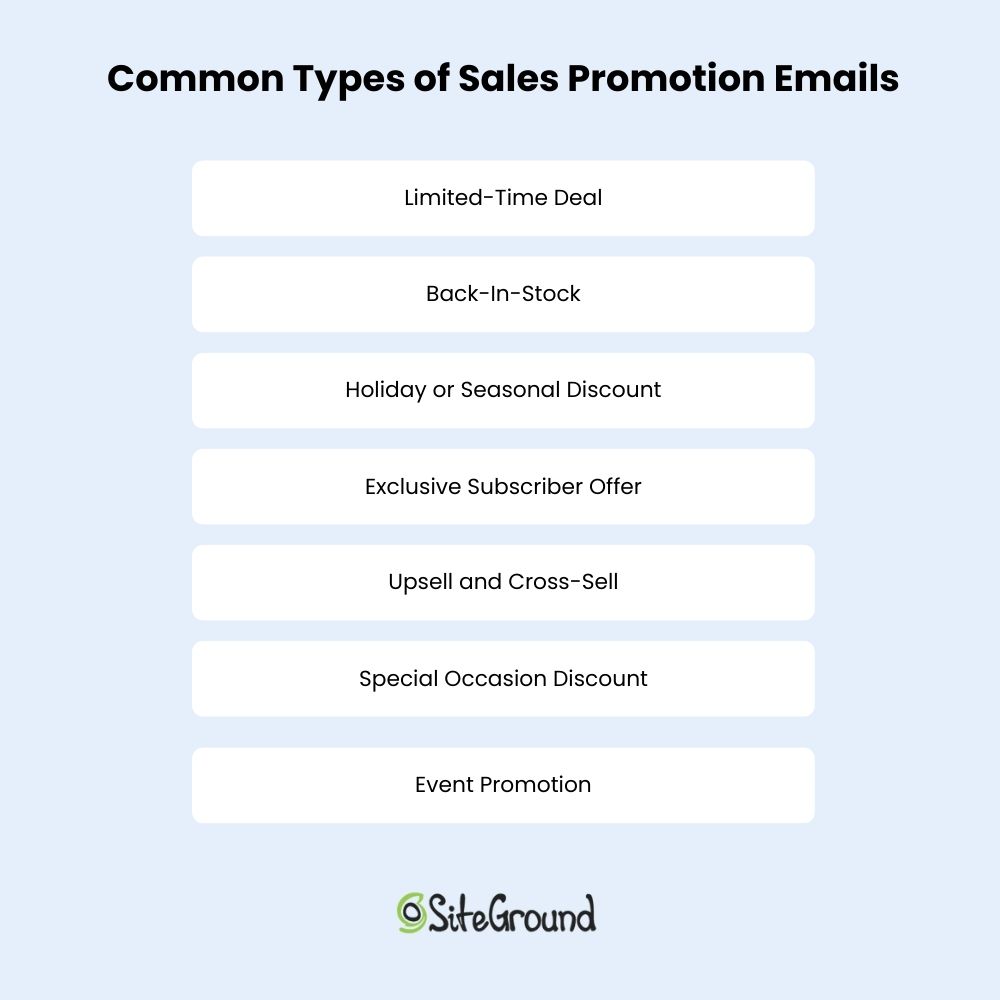
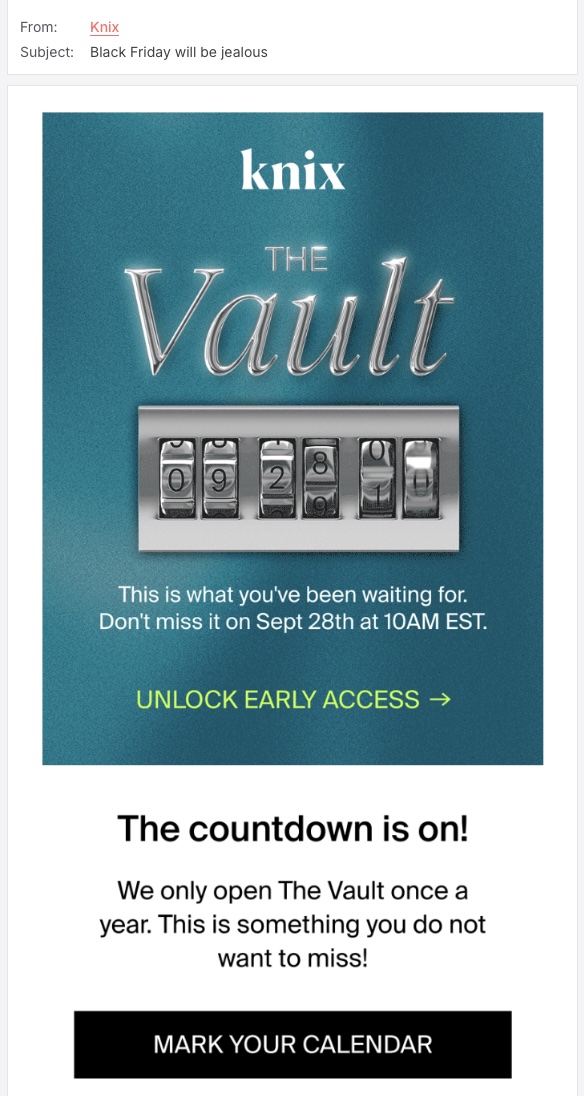
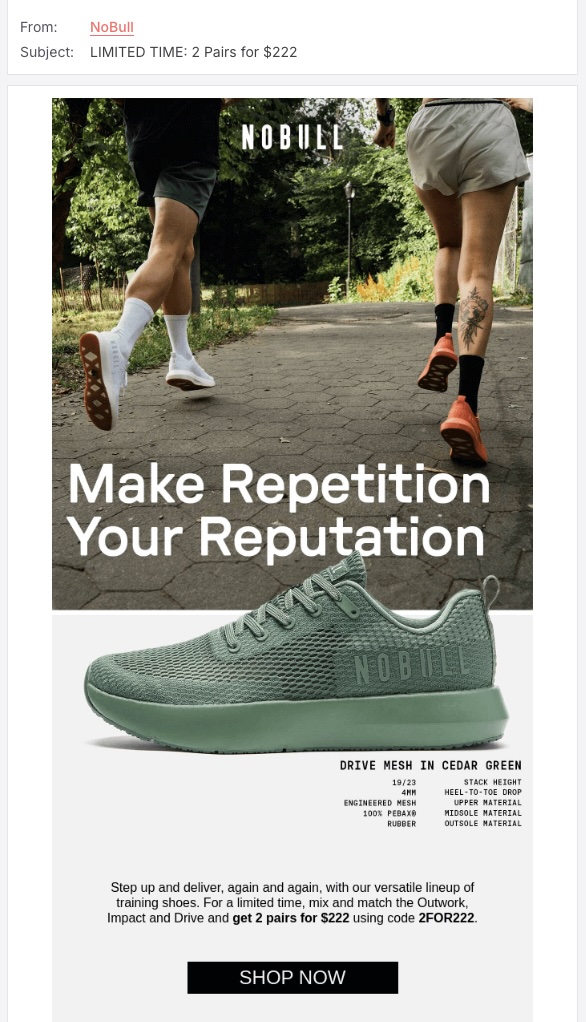
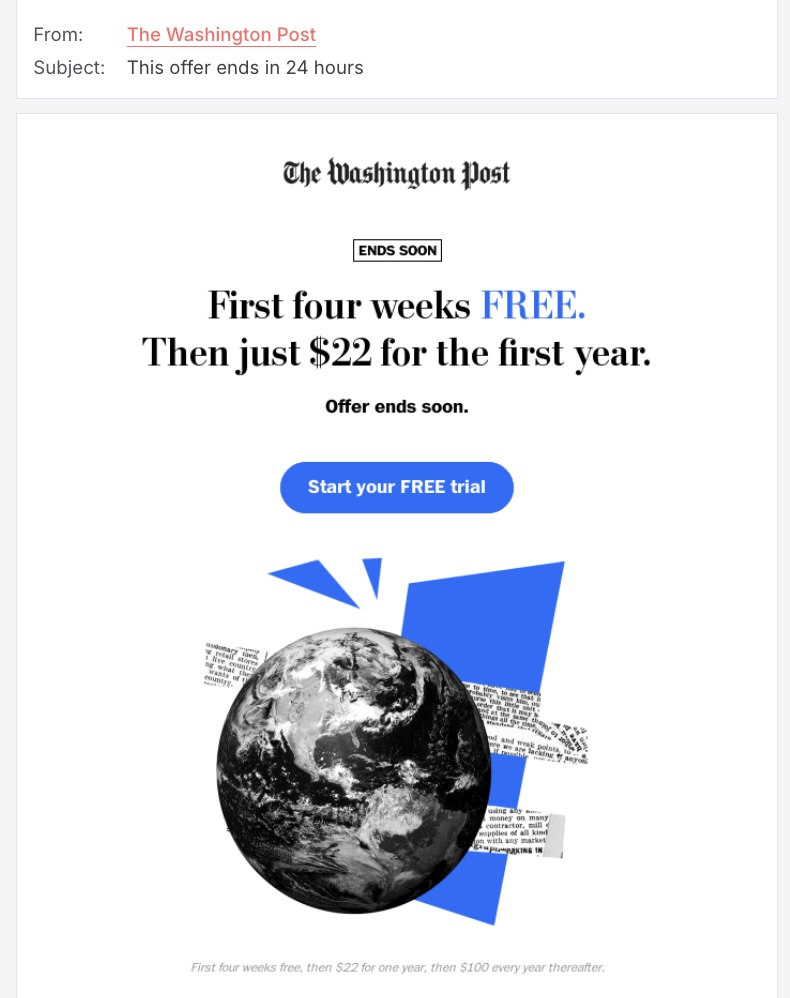
The SiteGround academy provides a wide variety of tips, tools, and resources related to WordPress, web performance, website optimization and site security.
Category: Email Marketing
Unlock the full potential of email marketing with expert strategies, tools, and tips to grow your audience and drive conversions.
Have you ever experienced a pushy sales pitch the minute you walk through a store door? Of course you have—we all have, and it can be totally off-putting, making you want to walk right out of the store, never to return. But a warm welcome, helpful advice, and a little space to explore? That’s a much better experience—one that makes people more likely to stick around, come back, and buy.
That’s exactly how lead nurturing works. Instead of rushing potential customers into a sale, it’s about guiding them through their journey. You gently build trust, address concerns, and keep your business top-of-mind until that future customer is ready to commit.
For small business owners and freelancers, lead nurturing can make a world of difference. And with the right strategies in your back pocket, you can turn those casual inquiries into loyal customers, and without the dreaded pushy or salesy vibes. Let’s dive into what lead nurturing is, why it matters, and three simple steps to make it work for your business.
What is Lead Nurturing?
Lead nurturing means staying connected with potential customers and guiding them toward a purchase by building trust and providing helpful information along the way. Rather than pushing for that immediate sale, lead nurturing focuses on giving value, addressing pain points, and guiding prospects toward a purchasing decision in a natural, trust-building way.
This approach is especially useful for small businesses and freelancers who don’t have massive marketing budgets but still need to turn leads into loyal customers. Consistent engagement with potential clients, whether through email or other channels, helps you to stay on their radar and increase conversions.
Why Is Lead Nurturing Important for Your Business?
For small businesses and solo entrepreneurs, a well-structured lead nurturing program can make a hugely important difference because:
Most leads aren’t ready to buy immediately. Studies show that the majority of prospects need multiple touchpoints before making a decision.
It builds trust and credibility. Consistently providing useful information helps position you as an expert in your field.
It increases conversion rates. Leads who receive personalized follow-ups are more likely to turn into paying customers.
It helps maximize your marketing efforts. Nurturing existing leads is often more cost-effective than constantly chasing new ones.
With the right lead nurturing strategies, you can keep your business growing without relying solely on expensive advertising or cold outreach. Return on investment is high and the process is scalable—there’s just no reason not to get on board.
3 Steps to Lead Nurturing
Now that we know why lead nurturing matters, let’s talk about making it work. Here are three key steps to make it happen.
1. Map Out the Customer Journey
Understanding your customer’s journey is your first important step in your lead-nurturing strategy. That’s because, before you can deliver the right message at the right time, you need to identify the right message and the right time—and for that, you need to map out how potential customers (your leads!) interact with your business.
To map out the customer journey, start by defining your buyer personas—detailed profiles of your ideal customers based on demographics, needs, and pain points. Then, outline the key touchpoints where they engage with your business, such as:
Visiting your website or landing page
Downloading a lead magnet (such as a free guide or checklist)
Signing up for your newsletter
Following your social media accounts
Attending a webinar or consultation call
And so on…
Map out these interactions carefully, considering where leads might first discover your brand, when they need more information, and when a well-timed nudge can move them toward a decision and beyond.
2. Create Lead Nurturing Campaigns and Content
Once you’ve built a clear map and identified key touchpoints and gaps, the next step is to develop lead-nurturing campaigns and content that will move those customers through each stage of the buying journey.
Your lead nurturing program should include a mix of content strategies that not only generate leads, but eventually create conversions.
There are many ways you can meet your future customers at each touch point and nudge them to the next. Here are some of the most common and effective methods for doing so:
Leverage Email Marketing with Freebies and Lead Magnets
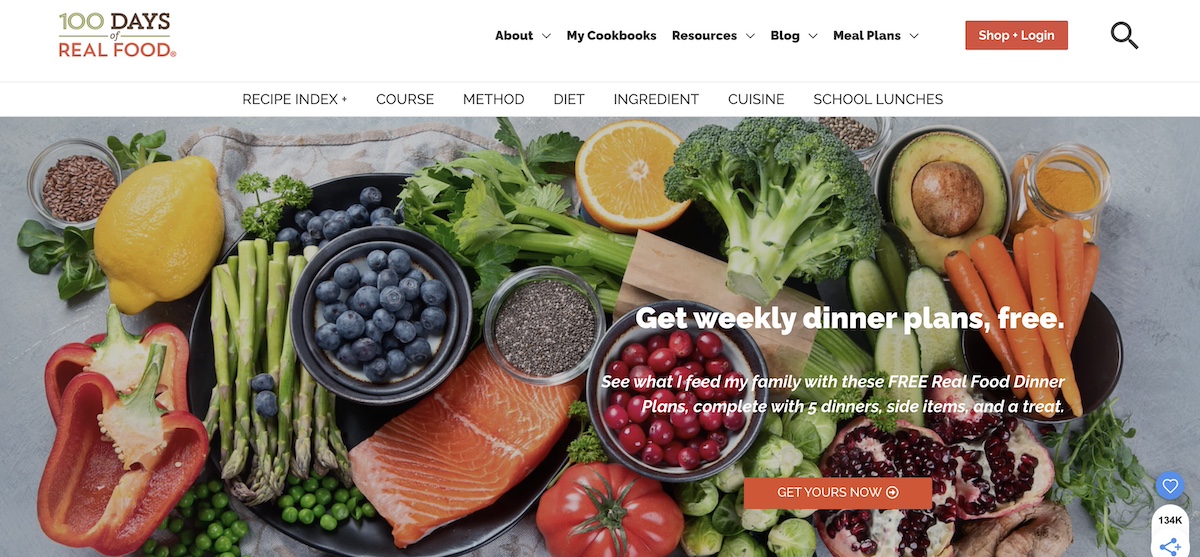
People love getting something of value for free. Offering downloadable guides, checklists, templates, or exclusive content in exchange for an email address is a great way to collect leads, build your email list, and begin the lead nurturing process. Just remember that free content should align with what you actually provide as a business, ensuring that gathered leads are actually interested in what you have to offer.
The above food website offers free weekly dinner plans in exchange for an email address. From there, the business can build a relationship with the customer via the weekly meal plans and other informational emails. Then, the business could eventually offer custom meal packages or consulting services, thus turning the subscriber into a customer.
But your email marketing list is just the first step—how you engage with those leads matters just as much. That’s where email marketing comes in. A well-designed email sequence allows you to follow up with your leads, keep them engaged, and gently guide them toward a conversion.
Instead of sending random emails, use a strategic approach:
Segment your audience based on how they joined your list (such as downloading a freebie, signing up for a webinar).
Create email automation sequences, with lead nurturing emails like welcome emails, follow-up messages, or exclusive offers tailored to their interests.
Keep emails engaging and actionable—short, clear, personalized, and value-driven with a compelling call-to-action (CTA).
SiteGround Email Marketing offers a seamless solution that makes automating lead nurturing emails a breeze, sidestepping the complexity of other traditional email marketing platforms. SiteGround’s intuitive approach helps you reach customers at the perfect moments, driving engagement and fueling business growth with ease.
Create Landing Pages that Convert
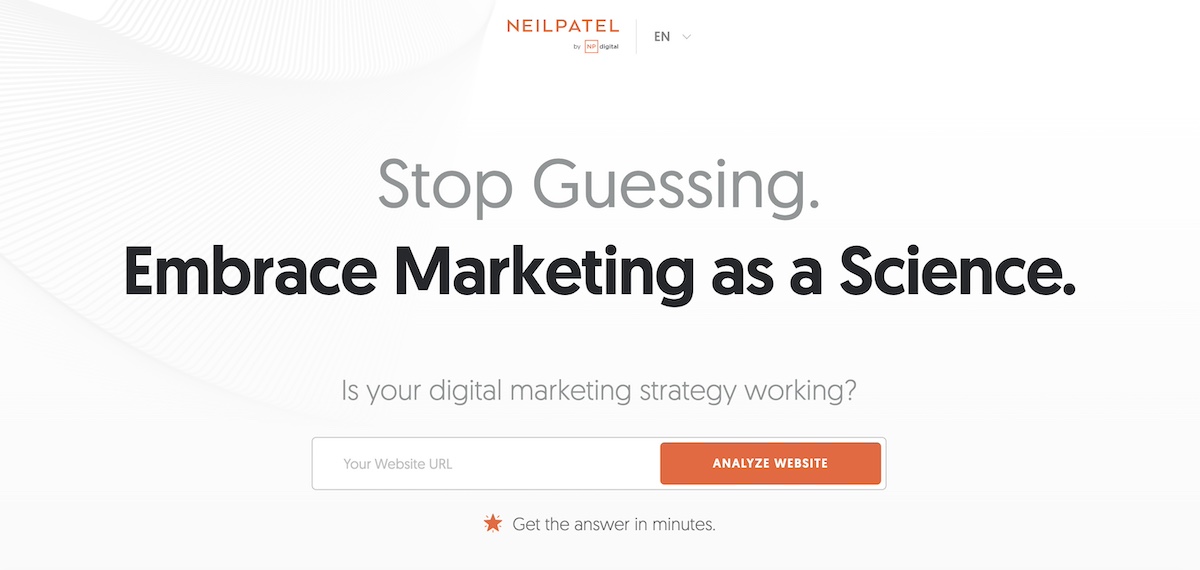
A well-designed landing page is a very targeted way to capture leads and guide them toward the next step in their journey. This kind of page typically focuses on one very important goal: to get conversions, and usually does so by offering an incentive in return, such as a free resource, a special discount, or an event signup.
To maximize results, drive traffic through targeted ads, email campaigns, and social media promotions. Keep it simple with a strong headline, a brief description of the offer, and a call-to-action (CTA) that encourages signups.
The above is a great example of a super focused landing page. The message is extra clear, as is the call to action. Once the visitor enters their site, they are then prompted to provide an email address, upon which the lead nurturing journey begins.
Give Exclusive Discounts and Offers
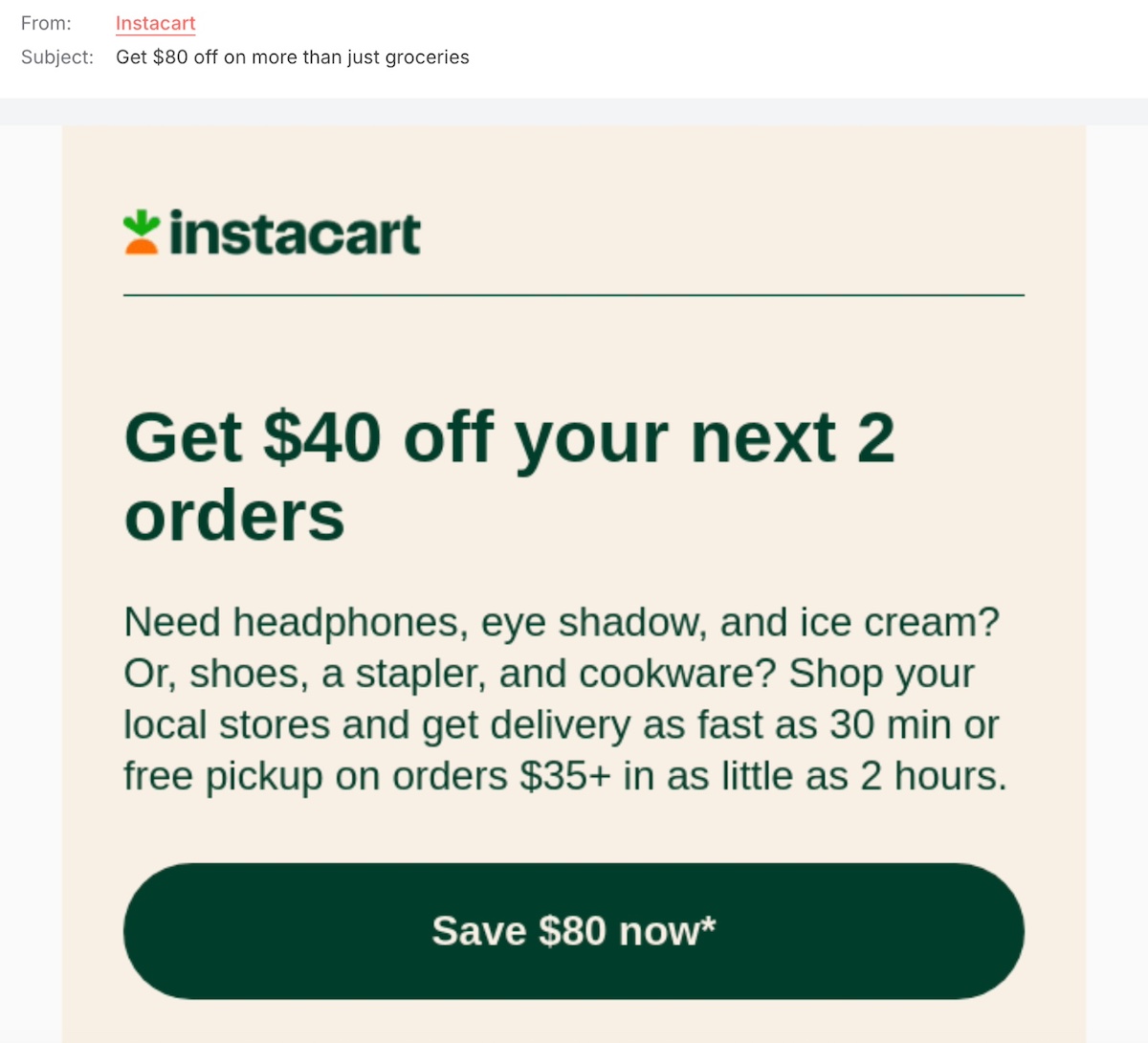
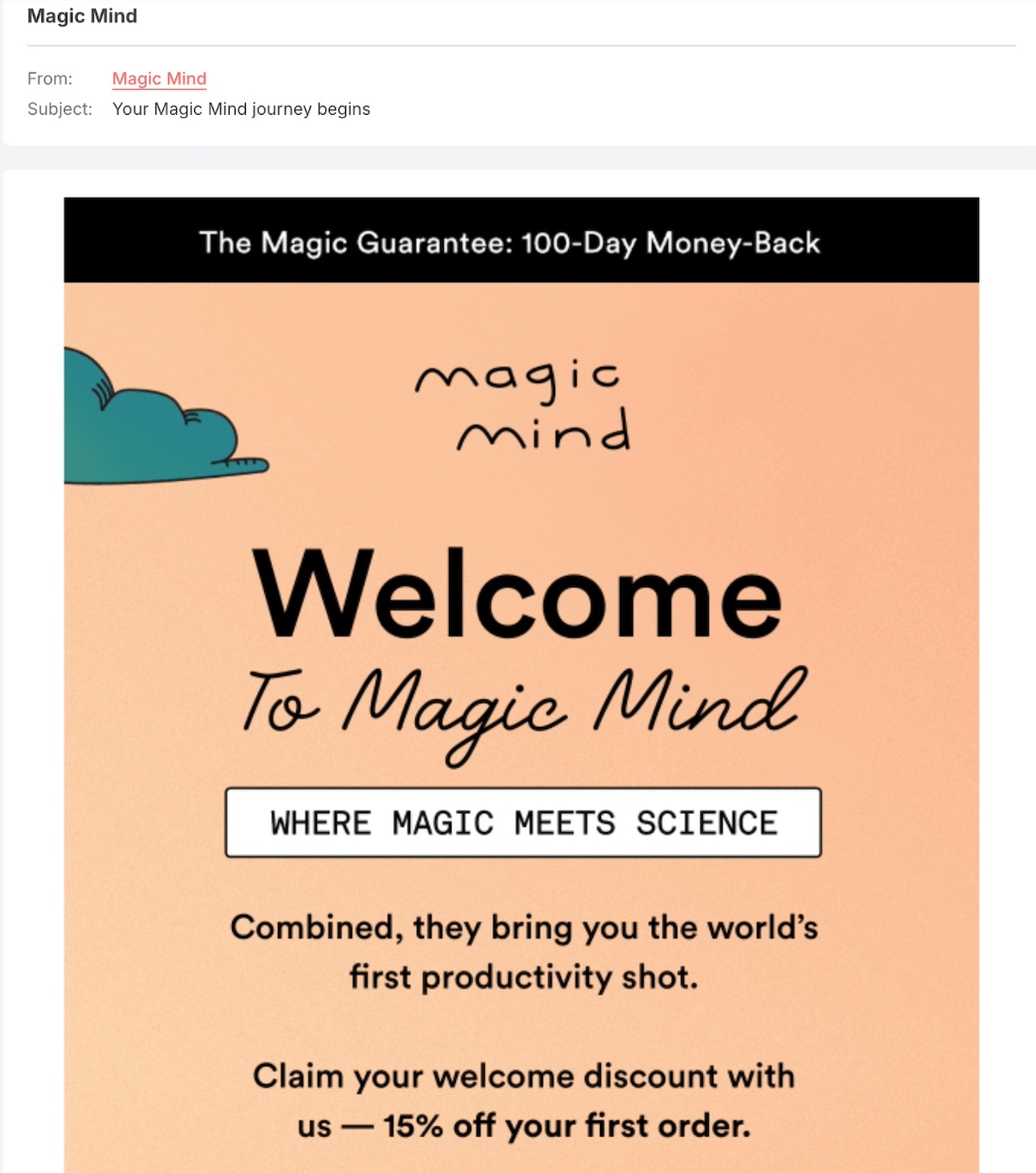
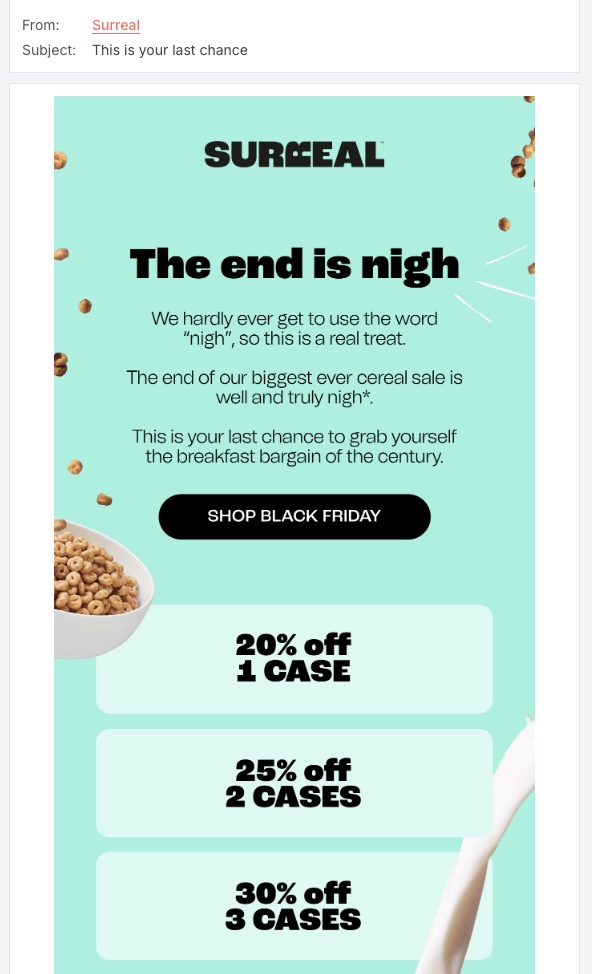
A well-timed discount or special offer can be the final push a lead needs to become a paying customer. Consider offering limited-time deals, first-time customer discounts, or loyalty rewards to keep leads interested and coming back for more.
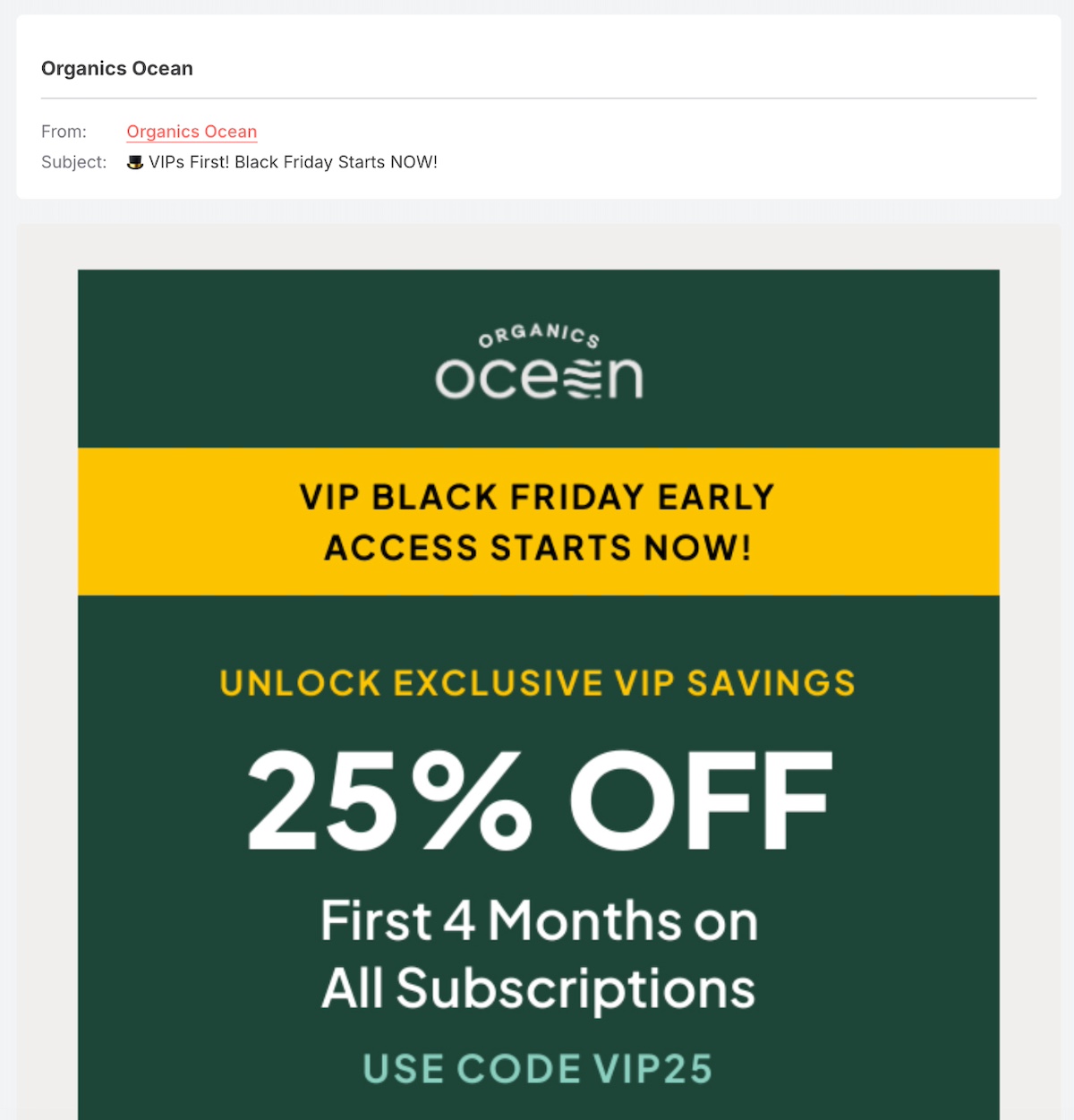
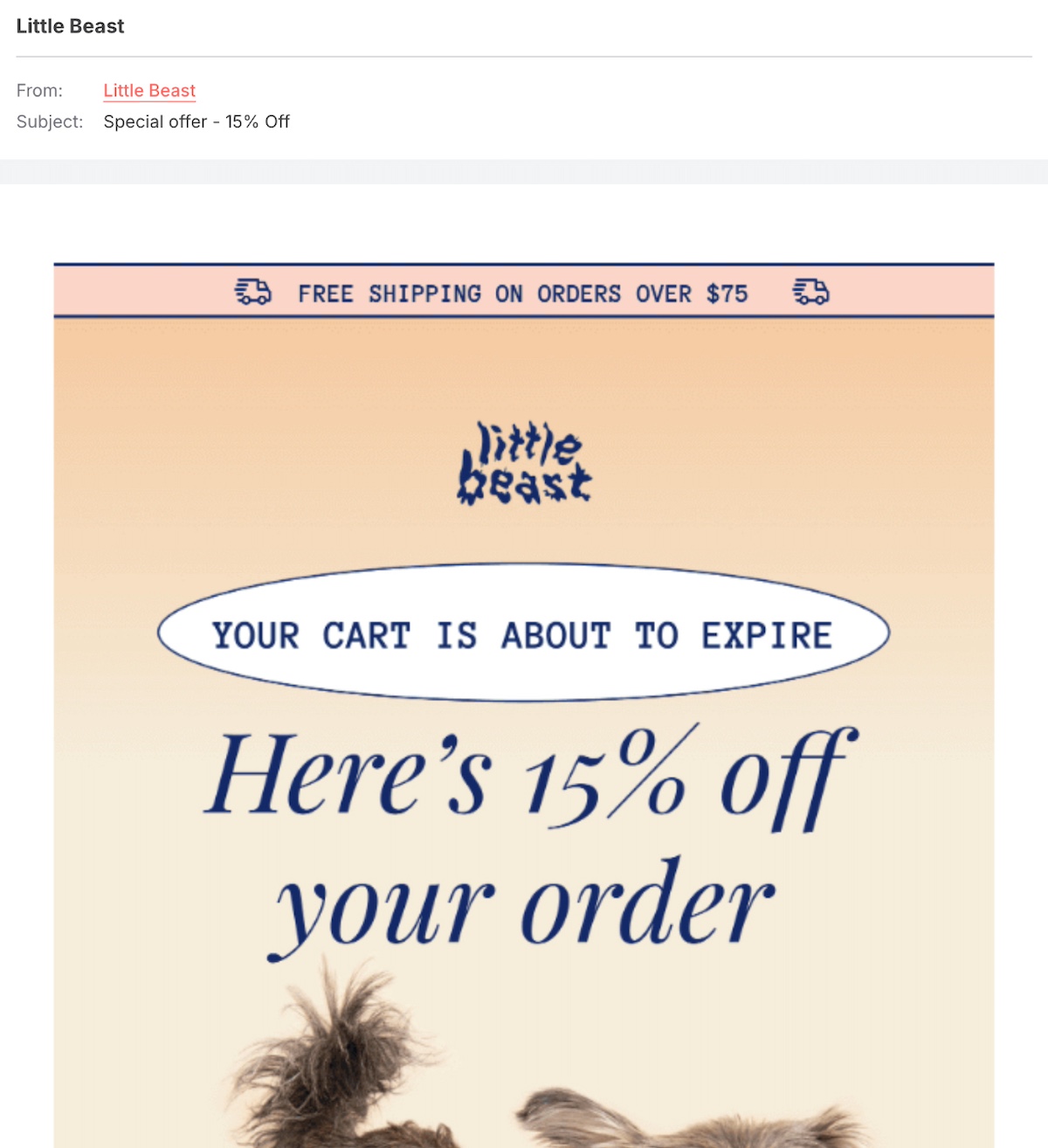
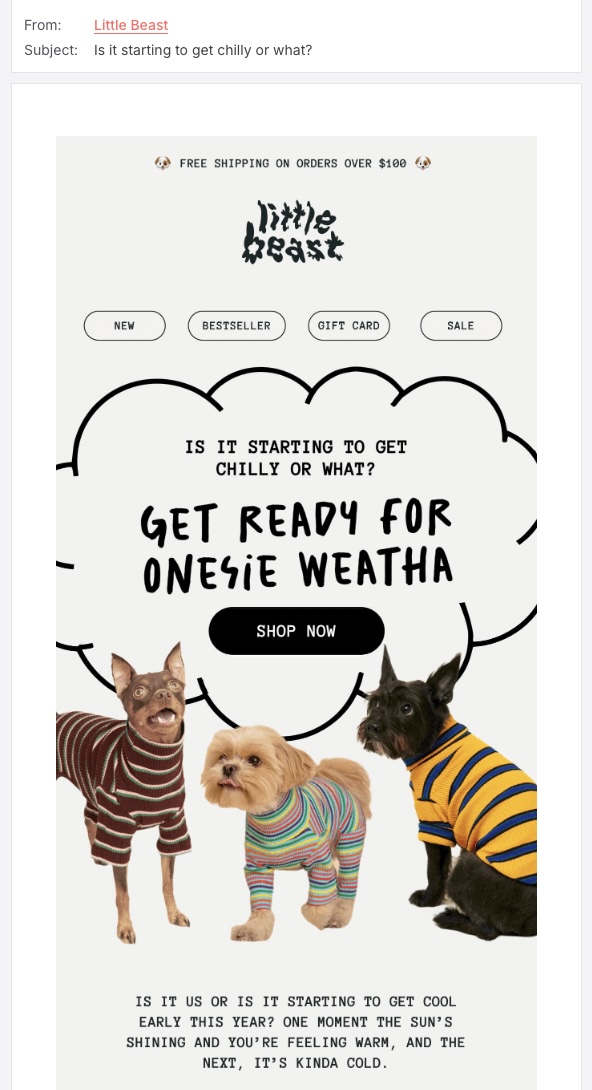
Upon receiving the above email, a curious lead might finally be enticed to make a purchase given the steep discount.
Organize Educational Events and Webinars
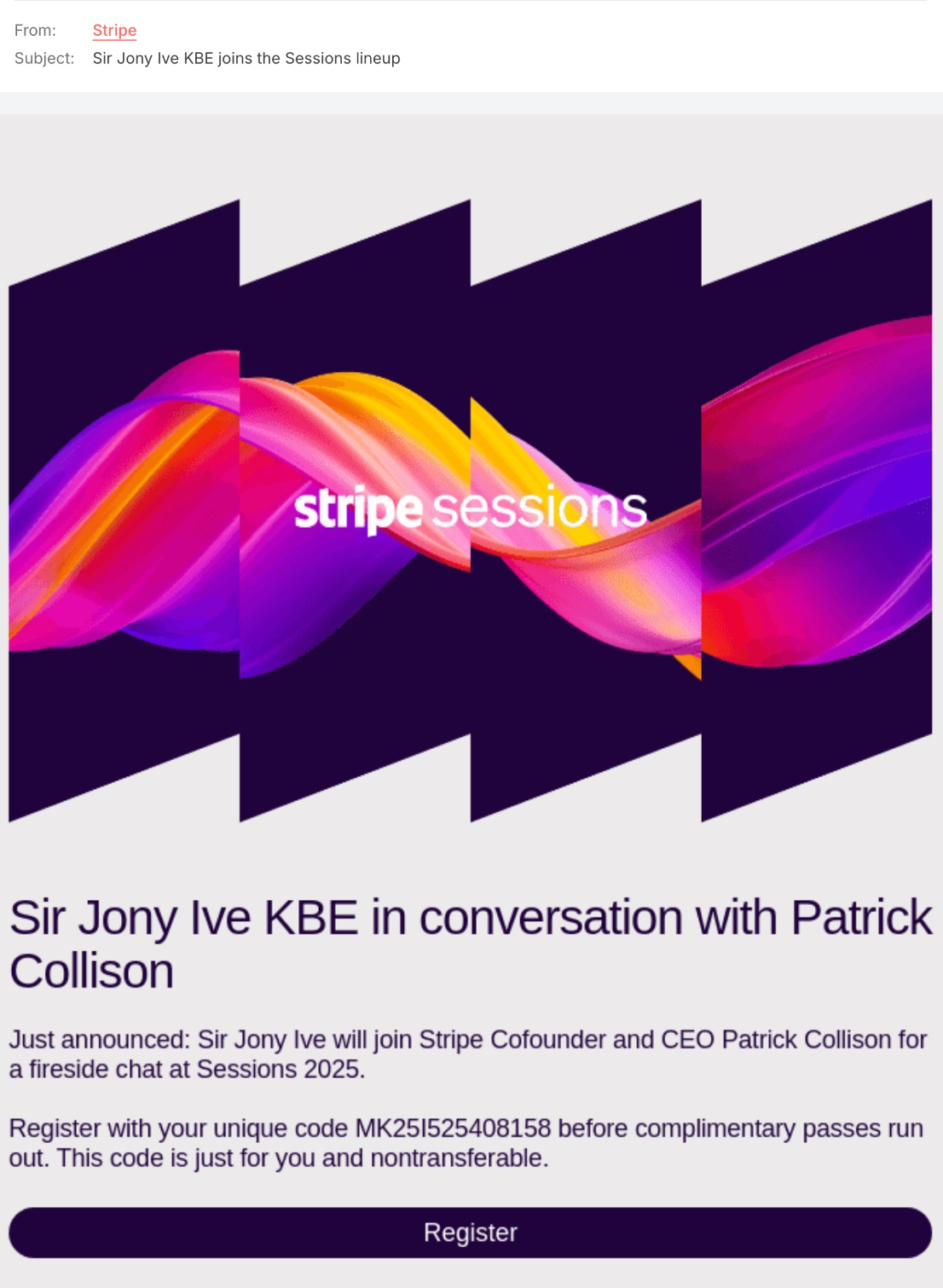
Live events—whether virtual or in-person—allow you to create a more personal connection with your leads. Hosting a free webinar, workshop, or networking event is a great opportunity for leads to interact with you, ask questions, and see the value of your product or service firsthand. It can also help build your credibility as an authority in your space, and more trust from your leads.
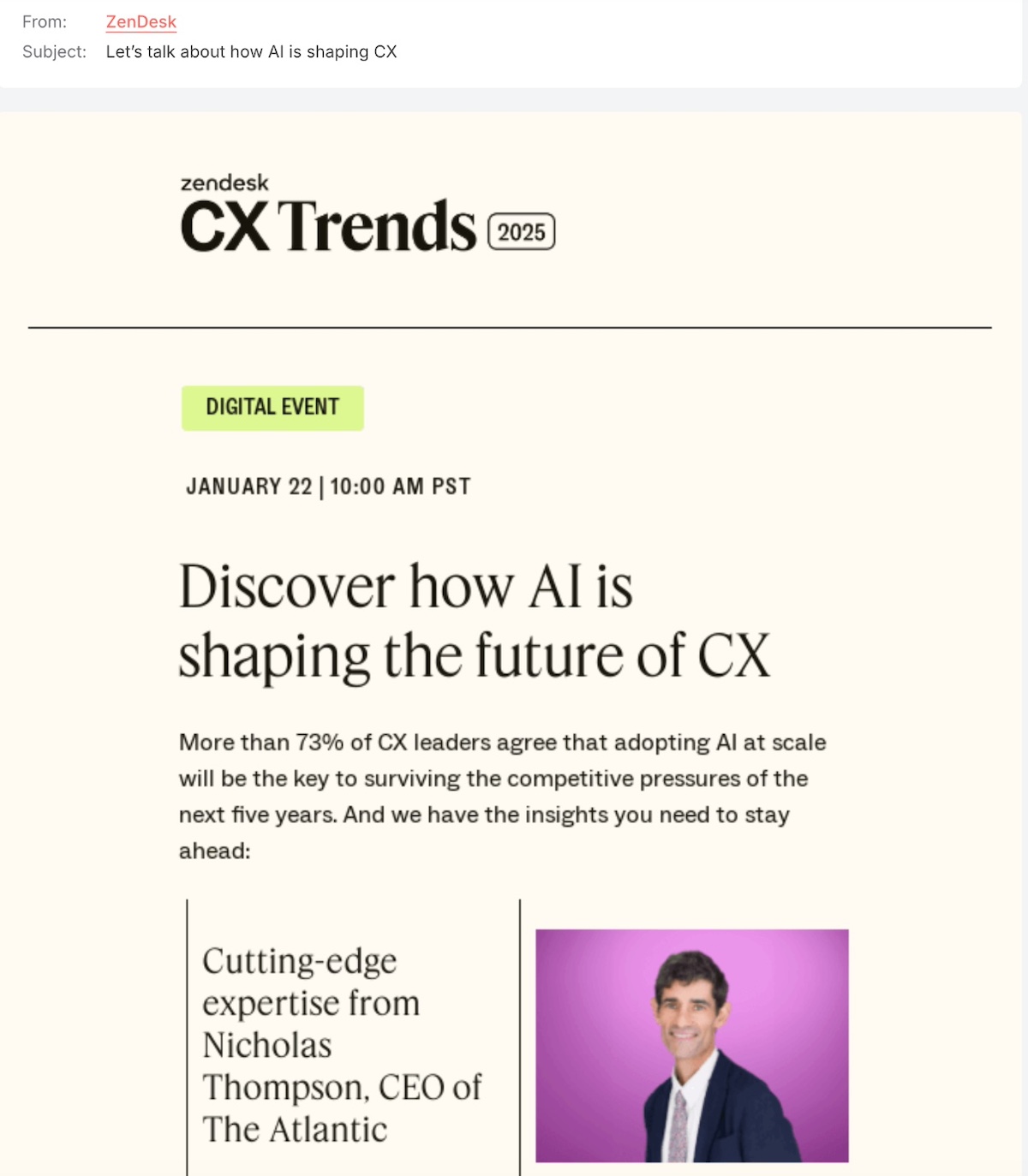
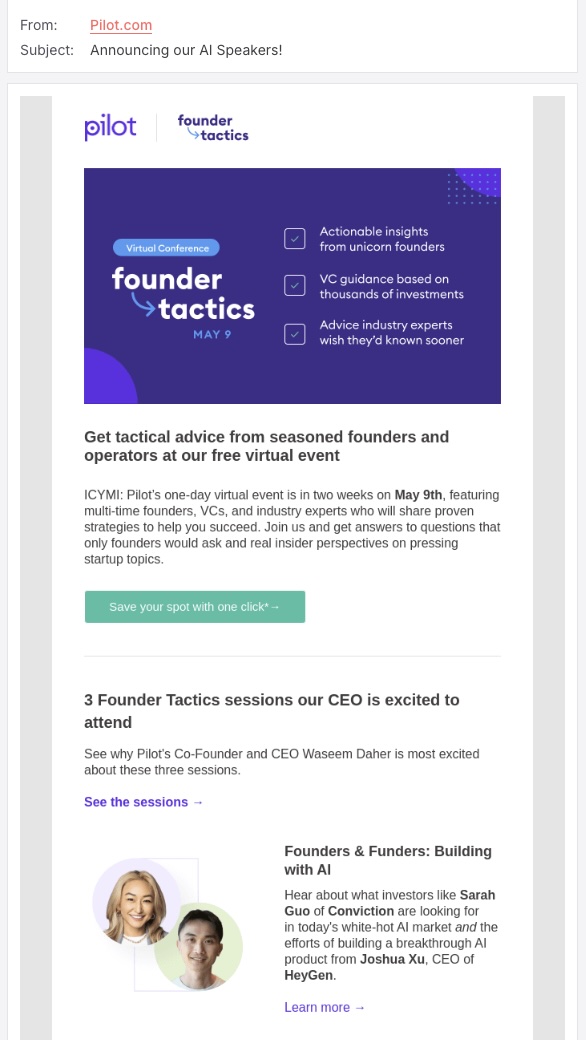
The above webinar email nails lead nurturing with an offer to join in on a fireside chat with the founder and a guest. The offer is made even more enticing by the fact that the pass is limited and complimentary.
Run Paid Ads
Not all leads move through your funnel at the same pace. Retargeting ads can help bring back visitors who have interacted with your website but haven’t converted yet. By serving them relevant ads with personalized offers, you can stay top-of-mind and encourage them to take the next step.
These are just a handful of ways that you can connect with your leads at each touchpoint. Don’t be afraid to get creative with what you implement and when—just remember that the key is to provide ongoing value, and meet your leads where they are in their journey.
3. Monitor Metrics and Improve
Lead nurturing isn’t a one-and-done process—it requires ongoing tracking and optimization so that you can be sure you’re getting the absolute best driving results. With that in mind, monitoring your lead nurturing campaign metrics will allow you to identify what’s working and what needs improvement.
That said, if you really want to optimize and improve, you’ll want to brush up on the meaning behind key metrics—especially email marketing metrics— but, in the meantime, here are the top stats to keep an eye on:
Email Open Rates: Are your emails getting noticed? A low open rate might mean your subject lines need improvement.
Click-Through Rates (CTR): Are leads engaging with your content? If CTRs are low, your calls-to-action (CTAs) may need more clarity or appeal.
Conversion Rates: How many nurtured leads actually turn into customers? This helps determine the overall effectiveness of your lead nurturing campaigns.
Lead Engagement Levels: Are people interacting with your emails, downloading resources, or attending events? If not, your content might not be resonating.
Unsubscribe Rates: A rising unsubscribe rate may indicate that your emails are too frequent, irrelevant, or not providing enough value.
Pro tip: A/B test key elements of your lead nurturing emails—subject lines, content formats, send times, and CTAs—to see what resonates best and continuously optimize for better engagement. Just be sure to test one thing at a time.
Begin Your Lead Nurturing Journey
A strong lead nurturing program helps you turn interest into loyalty—without the hard sell. Understanding your customer’s journey, sharing useful content, sending well-timed emails, and paying attention to what works, allows you to build real connections that drive long-term growth. The key? Stay consistent, keep adding value, and be the first brand they think of when they’re ready to buy.
And if you’re looking for an effortless way to manage your email marketing, SiteGround has you covered. With our easy-to-use email tools, you can send automated sequences, segment your audience, and track performance—all from one place. Whether you’re nurturing leads with helpful newsletters or sealing the deal with a well-timed promo, SiteGround Email Marketing helps you keep the conversation going without the stress. Ready to make lead nurturing work for you? Let’s get started!
Ever wonder how some brands skillfully connect with other businesses and drive substantial sales through email? It’s not just luck; it’s the strategic prowess of B2B email marketing at work. However, attempting to proceed without a strategy tailored for business audiences is like setting sail without a map—you’re likely to lose your way.
Today, we’ll be your north star, guiding you as we explore effective email strategies, real-life examples, and best practices to help you achieve results, just like the top performers in the B2B field.
What Is B2B Email Marketing?
Business-to-business (B2B) email marketing refers to the process of sending targeted messages from one business to another,selling products or services that can address internal challenges, improve operations, or enhance offerings.
It’s all about building brand awareness, nurturing relationships with potential clients, and ultimately increasing your bottom line. Although this might sound similar to the business-to-consumer (B2C) marketing model, there’s more going on beneath the surface.
Why Do B2B Emails Require a B2B Email Marketing Strategy?
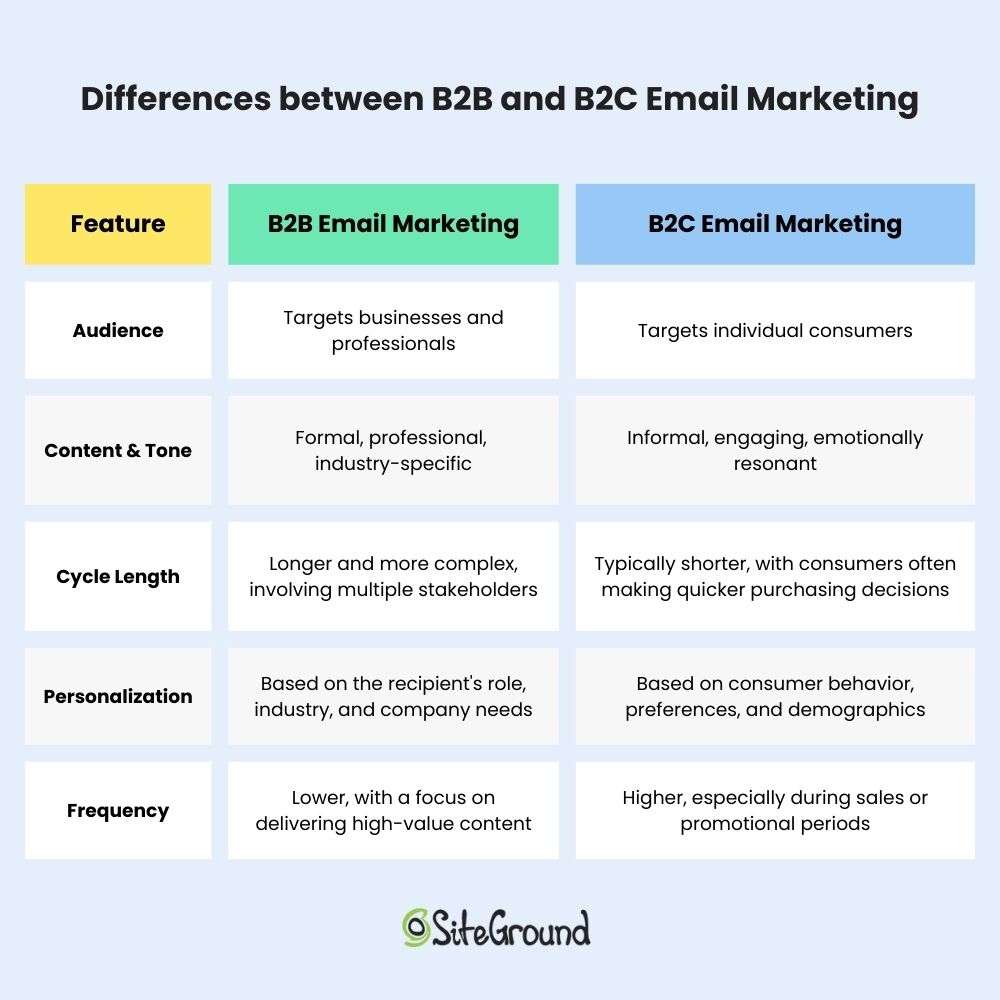
B2B email marketing campaigns, in contrast to B2C ones that focus on individuals, aim to connect with entire organizations—or, more precisely, the diverse group of individuals within them.
Unlike solo shoppers, a company’s buying process is much longer and more complex, often involving multiple stages of evaluation and approval. It’s like a team sport, requiring collaboration and input from people across various roles and departments.
This means B2B marketers need to tailor their email marketing strategy to address the diverse interests and concerns of multiple decision-makers. By providing valuable information—such as detailed product specifications, case studies, industry reports, and more—marketers can help each team member understand the benefits and relevance of the offering.
Therefore, B2C email marketing tactics simply won’t work for your B2B emails—just as different keys are needed for different doors, you’re reaching out to a completely different set of buyer personas.
B2B Email Marketing Tactics That Deliver Results
We’ve highlighted key steps to help you plan an effective B2B email marketing strategy, so you can direct your marketing efforts toward strategies that transform your readers into loyal customers.
1. Map the Buyer’s Journey
Just as an individual customer has a journey with a specific brand, so does a company as a consumer.
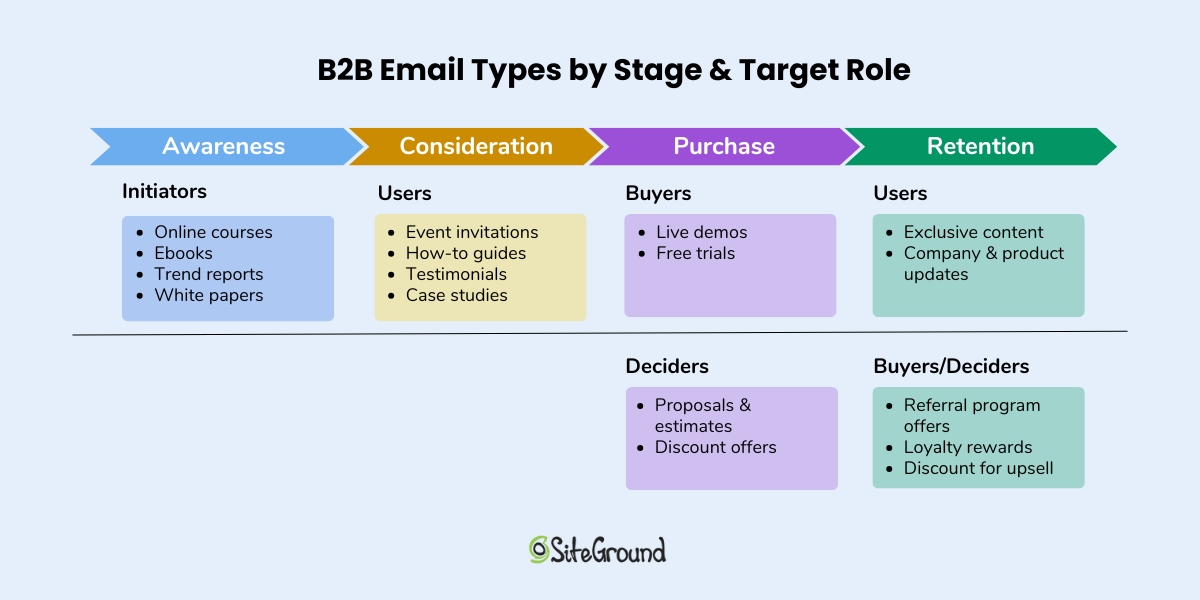
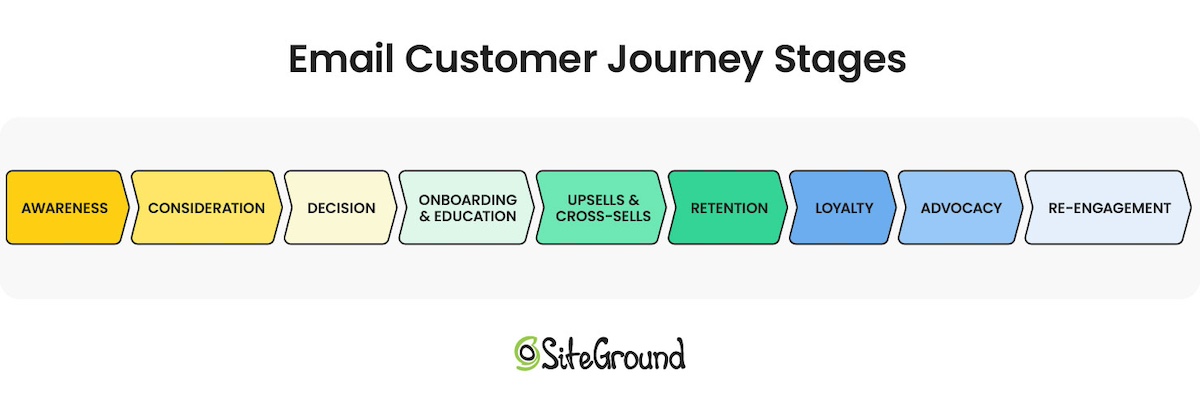
The B2B email customer journey outlines the experience a company has with your brand through email communication, starting with the initial introduction and continuing as they evaluate and consider your offer. Below are the key stages of the customer journey:
Awareness: The targeted company is becoming familiar with your brand and product but isn’t considering a purchase yet.
Consideration: Interest is shown in your offer, but more information is needed before making a decision.
Purchase: The company is prepared to buy or try your product and is assessing budget and return on investment (ROI) to finalize their decision.
Retention: After your qualified leads have become customers, your aim is to engage them and encourage repeat purchases and renewals.
Map the journey your prospects take, counting the touchpoints they need before they finally say “yes!” to your offer. Also consider how often you should pop up in their inbox to keep the momentum going.
Knowing what your prospects want and need in every stage of the sales funnel will guide the types of emails you send, ensuring they are relevant and impactful, but more on this in the following section.
2. Identify Your Target Personas
As we mentioned earlier, when you’re reaching out to a company, you’re not contacting just one person—you’re actually trying to connect with its buying center, or the team of people who decide whether to purchase from you.
In B2B email marketing, connecting with the right people is key—after all, you don’t want to spend your time chatting with gatekeepers or those who aren’t in the loop. So, it’s important to identify each member of the buying team to ensure you’re speaking to the right individuals, or at least that your message is passed on to the decision-makers you need.
The buying center typically consists of six key roles:
Initiators: Identify the need for a product or service. These could be department heads, team leaders, or managers.
Users: Utilize the product or service after purchase. They might include end-users like sales teams, or customer service representatives.
Influencers: Impact decisions and opinions within the buying center. These could be industry experts, consultants, or senior executives.
Gatekeepers: Manage the flow of information. These are often administrative assistants, office managers.
Deciders: Approve or reject the purchase. These are usually high-level executives or managers, such as CEOs, CFOs, or department heads.
Buyers: Handle logistics and administrative aspects of the purchase. These roles are typically filled by procurement officers, purchasing managers, or finance personnel.
Here’s a breakdown of the customer journey stages and the B2B email types you need to send for each stage and target role.
3. Build a B2B Email List
Cold emails might seem like an easy option, but it’s a risky adventure if you start sending messages to every email address you come across. Reaching out to those who haven’t given you the green light can lead to spam complaints, lower email deliverability rates, and leave recipients more frustrated than pleased.
Instead, focus on those who have willingly joined your email list through an opt-in form—and even better if you’ve implemented a double opt-in process. Below is an overview of five proven methods for generating qualified leads:
Utilize LinkedIn
As the saying goes, “Social media is for discovery, email is for conversions.” Leverage LinkedIn’s vast B2B network by running lead-generation ads, or, if you’re on a budget, try directly messaging your target buyer persona. Be transparent about your purpose, and it could open up new opportunities to follow up with emails.
Offer Lead Magnets
Sprinkling your website with ebooks, research reports, or mini-courses in exchange for email addresses is always a smart move. Toss in a few profiling fields on the sign-up form—like job title and organization—and you’ll have an easier time sorting and segmenting your audience later!
Organize Gated Events
B2B prospects value educational content, constantly seeking ways to innovate and deliver better solutions to their clients. Therefore, hosting gated events—either online or offline—can help you present yourself as an expert in your field, network with your target audience, and ultimately gather valuable contacts.
Use a Data Vendor
If you want to save time and effort, vendors like Global Database or D&B Hoovers serve up a treasure trove of insights, from key decision-makers’ details (like job title, seniority, age, education) to company scoop (industry, size, location, financials). They keep their databases fresh and up-to-date, and all this valuable information is just a subscription away!
Implement a Referral Program
If you already have a squad of email subscribers, why not turn them into your brand ambassadors by offering fun incentives like discounts or exclusive content for referrals? People love sharing great finds with friends and colleagues, making referrals a fantastic way to widen your reach and build trust.
4. Segment Your Audience
Having snagged those coveted email addresses, you’re halfway to hitting your email marketing strategy goal. However, when running email campaigns at scale, trying to personalize messages for each individual can be like trying to bake a unique cake for every guest at a party—overwhelming and inefficient.
Instead, think about organizing your contacts into customer segments. You could start with broader segmentation based on industry, company size, and job title to ensure relevance. Then, refine your segments further by considering the roles within the buying center as you gather more detailed information about your contacts.
5. Utilize B2B Email Sequences
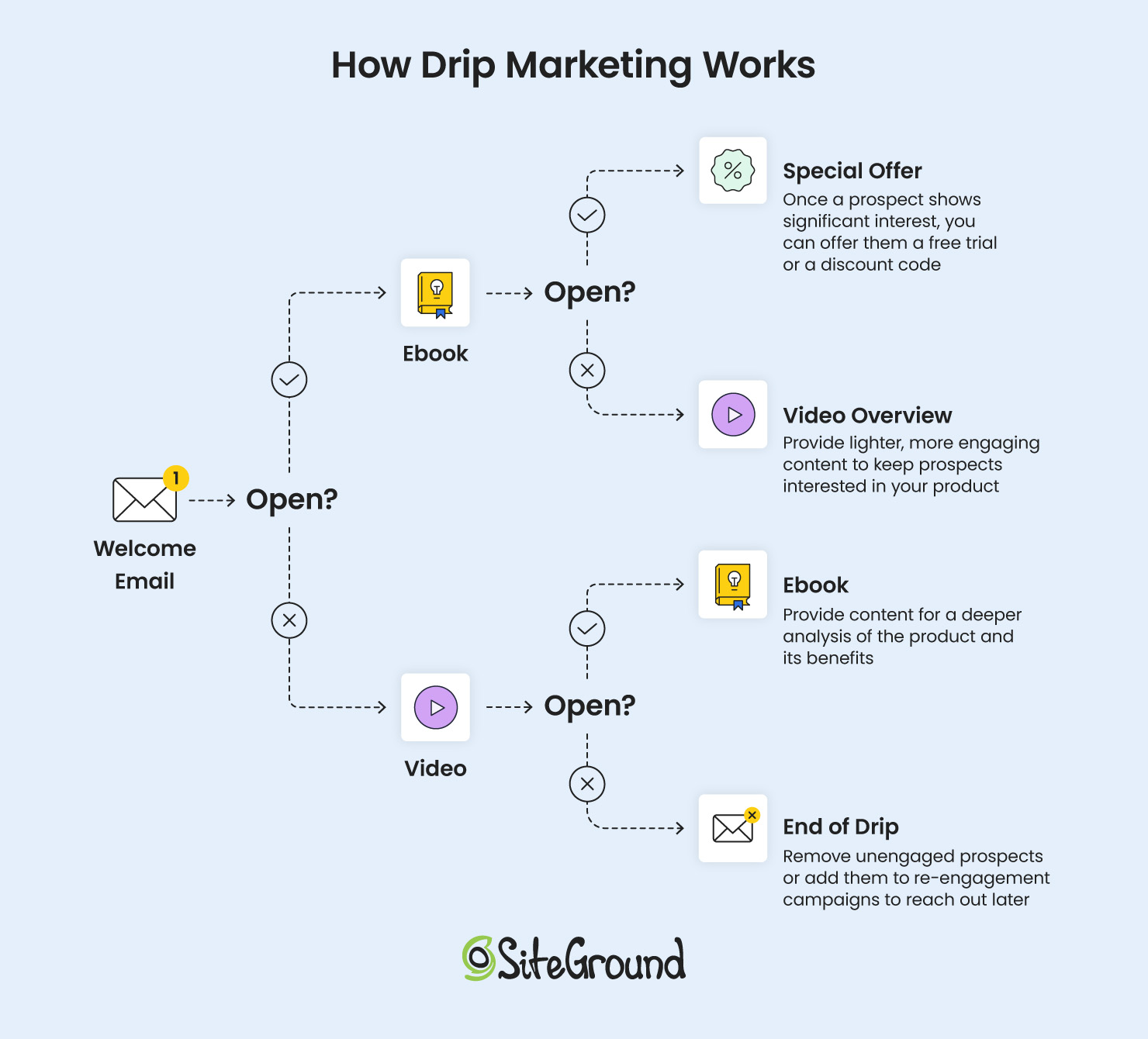
Once you’ve tailored your content to meet the specific needs and preferences of your target audience—whether they’re decision-makers, influencers, or end-users within a business—you can streamline your communication through drip marketing campaigns. These automated sequences keep your content relevant and engaging, especially in B2B contexts where the sales cycle is longer.
Drip campaigns allow you to deliver a series of pre-scheduled emails that guide prospects through the buyer’s journey and nudge them gently to conversion. They spring into action in response to specific triggers or behaviors, like website visits or content downloads, as you can see below.
B2B Marketing Emails Best Practices
A well-planned B2B email strategy is only as effective as its content. With your prospects’ inboxes likely blasted with emails daily, be sure to follow these best practices to ensure yours stands out and doesn’t get lost in the shuffle.
1. Use a Persuasive Subject Line
The busier your targets are, the more vital a captivating subject line becomes. It’s wise to kick things off by showcasing the value of your email—whether it’s an insider resource, a handy tool, or an irresistible offer. Plus, teasing a solution to a common industry challenge can really spark your recipients’ curiosity.
Here are some effective B2B subject line examples that you can apply to your emails:
📕 Educational content and guides:
“[number] tips to [lead’s goal] in [year],” “A proven solution for [lead’s pain point],” “[number] steps to achieve [lead’s goal].”
🛍️ Product or service promotions:
“Would you like to try [product/service name] for free?” “[number] facts about what [product/service name] can do for you,” “Did you know this about [lead’s interest]?”
📈 Niche-specific:
“Your [lead’s niche] service needs this,” “Every [lead’s job position] needs this tool,” “[lead’s company name] can sell even more with [your company name].”
2. Strike a Balance Between Professionalism and Personality
When crafting B2B content, it’s easy to adopt a formal tone that might seem stiff and robotic. While maintaining professionalism is important, remember that you’re still communicating with real people, even if they represent a brand.
Think about the business emails that catch your eye—the ones that speak directly to your needs and interests—and strive to write with empathy and a touch of personality. Below are some ideas on how to make your B2B emails more approachable:
Personalize
Use the information you’ve gathered to personalize as much of your email message to the recipient’s needs and preferences as possible. If your marketing content seems irrelevant or holds little interest for them, you risk being dismissed as spam.
Ask Questions
Engage your reader by asking questions that prompt them to think or reflect. This can make the email feel more interactive and less like a monologue.
Include Relatable Examples
Use anecdotes, scenarios, or even case studies that the reader can relate to, making your message more tangible and relevant.
Don’t Overdo Your Design
Occasional plain emails appear much more personal and authentic than fully designed pieces, as they give the feel of a one-on-one conversation, which stands out among overly salesy messages.
End With a Friendly Sign-Off
Use a warm and approachable closing, like “Take care,” “Looking forward to hearing from you,” or “Best wishes,” to leave a positive impression.
3. Add Straightforward Calls to Action
After capturing your reader’s attention with a stellar subject line and engaging content, guide them with a clear call to action (CTA) that specifies the next steps. Ensure your CTA stands out and is easy to follow, with descriptive links that lead to exactly what is promised.
Here are some effective calls to action to implement in your B2B emails:
📣 To increase brand awareness:
“Learn more,” “Start your journey,” “Discover [product name],” “Watch a demo,” “Take a tour,” “I’m interested,” “Tell me more.”
🛒 To encourage conversion:
“Get started today,” “Start free trial,” “Download the report,” “Book your appointment,” “Request a demo,” “Enroll now,” “Get early access,” “Sign up for free,” “Unlock exclusive access.”
🚀 To drive sales:
“Buy now,” “Upgrade to [product name],” “Get your [product],” “Claim your discount,” “Order now,” “Try premium.”
9 Great B2B Email Marketing Examples
This is where theory turns into practice—with cleverB2B email examples. They capture the many different types of emails you can send and the diverse techniques you can use to turn your professional emails from dull to dazzling.
So without further ado, let’s check them out!
1. Lead Magnet Delivery B2B Email
Lead magnets not only boost your credibility but also pave the way for building brand awareness. Satisfied visitors are more likely to share your content, amplifying your reach and influence, making lead magnets a proven email lead generation tactic.
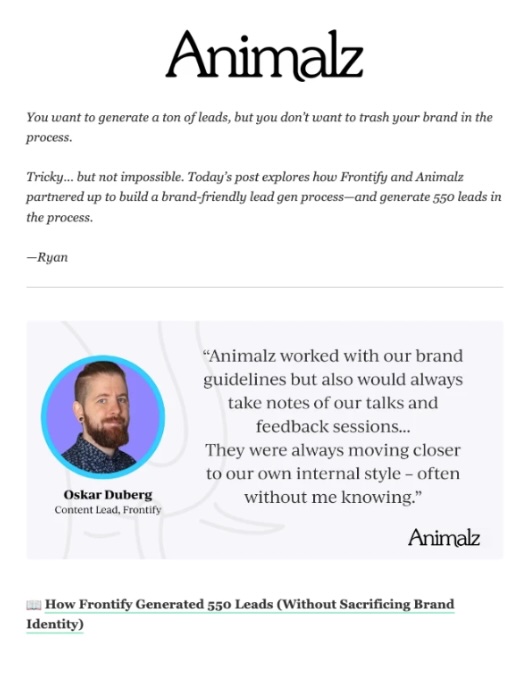
Case studies, success stories, and customer testimonials are a B2B marketer’s secret weapon, highlighting your solution’s effectiveness in real-world scenarios. These narratives provide tangible evidence of your product’s impact, demonstrating how it has successfully addressed challenges similar to those faced by prospective customers.
In the email below, Animalz hooks readers with a captivating opening line that makes it clear why they should stick around. Instead of immediately pushing a CTA button, they dive headfirst into the story, weaving in relatable challenges and impressive outcomes to draw readers in. After all, who can resist a good tale?
Screenshot
3. Event Invitation B2B Email
When you’re promoting an event—be it an in-person seminar, workshop, or online webinar—the goal of your emails is to encourage attendance and generate excitement among your subscriber list. To achieve this, your emails should effectively capture the essence of the event by highlighting key speakers, topics, and activities that will intrigue potential attendees.
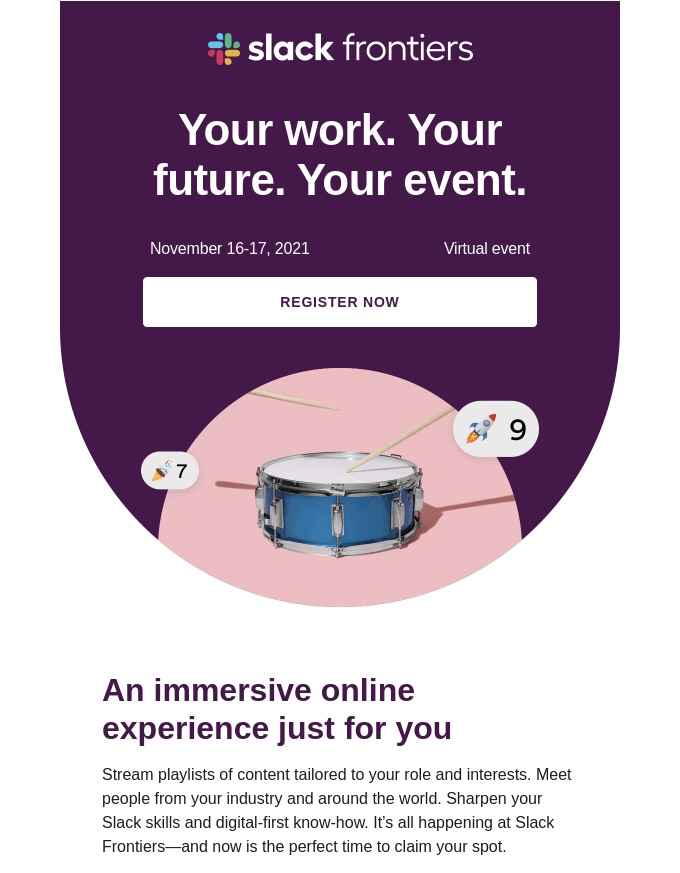
And just as you wouldn’t clutter your mailed invitations with unnecessary information, avoid doing so with your emailed invitations. Take a cue from Slack—they highlight key details upfront and offer a sneak peek of the event, crafting an email that’s both light and efficient.
Screenshot
4. Welcome B2B Email
A welcome email is your brand’s official introduction to new subscribers who’ve taken the exciting leap—whether by signing up for a newsletter or creating an account. It’s more than just a “thanks a bunch” note—it’s your moment to shine and make a memorable impression. Use it to showcase what your brand is all about and kick off your new subscriber’s adventure as a valued partner in your business journey.
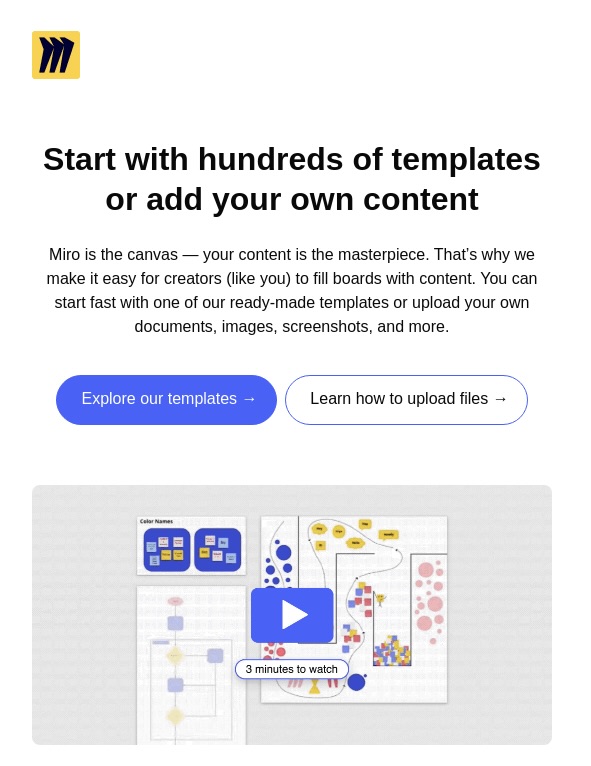
This welcome email example from Miro gets the job done right, giving readers a clear snapshot of what their platform offers while cleverly nudging them to revisit the website.
Screenshot
5. B2B Newsletters
In general, newsletters present a great opportunity to keep your new email joiners hooked and gently prompt them further along in the sales cycle. They offer email marketers the flexibility to deliver more in-depth content, as recipients often open them during moments when they can fully engage with the material.
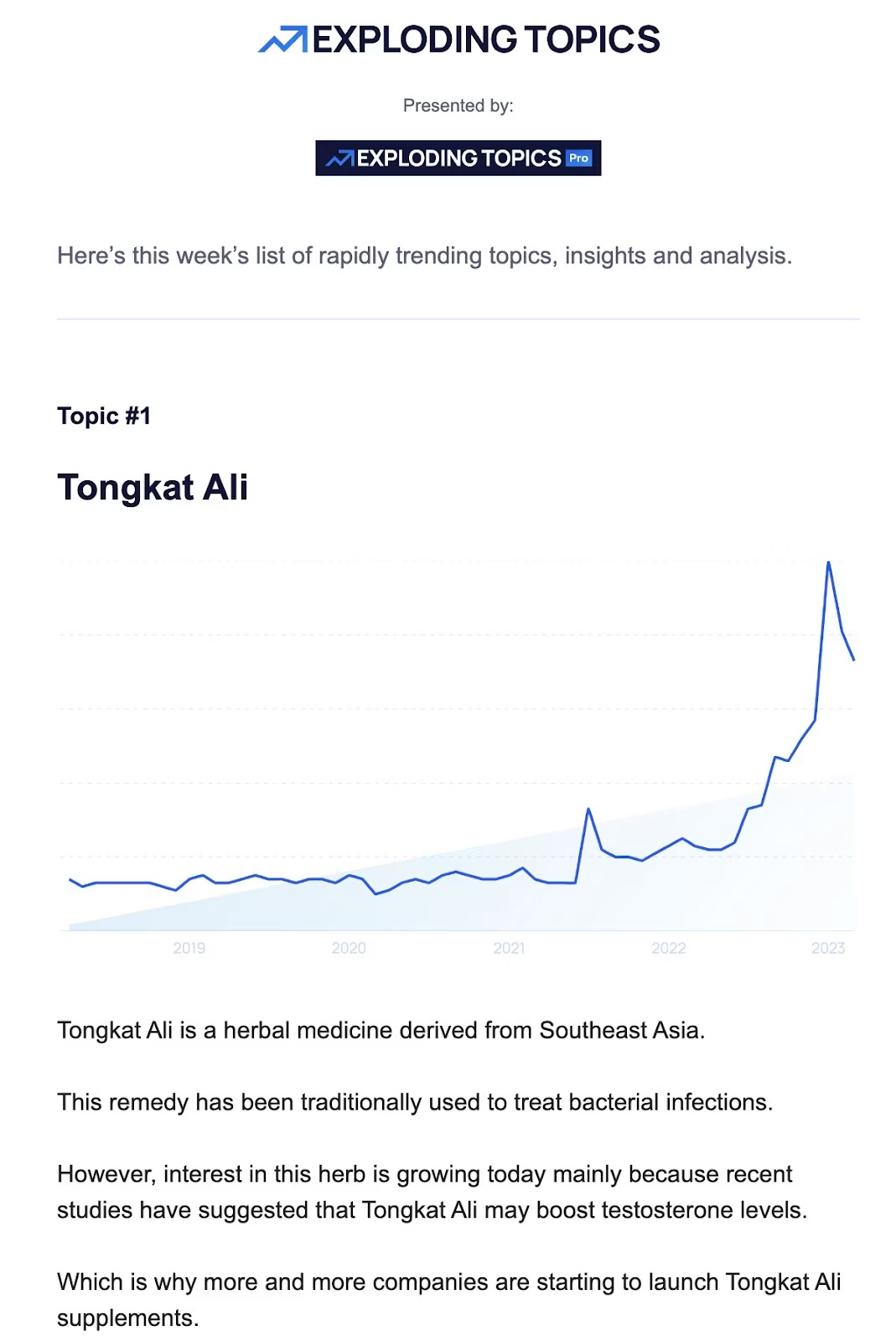
By incorporating industry insights, trends, and expert opinions, you can position your brand as an industry thought leader—just like this email from Exploding Topics.
Alternatively, you can dish out a selection of curated content or the freshest updates from your blog posts to keep yourself at the forefront of your audience’s minds.
6. Demo Invitation B2B Email
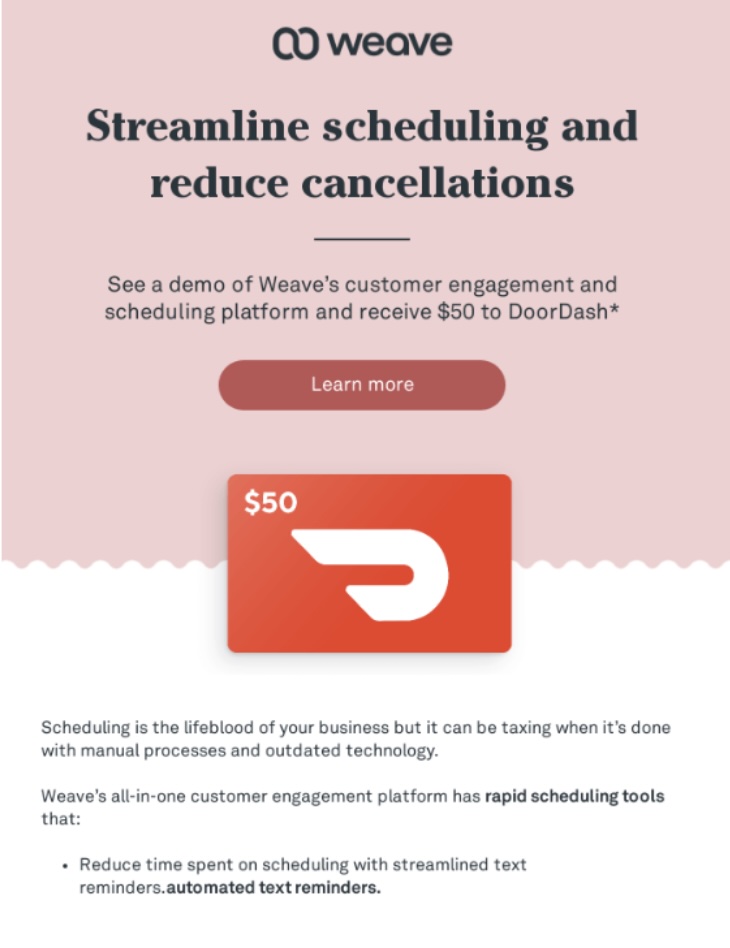
A demo invitation email is commonly used in B2B marketing, especially for products that are complex or benefit from a hands-on demonstration to fully convey their value. Whether it’s following up on initial contact, responding to a curious inquiry, or as part of a targeted outreach campaign, this email is all about engaging potential customers at the perfect moment.
In their demo invitation email, Weave added an exciting twist by offering a special discount from one of their partners—isn’t that smart?
Screenshot
7. Sales Promotion B2B Email
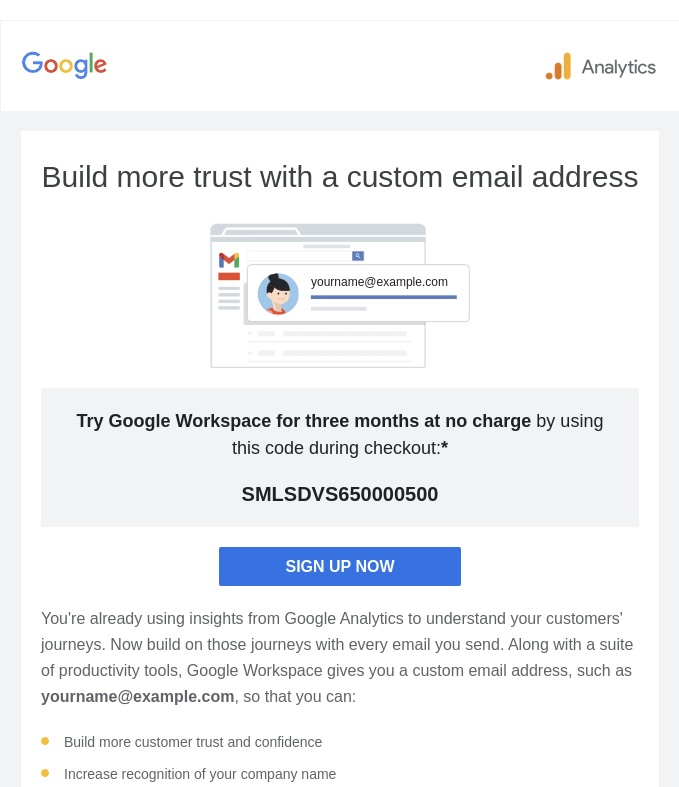
As consumers, we’re all familiar with promotional emails, and let’s be honest—who doesn’t love finding a great deal in their inbox? Businesses value this approach too. Once you’ve established a connection, showcased satisfied customers, and demonstrated the effectiveness of your product, why not seal the deal with a special offer?
In the example below, Google cleverly encourages their existing customer base to upgrade by slipping a tempting offer of free product usage into the subject line and kicking off the email with the benefit front and center!
Screenshot
8. Customer Survey B2B Email
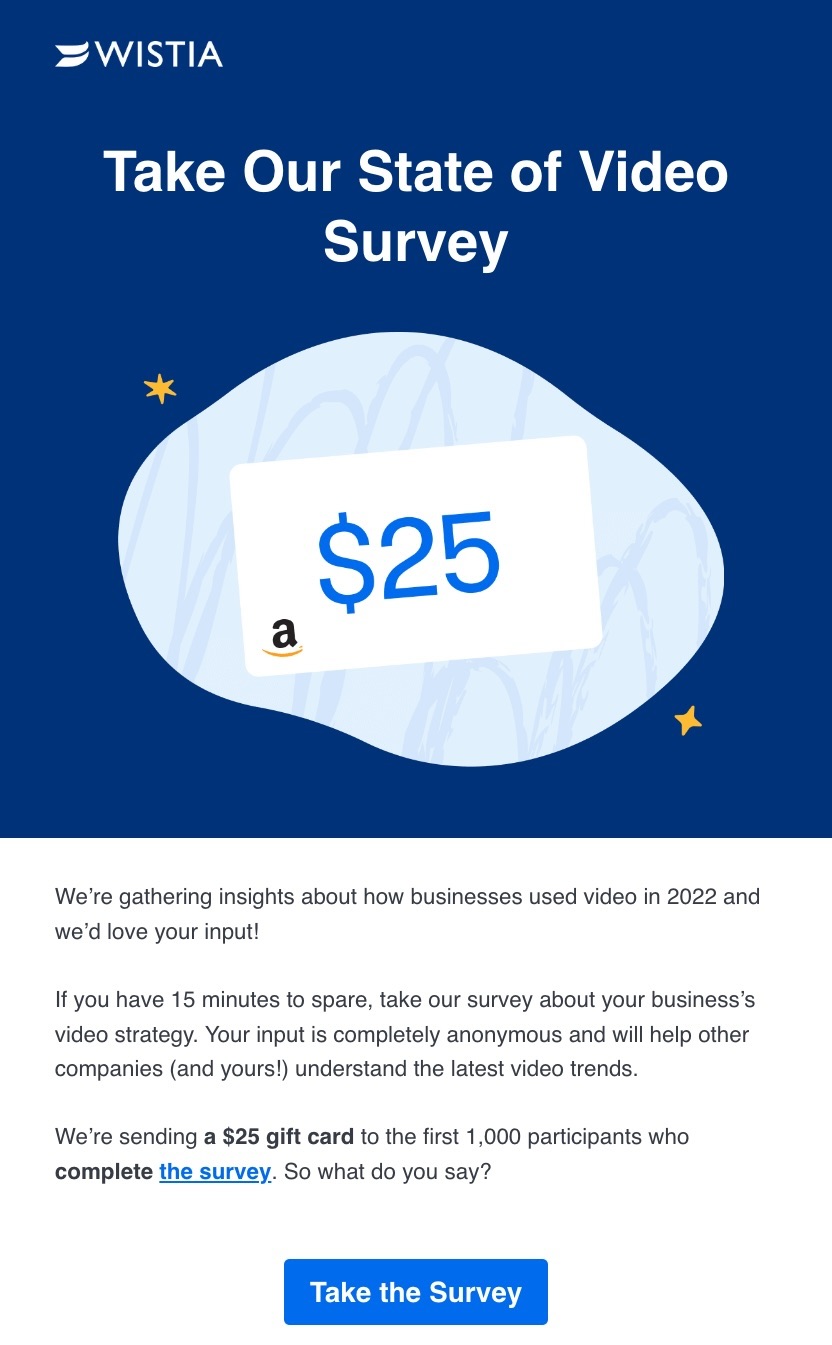
While we can’t read customers’ minds just yet, survey emails offer valuable insights into their thoughts, desires, and expectations. Whether you’re refining a product, enhancing a service, or simply checking in, these emails help strengthen customer connections. Plus, people love sharing their opinions—especially when they know you’re listening!
When putting together a customer survey email, be sure to let your audience know why it matters and how it benefits them. To secure their participation, consider adding a little extra fun by offering a chance to win a prize—just like in this example from Wistia.
9. Re-Engagement B2B Email
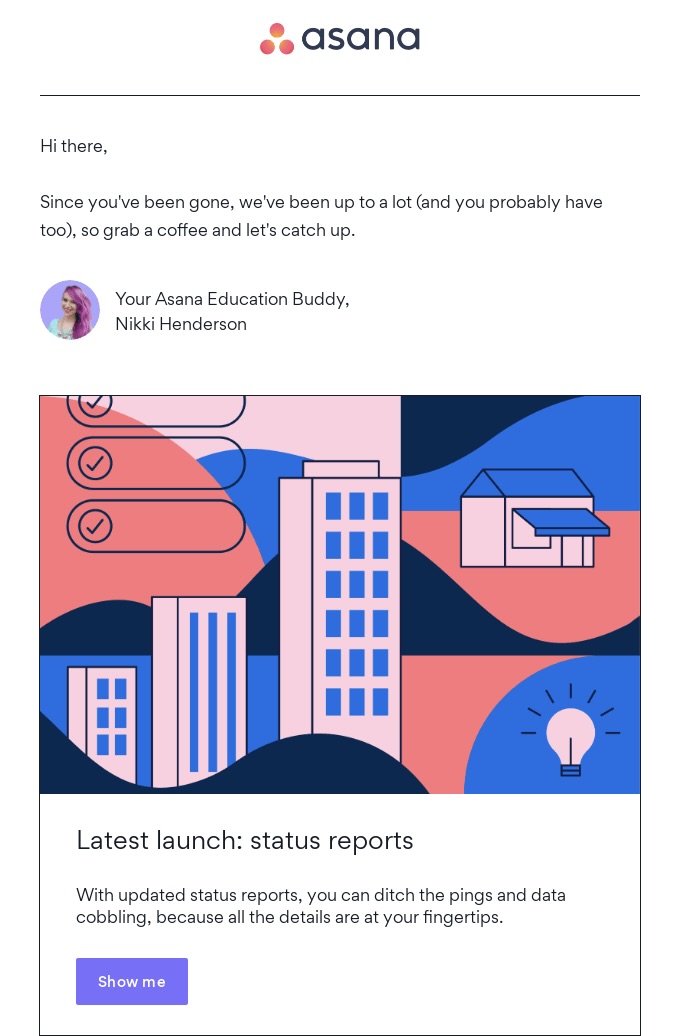
For B2B companies, re-engagement emails play a vital role in bringing back inactive subscribers, encouraging repeat purchases, or reminding customers of your value. This kind of email tends to be more formal, steering away from casual phrases like “we miss you,” and instead often emphasize educational content, product updates, or exclusive offers.
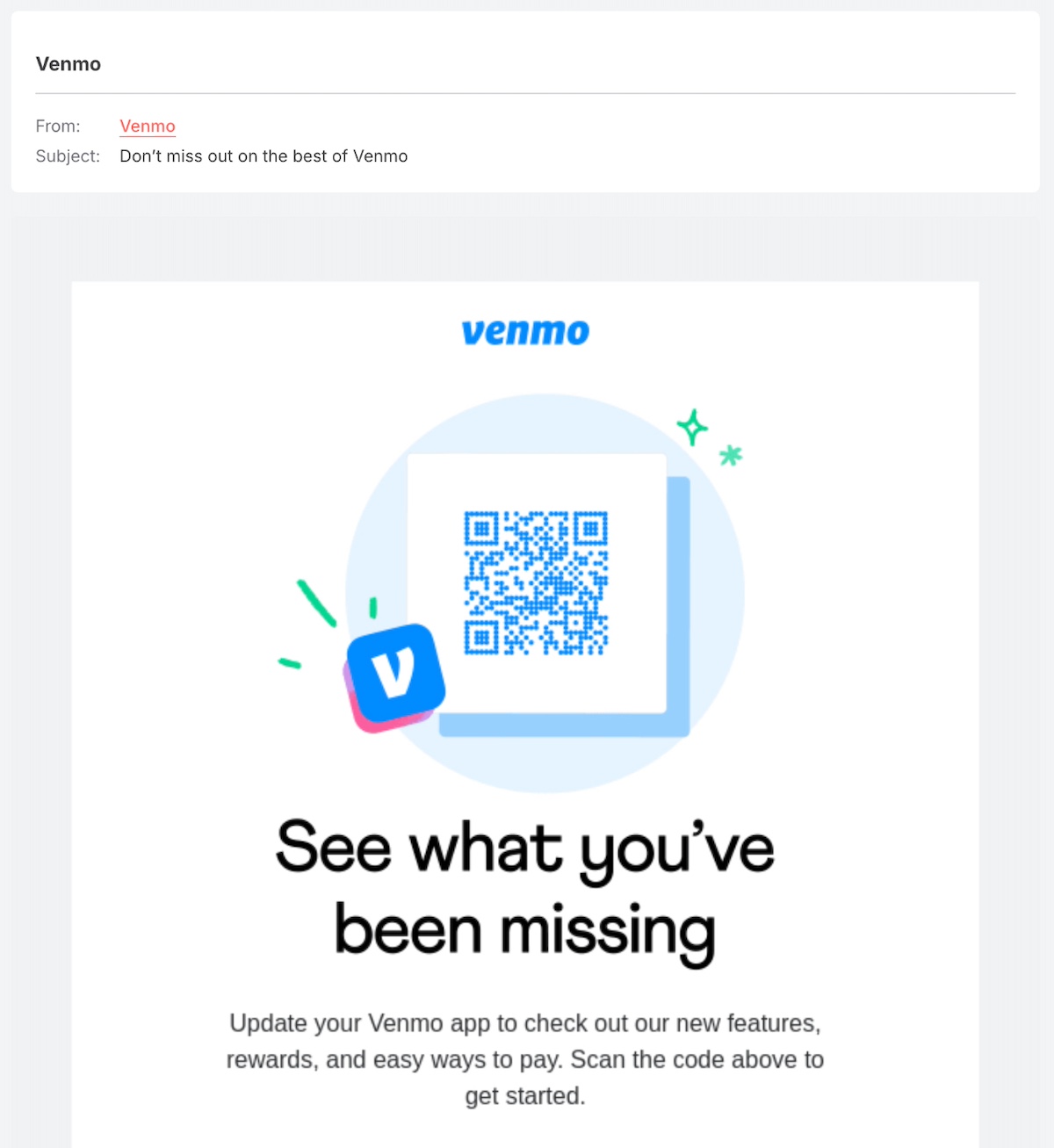
We like how this B2B re-engagement email from Asana clearly reminds the recipient that they’ve been missing out on new features and gently nudges them to reconnect.
Screenshot
Making the Most Out of Your B2B Emails
As we wrap up our journey through the world of B2B email marketing, it’s clear that success lies in a strategic approach tailored to the unique dynamics of business-to-business interactions. By mastering the intricate dance of the buyer’s journey and crafting communications that charm multiple decision-makers, your emails can become powerful allies in building partnerships and driving sales.
However, you don’t need a complex setup to get started with B2B email marketing. In fact, the most important part is consistency—sending helpful, relevant emails at the right time.
Our own email marketing platform offers essential automation features that help you set up simple but effective sequences, like sending a welcome email when someone signs up, or following up a few days later. For many B2B use cases, especially early on, that’s all you need to start seeing results.
Ever wish you could read your customers’ minds? While we’re still waiting on that superpower, survey emails are the next best thing. They give you direct insights into what your audience thinks, wants, and expects from you. Whether you’re fine-tuning a product, improving your service, or just checking in, survey emails help you build stronger connections with your customers. Plus, people love sharing their opinions—especially when they know you’re listening!
Today we’re sharing what goes into making the perfect survey email template—that is, the structure that makes up the absolutely perfect survey email. One that people want to open and answer, and that also adds positively to subscriber perception of your brand. And then we’ll examine some stellar survey email examples that you can use to inspire your own.
[36]
Why Send Survey Emails?
You probably have an idea as to why survey emails are worth considering. But lest you need convincing, here are the key reasons to get on board with surveys and start building the ideal survey template.
Understand Your Audience – Gain valuable insights into customer preferences, pain points, and expectations.
Improve Products and Services – Use direct feedback to refine offerings and enhance customer satisfaction.
Increase Engagement – Surveys create a two-way conversation, making customers feel heard and valued.
Enhance Customer Retention – Survey emails are an important part of the email customer journey—by addressing issues proactively you can retain customers and maintain loyalty.
Make Data-Driven Decisions – Rely on real feedback rather than assumptions to guide business strategies.
Measure Customer Satisfaction – Track Net Promoter Score (NPS) or other key satisfaction metrics to gauge brand perception.
Personalize Marketing Efforts – Tailor messaging and offers based on customer preferences revealed in survey responses.
By now you’re surely convinced and chomping at the bit to create your first survey. So let’s dive into the elements of a strong survey email template.
Elements of a Successful Survey Email Template
A great survey email template isn’t just about asking questions—it’s about getting people to actually open your message, click, and respond. Indeed, there’s an art to this process so that you can get meaningful results that truly benefit your business, and build trust with your customers—which is all part of a successful email newsletter strategy.
But first, let’s break down the key elements of a successful survey email template.
1. Subject Line: Grab Their Attention
If we’ve said it once, we’ll say it again (and again!): your email subject line is your first (and maybe only) shot at getting someone to open your email. As is the case with every email, your survey email subject line needs to be engaging, clear, and, ideally, irresistible. And because survey emails are their own breed of messages, we have a few more tools in our tool box to really tease that email-open. Here are some winning subject line ideas for inspiration:
Can we ask you a question?
Answer a [Number]-minute survey—win a [Prize]!
Shape our next product
Your feedback is important to us
We want to hear from you
Have a second?
“Tell us what you think & get [incentive]”
As you can imagine with the above subject lines, sparking curiosity or offering a small incentive can go a long way in increasing survey request email open rates. And the truth is people love sharing their thoughts, so if you keep it quick and focused on the customer and the value of their input, you’re a lot more likely to get a response.
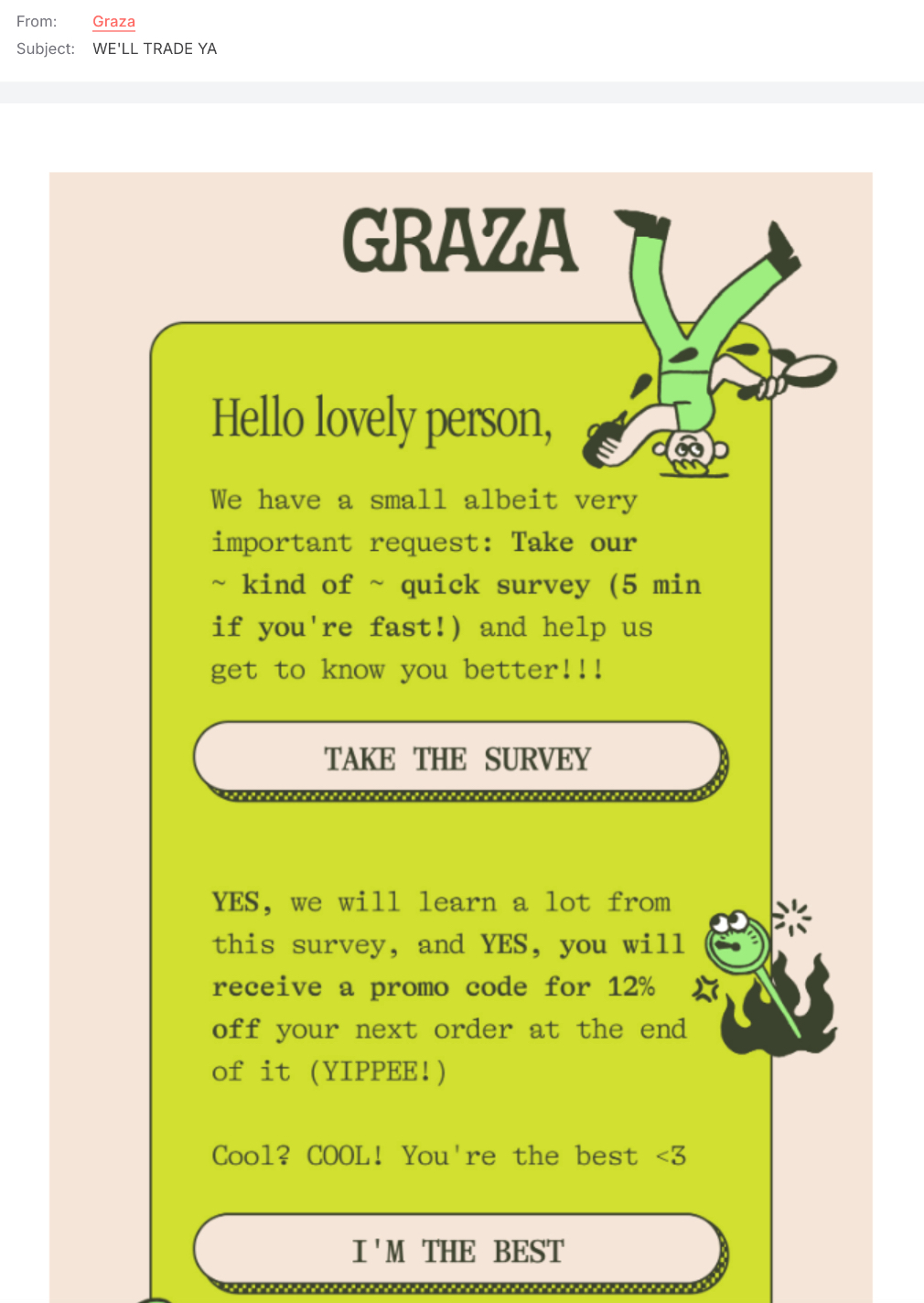
We love how the above email has a tempting and funny subject line. Trade us for what? Feedback for a discount, that is! The email itself follows up with a super playful message that emphasizes the value of getting to know the customer and offers a sweet incentive. Multiple clever and laugh-inducing call-to-action buttons ensure engagement.
2. Body Copy: Keep It Short and Sweet
Speaking of keeping it quick, no one wants to read a long-winded novel just to get to a survey link…only then to be faced with an enormously long and boring questionnaire. Let’s not do that to our customers. Keep your message concise, friendly, and to the point. Here’s a simple structure to follow:
Start with appreciation – “We value your opinion!”
Explain why you’re reaching out – “We’re working on improving [product/service] and would love your feedback.”
Set expectations – “It’ll only take 2 minutes!”
Add an incentive if applicable – “As a thank you, you’ll be entered to win [prize].”
Set expectations, and make it feel personal and conversational, like a message from a friend.
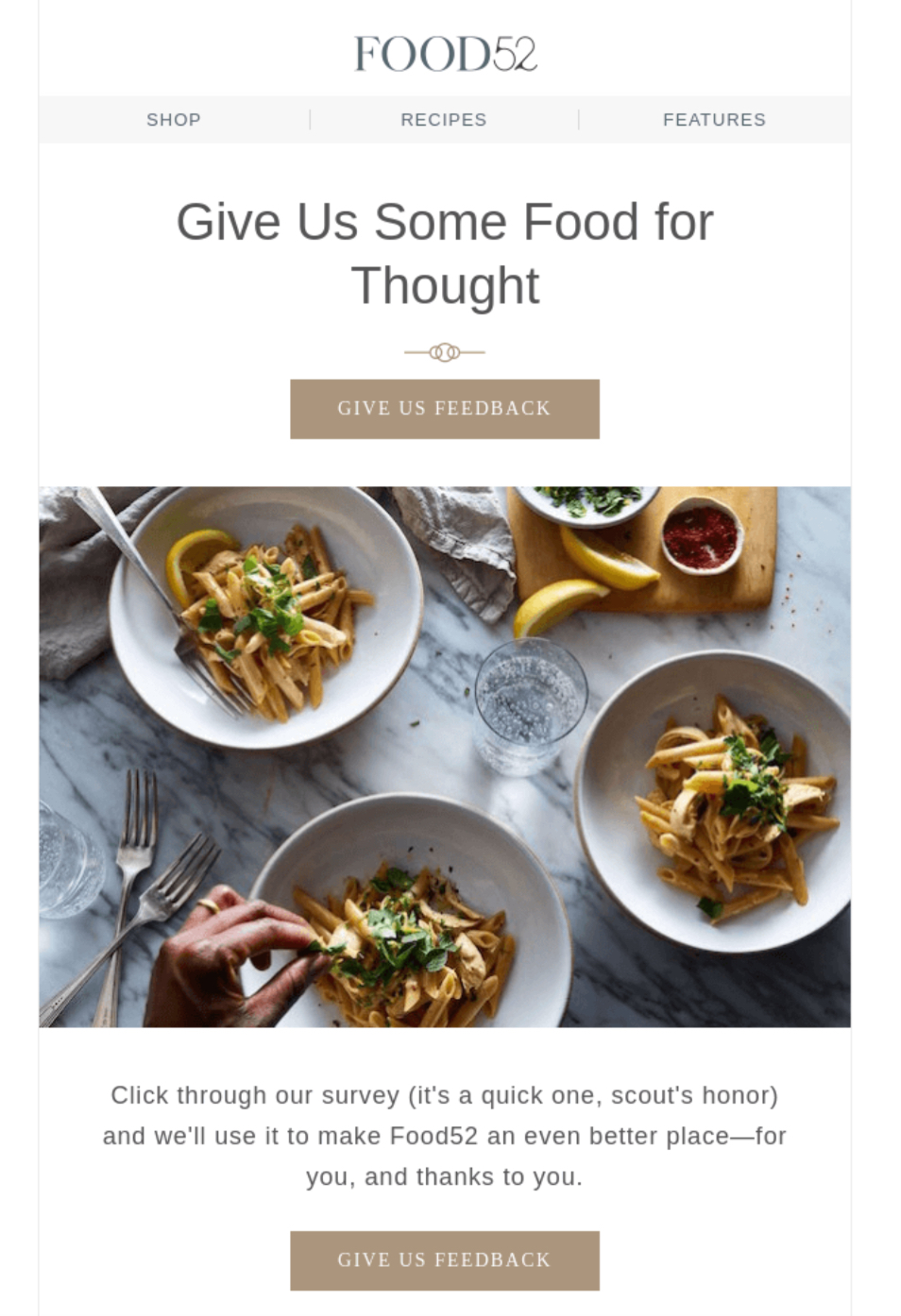
The above feedback email from Food52 checks all the survey email boxes with its to-the-point message that expresses gratitude and makes responding easy.
3. Imagery: Make It Eye-Catching
A well-placed image or graphic is an important part of good email design, and it can make your survey request email more visually appealing, friendly, and just generally add to your brand’s overall vibe (which is always important to enforce and reinforce). Consider using:
A friendly, relevant image (like a smiling person or a fun illustration)
Simple icons to highlight key points
A branded design to keep things consistent
Just don’t overdo it—too many visuals can distract from the main goal: getting that survey completed. Short and sweet and good to look at—that’s the goal.
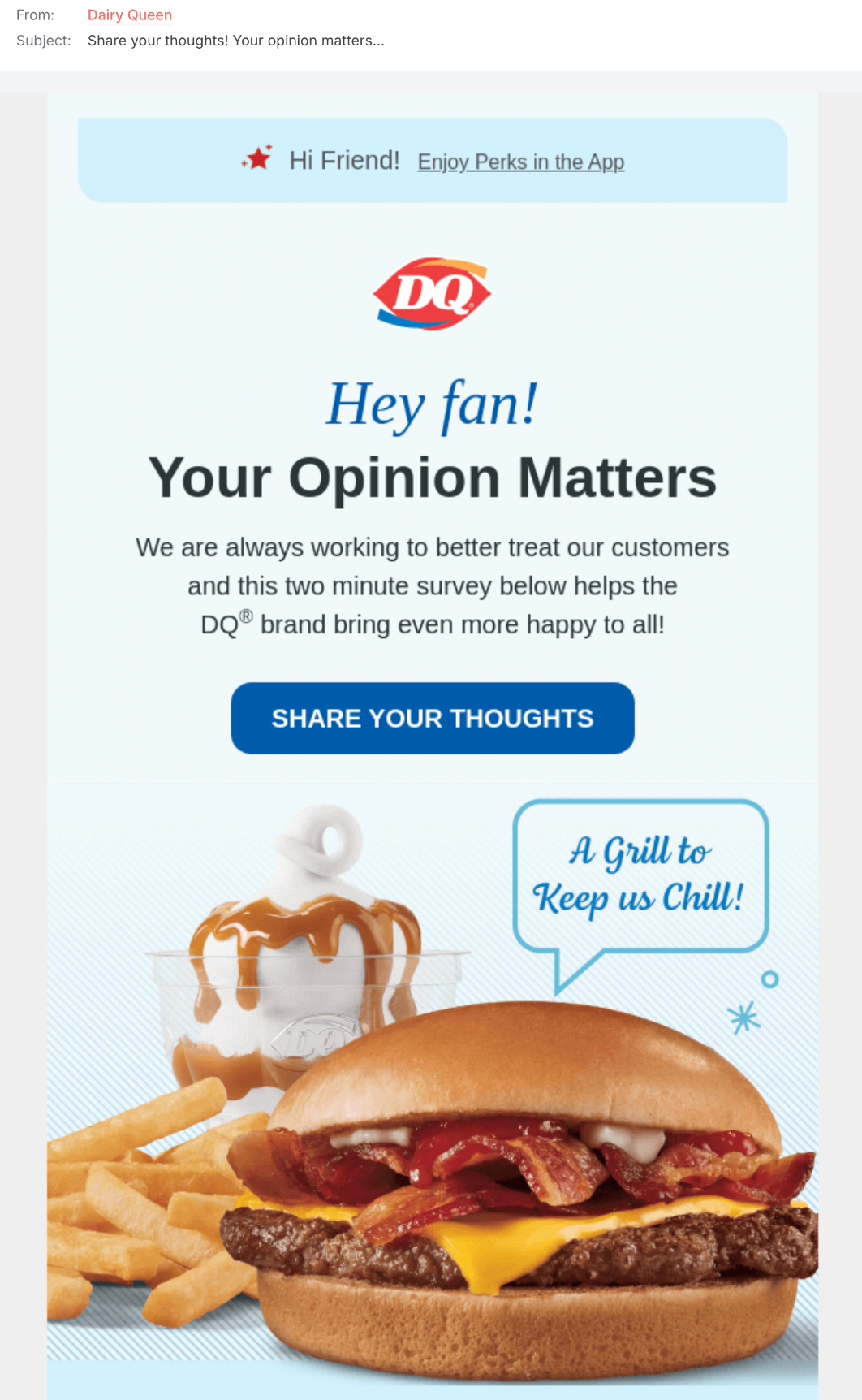
This email does a mouth-watering job of keeping it short and, especially captivating. Chances are customers will answer the survey and then head straight to DQ for a caramel-slathered ice cream sundae, maybe with a side of fries.
Not sure where to start with your email design? Or even your email sending? SiteGround Email Marketing is incredibly user friendly and easy to get going, offering robust features—such as email automation, segmentation, a built-in AI writer, and an intuitive builder—and all at a super accessible price.
Your survey email has one purpose: to get people to take your survey. So your survey link is your call to action (CTA), and it needs to be extra noticeable. If people have to hunt for the survey or questionnaire link CTA, they simply won’t bother. So place your link prominently, ideally as a button, and near the beginning and end of your email. Use bold, strategic colors and a large enough button to make clicking irresistible.
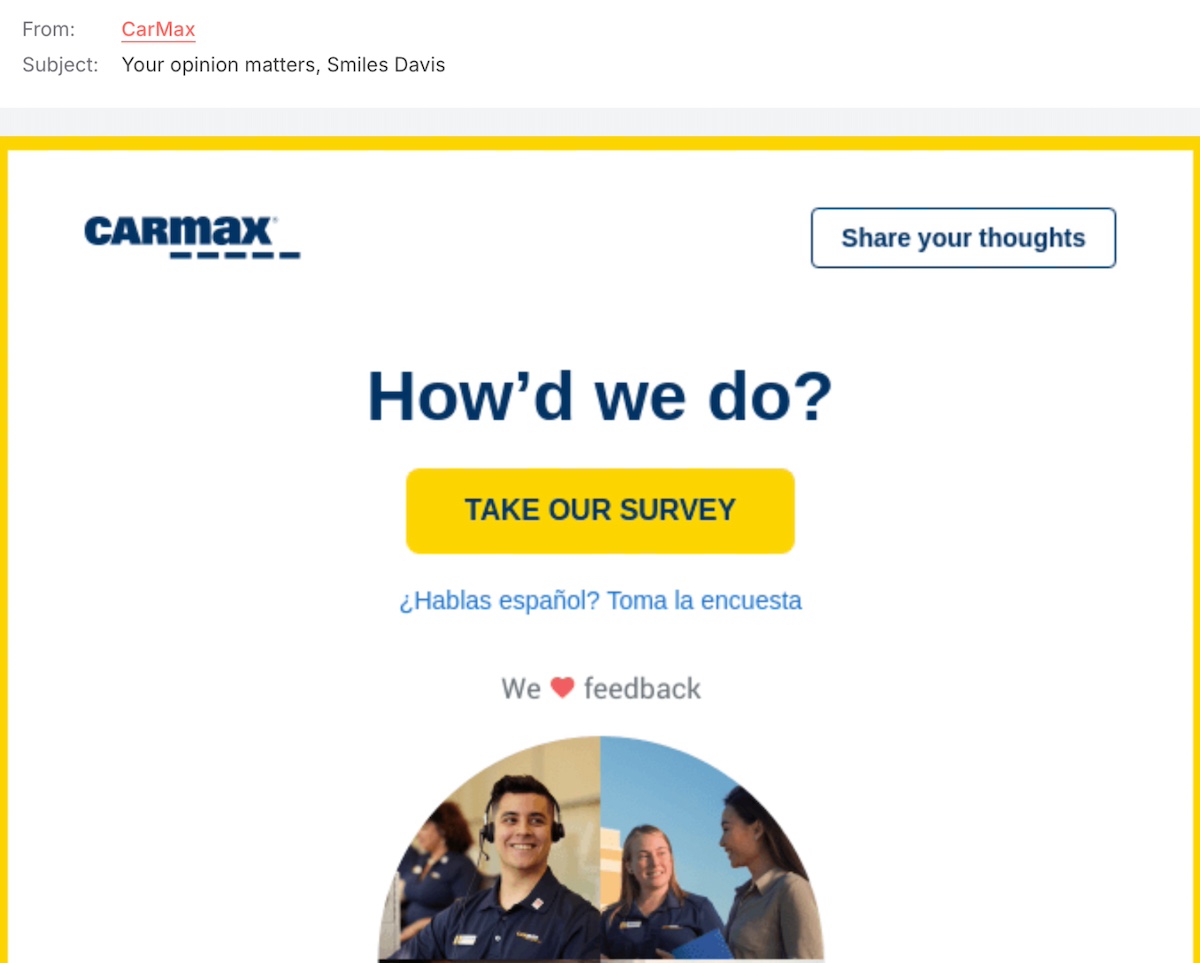
The above email wastes no time asking a short and super direct question, followed by an extra-simple and impossible-to-miss CTA button—survey response assured.
5. The Perfect Survey Template: Put Everything Together
In theory, a survey email template could seem rather simple, but you can tweak it a thousand ways to make it just right for your purpose and audience—and to ensure that you get those responses.
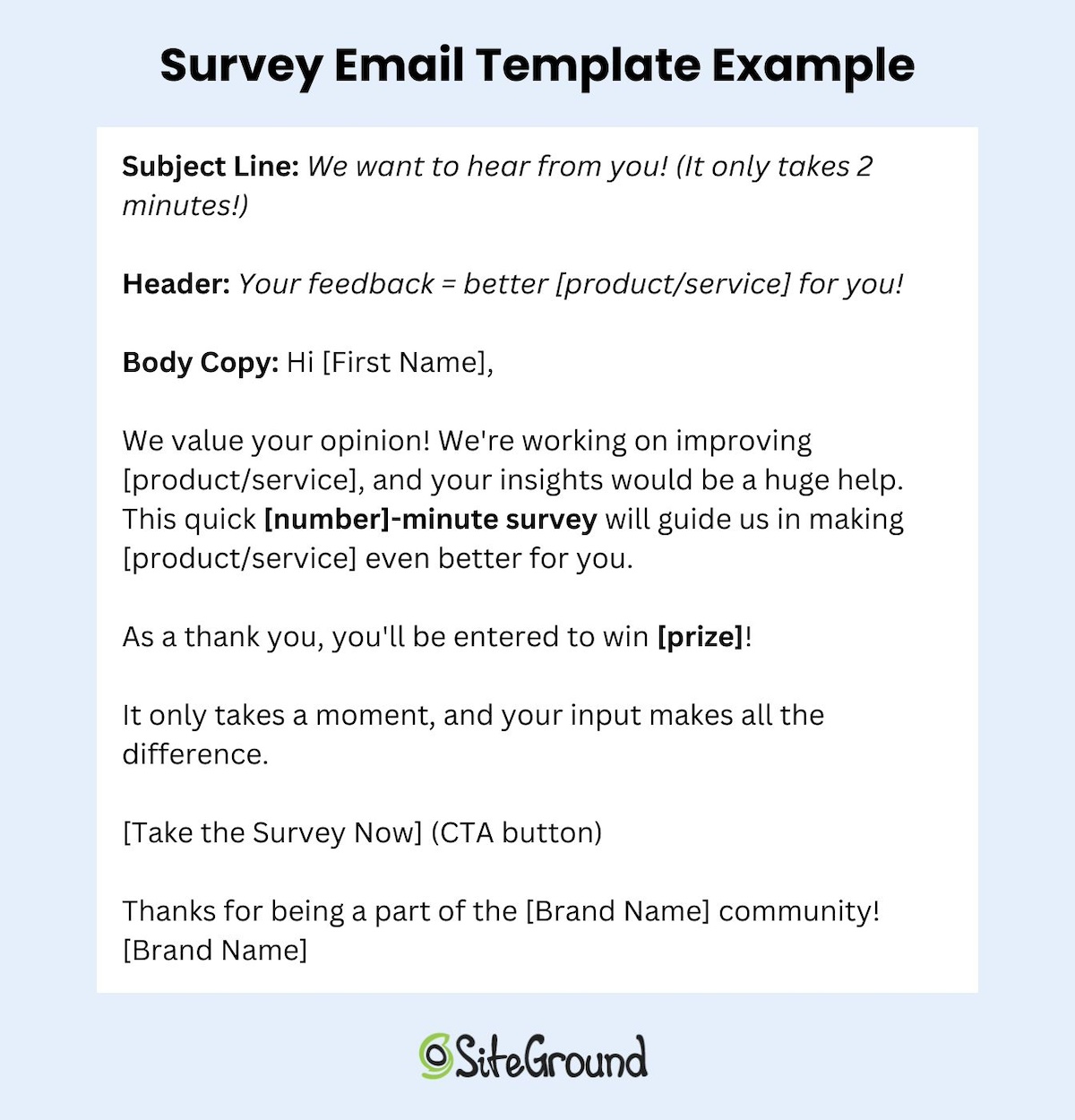
Pulling together the above elements, we can create this basic, but oh-so-perfect, survey email template.
Want access to more survey email templates? We’ve created X survey email templates for all occasions, each leveraging all the tips we’re covering today. Don’t forget to snag your list of free-to-use templates so that you can get started today.
We’ve covered the elements of a survey email, but how you put those elements into action is where the real magic happens. To maximize responses, follow up these best practices when crafting your survey email template.
1. Offer Incentives
“You want my opinion, and I get rewarded for it?” Sign us up, because hey, we’re human, we love to share our thoughts, and we love a good dopamin-inducing incentive! So offering a perk, like a discount, giveaway entry, or exclusive access can significantly increase open rates and up survey request participation.
Even something as simple as “Help us improve, and get 10% off your next purchase!” can give a nice bump to your survey responses. Plus it generates goodwill, and who doesn’t want a little more of that?
2. Explain the Purpose
By letting your audience know why their feedback matters, you can get them emotionally invested in your survey’s purpose and outcome. After all, they want to know their feedback matters—and why.
For example, are you looking to enhance customer service? Improve a product? Let your customers know this. If they understand the “why” behind your survey, it will increase the chances that they take the time to respond. And the bonus: they become more loyal to your brand in the process because they see that you care.
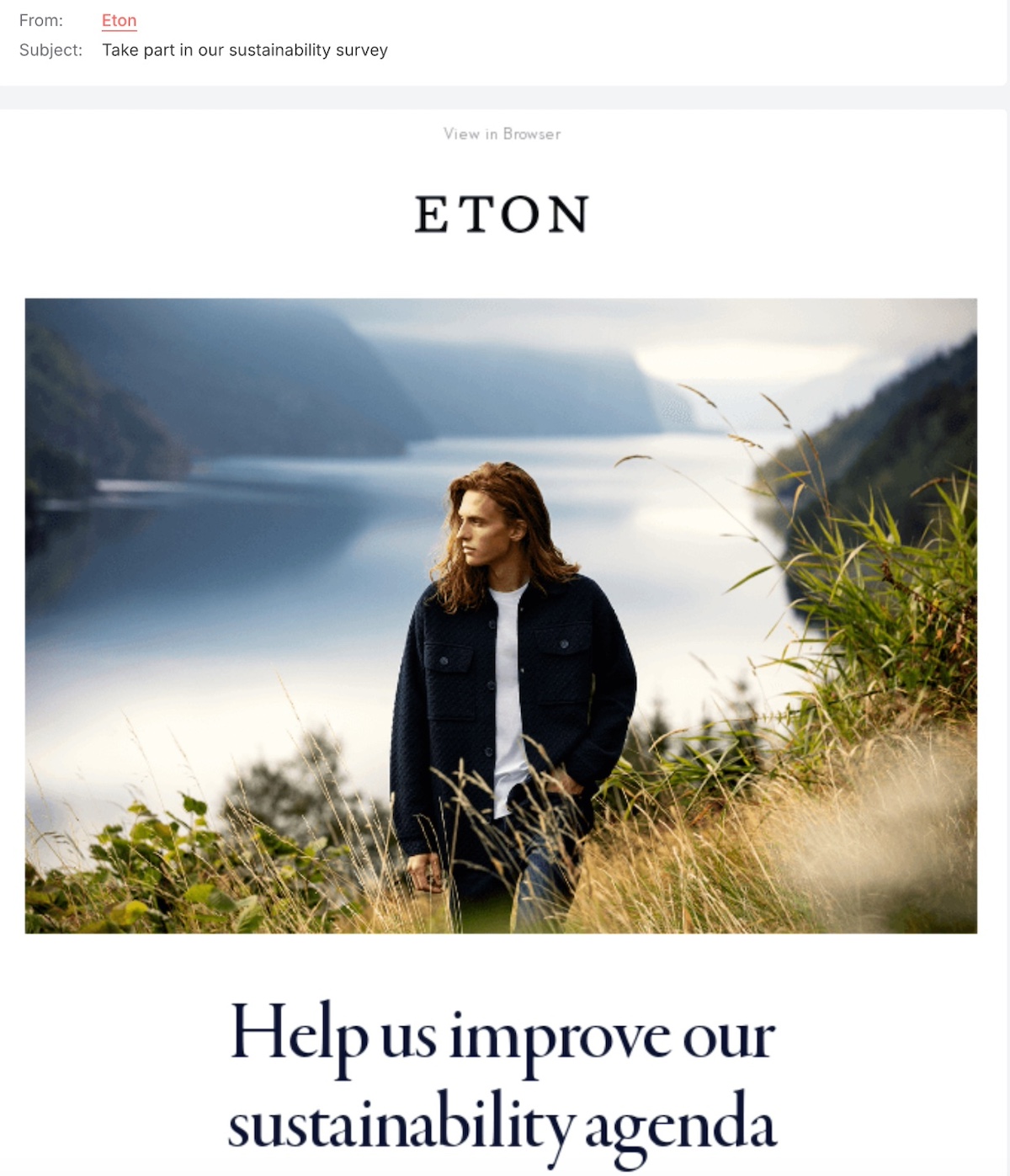
Eton makes the goal of their survey extra clear, starting right in the subject line, which they follow up by asking the reader to help them improve. This kind of transparent request helps the customer feel like their opinion is important and has a greater purpose.
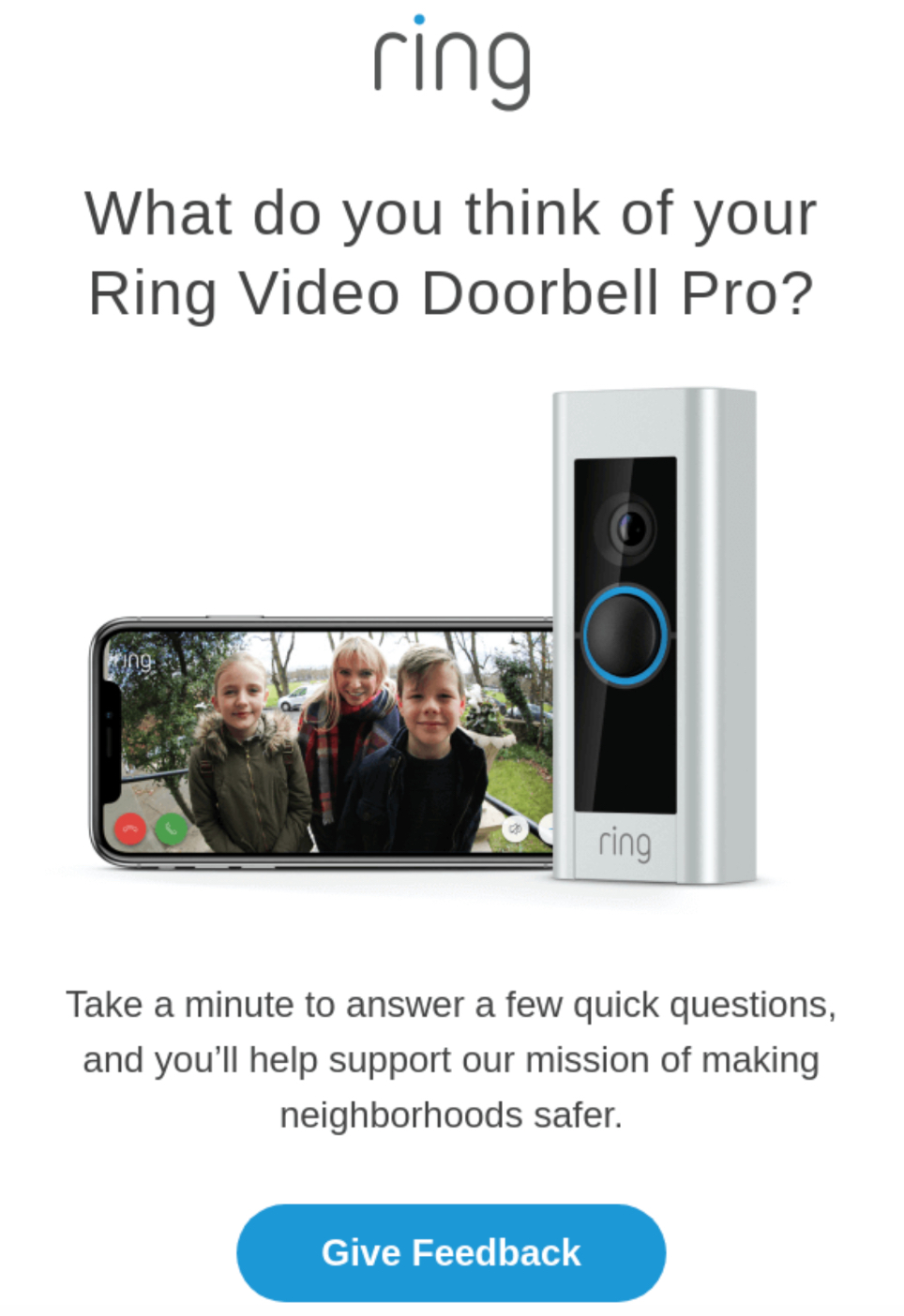
Ring’s survey email also does a stellar job of getting the recipient invested in the purpose of gathering feedback. By sharing their mission, they convey to the survey taker that they can directly support this mission—an appeal that is hard to ignore.
3. Set Expectations
It’s important to keep your survey request emails short, and a part of that is making sure the recipient knows that you won’t be monopolizing their time. Keep emails lean and surveys brief, and set expectations accordingly.
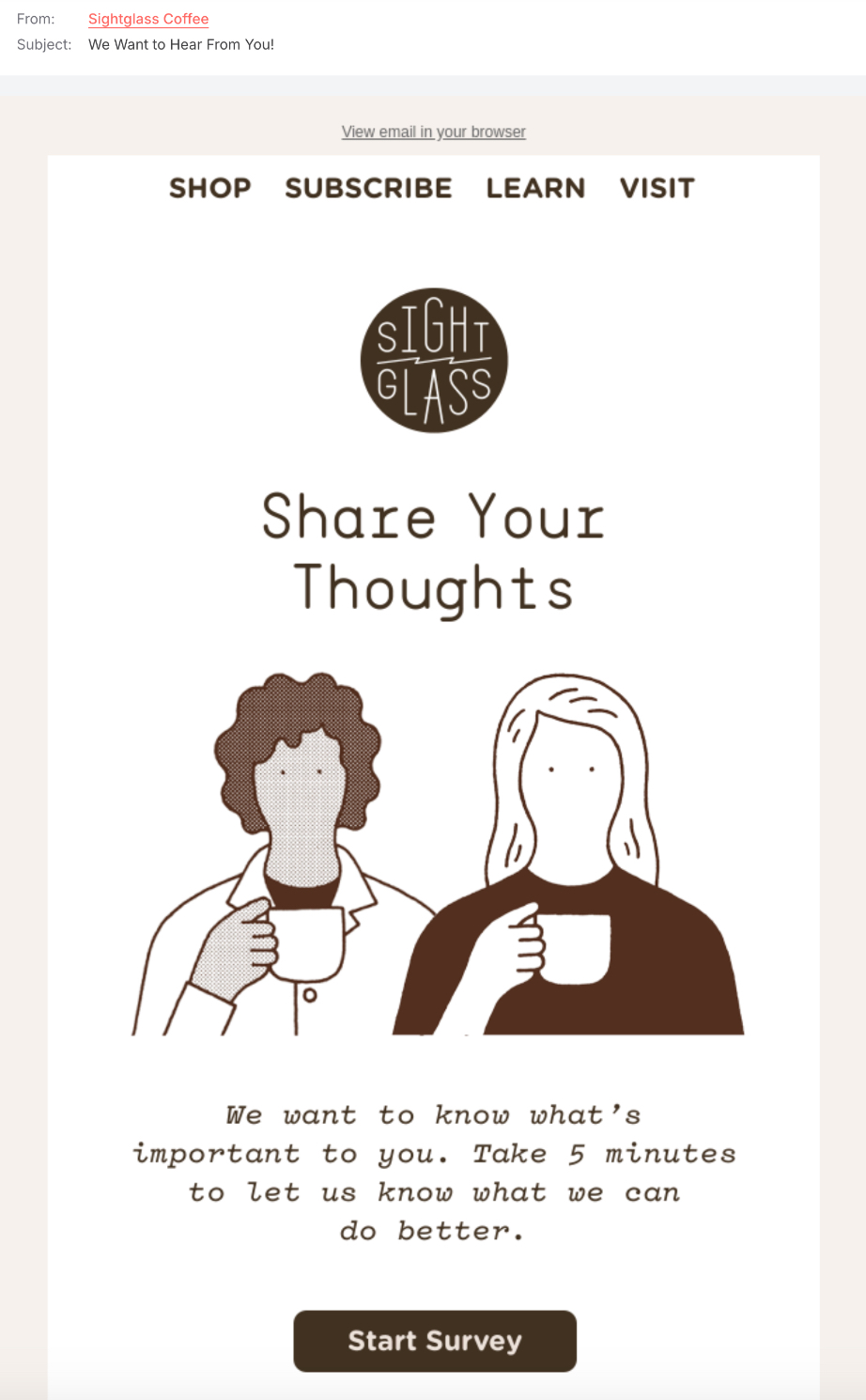
Sightglass does this nicely with their brief email that gets to the heart of the matter—the survey will only take five minutes, and Sightglass conveys their interest in knowing customer thoughts so that they as a business can do better.
4. Share Results
Your subscribers are invested at this point—they’ve given you feedback, and so for them to get to know the outcome of their well-spent time is the cherry on top. Once you’ve gathered responses, share the impact!
A follow-up email with key findings, or one that shares how you’ll implement changes based on feedback, not only builds trust but also reinforces the benefits of email marketing, keeping your audience engaged and connected to your brand.
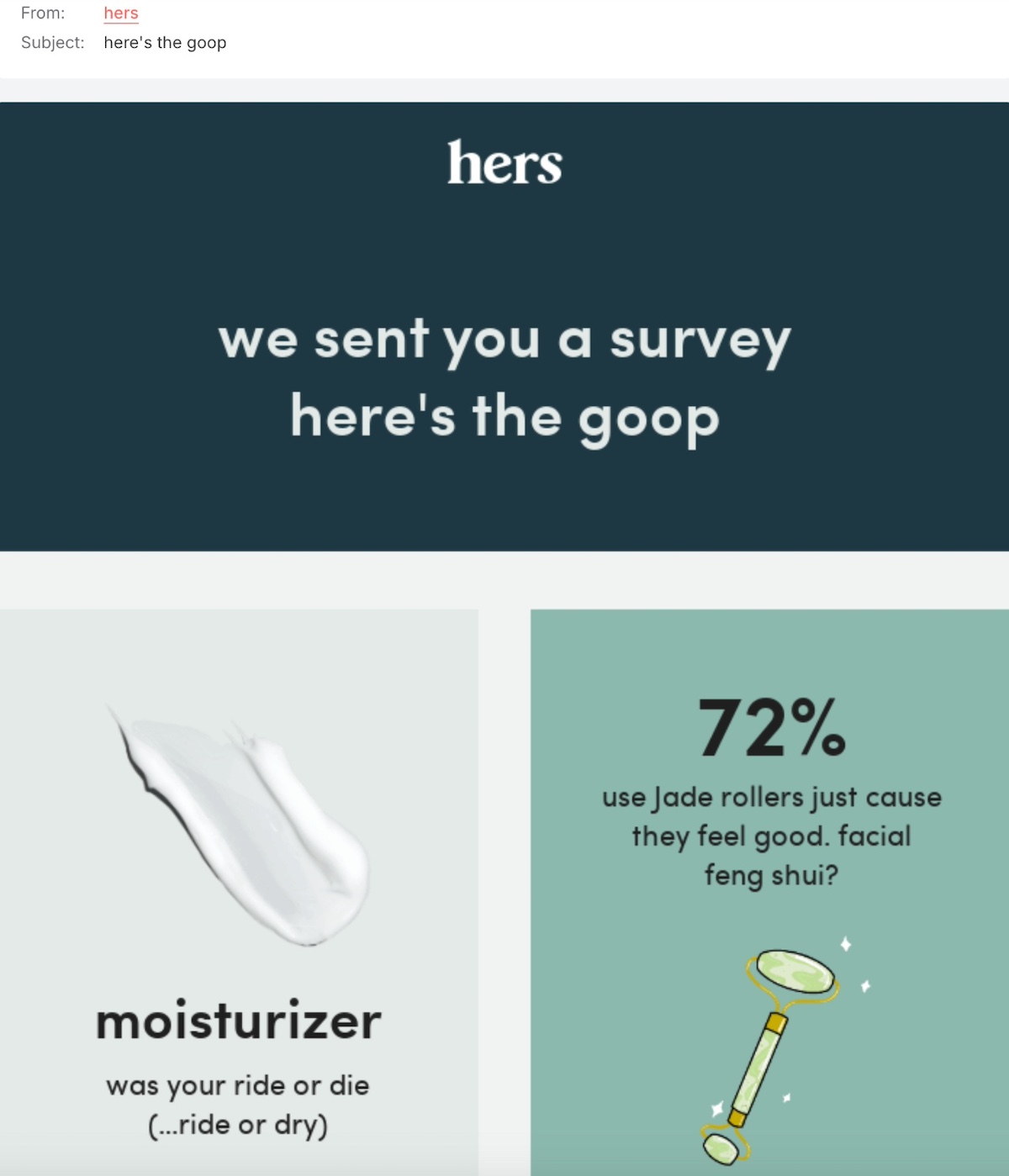
Who doesn’t love survey results, especially if you’ve gone to the trouble of providing your own answers? Hers taps into this curiosity with an email packed with survey data, letting customers feel valued for having shared their feedback, and providing them with the satisfaction of knowing the results.
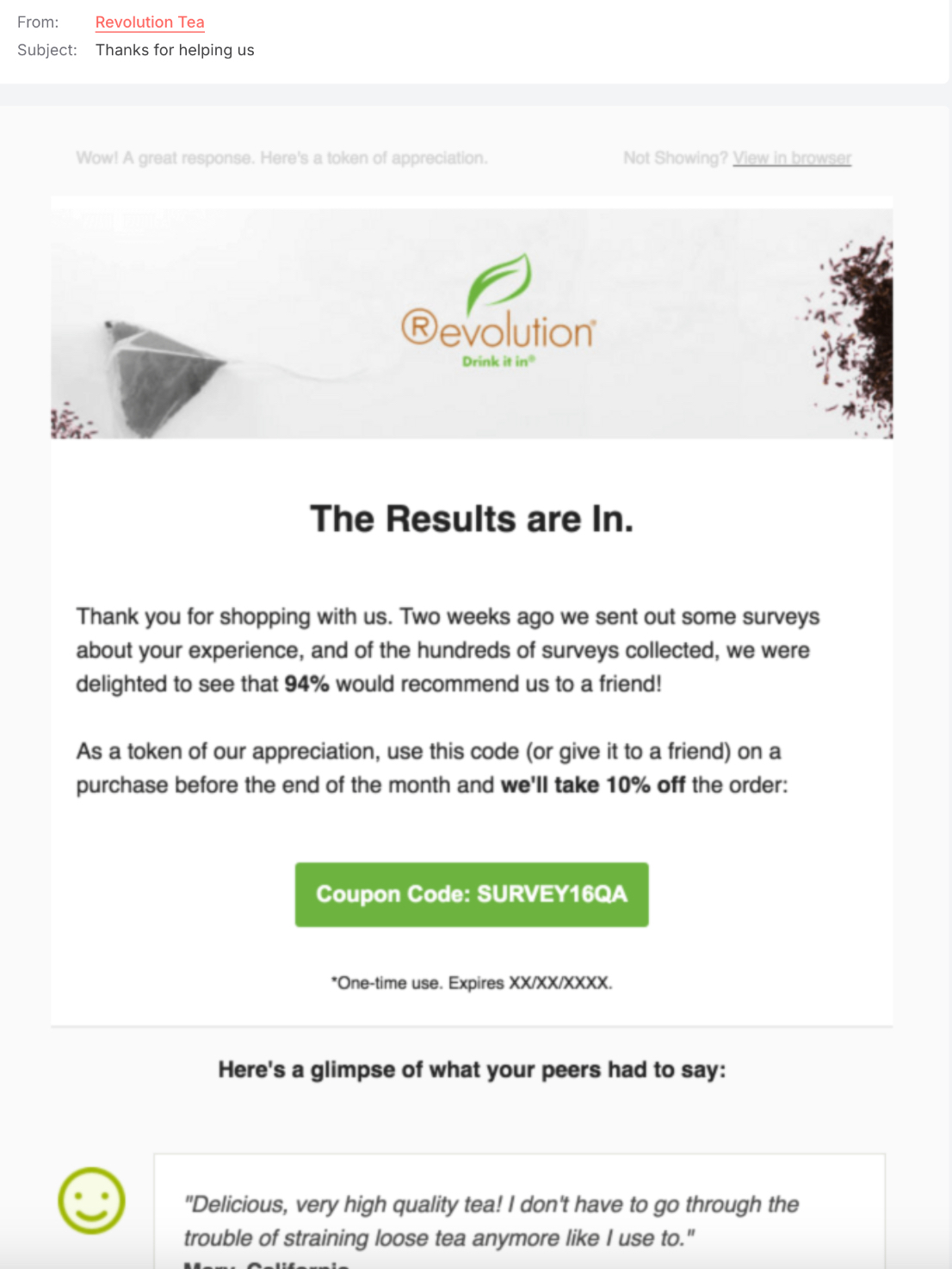
The above email demonstrates a super smart way to benefit even further from your survey emails. Revolution Tea expresses gratitude by not only sharing results, but also a discount. In addition to this, they use the actual survey results and testimonials as social proof to further encourage purchases.
Survey Email Template Examples in Action
This is where the rubber really meets the road—with clever survey email examples in action. These different design examples capture the many different types of emails you can send, as well as the range of ways you can make the humble survey email template playful, captivating, and compelling. So without further ado, let’s check them out.
Feedback Survey Email
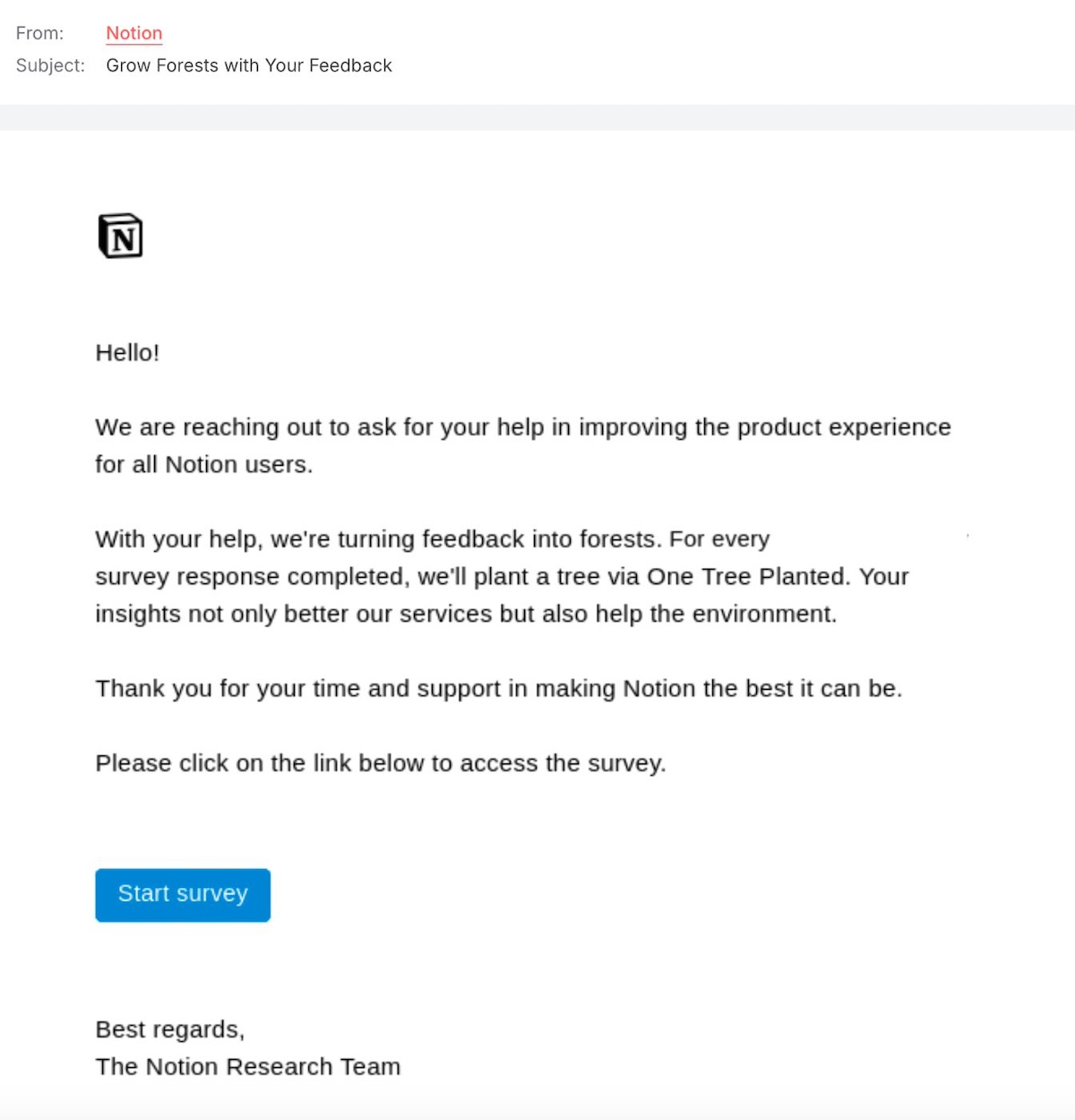
As a part of your lead nurturing email strategy, sometimes you just want to send a basic feedback survey email. This calls for you to roll out all the survey email best practices: a strong subject line, concise text, and an unavoidable call to action. Set expectations by letting your recipient know exactly what you’re asking for, and why, and make sure they feel valued. Extra points if you can get creative.
Which Notion very much does in the email below. They keep things uncomplicated but with a twist: they appeal to the recipient’s do-gooder side. The idea of growing forests with your feedback is a creative incentive—doing so makes the survey taker feel like they’ve accomplished something and, conversely, not doing so does the opposite (not growing forests—what a shame!). So this is a clever way to get that good old-fashioned feedback.
Survey Email With an Incentive
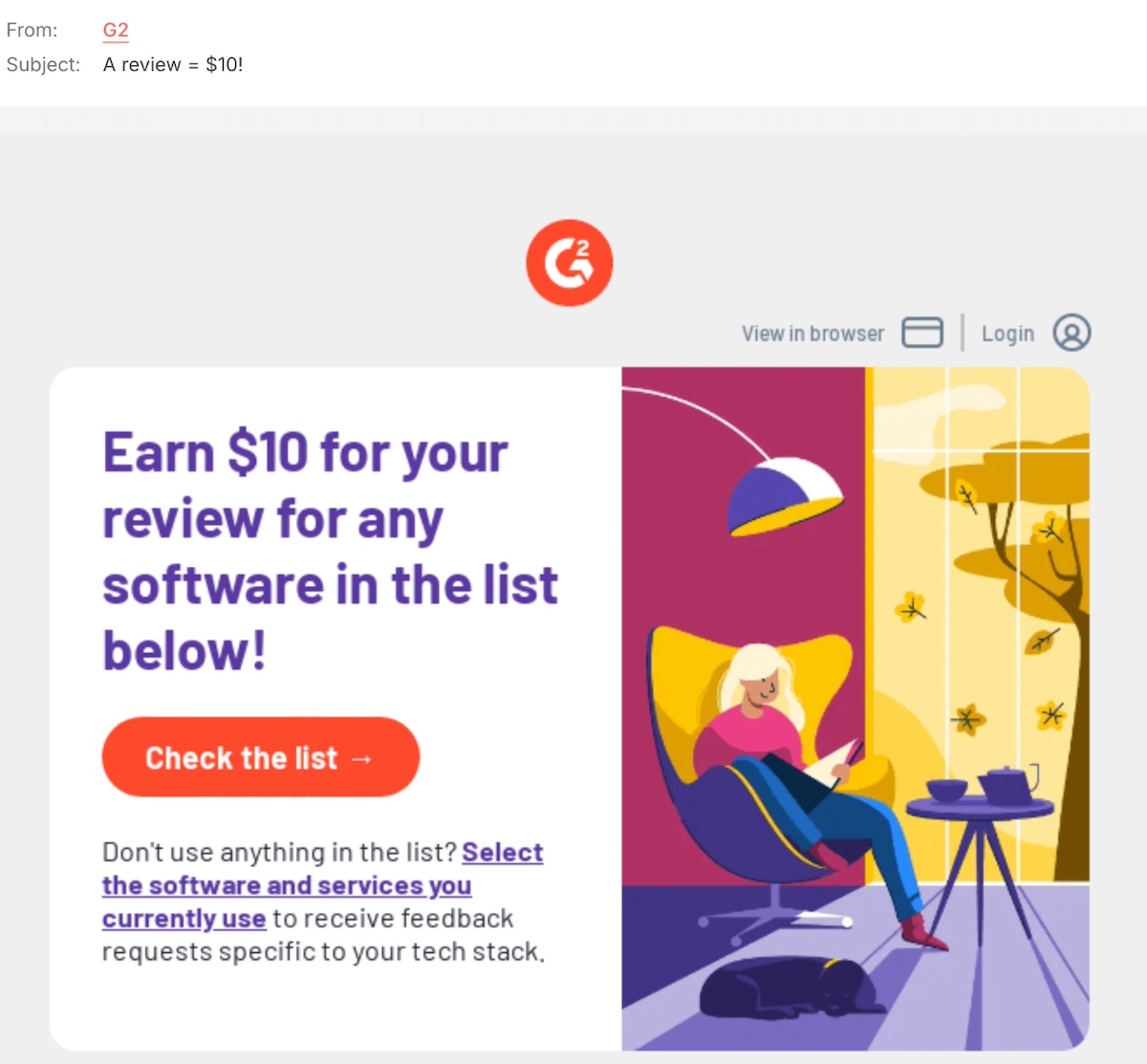
The best tried and true tactic for getting questionnaire responses is by simply offering an incentive. Giving a discount, cash back, or some other perk, means that people are more likely to share their thoughts.
The below email does this right, offering cold hard (virtual) cash as a benefit. They cleverly and simply point this out in the subject line, and make the email brief and to the point. No fluff. Just an incentive, a splash of text, and a CTA to take the survey.
Survey Email With a Giveaway
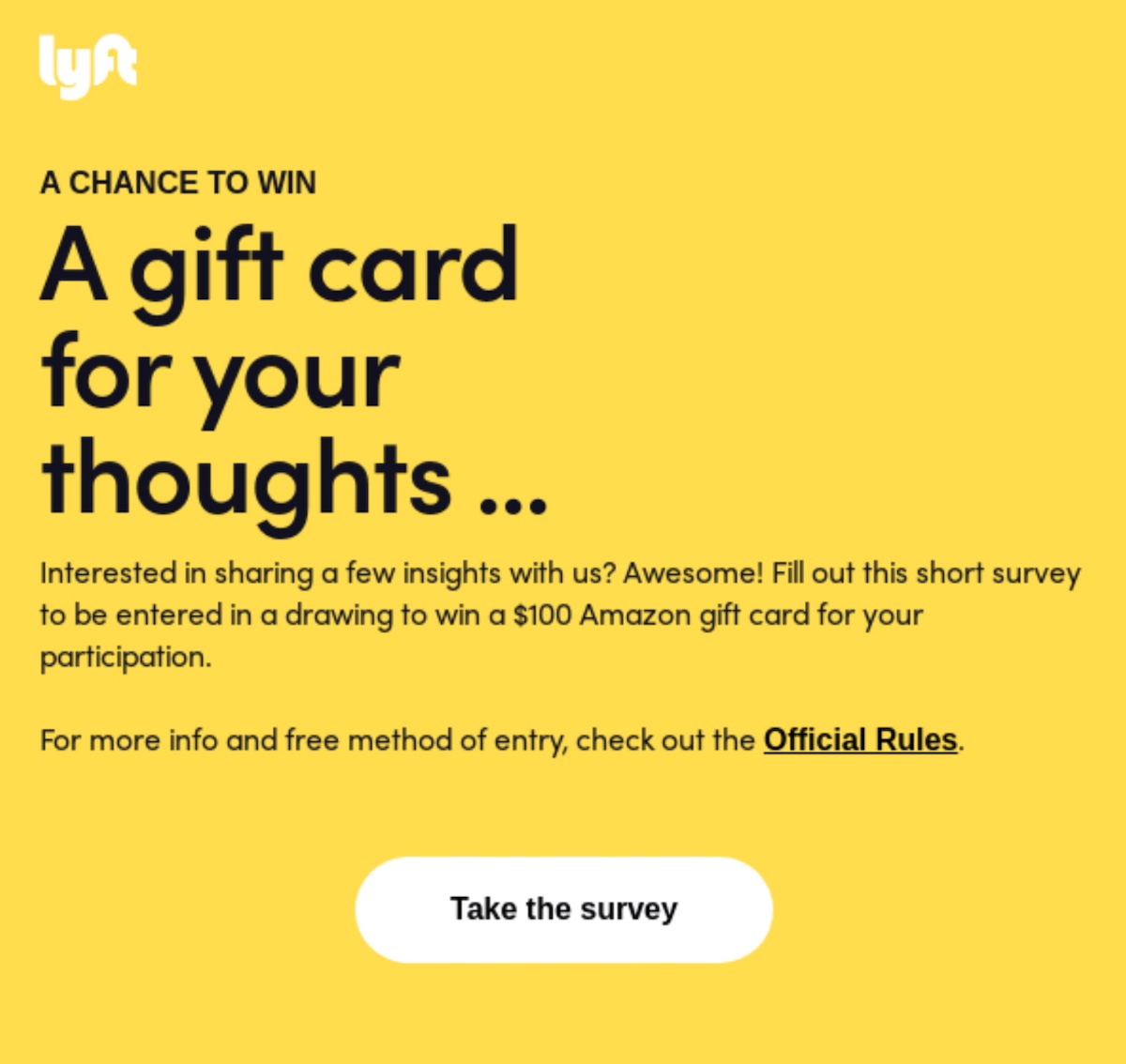
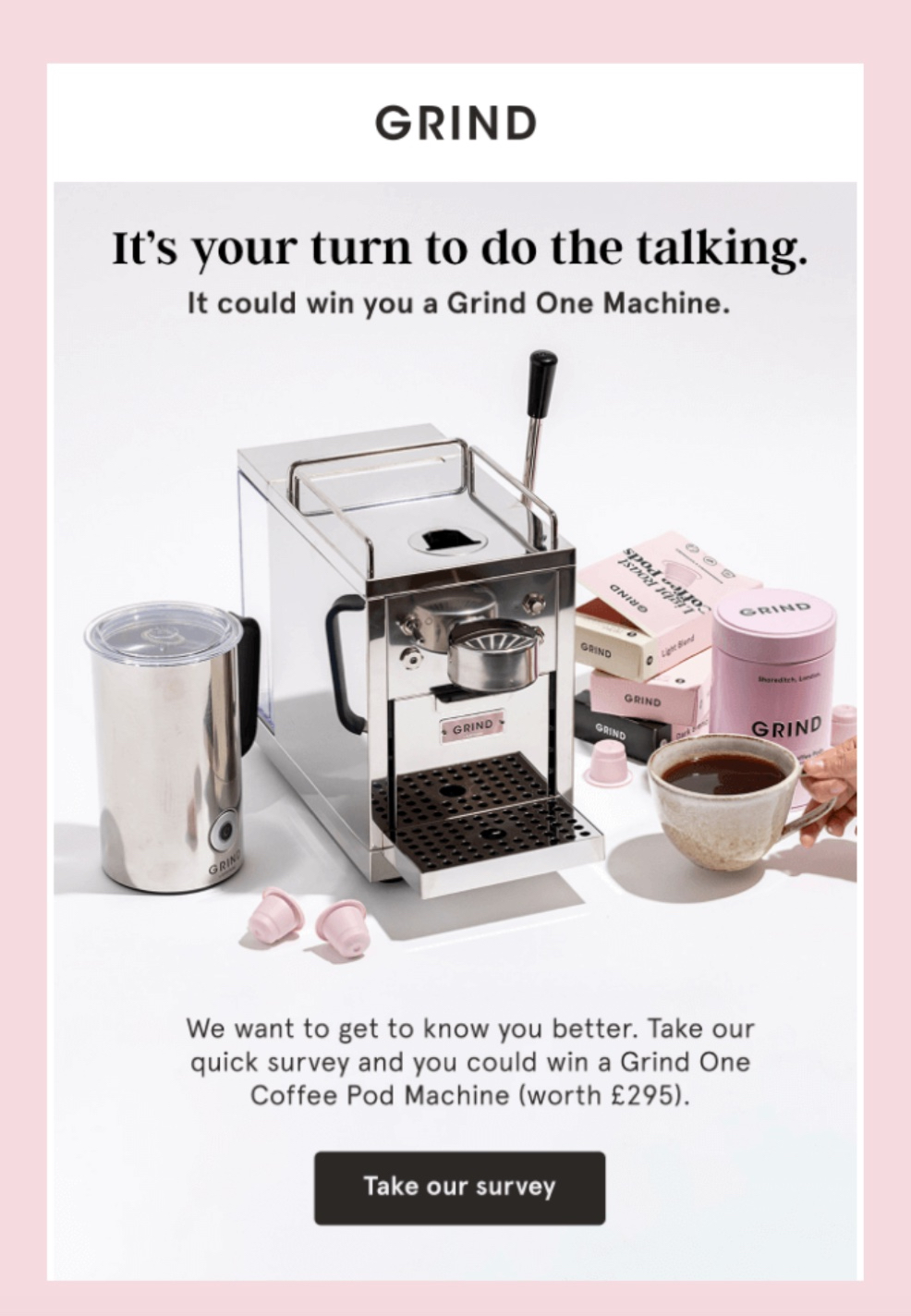
Incentives don’t just need to come in the form of discounts or cash back, they can be an even bigger and better reward in the form of a giveaway or contest. The potential of a big prize is a substantial incentive for the survey-taker, but likely a relatively small investment for your business.
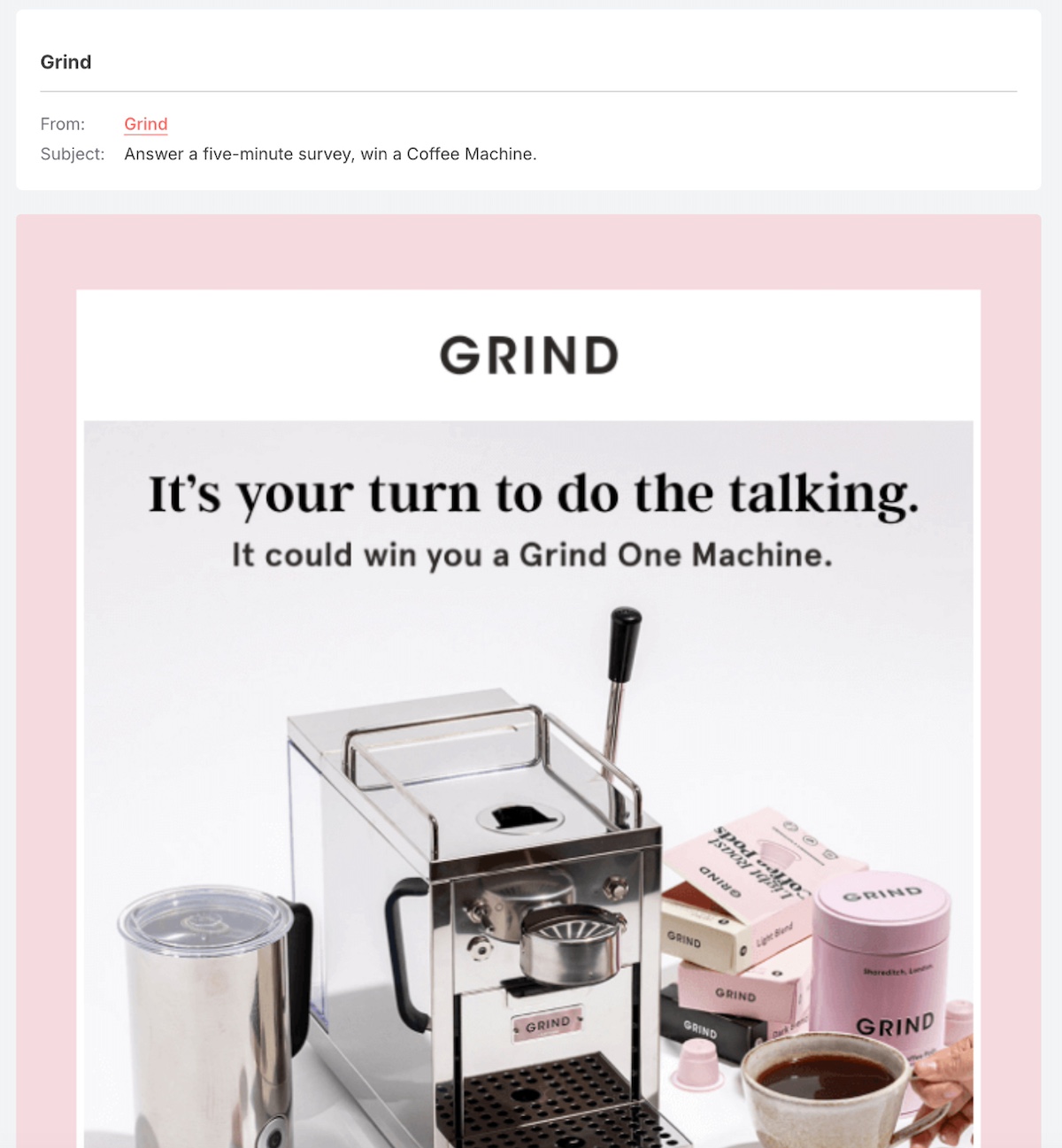
This email from Grind does a great job of valuing the recipient’s feedback while simultaneously teasing a much-desired giveaway.
Product Survey Email
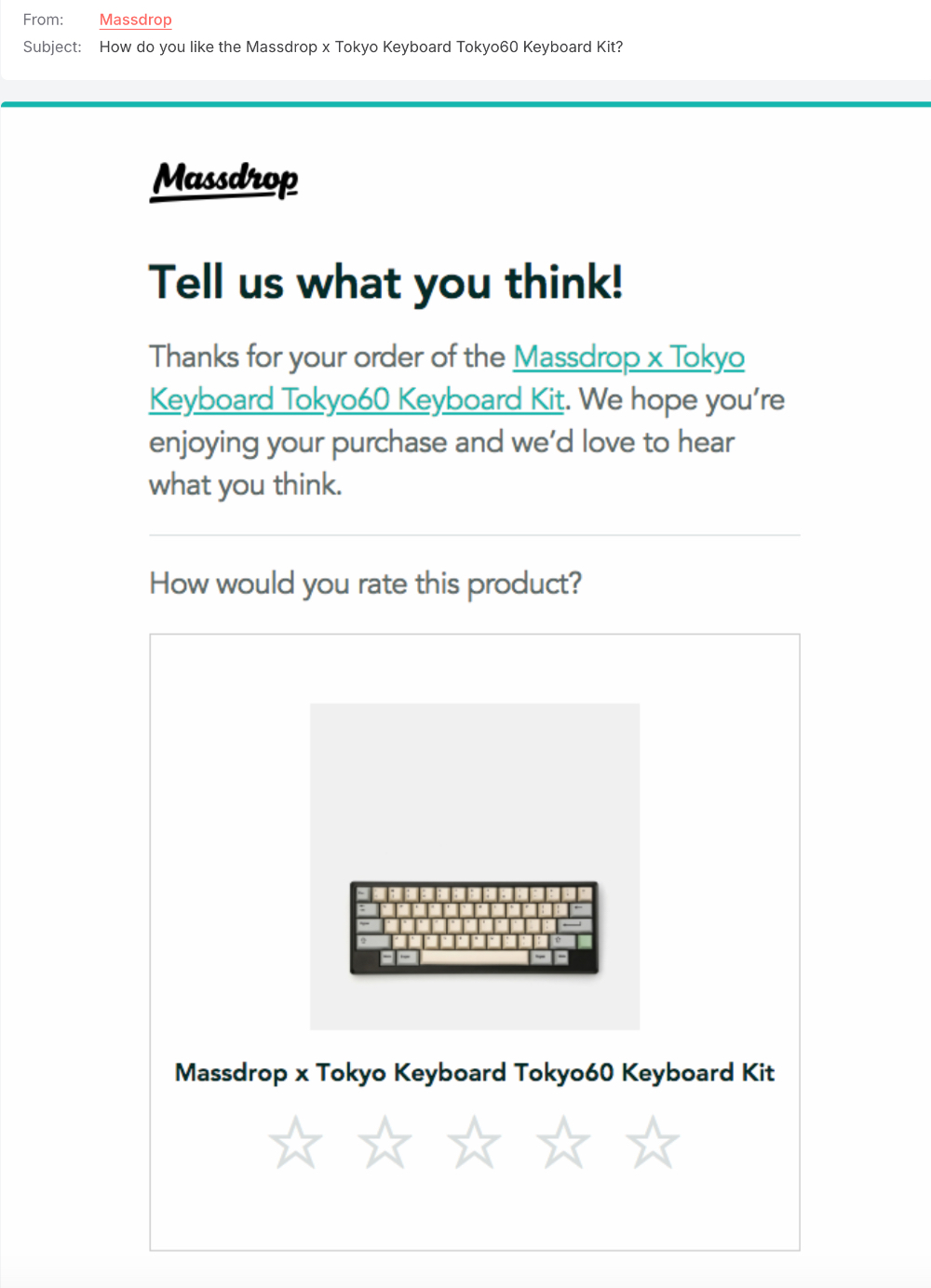
You’ve put time and effort into creating a great product—now it’s time to see what your customers think. A product survey email helps you gather that valuable feedback, improve future versions, and it lets customer’s know that you care. But it doesn’t have to stop there—this type of survey is also a great segue into asking for a product review, turning happy customers into brand advocates.
The email below keeps things simple and direct, making it easy for recipients to give a simple star rating. Once clicking the stars to give a rating, customers can be encouraged to leave a more detailed review that can be shared on the website’s product page.
Service Survey Email
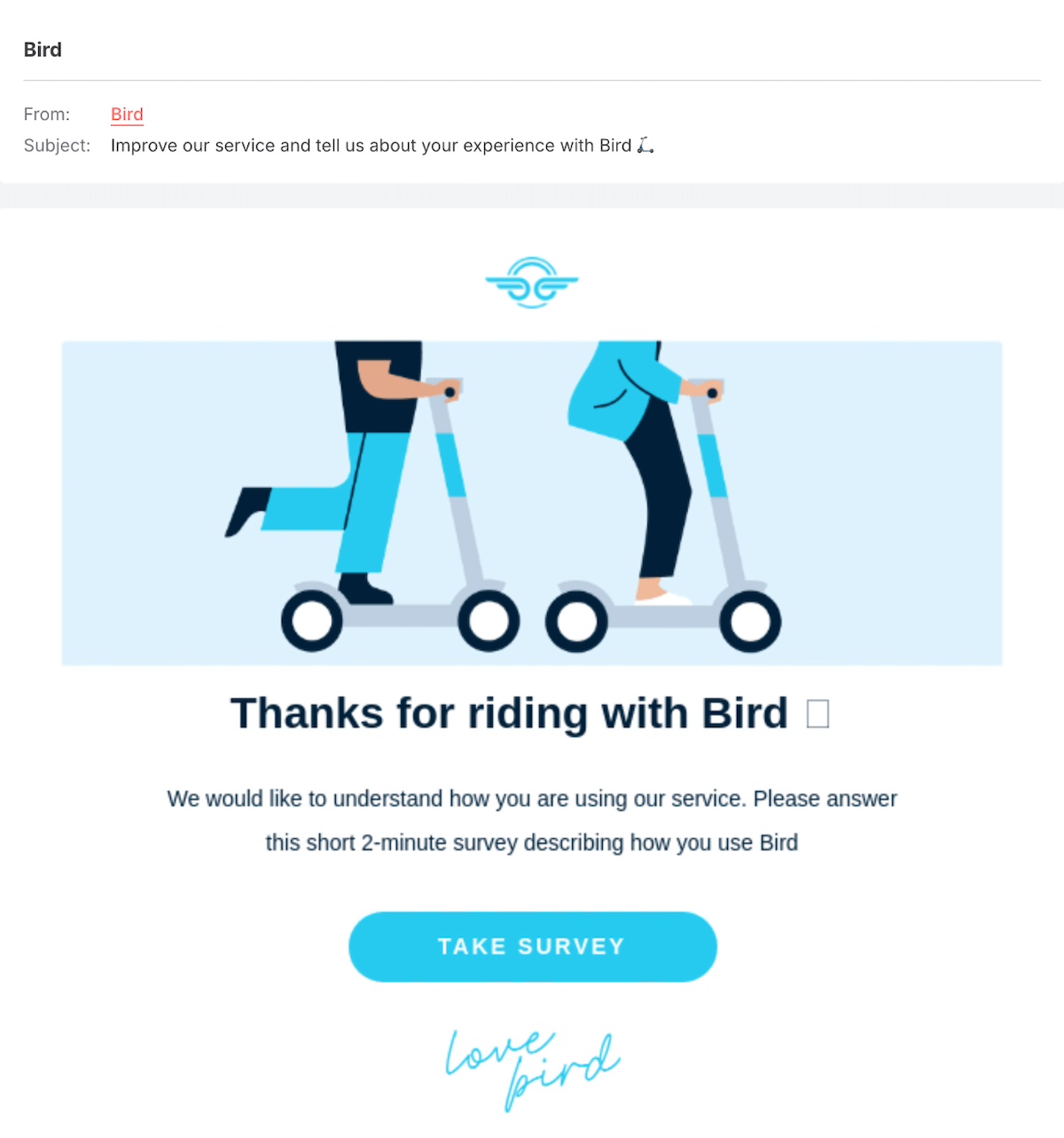
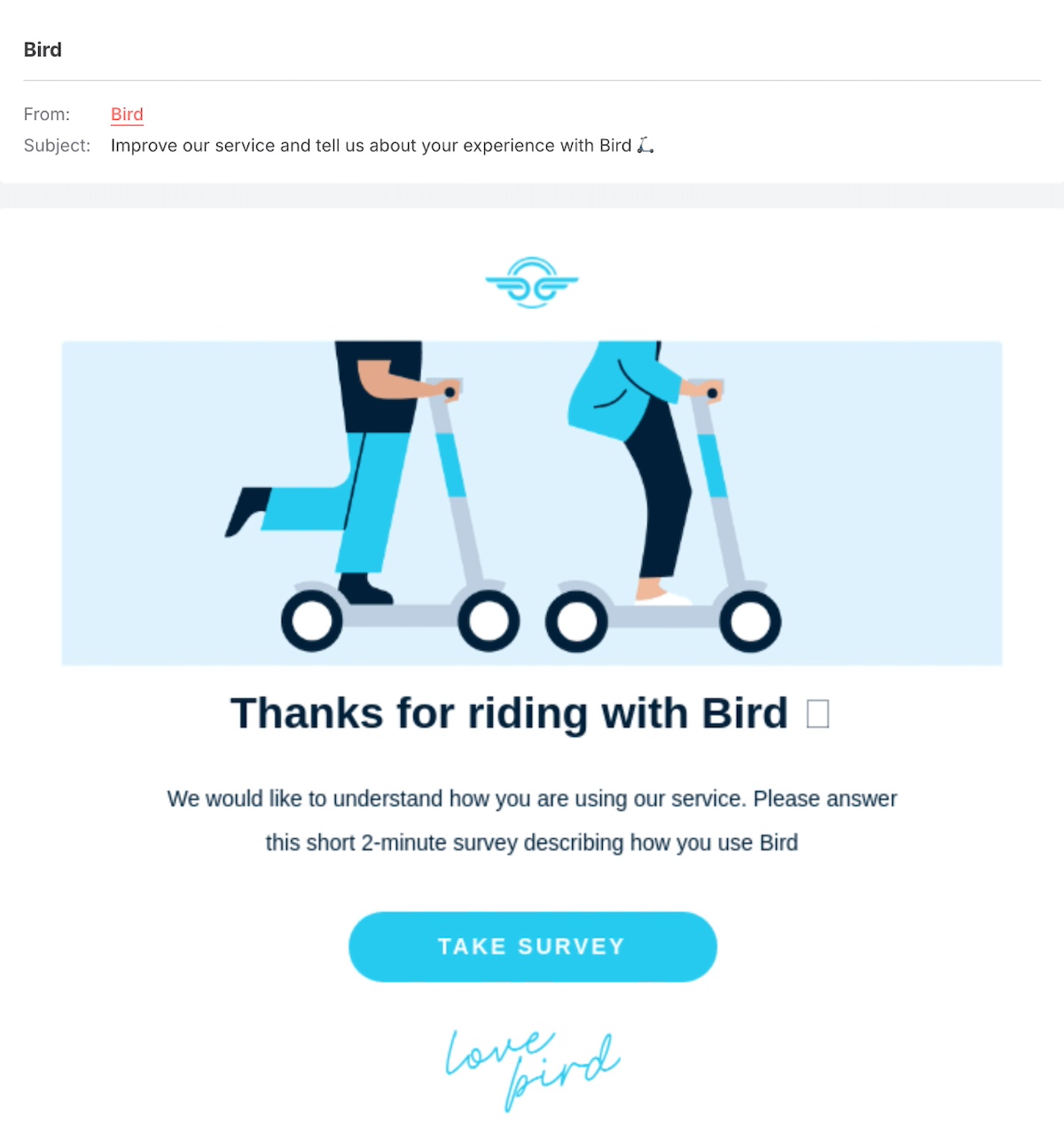
Just as with products, customers like to know that their opinion shapes what your business provides. As usual, keeping it simple, as Bird does in the email below, and setting expectations (just two minutes!), means customers will be more likely to provide their feedback.
Product Feature Survey Email
As a customer, it feels good to feel like you’re a part of the process. And as a business owner, it feels good knowing you’re building products and features that your customer really wants. So these survey emails can be especially helpful. Let the customer know that their input really makes a difference, and watch engagement go up.
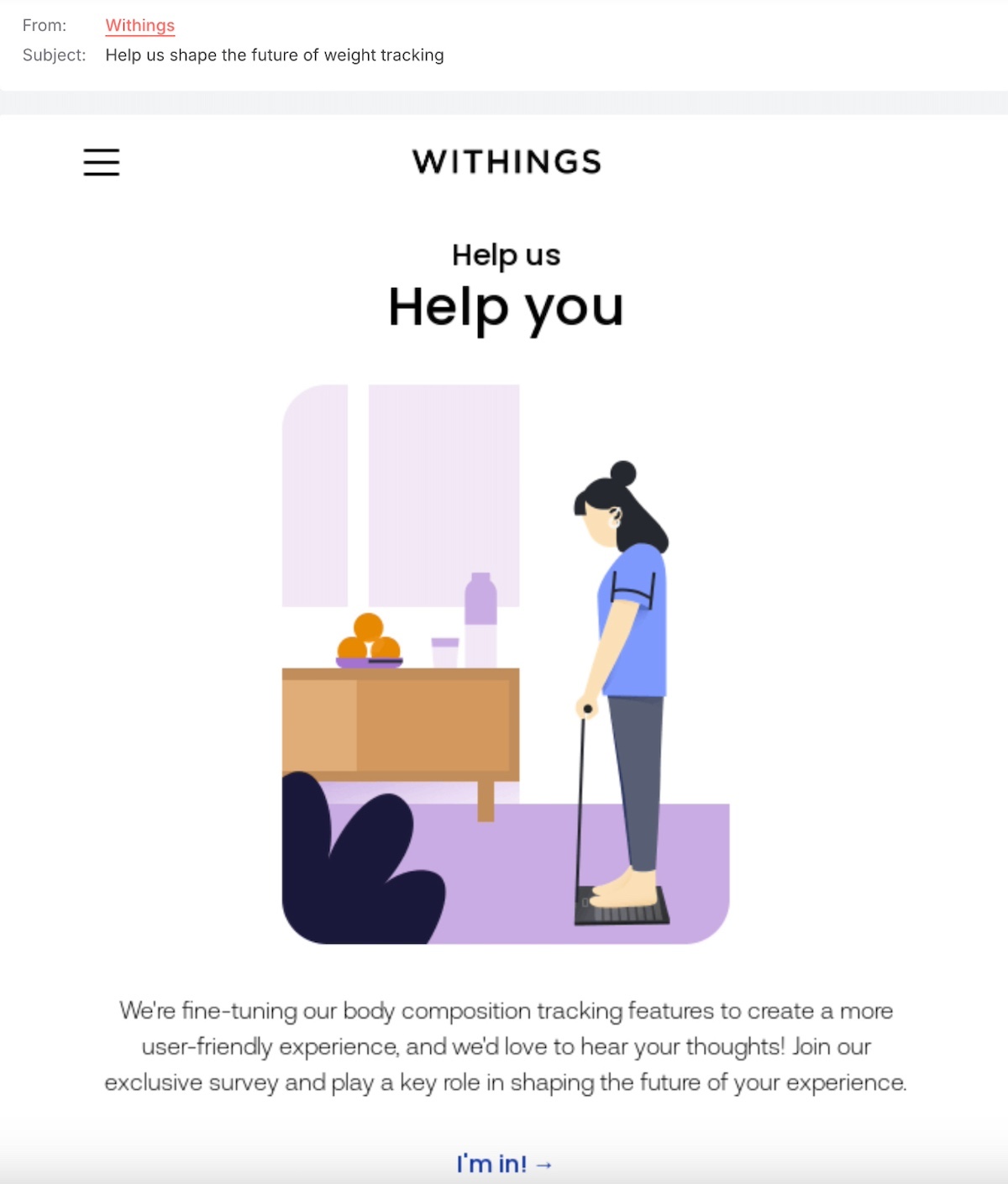
This survey email example from Withings gets the job done right, letting customers know that their feedback will play a key role in new features.
Hospitality Survey Email
One of the most common arenas for people to provide feedback is in the world of hospitality. Restaurant, hotels, tour guides: people always seem eager to share feedback on these experiences. But rather than overwhelming previous guests with a laundry list of questions in your survey email, keep it simple.
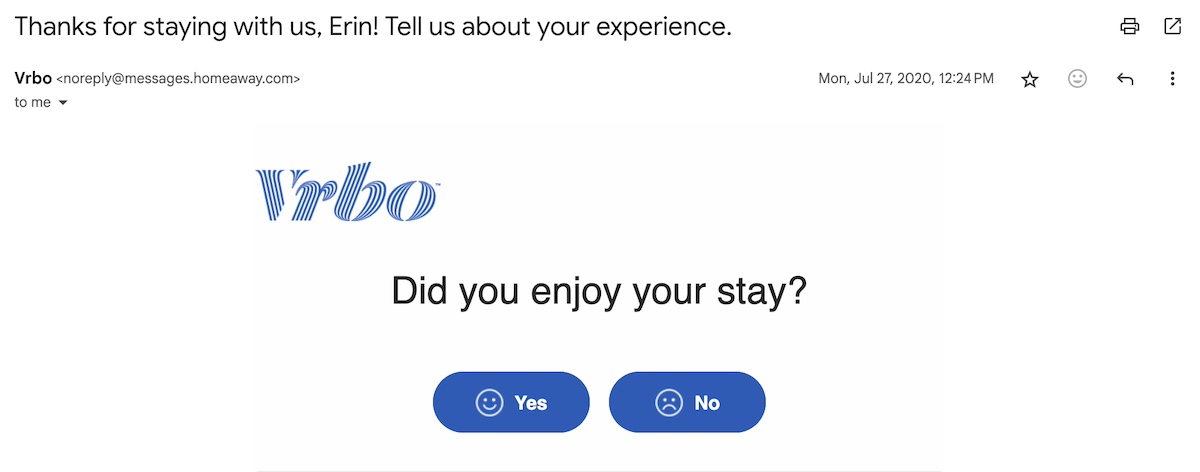
VRBO does this right by using a personalized subject line, and then asking an ultra direct question with a very simple yes or no. Once the recipient has interacted with a click, VRBO can engage further and ask more questions. But getting that initial response is a massive hurdle to getting more feedback from the customer.
Event Survey Email
Events are all about creating memorable experiences, and a post-event survey email is your key to making future gatherings even better. In addition to the usual best practices, you may wish to send follow-up resources, or perhaps recaps of takeaways from the event. The added value will inspire an email open—and hopefully a response.
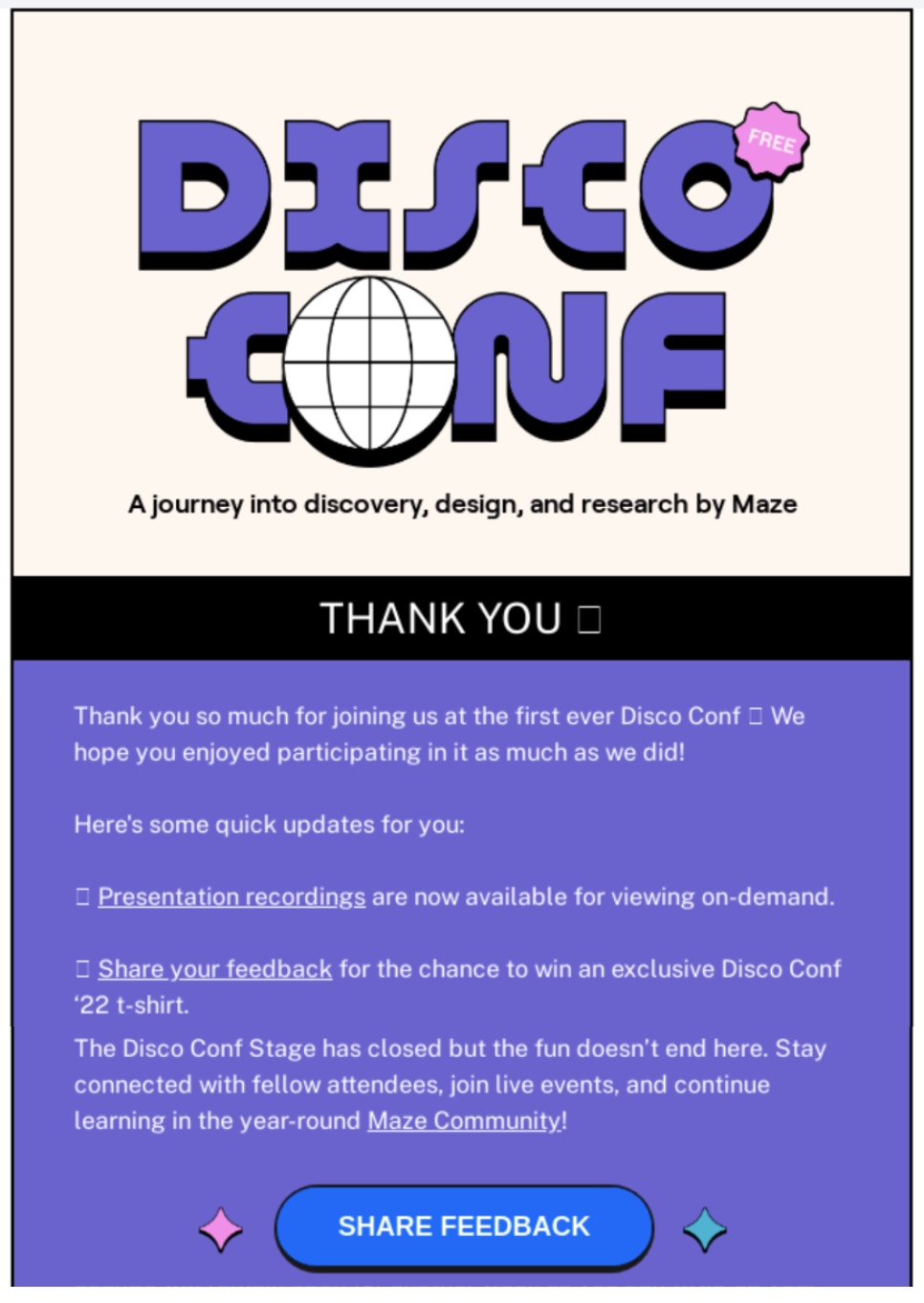
The below event survey email touches on all the key points: useful presentation recordings, gratitude for joining the event, and incentive for providing feedback.
Net Promoter Score Survey Email
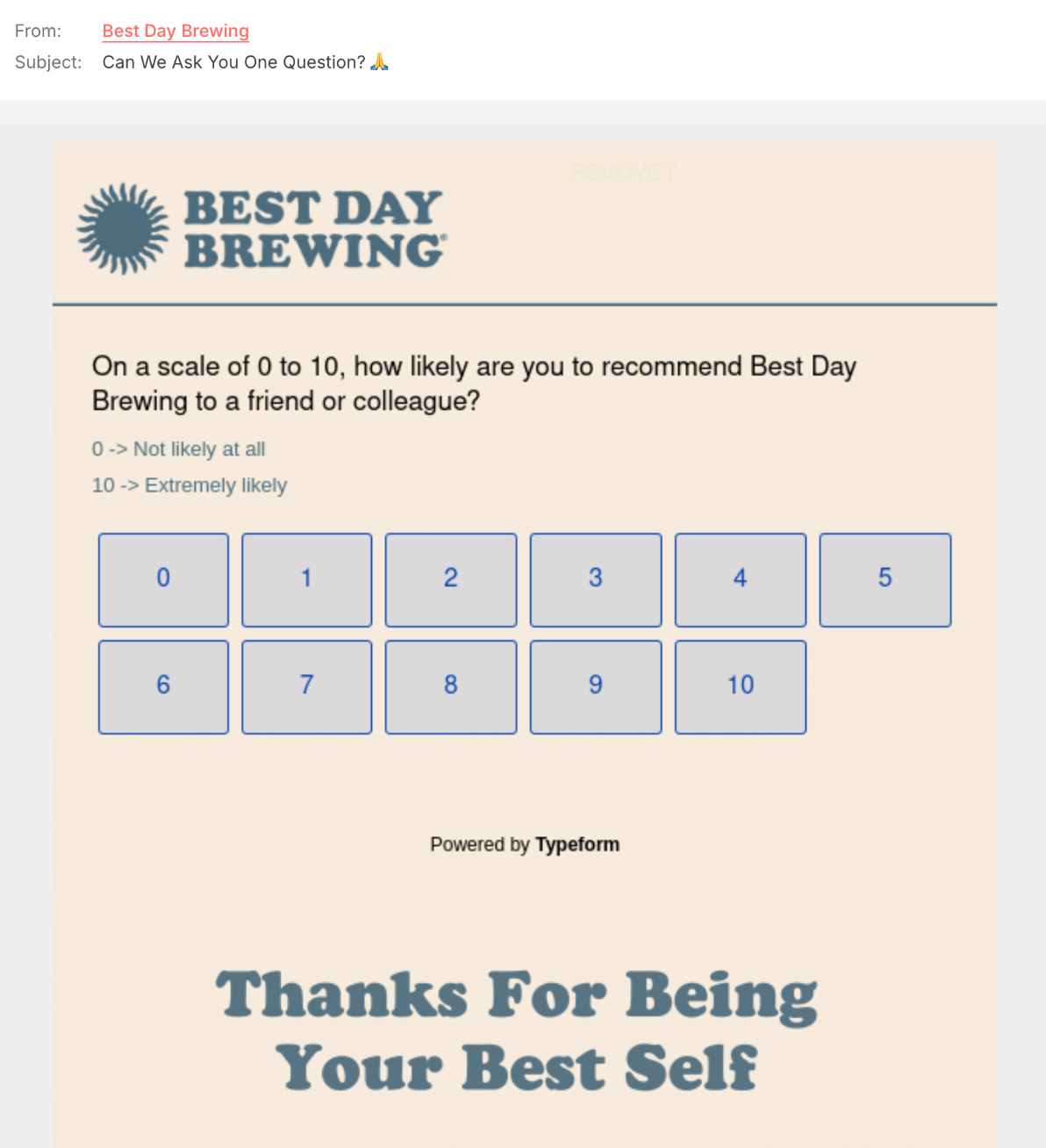
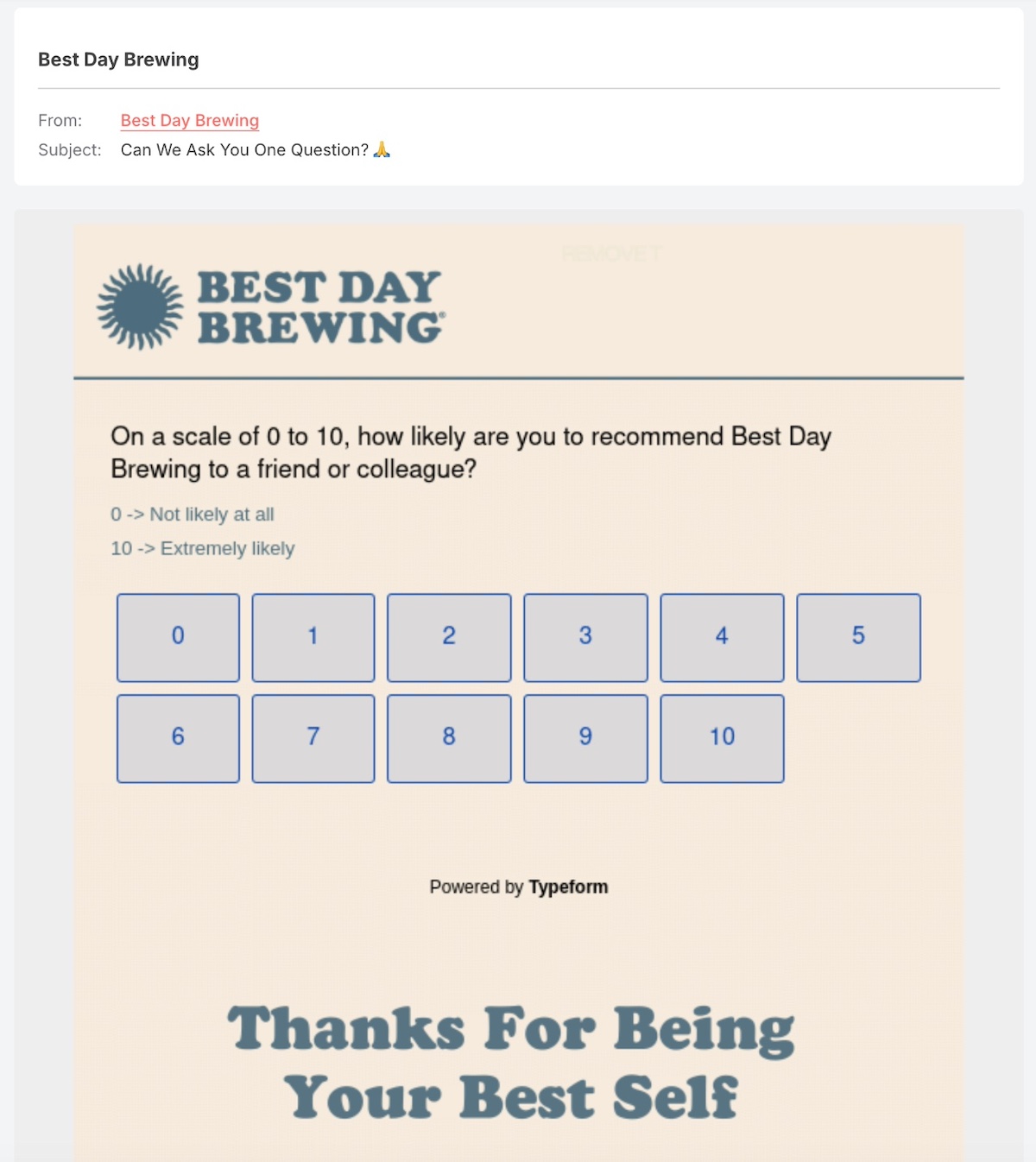
A Net Promoter Score (NPS) email is a survey email designed to measure customer loyalty and satisfaction. It typically asks recipients how likely they are to recommend your product or service to others on a scale from 0 to 10. The responses help businesses understand customer sentiment and identify opportunities for improvement.
In the below survey email example, Best Day Brewing gets straight to the point asking readers to rate on a scale from 1 to 10 how likely they are to recommend the brand to a friend or colleague. The ultra-simple question can also serve as a good springboard for further inquiry once the email reader (surely) marks their response.
Survey Reminder Email
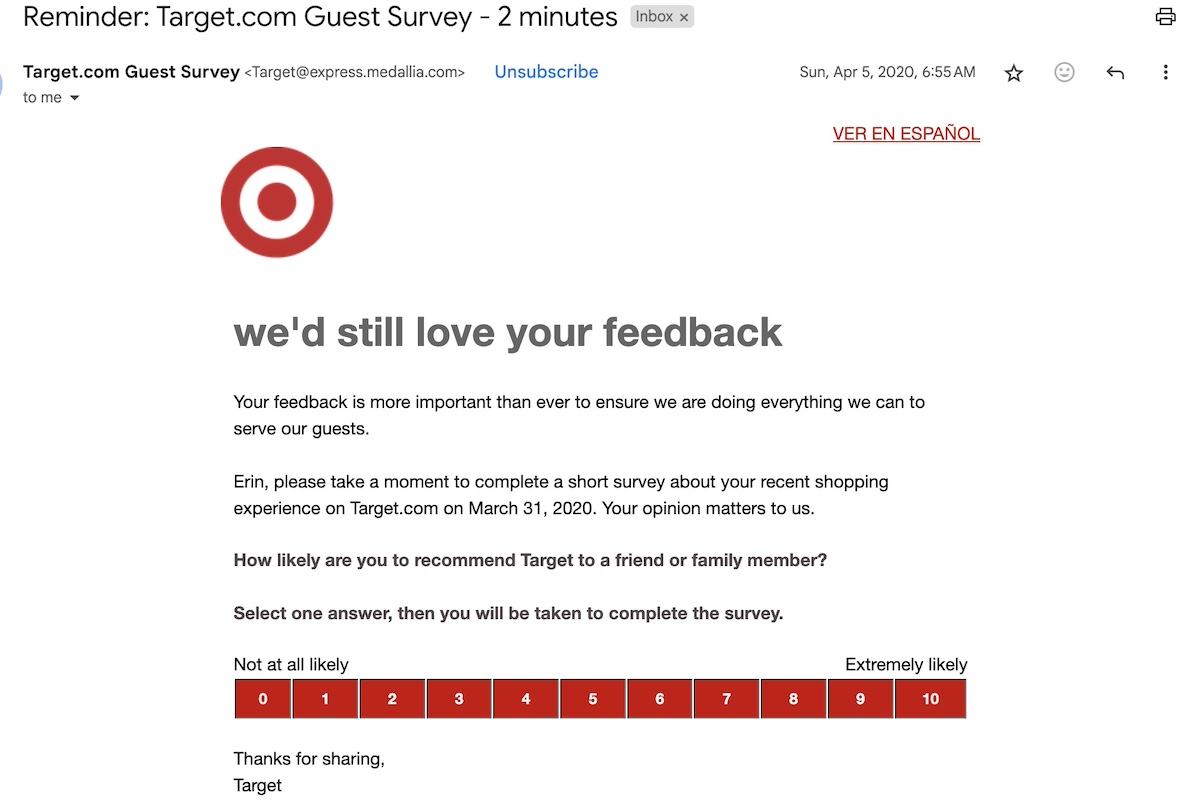
Sometimes we forget to respond, and a simple survey follow-up email is all it takes for us to open the message and do the thing—in this case, give that wanted feedback.
Target keeps its survey reminder email simple, letting guests know that their survey follow-up will only take two minutes, and that the guest’s input is valued.
Re-Engagement Survey Email
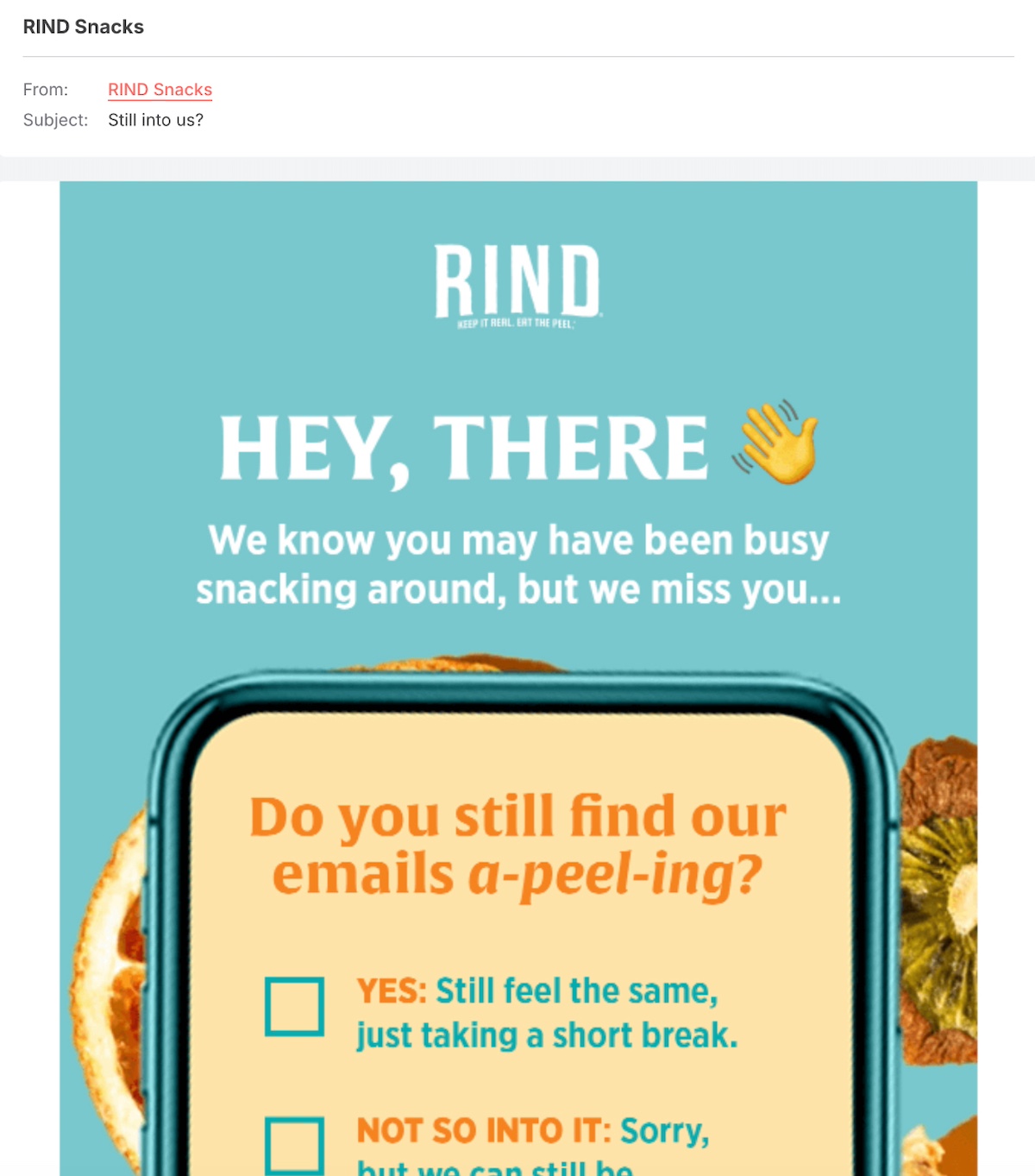
People love sharing their opinions so much that sometimes a simple survey can be used as a re-engagement email to an inactive subscriber.
We love how the below survey email example is super playful, starting with its hard-to-ignore subject line, and finishing with a couple cover clever questions to gauge interest. Chances are, after an email like this, most people will engage and want to continue to engage.
Making the Most Out of Your Survey Email Template
Survey emails don’t have to be complicated, but a little thought goes a long way. A clear, engaging message increases the chances of getting thoughtful responses—and more of them. Keep it short and to the point, let people know why their feedback matters, and make it as easy as possible to respond. And don’t forget to express gratitude—a little appreciation can go a long way in building strong relationships with your audience.
Want to make survey email sending extra easy? Hop over to SiteGround Email Marketing to start creating and sending surveys in no time. Choose from a variety of templates, leverage the built-in AI writer, and take advantage of powerful features that make email creation effortless.
The best time to send a survey email, or even a survey email automation sequence, depends on your goal.
After a Purchase or Interaction – Send a survey within 24-48 hours to capture fresh feedback.
Post-Customer Support – Send a follow-up email after a support ticket is resolved to measure satisfaction.
At Key Customer Milestones – Send periodic surveys (e.g., quarterly or annually) to gauge overall customer experience.
Before a Renewal or Upgrade – Gather insights on what customers need before they make a decision.
Can I Embed a Survey in My Email?
While most email clients don’t support fully embedded surveys, you can include a survey question with a clickable response option or a call-to-action (CTA) button that directs recipients to a full questionnaire on a landing page. This ensures a seamless user experience and also increases response rates.
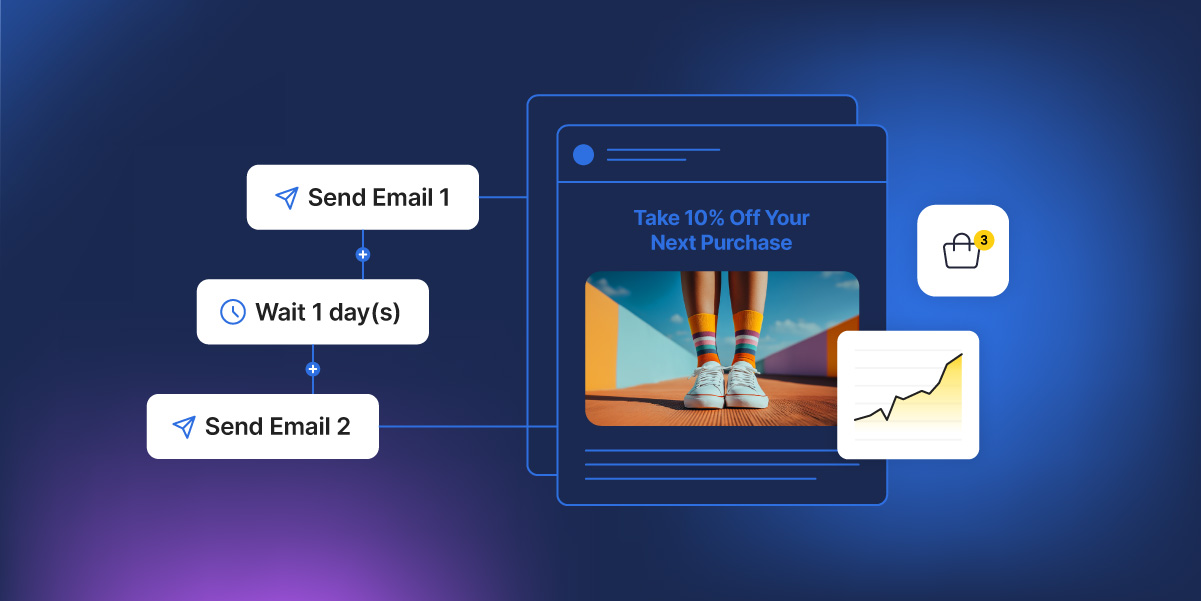
Gone are the days of only sending the occasional, one-off email newsletter. Email marketing has become more strategic, more elaborate, and, ultimately, a whole lot more effective. But to truly maximize its benefits—and your time!—you’ll need to get smart about how you implement it. And that’s where one of email marketing’s most important features comes in: email automation.
Whether you’re welcoming new subscribers or nurturing long-term relationships, email automations help you deliver the right message at exactly the right moment. Let’s explore how automated email campaigns can transform your marketing strategy.
What is Email Automation?
Email automation relies on predefined rules to send personalized emails based on subscriber actions. This process is powered by marketing automation software, ensuring timely and relevant communication. Following best practices in automation ensures that these emails are engaging, well-timed, and effective.
Automated email campaigns allow your business to connect in real-time in ways manual outreach just can’t match. For instance, a welcome email can be triggered as soon as a customer submits a form, reaching them at the ideal moment to engage, build trust, and drive action without extra effort.
Email automation sequences go a step beyond—instead of an action (like signing up for a list) triggering just one email, it instead triggers a timed and pre-planned sequence of emails.
What are the Benefits of Email Automation?
In the world of email marketing, email automation is what separates the kids from the adults. It’s like riding a bike with training wheels versus driving a race car—both could take you from point A to B, but one will do it a lot faster and more efficiently.
How so? Email automation amplifies the impact of email marketing by ensuring messages reach the right people at the right time, with less effort. That means higher engagement, stronger relationships, and ultimately, more revenue. It’s one of email marketing’s greatest benefits.
Here’s how automation makes email marketing more effective:
Personalize the Customer Journey
Email marketing is most powerful when messages feel relevant and timely—and automation makes this possible at scale. By delivering personalized emails based on subscriber behavior, automated campaigns create a seamless experience that feels natural and engaging. The result? Higher open rates, more clicks, and stronger conversions.
For example, a welcome series can gradually introduce new subscribers to your brand and products. Or, if someone attends your event, they can receive follow-up emails that reference their experience and provide additional insights or resources.
Automations like these make interactions feel tailored, even though they run in the background. By meeting subscribers where they are, they encourage deeper engagement and long-term loyalty, reinforcing the effectiveness of your email marketing strategy.
Nurture and Convert Your Leads Effortlessly
Email marketing is one of the best tools for lead nurturing, and automation takes it to the next level. Instead of sending one-off emails manually, you can guide leads through a structured journey that keeps your brand top of mind and moves them closer to a purchase.
For instance, if someone downloads a resource, they’ve already shown interest. A well-structured follow-up can deliver related content, helpful tips, or exclusive offers, keeping them engaged and naturally leading them toward a purchase.
By automating these touchpoints, you not only make email marketing more efficient, but you also increase the likelihood of converting leads into customers—without the need for constant manual outreach.
Increase Customer Retention
One of the biggest advantages of email marketing is its ability to drive repeat business, and automation makes this even more effective. Retaining existing customers is easier and more cost-effective than constantly pursuing new ones, and automated email sequences keep your brand top of mind long after the first purchase.
For example, when a customer comes on board, you can activate an email customer journey that not only encourages repeat purchases but also deepens brand loyalty. By sharing exclusive content, offering helpful tips, and inviting feedback, automated emails keep customers engaged in a way that manual efforts simply can’t match.
Scale Seamlessly
Email marketing is a high-ROI strategy, but without automation, scaling it can become overwhelming. Every hour spent on repetitive tasks—like scheduling, segmenting, and responding to subscriber actions—is an hour taken away from strategy and growth.
Email automation eliminates this bottleneck, ensuring that your marketing efforts remain just as effective whether you’re reaching 100 people or 100,000. With scheduled sequences, automatic email segmentation, and real-time triggers, your email marketing stays consistent and impactful—without additional workload.
How to Automate Emails Effectively
Email automation is a powerful tool, but to get the best results, you need to be strategic. By choosing the right platform, segmenting your audience, setting up trigger-based sequences, and continuously optimizing your approach, you can create highly effective automated email campaigns that engage subscribers and drive conversions. Let’s examine how to do this.
1. Choose a Tool
The first step in automating your emails is selecting the right email marketing platform: one with automation features that allow you to create sequences, set triggers, and track performance.
When choosing a tool, consider factors such as ease of use, personalization capabilities, and analytics. A good automation tool should enable you to streamline communication, personalize messages, and scale your email marketing efforts efficiently.
With SiteGround Email Marketing, automations are easy to set up. You’ll have a seamless solution that makes automating essential customer journeys—like welcome series and lead nurturing—a breeze, sidestepping the complexity of other traditional email marketing platforms. SiteGround’s intuitive approach helps you reach customers at the perfect moments, driving engagement and fueling business growth with ease.
2. Build and Segment Your List
A high-quality email list is the foundation of effective automation; without, you’re just sending messages into the void. Start building your email list via sign-up forms, lead magnets, or opt-in popups. And be sure to segment these sources—depending on the information you’ve gathered, group subscribers based on factors like sign-up source, demographics, purchase history, engagement level, or preferences. We’ll explore some of these examples in practice below.
3. Set Up Triggers
For email automation to work, you need to set up triggers. These can include signing up for a newsletter, downloading a freebie, attending an event, making a purchase, and so on.
Meanwhile, automated emails can be an especially effective best practice when sent as a sequence. This means that once that initial trigger is activated, a sequence of emails is sent at scheduled intervals. For example, if someone participates in one of your webinars, you can add them to a specific email segment, which then triggers a sequence of emails that might include further related resources, and eventually a discount to contract services with your business.
Defining clear triggers and logical sequences helps ensure your automation runs smoothly and delivers the right message at the right time.
4. Track and Optimize
Once your automated emails are running, continuous monitoring and optimization are what will help you maximize performance. Implementing best practices such as A/B testing subject lines, optimizing content, and refining call-to-action buttons can help identify what resonates most with your audience, and how you can improve.
To do this, track email marketing metrics such as open rates, click-through rates, conversions, and engagement levels. The goal is to refine your sends over time, ensuring that your automated emails remain effective and relevant.
Email Automation Examples
Now that we know how email automation works, let’s explore some key email automation sequences you can use to nurture leads, build relationships, and drive conversions.
1. The Welcome Sequence
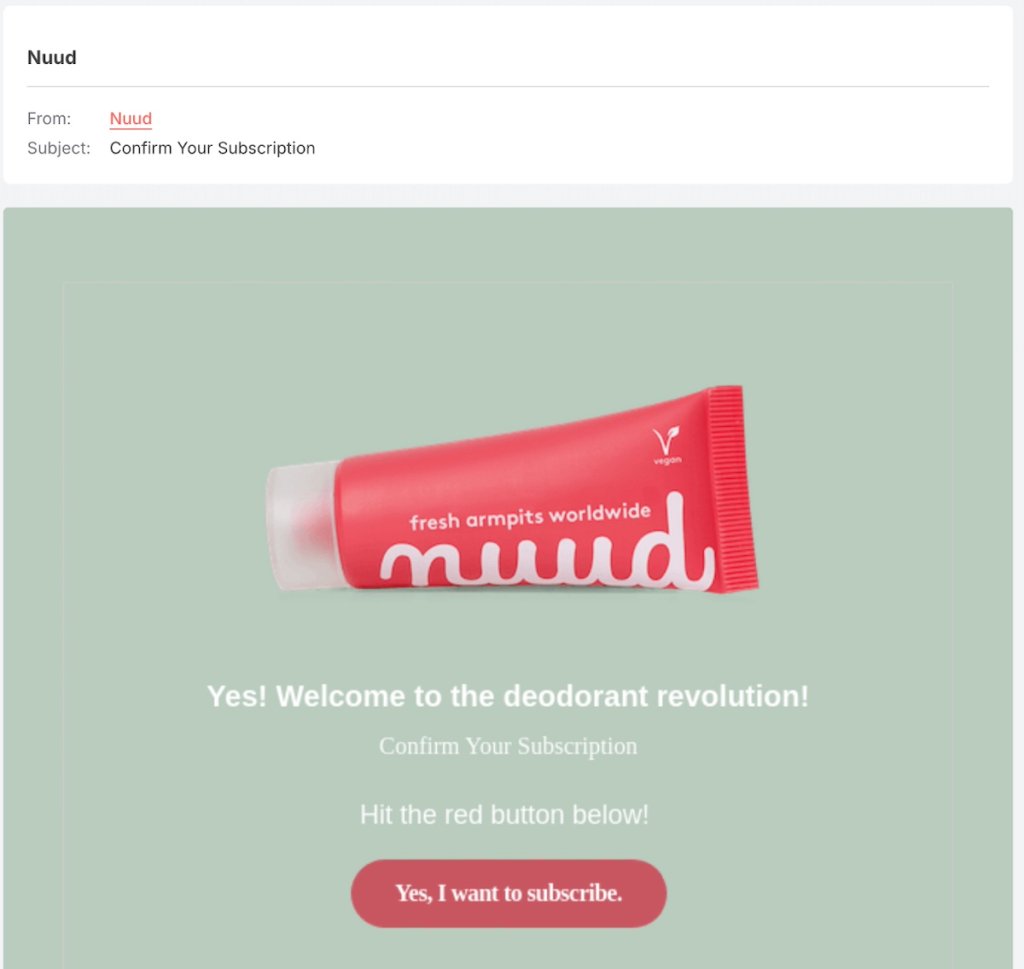
First impressions are everything. When someone subscribes to an email newsletter or creates an account, a welcome or confirmation email serves as the first touchpoint between the brand and subscriber—and it also can initiate a sequence of automated emails that build on this.
This series leverages what psychology calls the “primacy effect,” where first impressions heavily influence future interactions. New subscribers are most engaged during the first few days, so this sequence sets the tone and establishes your brand’s value right away.
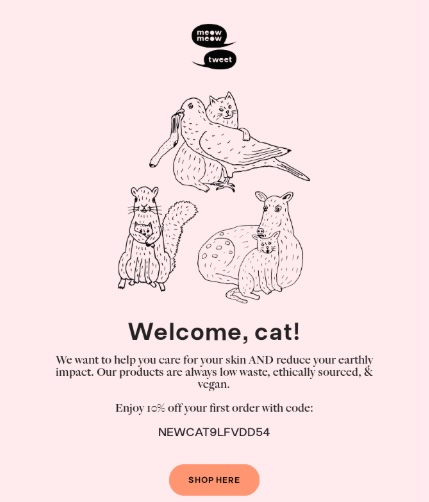
The above warm welcome serves multiple purposes: the customer confirms their subscription, and the message sets the stage for the spirit of the brand (a deodorant revolution!).
How this impacts your business: According to data from Invesp, welcome emails generate 4x the open rate and 5x the click-through rate compared to other emails. By making a strong first impression, this series builds trust and familiarity, which makes subscribers more likely to open future emails and engage with your brand.
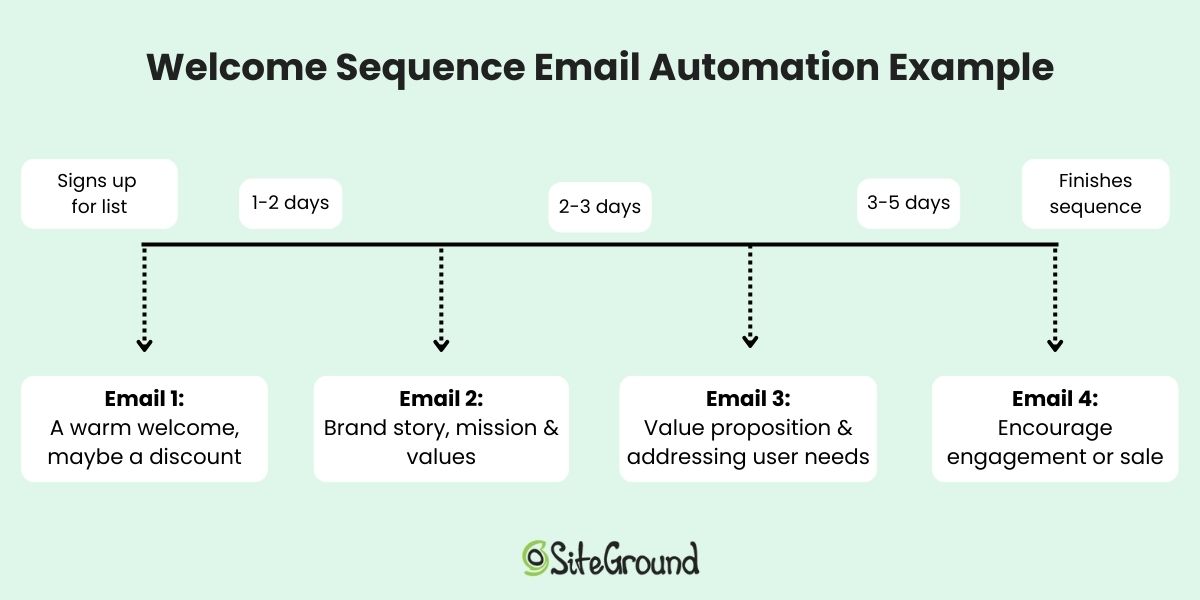
Suggested Structure:
Email 1 (immediate): A warm welcome.
Email 2 (1–2 days later): Introduce your brand story, mission, or values, helping subscribers connect with your purpose.
Email 3 (2–3 days after email 2): Share your value proposition, focusing on how you address subscribers’ key needs.
Email 4 (3–5 days after email 3): Encourage engagement, such as following on social media or taking advantage of a first-time offer.
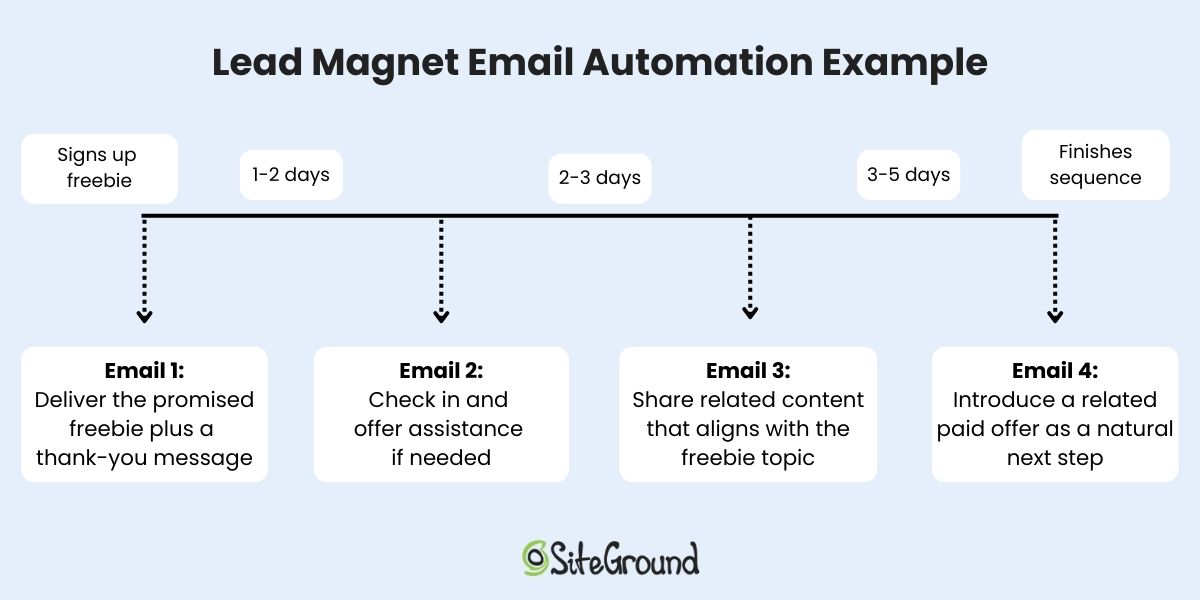
2. The Lead Magnet Delivery Sequence
Capture interest and nurture it. Subscribers who sign up for a free resource already show intent. This sequence capitalizes on that interest with timely follow-ups that guide them toward related content and, ultimately, a relevant offer.
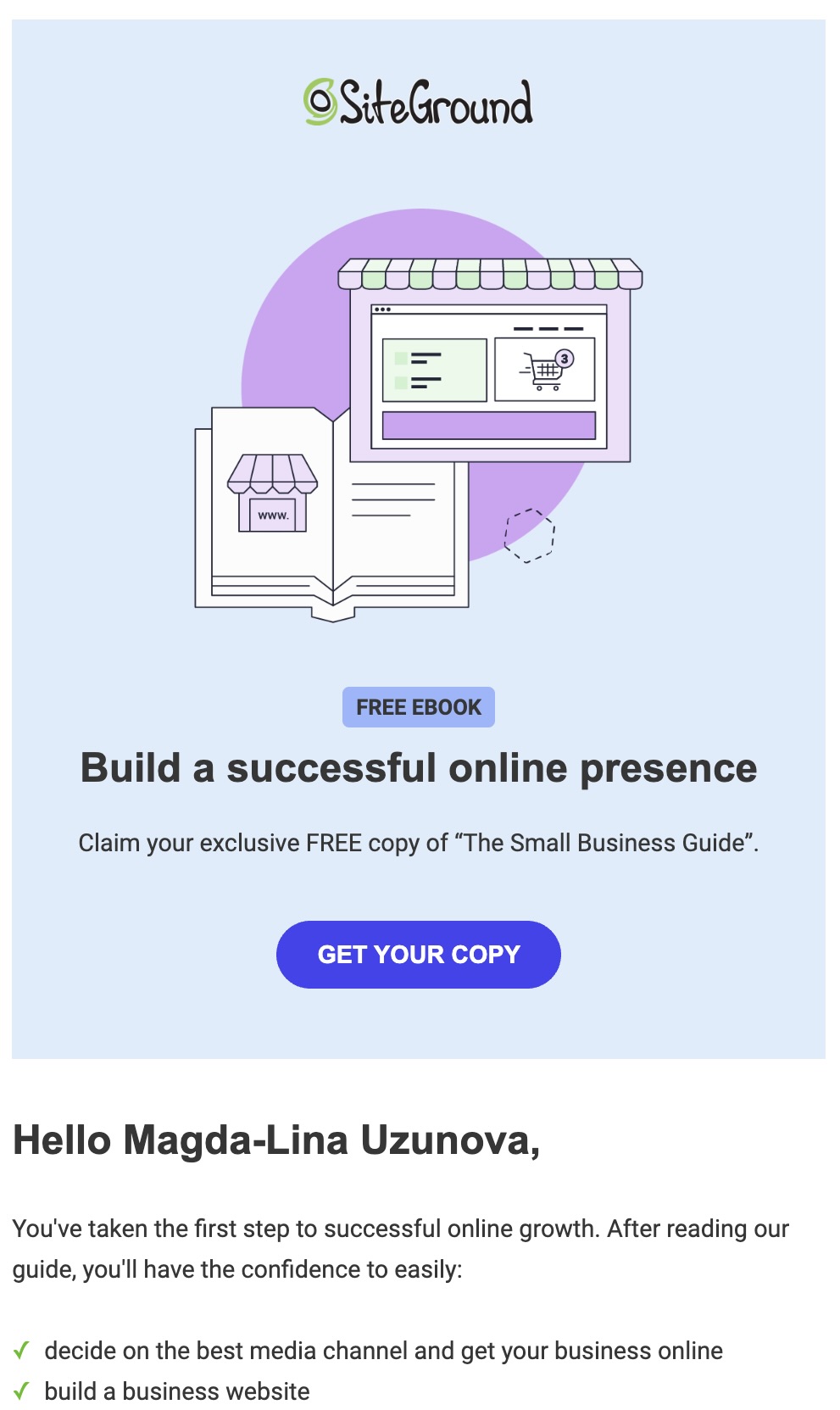
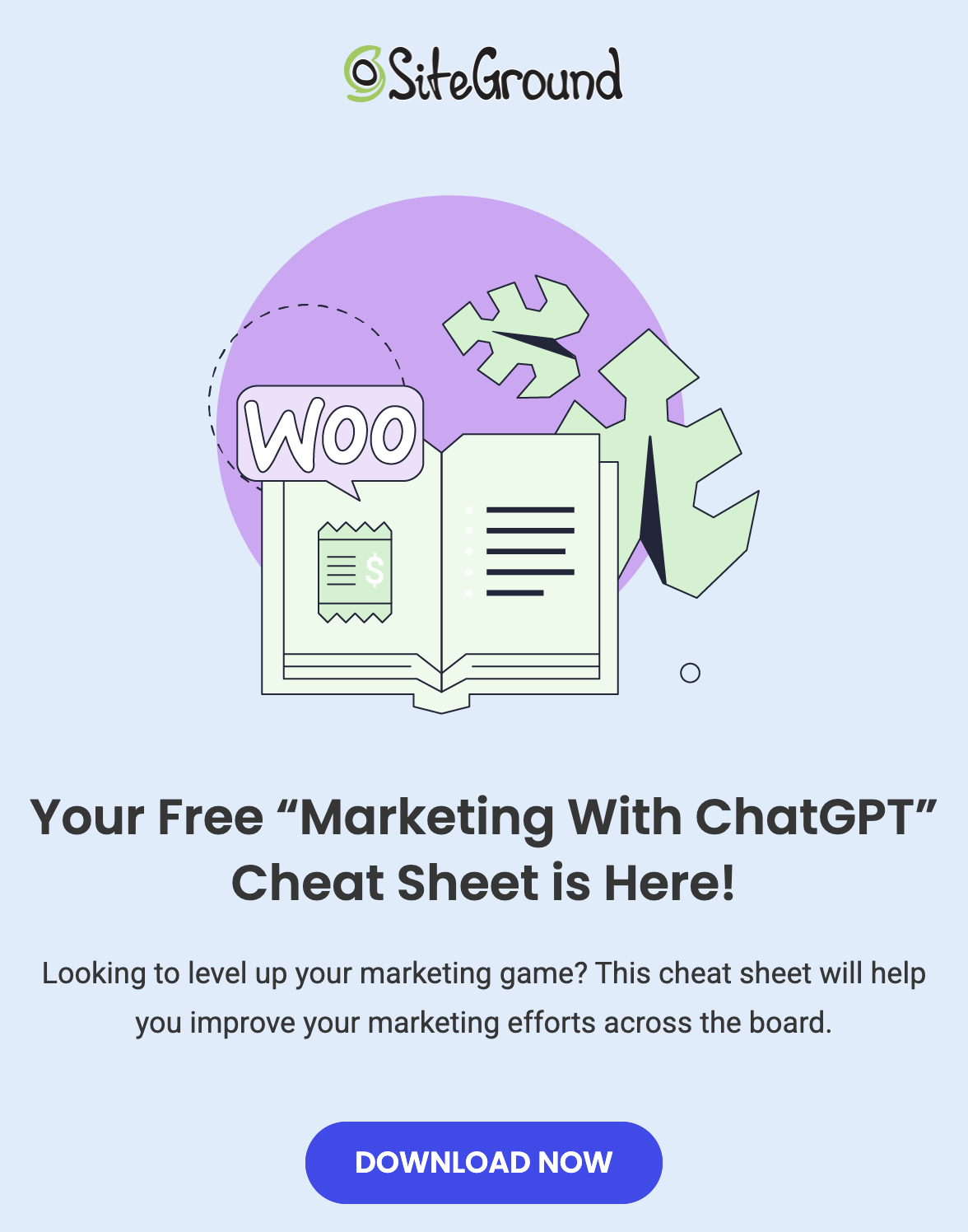
In the above example, SiteGround delivers the freebie that the customer signed up for. Meanwhile this could trigger a sequence for future emails based on similar subject matter that is of value to the recipient.
How this impacts your business: HubSpot research shows that follow-up emails have a 30% higher response rate than single emails. When you generate leads by delivering value and reinforcing the topic of the freebie, you build rapport and position those leads to respond more positively to your offer.
Suggested Structure:
Email 1 (immediate): Deliver the promised freebie with a thank-you message.
Email 2 (1–2 days later): Check in to see how they’re finding the resource and offer assistance if needed.
Email 3 (2–3 days after email 2): Share related content, such as articles or guides, that aligns with the freebie topic.
Email 4 (3–5 days after email 3):Introduce a related paid offer as a natural next step.
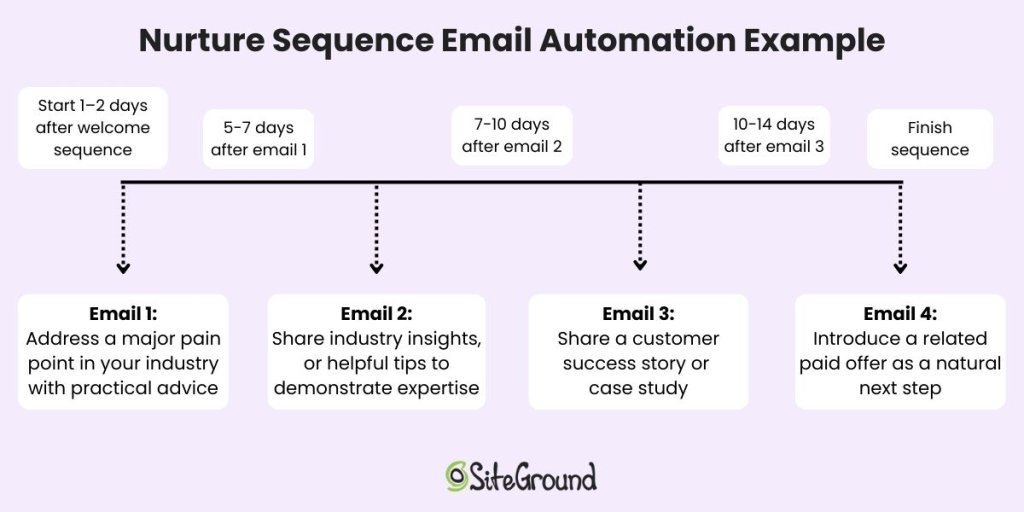
3. The Nurture Sequence
Trust is built over time, and nurturing is about consistently providing value. A steady flow of educational content, tips, and success stories keeps your brand top-of-mind, positioning you as an expert. People are more likely to trust and engage with brands they frequently encounter, especially when the content is genuinely helpful.
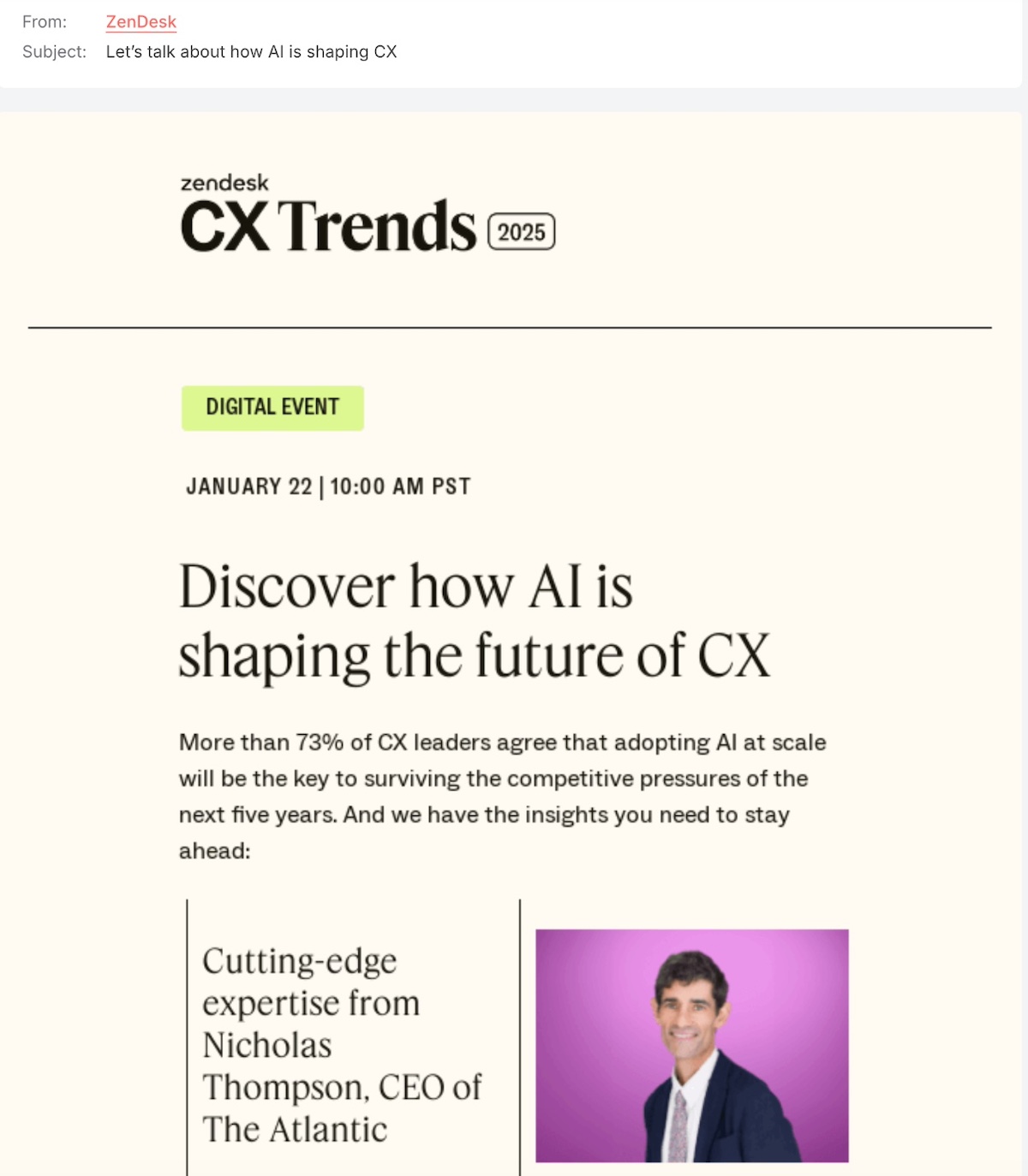
The above example aims to share trends, insights, and insider knowledge from experts in order to keep leads interested and moving through the sales funnel.
How this impacts your business: Research by Marketo indicates nurtured leads make 47% larger purchases than non-nurtured leads. Lead nurturing emails keep your brand top-of-mind, gradually building credibility and leading to higher conversions.
Suggested Structure:
Email 1 (1–2 days after welcome sequence): Address a major pain point in your industry with practical advice.
Email 2 (5–7 days later): Share industry insights, trends, or helpful tips to demonstrate expertise.
Email 3 (7–10 days after email 2): Present a customer success story or case study, showing real-world results.
Email 4 (10–14 days after email 3): Introduce a related paid offer as a natural next step.
4. The Customer Feedback Sequence
Gathering feedback helps improve products and services, and automated customer feedback emails make the process effortless. You could initiate this kind of sequence after a purchase, or anytime should you wish to capture your audience’s input.
Keeping these emails short and offering an incentive, like a discount on a future purchase, can increase response rates. Positive feedback can also be leveraged for testimonials, while negative feedback provides insights for improvement. For your customers, this proactive approach demonstrates that the business values their opinions.
In the above example, Bird gets straight to the point, making it clear that customers will help them shape and improve their business, and that the survey won’t take long.
Suggested Structure:
Email 1 (immediate): Express appreciation for being part of your community and invite them to share their thoughts. Consider offering a small incentive (like a discount, early access to a product) to increase participation.
Email 2 (7–10 days after email 1): Share key takeaways from past customer feedback and highlight how their input can help shape your business. This reassures subscribers that their voices matter.
Email 3 (10–14 days after email 2): Invite them to leave a public review on your preferred platform. Provide a direct link to make it easy.
How this impacts your business: Customer feedback isn’t just about collecting reviews—it’s about helping your business improve and grow. Responses from your audience can aid in your ability to refine your products, enhance customer service, and adjust marketing strategies to better meet client needs. And when it comes to customer reviews, according to BrightLocal, 98% of consumers read those online reviews, making public testimonials an invaluable trust signal.
5. The Client Loyalty Sequence
Maximize the lifetime value of existing customers. Retention is the real profit engine, with a 5% increase in retention translating to 25%–95% more profits (Bain & Company). This sequence is about keeping clients engaged and valued, encouraging repeat purchases and referrals.
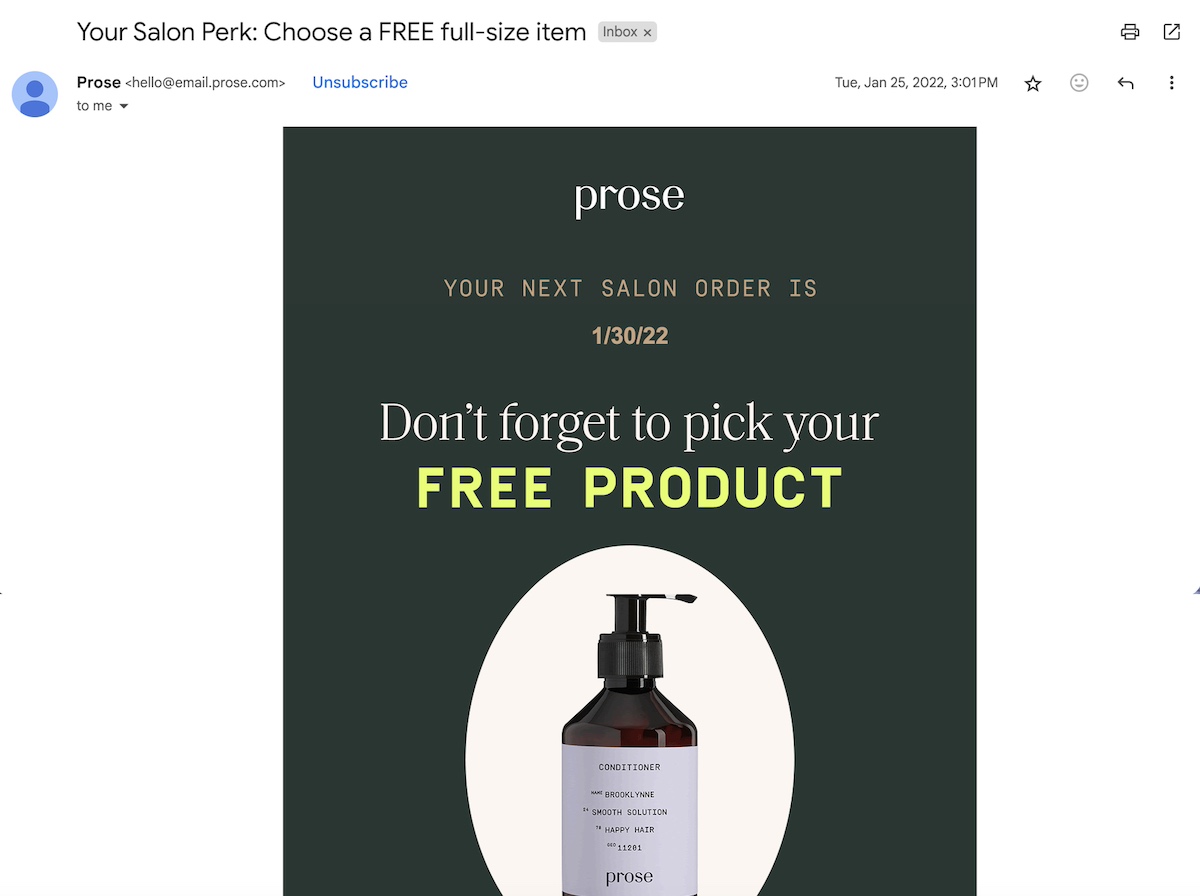
The above email shows gratitude for customers by offering a free product. This builds brand loyalty, and hopefully continued sales.
How this impacts your business: Loyalty sequences make customers feel like insiders, deepening brand attachment and increasing their likelihood to return. Retained customers drive higher profits and can become powerful advocates.
Suggested Structure:
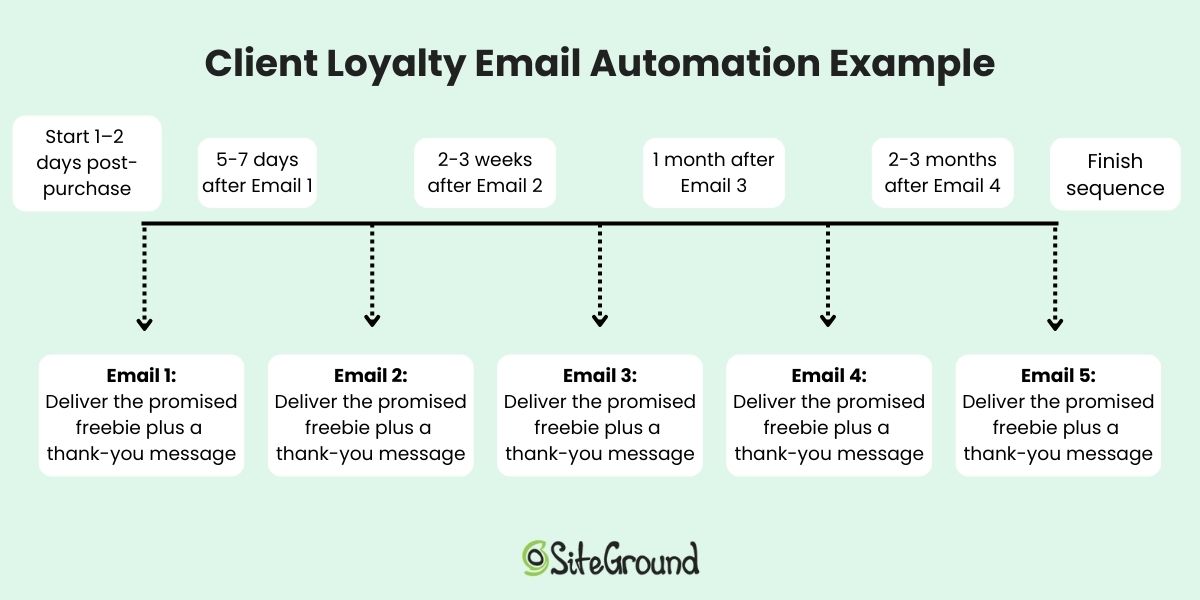
Email 1 (1–2 days post-purchase): Express gratitude with a thank-you message and offer a small, time-sensitive discount or perk for their next purchase to encourage return business.
Email 2 (5–7 days after email 1): Share practical tips or resources to help them get the most out of their product. Include links to guides, FAQs, or videos for a smooth and rewarding experience.
Email 3 (2–3 weeks after email 2): Feature a customer story or highlight how others enjoy the product. Invite them to share their own experience, leave a review, or engage on social media.
Email 4 (1 month after email 3): Request feedback to show their opinion matters. Offer a small incentive like loyalty points or a future discount to thank them for their time.
Email 5 (2–3 months after email 4): Remind them of the loyalty perks they have access to, reinforcing the ongoing value and encouraging future engagement.
Next Steps for Email Campaign Automation Success
Email automation isn’t just about convenience—it’s a strategic and effective way to build relationships, keep your audience engaged, and drive results without all that constant manual effort. When you set up the right triggers and sequences, you can connect with subscribers at critical moments, delivering value while saving time. By following email automation best practices, and choosing a robust email marketing tool, your emails will work behind the scenes, keeping your marketing running smoothly and your business growing.
Ready to start? With SiteGround Email Marketing, setting up impactful email automations is easy and effective. Build your customer journeys with a platform designed to help your business grow—effortlessly, around the clock.
This article was originally published in November 2024 and updated in March 2025.
Are your email marketing campaigns falling short in engagement? If your emails are being opened but the click-through rate is low, you might be wondering whether it’s the copy or the design of the email that is turning readers away. Since you’ve successfully gotten them hit “open,” there’s still hope—you might just need an email design tune-up.
In this article, we’ll help you understand the importance of good email design and how you can achieve it with the help of effective layouts and email design ideas that have gained popularity recently—all to create beautiful emails that keep your readers glued from start to finish.
Why Do Your Emails Need Great Design to Stand Out?
Think about it this way: when you open an email, what grabs your attention first? For most people—and even your email subscribers—it’s not long paragraphs of text. With information coming at them from all directions, it’s unrealistic to expect them to read every word of your email, no matter how connected they are to your brand.
Your recipients are more likely to skim rather than read in detail to quickly assess if the content is worth their time. So, how can you effectively convey your message? This is where great email marketing design comes in handy.
By using visual cues to direct the reader’s attention, you can highlight the essential elements your audience needs to understand for your email marketing campaigns to be successful.
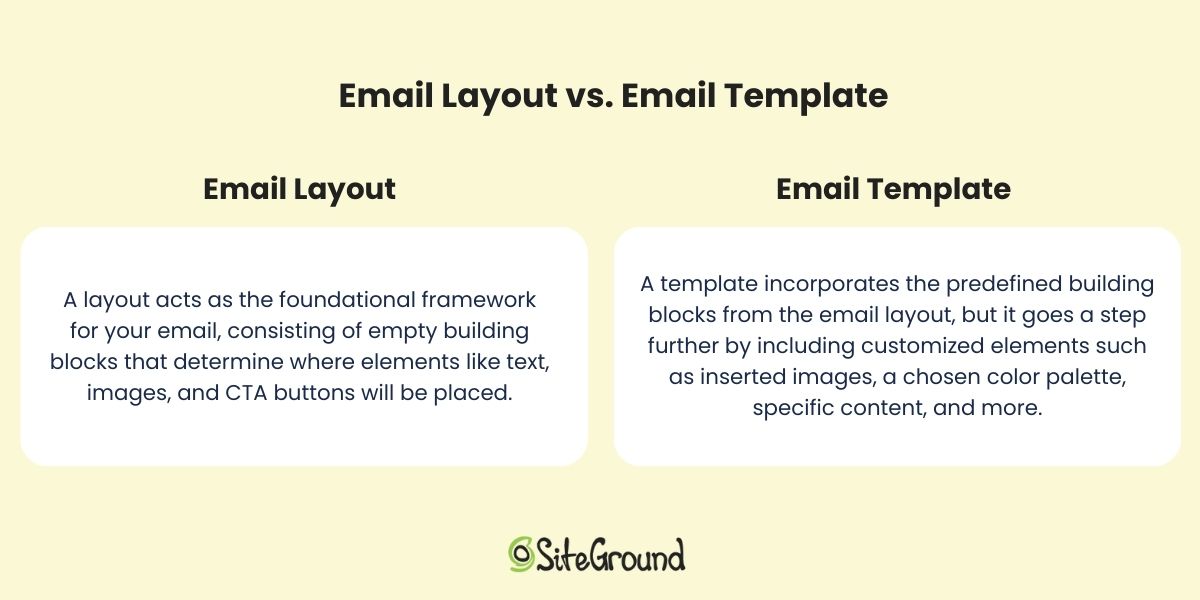
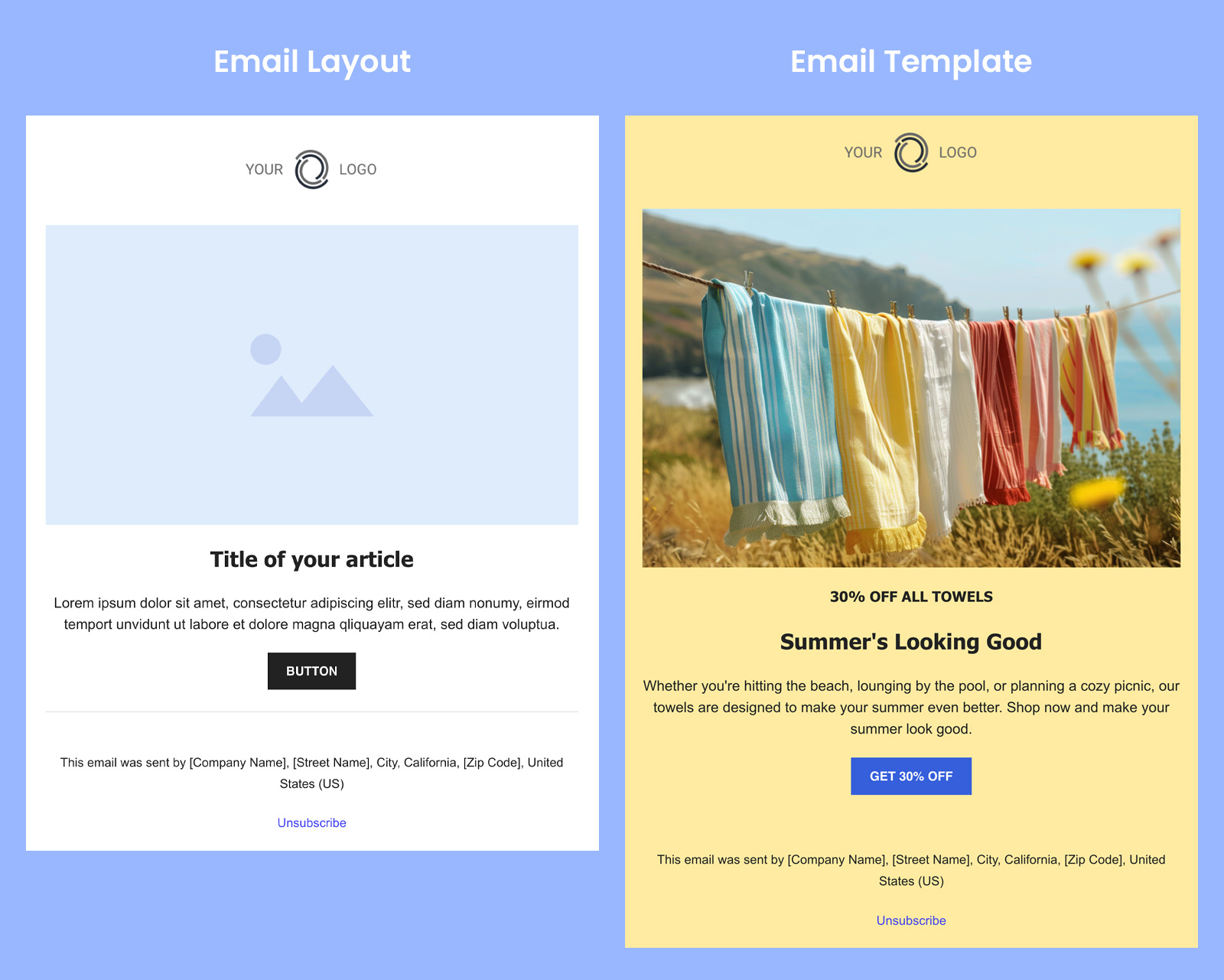
Email Layout vs. Email Template: Understanding Their Roles in Email Design
To clear up any confusion from the start, and save you from wondering what comes first, here’s a simple breakdown of each term:
So, how does creative email design fit into the mix with these terms?
While the email layout ensures a balanced and organized presentation for your email’s appearance, an effective email design builds upon this by styling elements within this framework—from color palettes and fonts to all kinds of visual elements—to create an email that’s both engaging and visually appealing.
The result of this combination is the email template—a ready-to-use framework that simplifies the email creation process. It ensures consistency, saves time, and allows for customization to align with your branding and the goals of your message.
Most email marketing platforms offer predefined templates to help you create beautiful emails at one time. SiteGround Email Marketing is one of them—offering a range of professional email templates that can be easily customized using a no-code builder and built-in AI assistant.
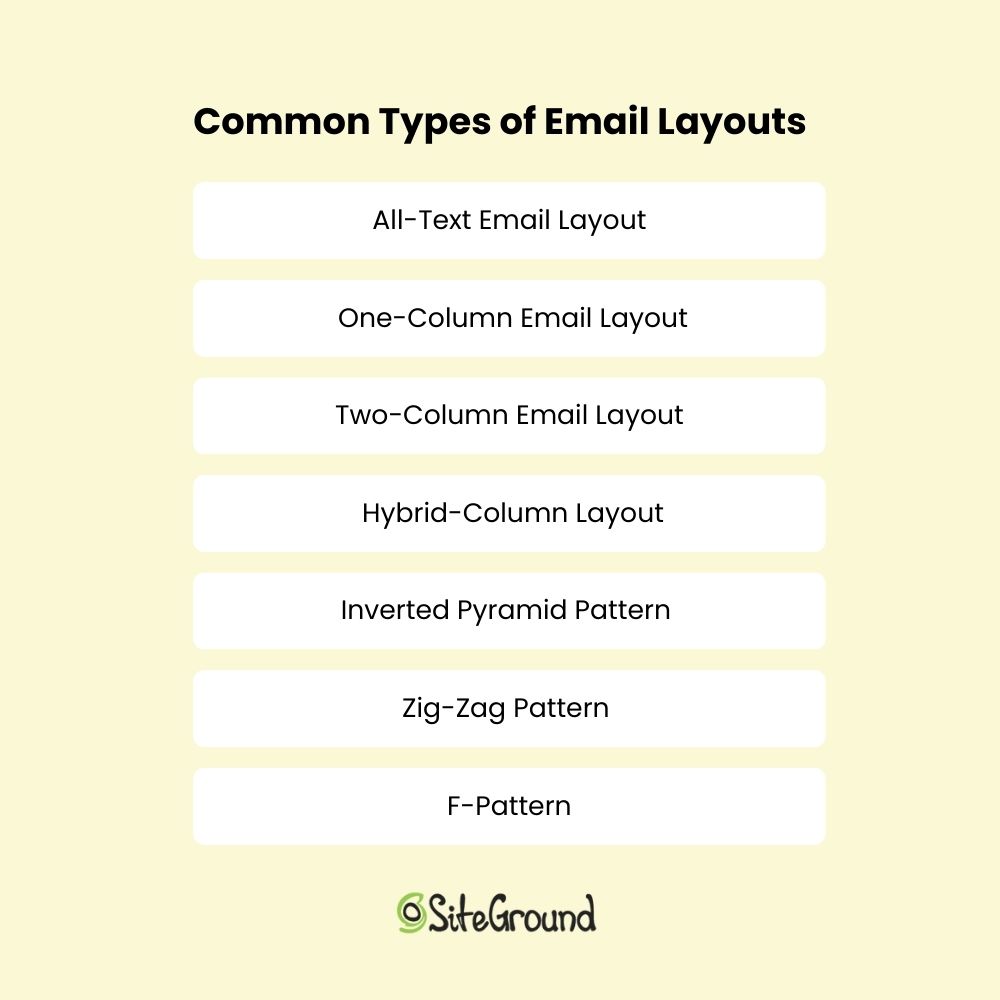
Common Types of Layouts for Effective Email Design Ideas
The design of your email should align with its purpose. While some emails might be all about the words, others come alive with images, graphics, and videos. It’s all about arranging these elements in a way that guides your reader’s eyes smoothly through the content, whether it’s a structured hierarchy or a natural reading flow.
We’ll be exploring some common types of email structures, accompanied by template examples to discover how each design comes to life.
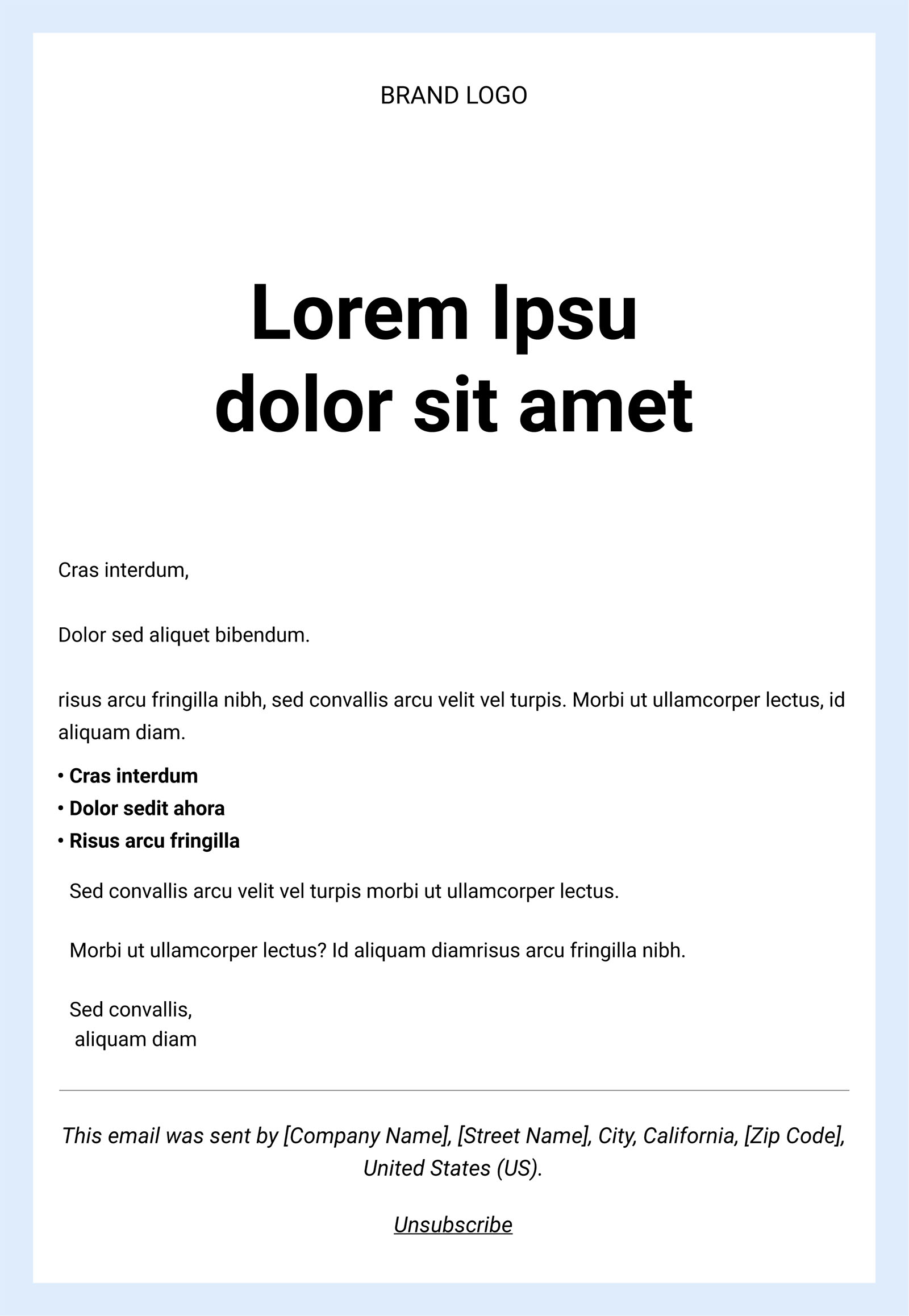
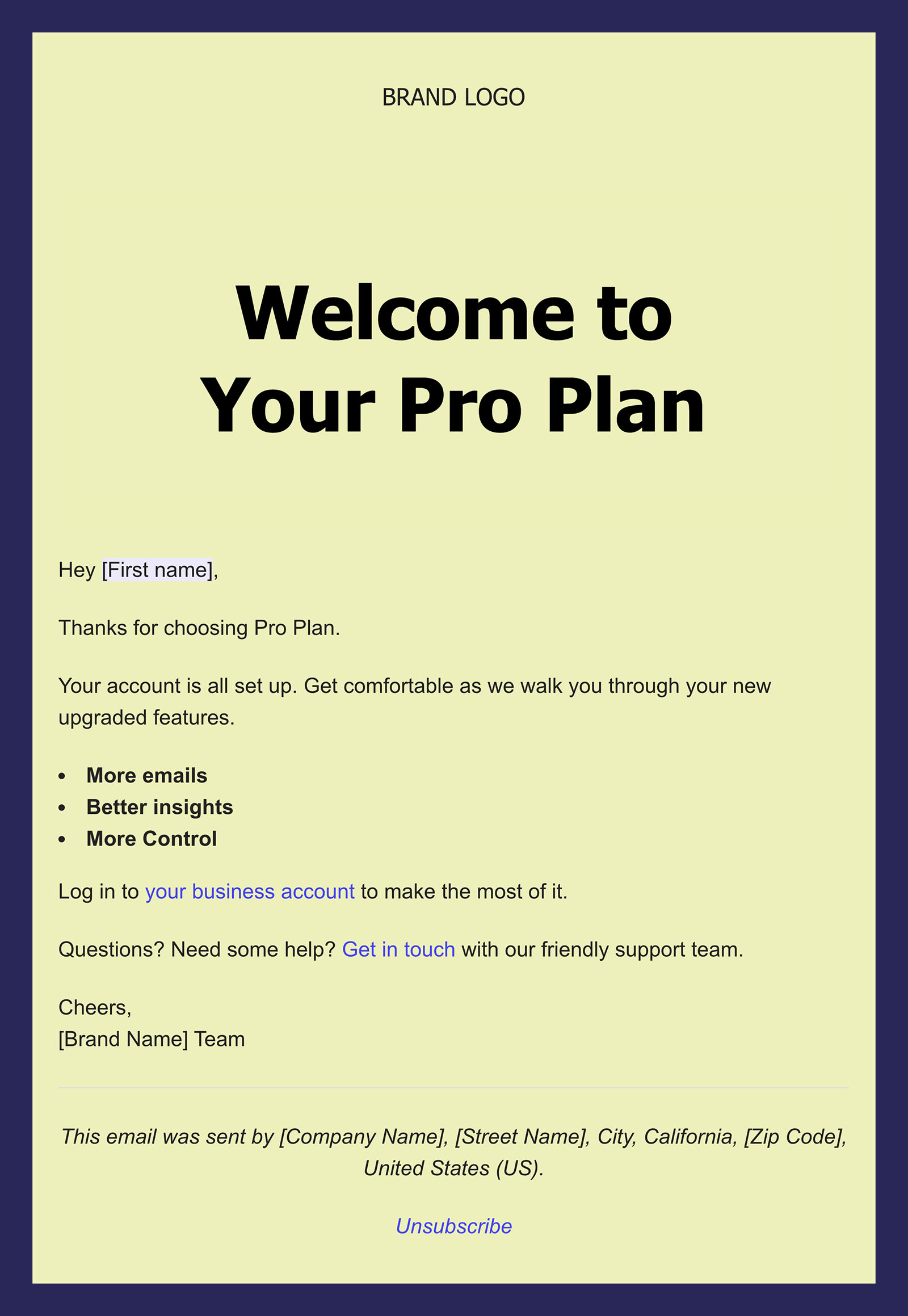
1. All-Text Email Layout
As the name suggests, all-text emails do not include any images or graphic elements; it’s just plain text. Because of that, emails with such structure are often used for password resets, order confirmations, and for almost any kind of transactional email.
But don’t think that’s all they’re good for—they’re also great for welcome emails or any message you want to feel more personal. Without logos or images, they can come across as if they were sent by an actual person.
And while you might think that with your concise and simple copy, success is guaranteed, there are a few rules to follow to make your message pop, such as:
Use well-formatted text with short sentences and short paragraphs.
Include headings and subheadings to break up text, where appropriate.
Bold important phrases to catch and keep the customers’ attention.
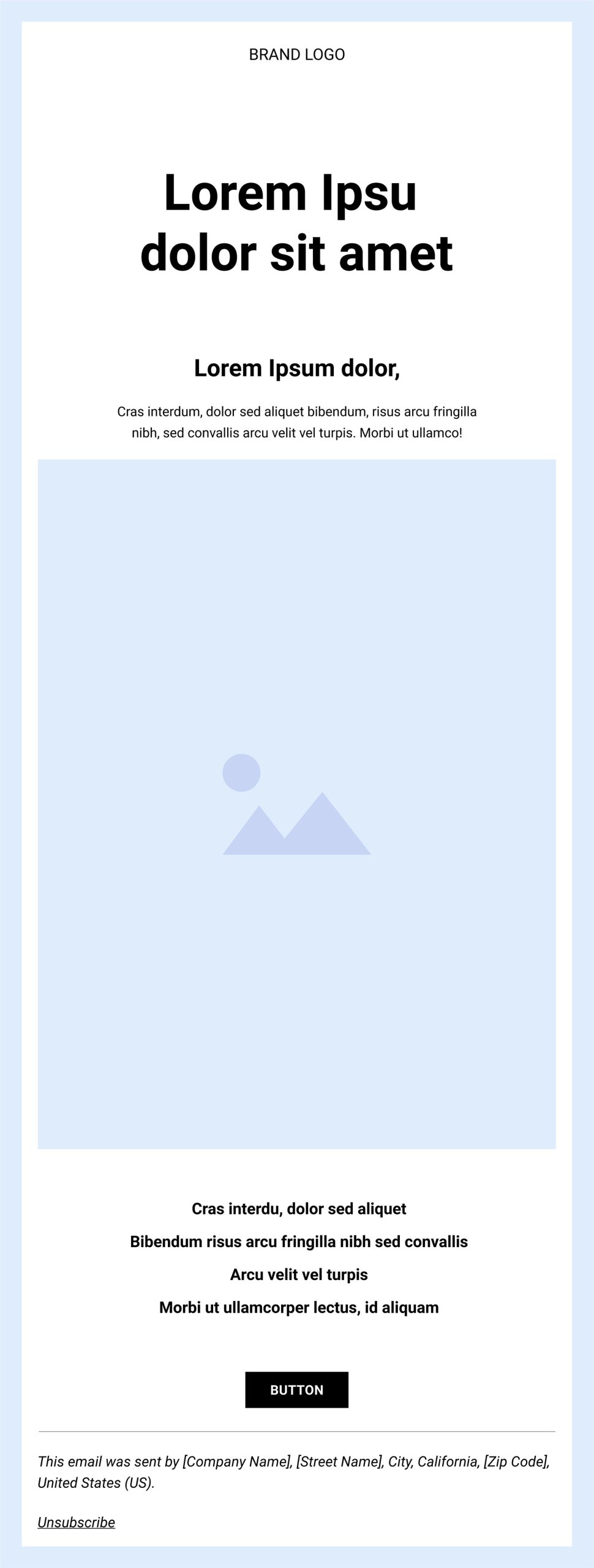
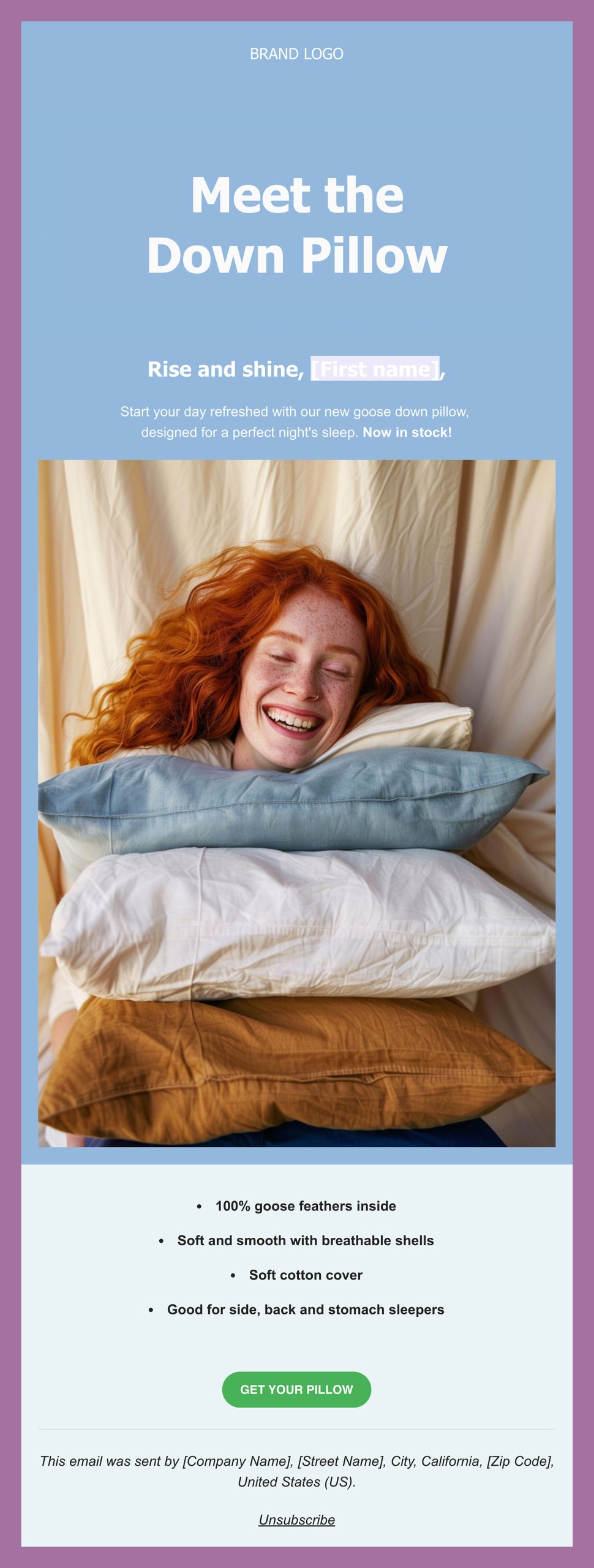
2. One-Column Email Layout
When we say one-column layout, we’re referring to an email where everything is arranged in a simple, straight line—just like a column. This format allows you to include as many sections as needed, with each section typically featuring a single image or block of text.
The simplicity of this design is its greatest strength, as it offers a clean and straightforward presentation that keeps the reader engaged with the main message without any distractions. That’s why single-column layouts are effective for welcome emails, sales promotion emails, and re-engagement emails. They also work well on mobile devices because they easily adapt to smaller screens, offering a user-friendly reading experience.
3. Two-Column Email Layout
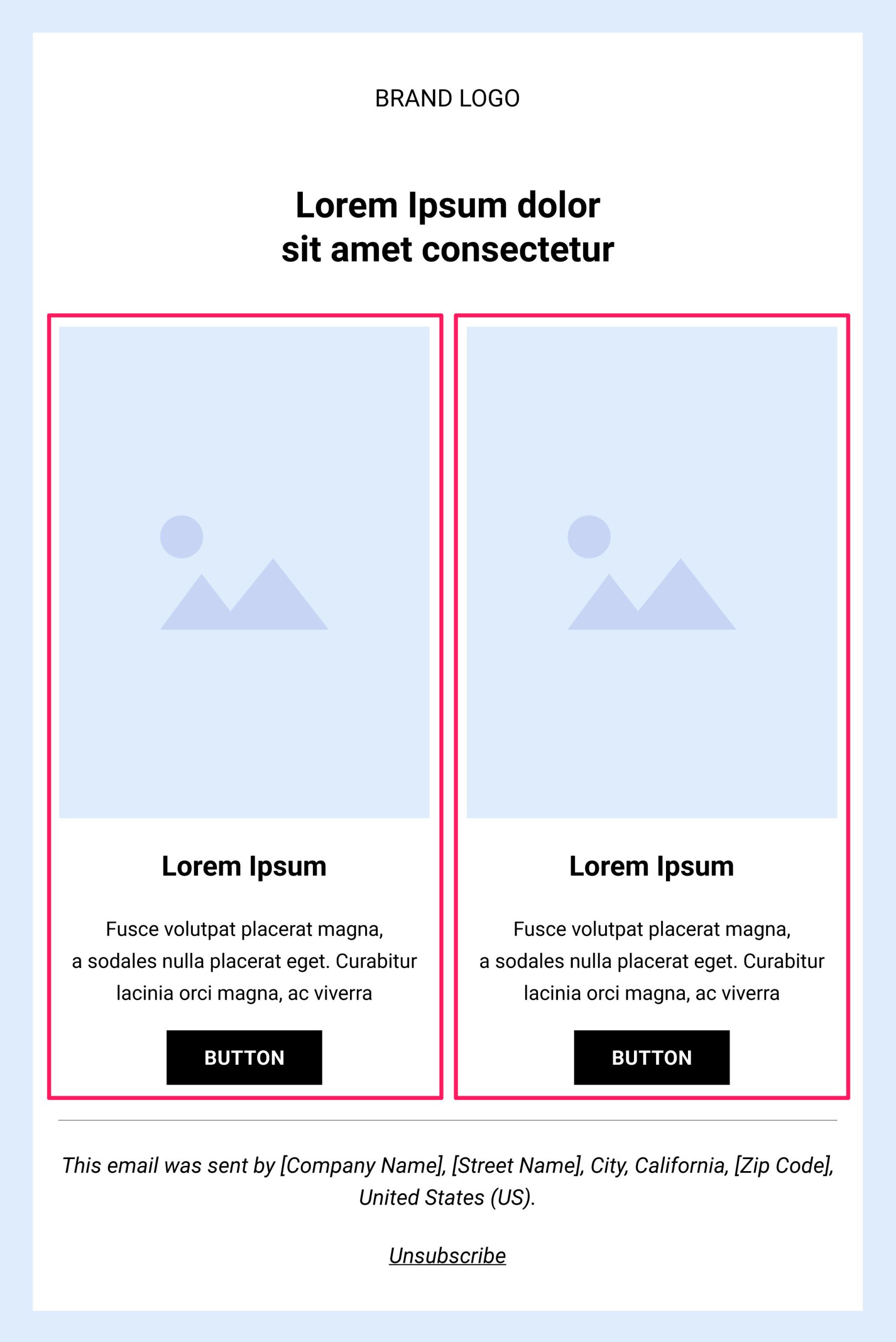
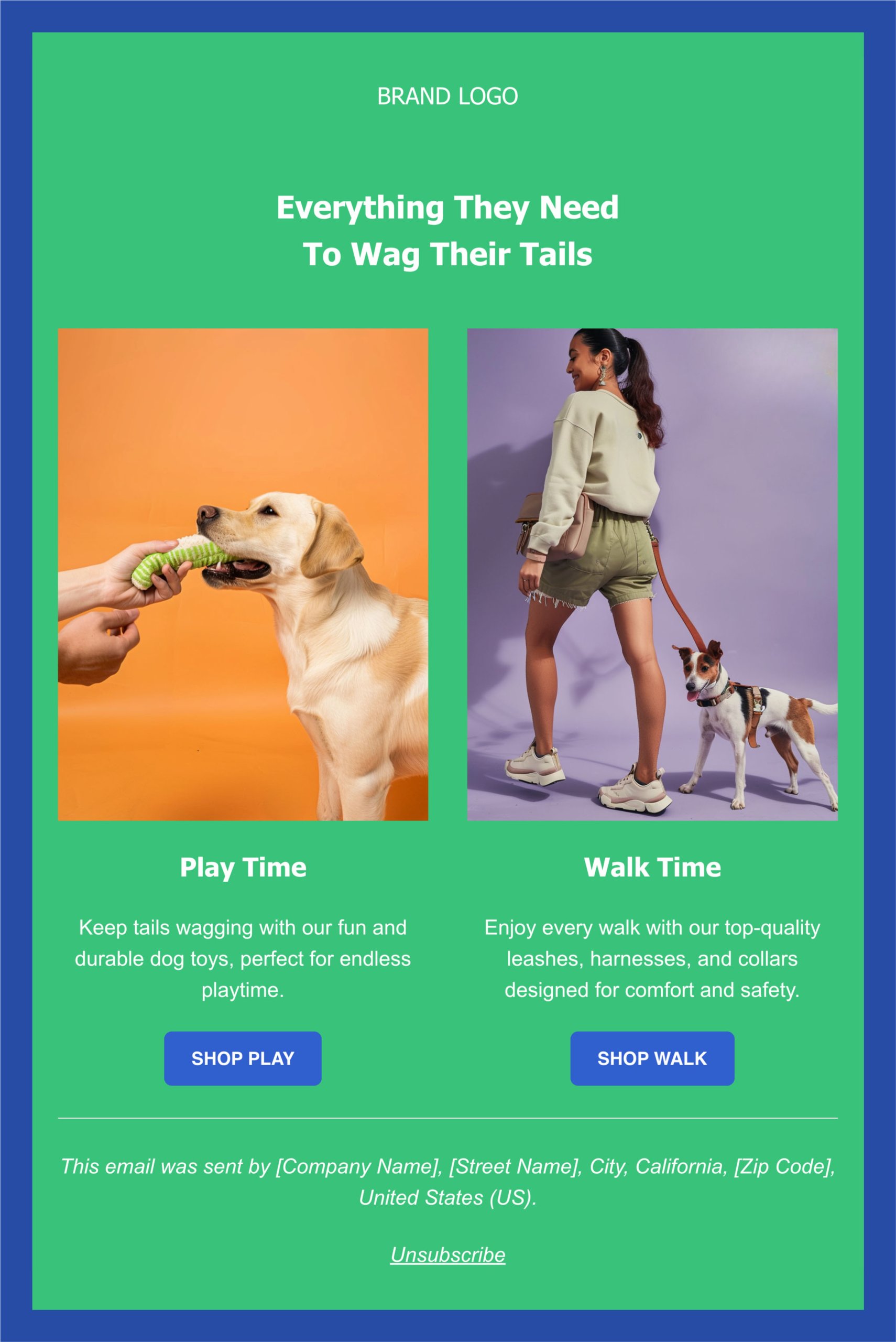
A two-column layout organizes your essential elements—content and images—into two distinct sections, providing clear separation within your content.
This format is ideal for covering multiple topics at once, such as introducing your brand while guiding readers to the landing page of your services. It’s also well-suited for information-heavy content like newsletters, especially those featuring blog posts where you need to present various pieces of information in an organized manner.
Plus, this format works wonders when incorporating multiple calls to action, as it enables you to strategically position them throughout your body copy without overwhelming the reader.
4. Hybrid-Column Layout
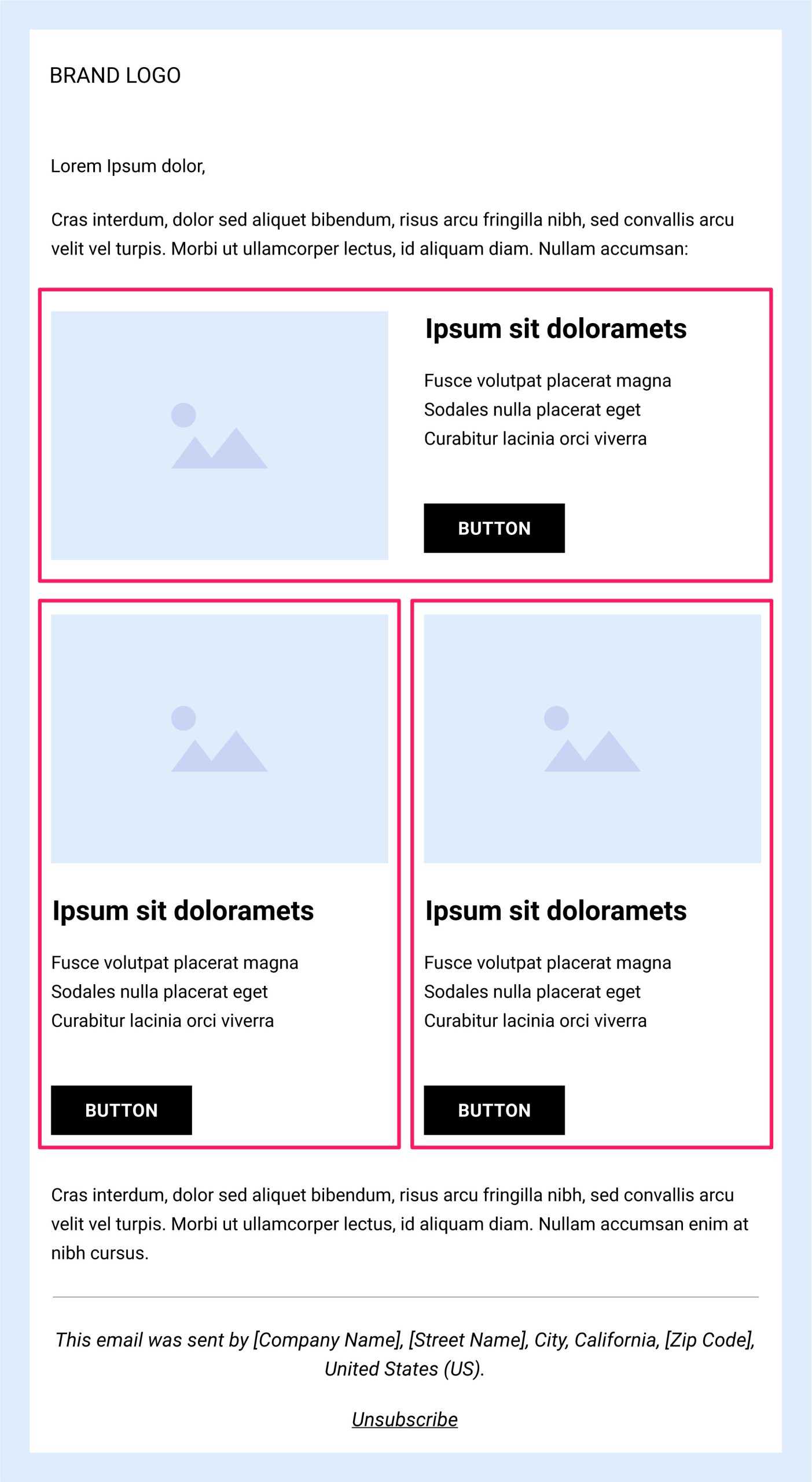
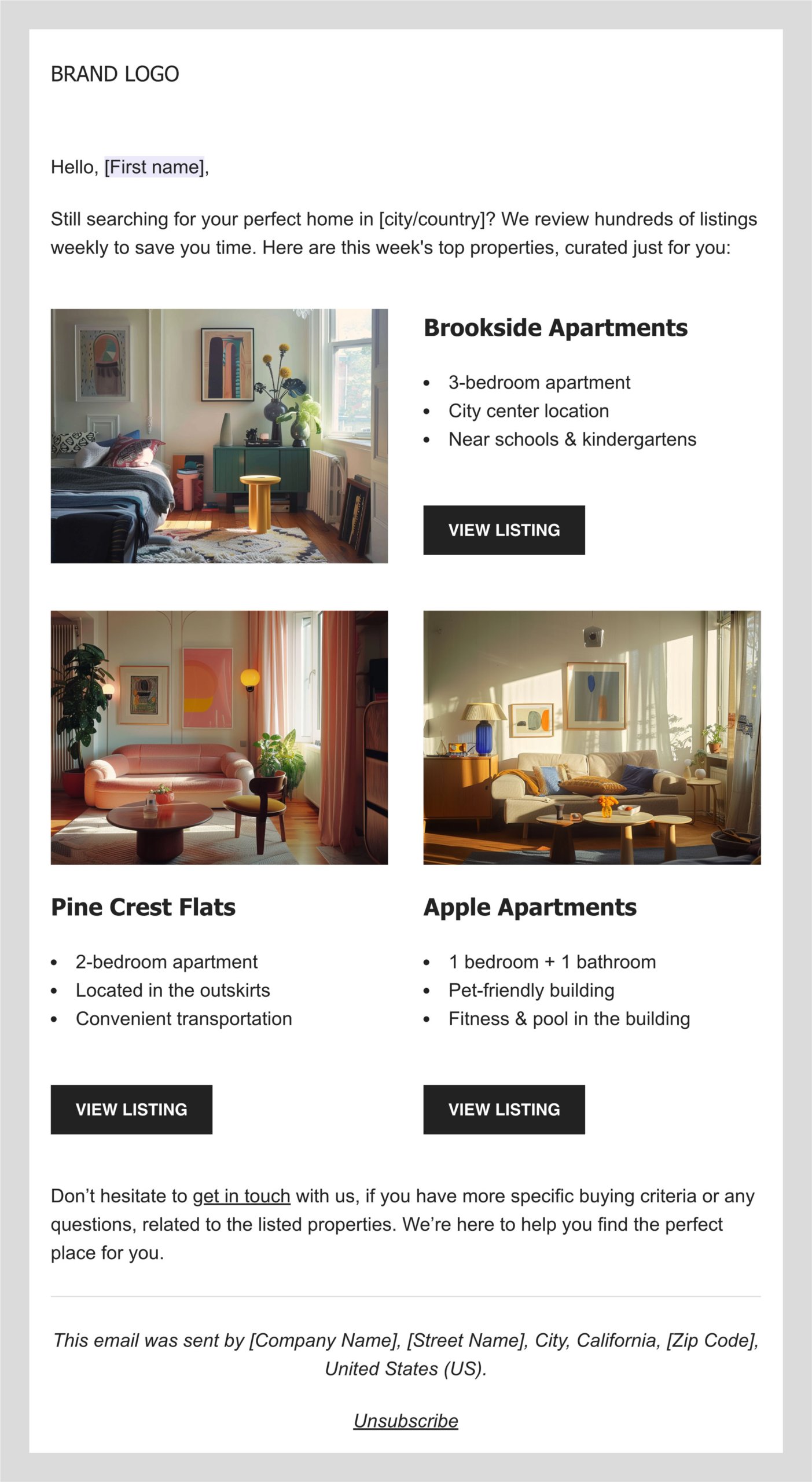
A hybrid-column or multi-column layout starts with a wide, single-column header that can be used to provide context for the topic of your email or, if it’s a promotional email, to highlight your main offer. Following the header, the layout transitions into multiple blocks arranged in a two-column format, where you can place your calls to action and additional information.
The main advantage of this format is its ability to convey a large amount of information in a streamlined design, keeping your email both tidy and visually engaging.
Just keep in mind that while some email platforms offer mobile-friendly templates, emails with more than one column might present challenges in optimization. Therefore, always preview your email to ensure it looks great on all screen sizes.
Now that you’re familiar with the columns, let’s move on to discovering how different visual patterns can elevate your email designs.
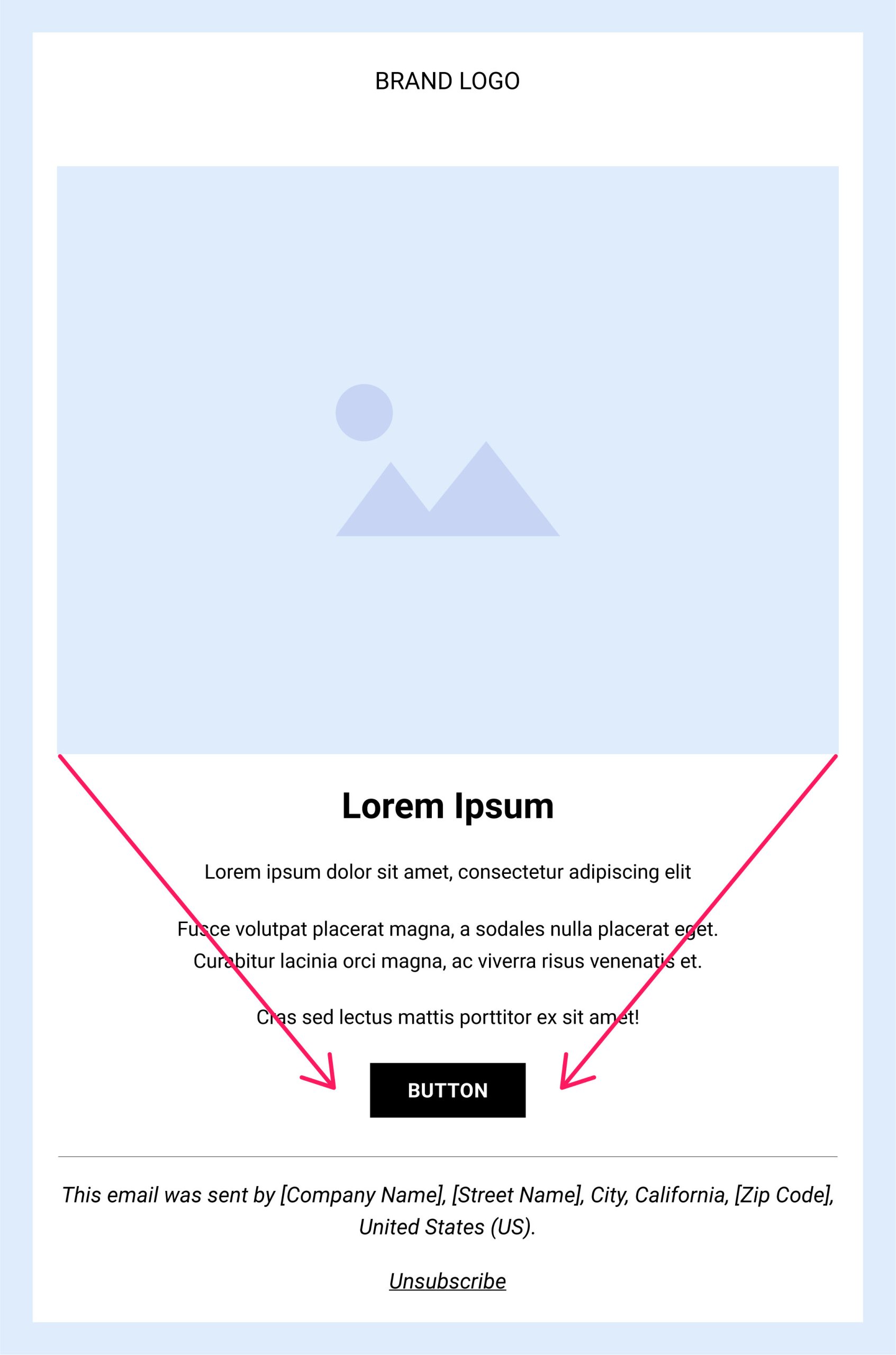
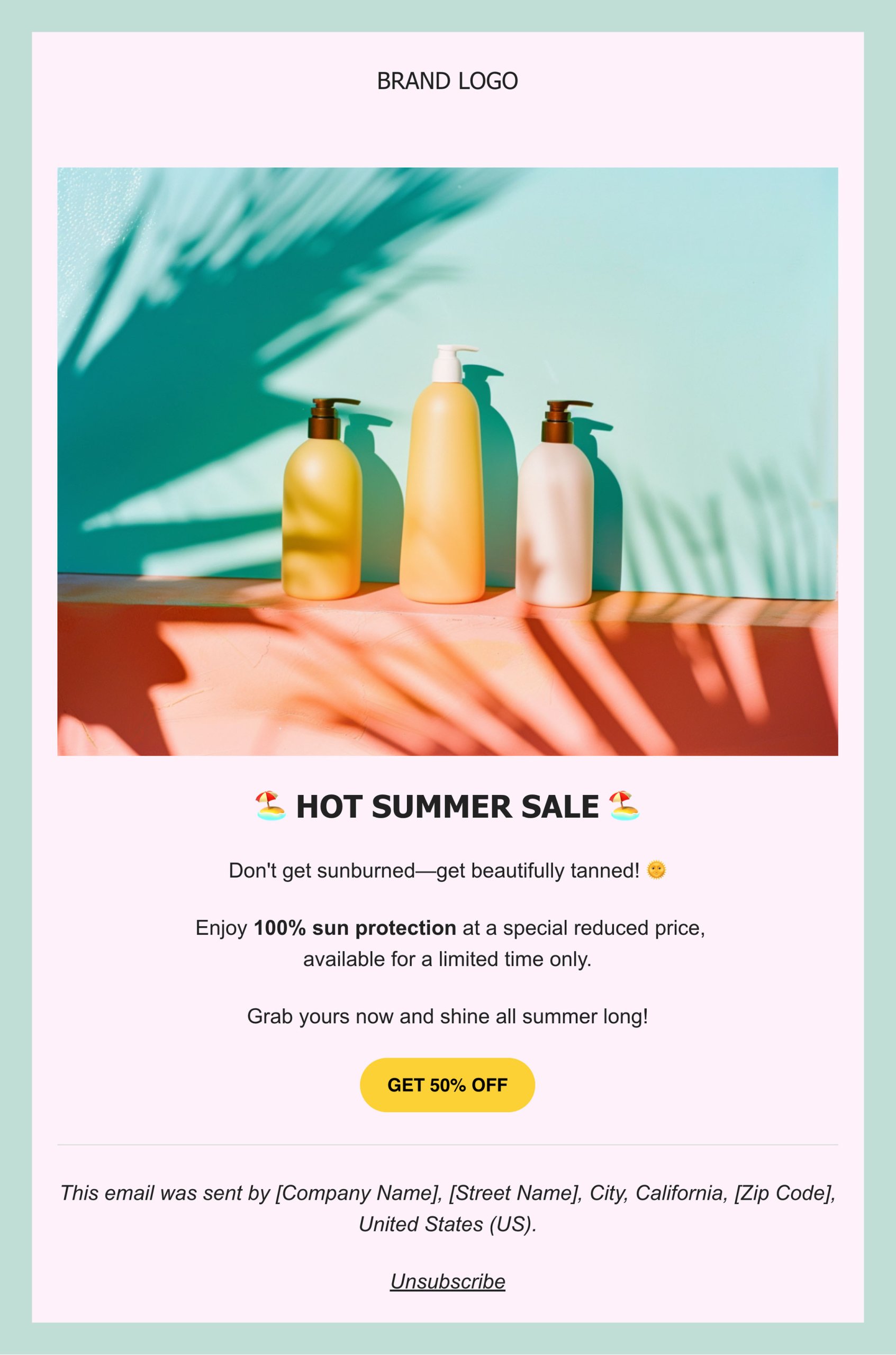
5. Inverted Pyramid Pattern
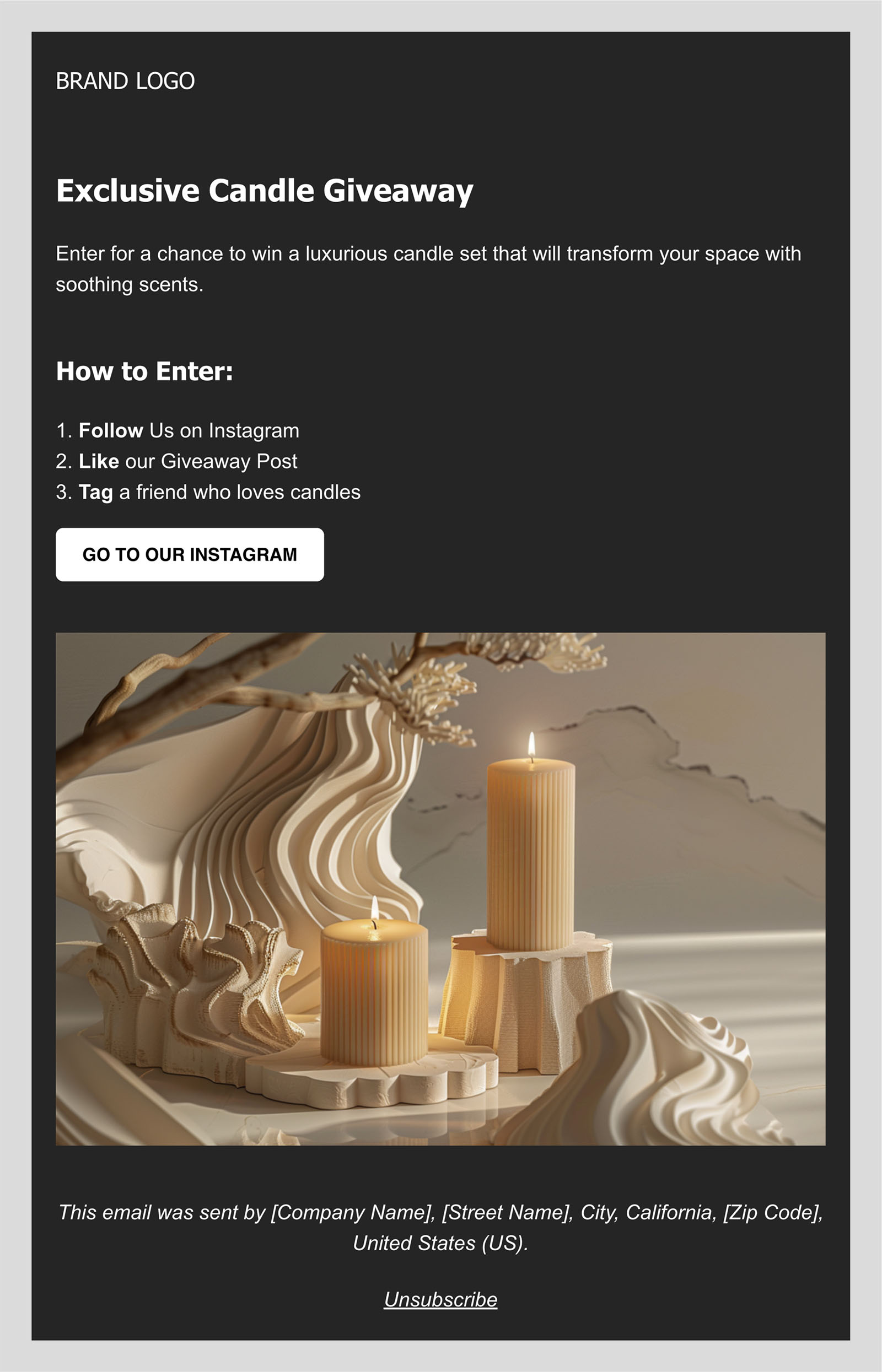
The inverted pyramid layout follows how readers naturally skim through text. It starts with an appealing visual or catchy copy that captures attention, then gradually narrows the reader’s focus toward the main goal of your email—the call to action. This progression is particularly effective for promotional emails, where the primary objective is to drive conversions.
In this layout, every element of the email is designed to support the call to action and eliminate distractions, ensuring that readers have a clear and direct path to engage with your offer.
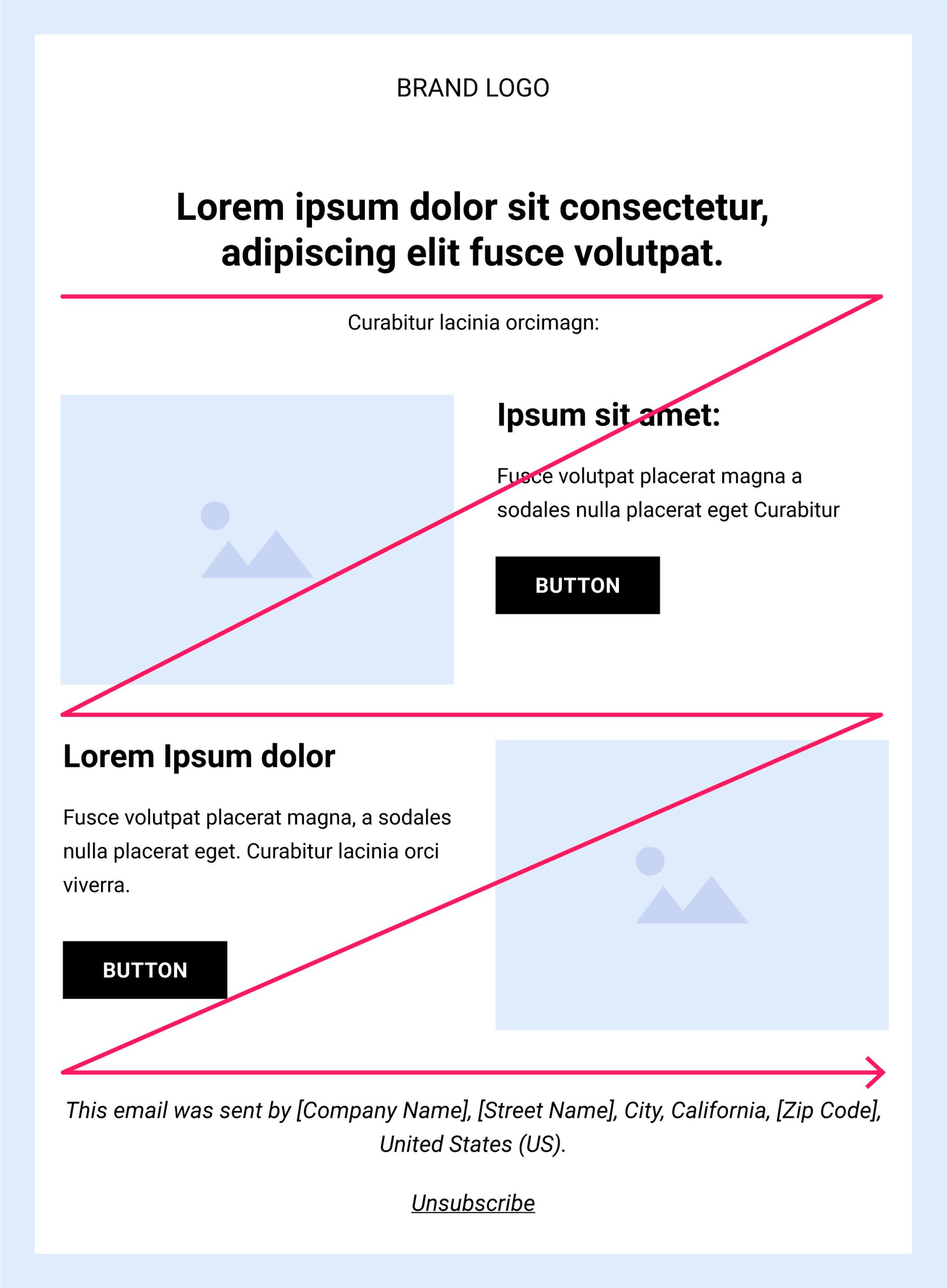
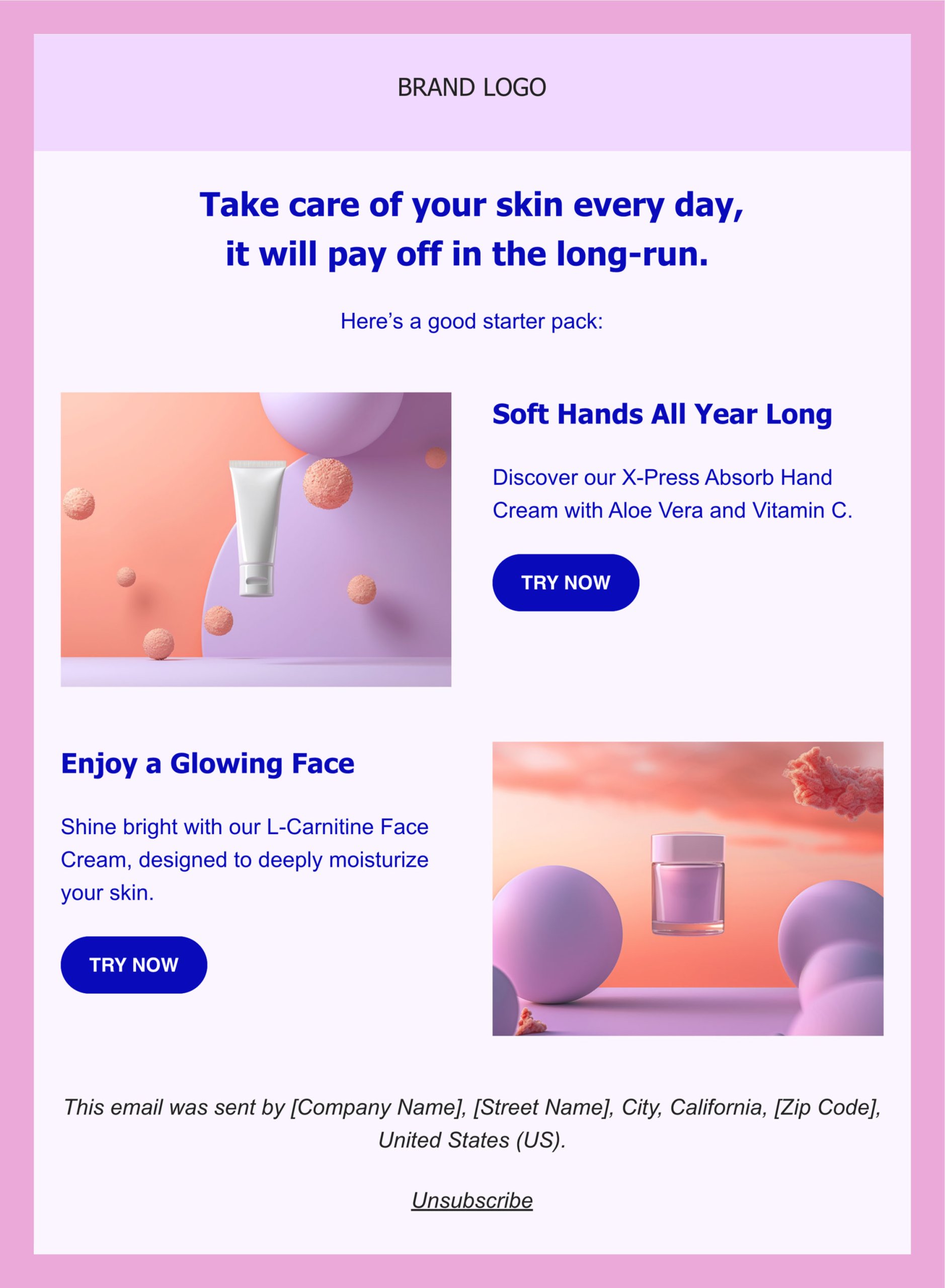
6. Zig-Zag Pattern
This pattern is perfect for emails that are packed with information but still need to be visually appealing, as it leverages the natural way our eyes move when we read—from left to right—creating a “Z” pattern. That’s where its name comes from.
When creating emails following the zig-zag pattern,it’s a good idea to place the most important information on the top horizontal line, as this is what readers notice first. From there, guide the reader’s eye along a diagonal line that leads to engaging copy and a call to action, and do the same for the opposite side. Additionally, if you want to improve readability and maintain a clean email design, utilize the white spaces.
The zig-zag pattern is perfect for emails that contain weekly updates, product launches, or tips—any scenario where you need to highlight key elements while presenting more details.
7. F-Pattern
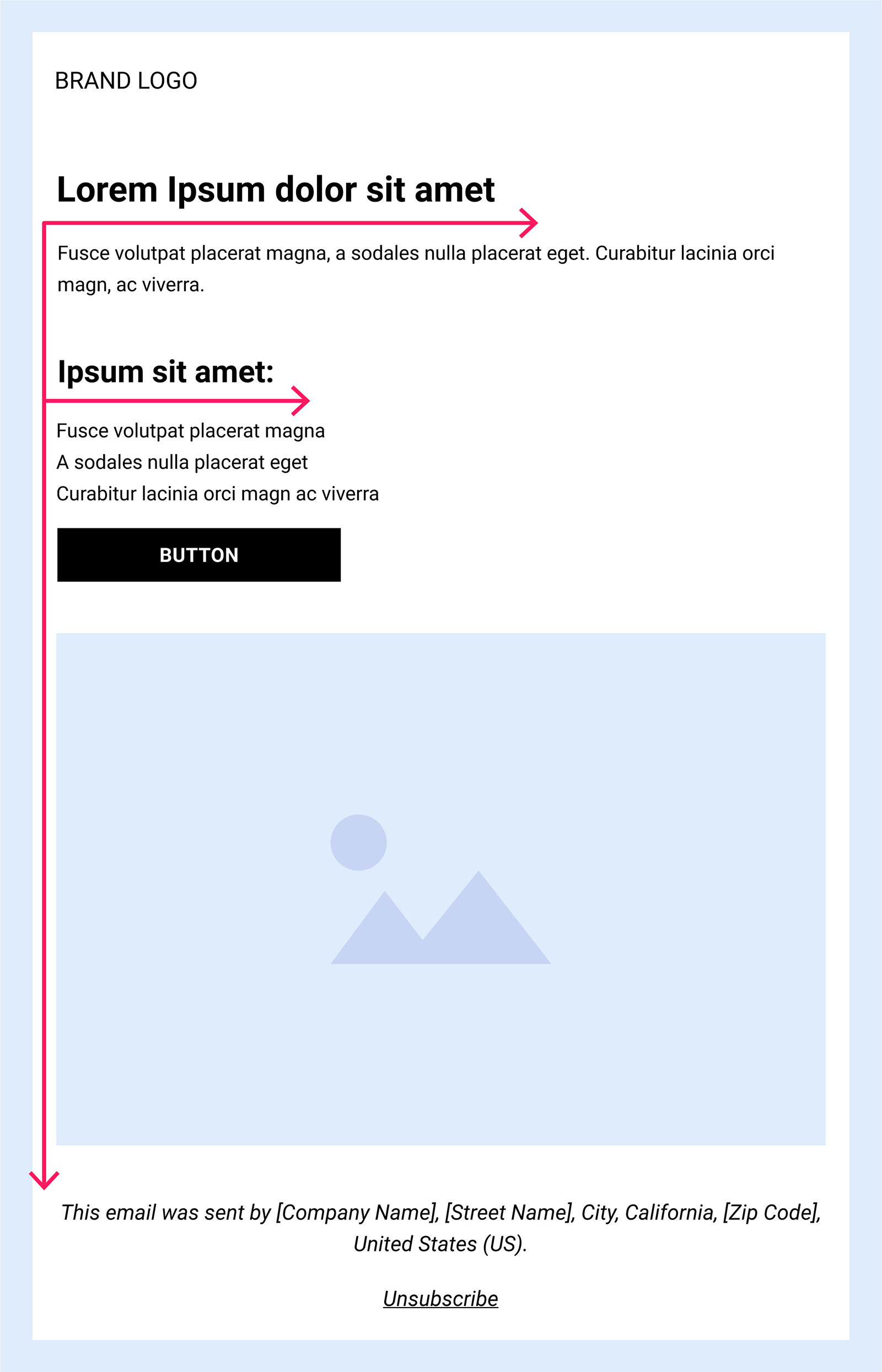
This pattern uses the following visual hierarchy: the most important information is at the top, followed by less important information on the left sides below, including the call to action at the bottom.
This layout also follows a natural reading pattern, as users tend to read one section at a time, left to right, with CTAs at the bottom of each section, where the reader’s eyes are drawn to. As the content continues, the text on the right becomes shorter, gradually leading to the CTA button.
The F-pattern layout works well for information-heavy emails that need to be easy to read and mobile-friendly.
Now that you’ve got the knack for structuring emails that grab attention, it’s time to shift our focus to elevating your email design to maintain that attention.
Whether you’re eager to revamp your style or explore bold new ideas, below are some great email design ideas to get your creativity going.
1. Gamifying Elements
Imagine incorporating game-like elements into your emails to increase reader engagement. For instance, you could create a series of emails where subscribers complete fun challenges or quizzes to earn points. As they accumulate points, they can unlock new content or receive special rewards. You might also introduce a leaderboard to foster friendly competition among subscribers.
Additionally, developing storylines that unfold over multiple emails can further hook subscribers, enticing them to see how the narrative evolves and encouraging them to come back for more.
Gamifying your emails leads to increased time spent reading and even higher click-through rates. This email design is especially effective in re-engagement emails, where rekindling the connection with your readers is the main goal.
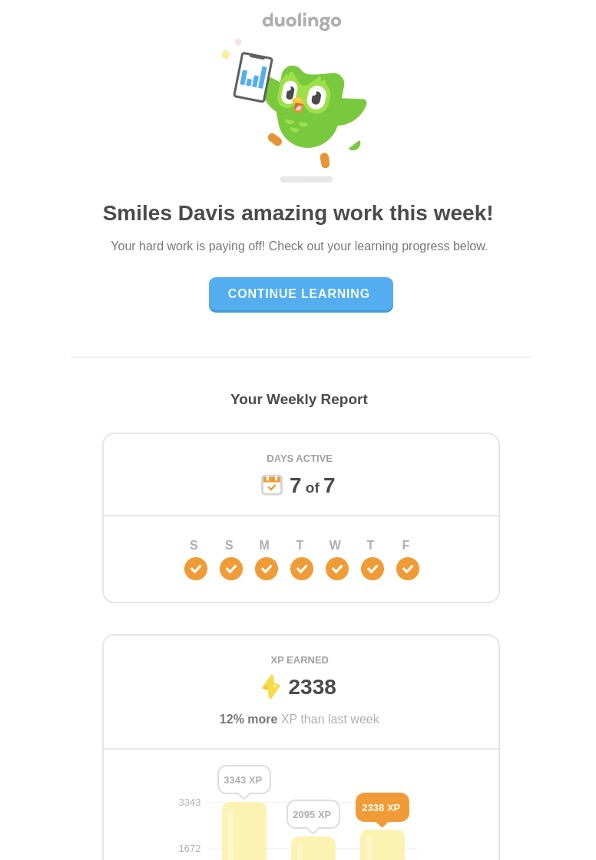
Here’s a great email design example from the language learning app Duolingo. They send out gamified emails with mini-quizzes and progress reports to keep users engaged and to encourage regular app use.
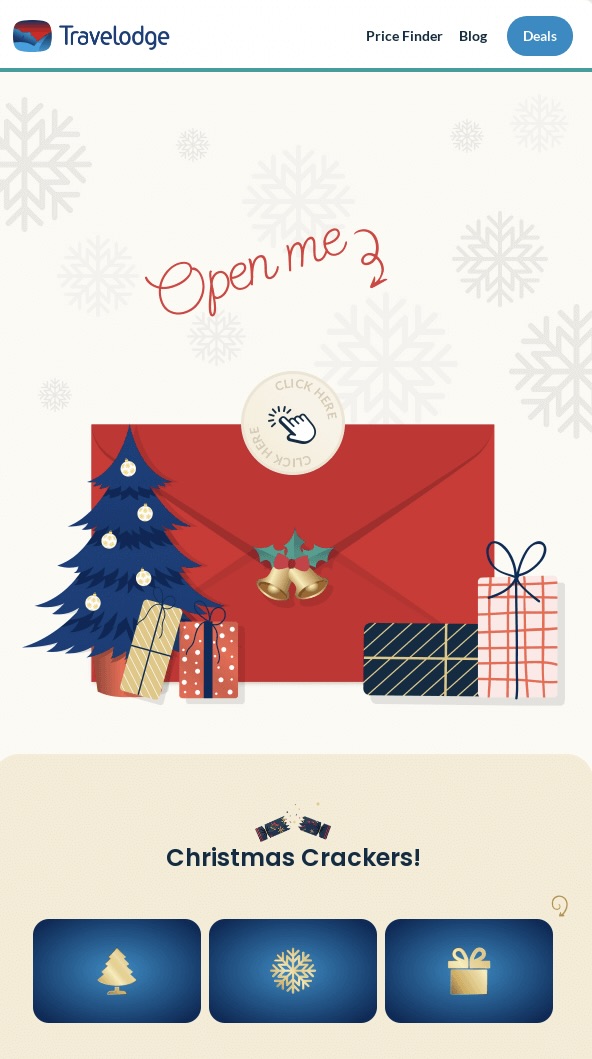
This email from Travelodge taps into the festive spirit by offering a free trip to the lucky winners. By incorporating a challenge-based entry, it encourages active participation, transforming a simple email into an exciting adventure.
2. Dynamic Content With High-Quality Images
Your readers have diverse preferences, so instead of creating emails that try to use one-size-fits-all content, focus on more personalized messages that resonate with your subscribers.
Dynamic content allows a single email to automatically adapt and personalize itself based on who receives the message. You can either set up specific content blocks and choose which subscriber groups or segments to show the content to, or customize content based on individual subscriber information, such as using their name or other details from their user profile.
Pair it with eye-catching images, and your subscribers will be hooked.
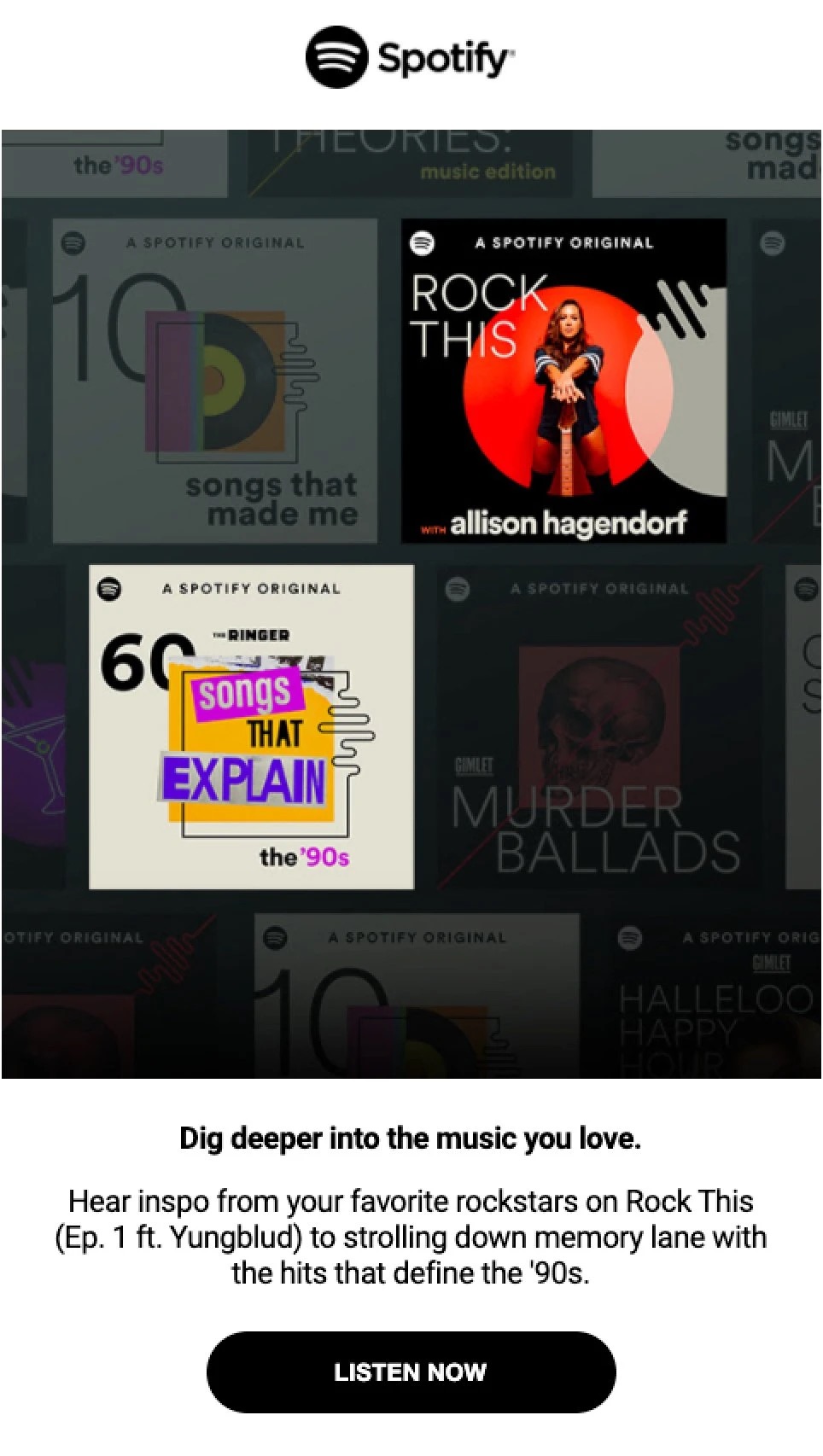
Here’s an email design example from Spotify: the content in their newsletter changes based on each subscriber’s listening preferences. This way, recipients are more likely to explore the recommendations in the app, whether it’s ’90s hits or another music era tailored to their tastes.
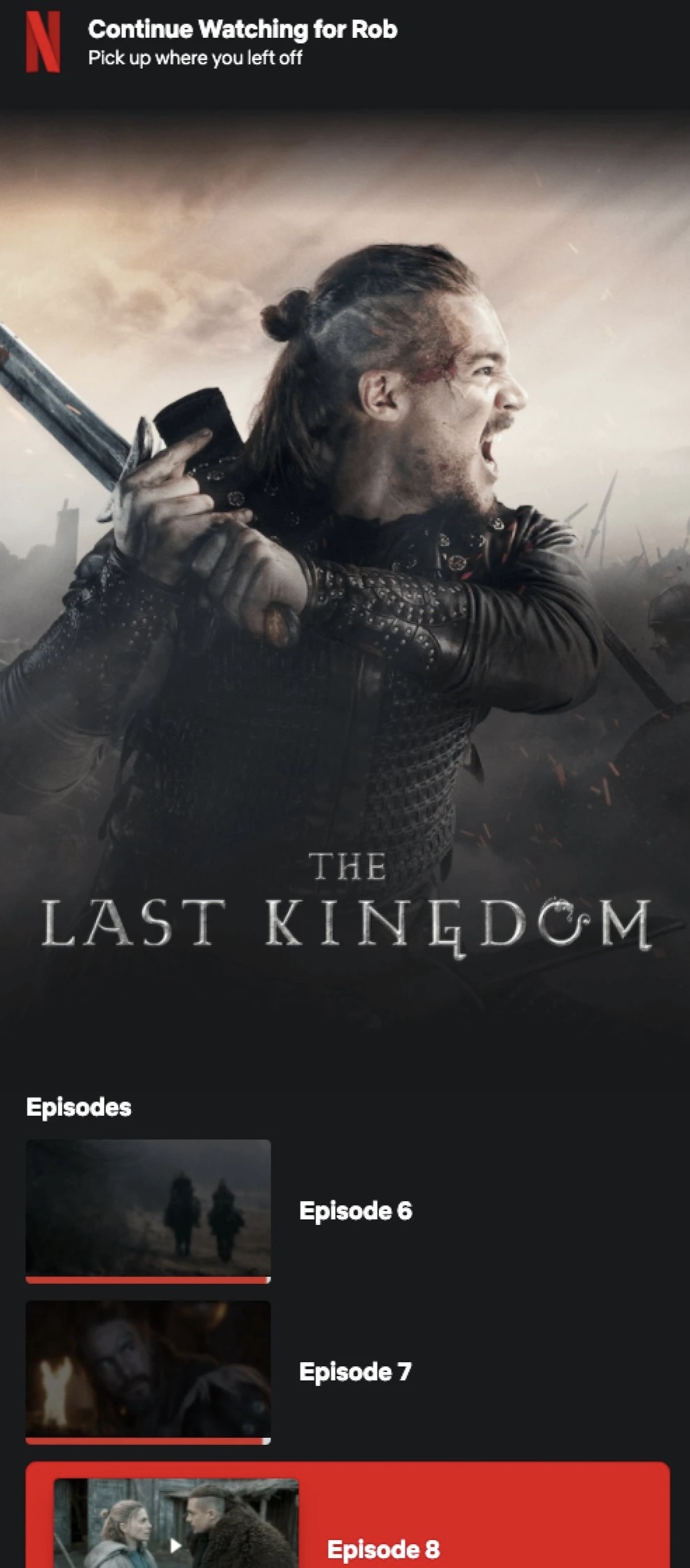
Netflix adds a splash of personalization to their emails with customized elements, nudging subscribers to dive back into their latest series right where they left off. Plus, they sprinkle in recommendations for new shows adapted to each viewer’s unique tastes, based on their viewing history.
3. Cinemagraphs
The next email design idea might be something you’ve spotted before, but didn’t know by name—cinemagraphs, more recognized as animated GIFs. These delightful animations within still photographs feature a portion of the image that moves in a seamless, endless loop. This masterful blend of motion and static elements breathes life into the photo, creating this wow factor for your reader.
Usually lasting 3-10 seconds, cinemagraphs pique visual interest and lend a sleek look to your emails. Remember, while these charming loops are visually captivating, they should remain subtle to avoid distracting from your main message.
Do you sense the aroma from the freshly brewed pot? Detour Coffee Roasters makes sure you do, leaving a memorable mark on new subscribers. By adding a cinemagraph to the coffee cup, they not only spotlight their product but also sprinkle a touch of elegance to their welcome emails.
This promotional email from Korres is another great email design example. With a splash of motion in their product images, the email transforms into an eye-catching showcase, letting readers almost feel the products’ presence.
4. 3D Graphics
By adding 3D animations or illustrations, you can create a rich, immersive visual environment that draws the reader in and holds their attention. These elements can be particularly effective in showcasing products or highlighting key features in a way that feels more tangible and engaging.
Additionally, parallax scrolling effects—where background and foreground elements move at different speeds—can create a layered, dynamic design that adds depth and motion to your emails.
The next email design from Envato can only be described as a masterpiece. The brand skillfully showcases their 2D and 3D services, using the email as a dynamic canvas to demonstrate the full potential of their platform.
5. Hand-Drawn Illustrations
Incorporating hand-drawn elements into your email designs can infuse them with a sense of personality and authenticity, creating a more intimate connection with your audience. This approach subtly conveys that there are real, creative individuals behind your brand, which can help build trust and foster stronger relationships with your subscribers.
Whether it’s a sketched icon, a handwritten font, or a doodled border, these artistic touches can add a unique flair to your marketing emails, distinguishing them from more generic, mass-produced designs.
You can draw inspiration from this effective email design by Rifle Paper:
Similarly, adding organic, imperfect shapes can greatly enhance the aesthetics of your email designs. Unlike the rigid, geometric shapes often found in digital design, organic shapes are free-flowing and less structured. This can evoke feelings of creativity, spontaneity, and warmth, offering a refreshing contrast that adds a unique and inviting touch to your message—just like this welcome email.
Screenshot
6. Dark Mode Compatibility
Now that you’ve gathered some email design inspiration, it’s time to consider how these designs will fare in dark mode. This is an essential step if you want to keep your email campaigns looking sharp and engaging despite your reader’s preferences for dark or light mode.
While you can’t completely control how emails are displayed in dark mode—since that’s often up to the user’s device or email provider—you can design your emails to be more adaptable.
Here are some handy pointers to keep in mind when making your emails dark mode-ready:
Use transparent PNGs: Ensure images blend well by using transparent PNGs or removing backgrounds that may not integrate smoothly.
Add padding to non-transparent Images: If images have backgrounds, add sufficient padding around focal points to prevent awkward contrasts.
Enhance brand logo: For black logos, consider adding an outline to prevent them from disappearing on dark backgrounds.
Opt for subtle accent colors: Select less saturated accent colors that look good on dark backgrounds.
Rethink icon colors: Аvoid black icons on white backgrounds, as they may vanish in dark mode. Use a poppy color with white icons for better visibility.
The Art of Creating Your Own Email Design
Great email design is an essential part of any successful marketing strategy. By understanding the different types of layouts and incorporating creative design elements, you can create emails that resonate with your target audience and achieve your business goals.
Whether you’re looking to generate leads, increase brand awareness, or drive sales, a well-designed email can make all the difference. Additionally, don’t forget to continuously evolve your design strategies, keeping them fresh and relevant to maintain your audience’s attention and create memorable interactions.
With these insights and examples, you’re well-equipped to design emails that not only stand out but also deliver results.
This article was originally published in June 2024 and updated in March 2025.
Picture a different kind of sales experience: one in which you walk into a store, and instead of a pushy salesperson trying to close a deal immediately, you’re greeted with helpful tips, personalized recommendations, and just the right amount of attention. You feel seen. And that’s exactly what lead nurturing emails do—minus the awkward small talk.
Lead nurturing emails help businesses build relationships with potential customers over time, offering the right kind of value at every step of their journey. Whether someone just discovered your brand or is on the verge of making a purchase, the right email at the right moment can make all the difference.
This may sound easier said than done, so today we’ll walk you through everything you need to know to make it happen.
What Is a Lead Nurturing Email?
A lead nurturing email is a strategic message sent to potential customers to guide them through the buying process. Rather than pushing an immediate sale, these emails educate, engage, and build trust, ensuring leads stay interested and move closer to conversion.
Think of it like dating: You wouldn’t propose on the first date (hopefully). Instead, you build a connection, earn trust, and show why you’re the right match. Lead nurturing emails work the same way by offering valuable content, addressing pain points, and keeping your brand top of mind.
How to Write Lead Nurturing Emails
Lead nurturing emails form an important part of email marketing. They follow the email customer journey, ensuring that leads (that is, potential customers) receive the right information at the right time. So prior to creating high-impact lead nurturing emails, you need to understand how leads progress through your sales funnel and how each email fits into each stage.
Let’s explore how to do email lead nurturing, step by step.
1. Map Out Your Sales Funnel
Before drafting a single word, map out your sales funnel and its email touch points—you’ll want to slot in one (or several!) emails at every stage. Indeed each stage requires a different approach—and a different message!
Consider these common email stages and examples based on the customer journey:
Awareness stage – Educate leads on their problem and introduce your brand. (Example: Welcome emails)
Consideration stage – Help them evaluate solutions and see why your product is the best fit. (Example: Product tutorials, case studies, comparison guides)
Decision stage – Nudge them toward a purchase with incentives or social proof. (Example: Discount offers, testimonials, abandoned cart reminders)
Retention and loyalty – Keep customers engaged and encourage repeat business. (Example: VIP offers, new product announcements, surveys)
Think about your customers and the journey they take from awareness to purchase and beyond, and then which lead nurturing emails you can send to them to nurture their interest and move them through each step.
2. Segment Your Email List Thoughtfully
Assuming you’ve generated leads and built your email list, then the next important part of sending lead nurturing emails is to segment your list. This ensures each lead receives relevant content based on their interests, behavior, and position in the funnel—and it’s an essential part of keeping people moving through the funnel.
Let’s examine how you might organize your leads, and how this might work in practice:
Example: If a lead downloaded an eBook on SEO, send a follow-up email with an SEO case study rather than a generic company introduction.
Behavioral data: Browsing history, email engagement, past purchases.
Example: If a lead frequently visits a product page but hasn’t purchased, send an email with customer testimonials or a limited-time discount.
Demographics: Industry, job title, company size.
Example: A small business owner might receive content about budget-friendly solutions, while an enterprise lead gets insights on scalability and integrations.
3. Create a Lead Nurturing Sequence
You’ve got a lead nurturing journey, and segments to target, and now you need to put it into action. One of the best ways to accomplish this is by implementing an email sequence.
This basically entails sending a planned series of emails (discussed in step one) based on the recipient’s behavior, engagement, or stage in the customer journey (which we discussed in step 2). Each email is designed to provide value, build trust, and guide potential customers toward a decision, whether it’s making a purchase, signing up for a service, or taking another key action.
Manually managing a lead nurturing sequence is impractical, especially as your list grows. The good news is that many tools allow you to set up email automations. This ensures consistency, saves time, and allows you to scale your efforts effectively.
4. Personalize Your Emails for Maximum Impact
Segmentation lays the groundwork, but personalization makes your emails truly engaging. It’s more than just adding a first name—it’s about making each message feel relevant to the individual.
Ways to personalize your emails:
Reference past interactions: Mention a resource they downloaded, a product they viewed, or an event they attended.
Use dynamic content: Customize email content based on location, preferences, or purchase history.
Tailor subject lines and CTAs: Adjust messaging based on where the lead is in their journey.
The more your emails feel like they were written for an individual rather than a mass audience, the more likely they are to resonate and drive action.
5. Track Performance and Optimize
Once your emails are live, monitor key email marketing metrics to see what’s working and what needs improvement. Important metrics include:
Click-through rates (CTR) – Is your content relevant and compelling? Make your calls to action aren’t strong enough? Tweak for future emails and track the results.
Conversion rates – Are leads taking the desired action? Maybe people are clicking through from your email, but sales don’t reflect that. Make sure your emails, calls to action, and desired conversion all align, and that the process is smooth and intuitive.
Unsubscribe rates – Are you sending too many emails or missing the mark? If you notice more people drop off after a certain email, you might want to consider the cause behind that. Or if you notice a gradual decline, think about changing up your email frequency to see if that makes a difference.
When in doubt, A/B test. That is, if you just can’t figure out the cause for a certain metric’s behavior (whether it’s increasing, decreasing or staying the same), then experiment with different subject lines, content formats, and CTAs to see how performance changes. Just remember this email marketing best practice: test one thing at a time so that you know exactly what is working and what isn’t.
Types of Lead Nurturing Emails and Great Examples
Now that we’ve covered how lead nurturing emails work, let’s examine some of the different types of emails you might send during this process. Some introduce your brand, others provide helpful resources, and a few give that final nudge to convert, among other objectives. Here’s a breakdown of the essential types of lead nurturing emails and how they keep potential customers engaged:
1. Welcome Emails – Make a Great First Impression
A welcome email is your chance to introduce your brand and set expectations. It should reinforce why the lead signed up, provide helpful information, and encourage engagement. This is a great opportunity to share your brand’s mission, direct them to key resources (such as blog posts or product pages), and invite them to follow you on social media. A well-crafted welcome email helps establish a positive relationship from the start.
The above lead nurturing email example warmly welcomes recipients as their “journey begins” and adds the bonus of 15% off, which is always a nice incentive for new subscribers to convert straight away.
2. Discount Offer Emails – A Gentle Push Toward Conversion
Sometimes, a little incentive is all it takes to turn a hesitant lead into a paying customer. A discount offer email provides potential buyers with a time-sensitive promotion, making it more tempting to take action. These email campaigns work especially well for first-time buyers, seasonal promotions, or re-engaging inactive leads. To maximize effectiveness, highlight the savings clearly and create a sense of urgency. You may even wish to include this offer in your welcome email in order to encourage the purchase right away.
This lead nurturing email campaign example from Crate&Barrel incorporates a couple top email marketing tips: the conversion-driving discount, as well as the classic “sense of urgency.” Throw in the fact that the discount is for furniture faves, and there’s a good chance the recipient will be more likely to move along to the next step in the lead nurturing process.
3. Product Tutorial Emails – Show, Don’t Just Tell
If a lead has shown interest in your product but hasn’t purchased it yet, a product tutorial email can help them see the value firsthand. These emails provide step-by-step guides, feature breakdowns, or video demonstrations to showcase how the product works and why it’s beneficial. For service-based businesses, these emails might include FAQs, onboarding instructions, or use case examples to help potential customers feel more confident in their decision.
On the other hand, for those who have already made a purchase, a product tutorial email helps them maximize the value of their new item—increasing both satisfaction and the likelihood of repeat business. It also keeps them engaged with the brand, strengthening the relationship and driving long-term loyalty and conversions.
The below coffee-making tutorial email is a great lead nurturing email example of helping the customer better learn how to use and enjoy the product more, and hopefully continue to buy more as well.
4. Personalized Recommendation Emails – The Right Fit at the Right Time
Based on a lead’s behavior—such as past interactions, browsing history, or perhaps quiz results—personalized recommendation emails suggest relevant products, services, or content. These emails create a more custom experience, making the recipient feel understood while increasing the chances of conversion. The more relevant the recommendation, the more likely the lead is to engage. We’ll discuss how to make this happen shortly.
In the following lead nurturing email example, Audible tackles personalization from a few different angles: they address the lead by name, they add in the shiny new credit, and then follow with a personal book recommendation.
5. New Product Announcement Emails – Keep Leads in the Loop
When you launch a new product or feature, announcing it through email is a great way to generate excitement and momentum. These email campaigns can highlight key benefits, share exclusive first looks, or invite leads to pre-order or join a waitlist. Even if a lead isn’t ready to buy, keeping them informed strengthens brand awareness and ensures they think of your company when the time is right.
The below email newsletter example teases the launch of a new Starbucks line of drinks. The colorful image evokes summer and delivers on the idea of something refreshing—and it hopefully inspires the recipient to stop by a shop for an icy drink.
6. B2B Lead Nurturing Emails – Build Trust and Drive Conversions
B2B lead nurturing emails share similarities with other marketing emails we’re discussing here but have a key difference: they involve a longer sales cycle due to the nature of selling to companies rather than individual buyers. With multiple decision-makers involved, these emails need to nurture relationships and provide valuable insights, case studies, and industry expertise to guide potential clients toward informed decisions.
Unlike consumer-focused emails that often highlight limited-time offers or impulse-driven purchases, B2B nurturing emails take a strategic, trust-building approach. This makes them especially effective for SaaS companies, professional services, and high-ticket B2B sales where buyers need ongoing engagement before committing.
The email below is a prime example of B2B lead nurturing best practices. It delivers valuable, industry-specific insights that establish Zendesk as a trusted authority in the customer experience (CX) space. By featuring interviews with CX leaders and sharing unique perspectives, Zendesk strengthens its credibility, builds trust with subscribers, and strategically guides leads further down the nurturing path.
7. Exclusive & VIP Access Emails – Make Them Feel Special
People love feeling like insiders, and exclusive access emails tap into that desire. These emails invite leads to be the first to try a product, join a beta test, or get early access to a sale. By offering something not available to the general public, you create a sense of exclusivity and urgency that encourages engagement. This strategy works particularly well for luxury brands, loyalty programs, and membership-based businesses.
This lead nurturing email campaign from Organics Ocean is a good example of offering early access with exclusive savings. Insider perks abound, making it hard to resist in the lead up to Black Friday.
8. Survey Emails – Engage and Learn from Your Leads
Asking for feedback not only helps you improve your offerings but also shows leads that their opinions matter. A survey email encourages potential customers to share their thoughts, preferences, or experiences. Whether you’re seeking input on new product ideas, customer pain points, or overall brand experience, these emails create a two-way conversation that fosters engagement and brand loyalty.
We like how the below lead nurturing email example has a playful and friendly tone by saying “it’s your turn to do the talking,” but it also throws in an incentive: a free machine. Customers feel heard and rewarded, which are a couple of the best ways to nurture leads on their path to conversion.
9. Abandoned Cart Emails – The Gentle Reminder
Leads often get distracted or hesitate before making a purchase. Abandoned cart emails serve as a friendly reminder, encouraging them to complete their transaction. These emails can include a recap of the items left behind, highlight product benefits, and even offer an incentive (like free shipping or a small discount) to motivate action.
The below email example entices the potential buyer to come back and complete the purchase by offering 15% off. So if the recipient was on the fence, this extra discount might help seal the deal.
10. Win-Back Emails – Reignite Their Interest
Not every lead converts right away, and some may disengage over time. Win-back emails—or re-engagement emails, as they are often called—are designed to re-engage cold leads and remind them why they were interested in your brand in the first place. These emails can highlight recent updates, offer an exclusive deal, or simply check in with a friendly message. By making an effort to reconnect, you increase the chances of bringing inactive leads back into the sales funnel.
Below, Venmo’s lead nurturing email taps into user FOMO in hopes that they’ll want to update their app and see what’s new. With a scannable QR code, this is a great example of how to make moving to the next step extra easy.
The Future of Your Email Marketing Lead Nurturing
Lead nurturing is an ongoing process, not a one-time strategy. As technology advances, automation and AI will make it easier to personalize emails and predict customer behavior. But no matter how sophisticated your tools become, the key remains the same: send relevant, timely, and valuable emails that guide leads toward a decision.
Refine your approach, track what works, and keep your audience at the center of your strategy. The more intentional you are, the more effective your email marketing will be.
Great marketing doesn’t have to come from a big-budget team or a decade of experience. With the power of ChatGPT, anyone—whether you run a small family business or are part of a growing brand—can create marketing that feels polished, engaging, and effective. The secret to success? Mastering ChatGPT prompts for marketing. By learning how to prompt the tool effectively, you can tap into its full potential and craft everything from attention-grabbing social media posts to strategic email campaigns.
In this guide, we’ll reveal some of the most impactful and creative ways to use ChatGPT for marketing, and also show you how to craft the perfect prompts. Ready to elevate your marketing game? We’ve got you covered with ideas and tips to make ChatGPT prompts for marketing work for you.
[44]
What Is a ChatGPT Prompt for Marketing?
A ChatGPT prompt for marketing is a specific instruction you give to ChatGPT to generate marketing-related content, such as ad copy, social media posts, blog articles, email campaigns, or strategy ideas. When used effectively, ChatGPT marketing prompts can help you streamline your efforts, create more content in less time, and enhance the quality and effectiveness of your campaigns—helping you market smarter, faster, and at scale.
The Importance of a Good ChatGPT Marketing Prompt
The key here, though, is the quality of those prompts. The best ChatGPT prompts for marketing can make all the difference when it comes to getting results that truly benefit your efforts. By crafting a clear, detailed, and focused prompt, you set the AI up to provide high-quality content that speaks to your audience, reflects your brand voice, and aligns with your marketing strategy. Long story short: it saves you time and improves your results.
To get the most out of AI, structure your ChatGPT prompts for marketing by using a formula that includes certain key elements for clarity and precision. Here are the most important elements to consider as you develop your prompt formula:
Context – Provide background information about your brand, audience, or campaign to give ChatGPT a clear understanding.
Task – Clearly state what you need, whether it’s a blog post, ad copy, social media captions, or email subject line ideas.
Format – Specify how the output should be structured—bullet points, paragraphs, headlines, or even a script.
Examples – Share samples of the style, tone, or structure you want ChatGPT to follow for consistency.
Role – Assign a perspective, such as “act as a digital marketing strategist” or “write like a social media expert.”
Tone – Set the voice—professional, conversational, witty, persuasive—so the response aligns with your brand.
Constraints – Define word count, key phrases, or any specific requirements to keep the output focused.
Goal – Clarify the purpose of the content, whether it’s increasing engagement, driving sales, or educating your audience.
Refinement – Adjust and iterate based on ChatGPT’s responses to fine-tune the results.
If you follow this structure, you’ll generate more accurate and effective content for your marketing needs—and more quickly.
ChatGPT Prompts for Website Content
Now that we’ve got a handle on the basics, let’s take a journey through all the most important ways ChatGPT prompts can help you with your marketing—starting with the ever-important website. It’s your brand’s home base, and it’s where first impressions are made, customers are won over, and the sales hopefully come rolling in.
Every page should work hard for you, but it can be hard to know how to make this happen. That’s where AI can really hook you up, helping you clarify your messaging, craft thoughtful copy, and fuel your blog with content that connects.
Here are a few ways to really extract the most out of your ChatGPT prompts for website content:
1. Define Your Unique Value Proposition (UVP)
Before you start creating your website, you’ve got to get your UVP dialed, because it’s the core reason customers will choose you over competitors. And, if you’re struggling with how to define yours, AI can help.
Provide details about your business—who you serve, what problem you solve, and what makes you different—and get crystal-clear UVP suggestions that instantly communicate your value. You can use the UVP as a foundation for website messaging, as well as in marketing materials, and even in ad copy.
Here’s a good example of what a UVP prompt might look like:
“I need help crafting a unique value proposition for my business. We are a small business in Austin, Texas, that offers homemade food delivery that helps busy professionals and families enjoy fresh, healthy, and comforting meals without the hassle of cooking. Our main differentiator is that our meals are made from locally sourced ingredients and delivered fresh, never frozen. Please generate five UVP options that are concise, clear, and compelling.”
Pro tip: As is the case with all of these prompts, if you don’t like the options ChatGPT gives you, simply tell it why and ask it to go back to the drawing board. Just keep giving it feedback until you receive the perfect content.
2. Nail Your Web Page Copy
Every page on your website has a job to do—maybe it’s to inform potential customers about your mission, or perhaps it’s to provide contact information, or, of course, to close a big sale. So you’ve got to get the copy just right.
So, let’s say you want to create an About page that really conveys your story and message. Just share your brand story, key facts, and the tone of voice you want. AI can generate polished copy that captures your personality and resonates with your audience.
“I need an engaging About page for my homemade food delivery service. Our story started with two sisters who had a passion for cooking and a desire to bring fresh, homemade meals to busy professionals and families. We use locally sourced ingredients, never freeze our meals, and focus on delivering both convenience and comfort. Key facts to include: we started in 2020, it’s a family-run business, and we offer customizable meal plans. The tone should be warm, inviting, and a little personal—like a friend sharing a home-cooked meal. Please craft a compelling About page—about 300 words—that connects with our audience.”
3. Keep Your Blog Fresh and Relevant
A well-maintained blog builds trust, increases SEO, and keeps your audience interested (in part because you always have content to share and repurpose!). But coming up with ideas and writing consistently can be a real pain. AI makes it easier.
Get help brainstorming topics, outlining posts, crafting introductions, and fine-tuning headlines. Have a specific style in mind? Share an example, and AI can match the tone and structure. Notice the precision of the below example, which includes the context, task, goal, format, tone, and even an example for style.”
“I need help generating blog post ideas for my homemade food delivery service. The goal is to educate and engage my audience while boosting SEO. Topics should focus on healthy eating, the benefits of homemade meals, and time-saving meal solutions. Please suggest five blog post ideas.”
Of these five ideas, you can narrow in on one that you like, and then just ask ChatGPT to elaborate on the topic by giving you an outline.
Please help me create a blog post outline for the topic, “”How to Eat Healthy Without Spending Hours in the Kitchen.” I want the post to be around 1,000 words and for the tone to be friendly, informative, and approachable—similar to Bon Appétit’s blog style, which I’m linking below.”
From refining your brand message to building your content, AI is the secret weapon for a website that works harder for your business—and makes your life a whole heck of a lot easier.
ChatGPT Prompts for Marketing Campaigns
Running a marketing campaign, never mind a successful one, can easily feel out of reach. Where does one start? What if you only have a small budget? And—eh hem—no marketing skills? More good news here: ChatGPT prompts for marketing can simplify the entire process.
1. Develop a Marketing Plan
First thing’s first. When starting out, it helps to have a clear strategy in place—but maybe you’re not even sure about that! Whether you’re trying to increase website traffic, or promote a new product, ChatGPT can help guide you with actionable strategies that fit your precise needs and skillset.
To make that happen, we’ll need to return to the trusty ChatGPT prompt, complete with all the essentials: the context, task, goals, restraints (like your budget), etc. You can even specify the format you’d prefer—like a bulleted list or a table—to make the output more digestible and actionable.
Here’s an example of what this might look like:
“I run an online store selling handmade ceramic mugs. My target audience is men and women in their late 20s to early 40s who love unique home décor. I want to increase traffic to my site and boost sales with a $500 per month marketing budget. Can you suggest 5-10 digital marketing strategies I could implement over the next two months and put it in a spreadsheet with dates?”
By providing ChatGPT with the most pertinent details, you’ll get back a list of marketing strategies designed to meet your goals.
2. Craft Engaging Ads
Alright, the plan is in place, and one of your to-dos is to create compelling ads. If you don’t have the time or budget to hire a copywriter, ChatGPT can take over too. Provide context about your product, audience, and tone, and—voila—it will generate creative ad copy for you.
“Write an Instagram ad copy option for my handmade ceramics shop. The ad should emphasize the unique craftsmanship of my mugs and encourage customers to explore our collection with a friendly, inviting tone. Please include a headline (40 characters), primary text (125 characters), a call to action, and 10 recommended hashtags.”
Once you receive the options, you can choose the one that fits best or ask for further refinement based on your preferences. Maybe you’d like to see different headline options, or perhaps have the ideas repurposed for another social media platform—just keep iterating to meet your exact needs.
ChatGPT Prompts for Social Media Marketing
While we’re on the subject of social media, chances are you’ll want to do more than just advertise there; you’ll need to create posts, stories and so on. But creating and planning content can quickly become a full-time job. Thankfully, ChatGPT can pick up the slack, helping you generate ideas, craft posts, and even plan a schedule for your content.
1. Come Up with Content Ideas
Before jumping into scheduling, it’s important to first come up with different content ideas that you can post. That’s because a well-rounded social media strategy includes a mix of post types to keep your audience engaged—think product highlights, behind-the-scenes glimpses, educational tips, user-generated content, and promotional offers. Let’s turn it over to ChatGPT:
“I work for a travel agency and want to create Black Friday ideas for social media for the month leading up to the sale. Our travel focuses on spa and yoga retreats, and we’ll be offering a 15% discount on all travel during Black Friday week, as well as a chance to win a free, four-day trip. Our audience is women aged 30-50. Can you suggest a mix of ideas for engaging post types, including promotional, educational, and sale teasers?”
2. Plan and Schedule Your Social Media Content
Let’s move on to that schedule: it’s where effective social media marketing really takes shape. ChatGPT can help you design a content calendar to make sure that you’re consistently posting relevant and interesting content—not just the same old stuff, and sporadically.
Continuing with our previous example we can ask ChatGPT to help you devise a content calendar of posts in order to maintain a diverse feed and stay on track. It could look something like this:
“Can you create a Black Friday-related social media calendar for Instagram? Include diverse post types using your ideas, as well as product features, behind-the-scenes, and customer testimonials. Suggest posting frequency and optimal posting times for my target audience.”
And just like that, you’ve taken so much of the guesswork out of social media planning. Now you know exactly what you need to do and when, making sure that your content is both consistent and stimulating.
3. Create Social Media Content
You’ve got the calendar of diverse content ideas; now you’ll need that content. Once you’ve planned your posts and settled on a schedule, ChatGPT can help with the actual content creation process. You’ve already got the marching orders: set the stage with context and so on, and then tell it exactly what you need. Consider a prompt such as the following:
“I need an Instagram post (100 characters) for our soon-to-launch yoga retreat in the Canary Islands. The post should highlight the beach destination, the duration (one week), the chef-made food, the small group (just 10 people), and an expert local instructor. The tone should be friendly yet sophisticated. Please include copy, a call to action to reserve the trip, and a few hashtags.”
With ChatGPT’s assistance, you can quickly generate multiple content options, saving time while maintaining consistency in your brand’s voice and coming up with heaps of ideas.
ChatGPT Prompts for Launching New Products & Services
We’ve come this far, and now it’s time to sell those products and services. And, as always, ChatGPT can be the best tool to help you get the job done too. Here are some of the top things it can help you tackle:
1. Develop Product Descriptions
One of the first tasks you’ll face when launching a new product or service is writing product copy and descriptions that really speak to your customers. Maybe you need text for your website, or perhaps a brochure. Whatever the case, ChatGPT can help you create the right copy—just give it the usual context info, plus provide it with the details of your product, the task at hand, the tone you want, and the length you’re aiming for. Here’s an example:
“My company is launching a new set of eco-friendly bamboo toothbrushes. They come in two finishes (natural and dark), and with soft or hard bristles. They are made locally at a family-run factory. Please write a product description that’s about 50 words, highlights the environmental benefits, and uses a friendly, conversational tone.”
Or, if you have existing product descriptions that you like, you can just ask ChatGPT to create something similar.
“Here’s a description for one of our other products. Can you create a similar one for a new shampoo bar, emphasizing its natural ingredients of lavender and chamomile, and its eco-conscious, compostable packaging?”
ChatGPT will be able to match the style, tone, and length of your previous descriptions, saving you time and maintaining consistency across your product lineup.
2. Write a YouTube Script
Product copy is done, and it’s time to spread the word! Perhaps you want to launch your product with a YouTube video teaser but aren’t sure where to start with the script. ChatGPT is the perfect tool to help. Just provide the details about the product, the video length, and the tone you want to convey, and ChatGPT can draft and outline or script for you.
“For the launch of our eco-friendly bamboo toothbrush we need a short video teaser script (30-45 seconds) to generate excitement. The video should highlight the toothbrush’s sustainability, biodegradable materials, and sleek design. I want the tone to be fresh, modern, and inspiring—like an Apple product launch, but for an eco-conscious audience. Please include a compelling hook, key product benefits, and a strong call to action.”
ChatGPT can quickly draft an organized script, making it easier for you to create a polished and professional video.
3. Produce a Press Release
Writing a press release used to mean you had to reach out to (and pay) a PR expert or scour the web for templates, and all without really knowing exactly what you were doing. But with ChatGPT, you can now create a professional press release in no time. To get started, you can simply ask ChatGPT what information it needs to craft one.
“I want to create a press release for the launch of our new bamboo toothbrush. I’d like you to help me write a press release—can you start by telling me what details you need from me?”
Once you provide ChatGPT with the necessary details, it will guide you through the process, and you’ll end up with a clear, well-written press release ready to distribute.
4. Strategize Your Product Launch
ChatGPT can also help you plan and execute your product launch with a proper strategic plan. Whether it’s coming up with ideas for promotional tactics (such as distributing that fresh press release!), defining digital marketing strategies, or coming up with product launch email ideas, ChatGPT is ready to assist.
“I’m planning a launch event for the new toothbrush. Can you suggest a detailed promotional timeline for the next month, covering key activities like PR, social media, paid ads, influencer outreach, and any other relevant strategies? My budget is $5,000, so please recommend cost-effective ways to maximize reach and engagement.”
Leaning on ChatGPT for this planning helps you make sure you’ve got all your bases covered and that you stay organized and focused.
ChatGPT Prompts for Email Marketing
With all the previous elements in place, it’s time to connect the dots by tackling your email customer journey. This is the process that guides your subscribers from initial engagement to conversion. It’s with email marketing where the real magic happens—and ChatGPT can make this process a whole lot easier.
1. Generate Email Content Ideas
You know you should send email newsletters, but you’re short on ideas—it happens. If you’re feeling stuck and need content inspiration, ChatGPT can help brainstorm a list of the best topics that are tailored to your audience and objectives. Here’s an example:
“I work for a fitness apparel brand, and I need newsletter content ideas. My target audience is active women between the ages of 25 and 45. Please give me a list of 10 newsletter topics that would engage this audience.”
We really don’t mean to be a broken record here, but don’t forget how important it is to provide all the necessary context about your business, ranging from audience information to product details, etc. We’ll say it again: the more precise you are, the better and more useful the ChatGPT responses will be.
2. Put Together an Email Calendar
Once you have some ideas, your next step is to create an email content calendar. That’s right—for maximum effectiveness, you should plot out your email plan so that it’s scheduled in a way that keeps your audience engaged without overwhelming them. ChatGPT can help you draft an email calendar so that your emails are sent at the right times to maximize clicks, and so that you stay on track.
“I want to create an email newsletter calendar for new subscribers. Please include some of the ideas you’ve provided, but also mix them with other types of emails, including a welcome email, a 10% off promotion for our Ever-Fit Sports Top, and a meet-the-founders email. Please include recommended days and times for sending. Can you create an email calendar for me for the month of March?”
With recommended dates, times, and topics in hand, you’re ready to swiftly move on to the next step.
3. Craft Your Newsletter Content
Now it’s time to create those emails—you could write them yourself, or, of course, there are ChatGPT prompts for this too. Let’s say you want to tackle that first welcome email. Consider the following prompt:
“I want to create the newsletter welcome email you suggested. Can you please produce newsletter content that has a couple introductory sentences about my brand (women-owned, locally made products, environmentally conscious), and then offers 20% off our light-weight, breathable Ever-Fit Sports Top? The tone should be warm and friendly, and it should include a call to action to ‘shop now.’”
Or, you could also make this whole process even more simple: with SiteGround Email Marketing, take advantage of a built-in AI writer that can help you craft creative email copy on the fly right within the easy-to-use email builder.
Getting the Most Out of Your ChatGPT Marketing Prompts
ChatGPT continues to lead the way as one of the best AI tools for business, and it’s no different when it comes to marketing. No massive budget needed, nor decades of experience under your belt—just the right ChatGPT prompts for marketing. And by learning how to structure your prompts effectively, you can get the most out of this revolutionary tool. Now it’s time to put these strategies into action and take advantage of the full potential of AI-driven marketing.
Keen to have all the top ChatGPT Marketing prompts and ideas all in one place? Download our free Marketing for ChatGPT Cheat Sheet to make prompting like an expert a whole lot easier.
Let’s be honest—everyone appreciates a good deal, but no one enjoys being overwhelmed with emails that simply push products.
In this article, we’re ditching the usual advice and diving into what actually makes an offer irresistible and how to communicate it effectively to minimize customer churn. After all, for a sales promotion email to catch the eye, you need to do more than just throw one together and expect to get results.
We’ll also look at some great promotional email examples, and share key insights into crafting emails that resonate with your recipients and keep them far from the spam button.
And as a bonus, we’re throwing in a free downloadable guide packed with ready-to-use promotional email templates.
[40]
What Are Promotional Emails?
Sales promotion emails, also known as promotional or promo emails, are exactly what they sound like: marketing emails sent to your audience—whether they’re customers, leads, or subscribers—with the purpose of encouraging purchase by highlighting special offers, discounts, or products.
You can send email promos for a variety of occasions, but to maximize those conversion rates, consider aligning them with the stages of your customer’s journey.
Based on your customer’s current stage, you can send:
Welcome promo codes, one-month free trials, or limited-time offers (consideration)
Abandoned cart reminders, exclusive discounts, or flash sales (decision)
Back-in-stock alerts, product launch announcements, or personalized product recommendations (upsell and cross-sell)
Milestone celebration discounts, VIP offers, or seasonal and holiday promotions (loyalty)
How to Write the Perfect Promotional Email
You can’t skip essentials like using high-quality images, creating a sense of urgency, and including clear calls to action when crafting your sales email. However, there are additional tricks you can use to make your offer irresistible.
1. Write Catchy but Clear Subject Line
Did you know that 47% of emails are opened solely based on the subject line? With this in mind, make sure yours stand out by clearly highlighting the offer or benefit for your subscriber. For instance, the subject line “Exclusive Offer: 20% Off Only for Our New Customers” grabs attention, sets clear expectations, and is more likely to prompt opens than a vague line like “Socks on Discount.”
Additionally, keep your subject lines short—no more than 50 characters long—and simple, as overly clever or complicated ones often get overlooked.
Finally, strive to be catchy, conversational, and compelling, but be cautious of spam-trigger words like “100% free,” “guaranteed,” or “urgent,” as they could send your email straight to the spam folder.
2. Use Preheader Text to Back Up Your Subject Line
Before opening an email, your subscribers see three key pieces of information: the sender name, subject line, and preheader text (which is sometimes called preview text). So, if your subject line didn’t steal the show, you’ve still got a shot to make an impression with the preheader!
The preheader is a brief snippet of text that follows the subject line in the inbox. Though only 30-80 characters long, this small piece of text can be the deciding factor in whether someone opens your email. Therefore, avoidrepeating the same message as your subject line, as it would be a waste of space and might create the perception that your brand is lazy or sloppy.
Some best practices when it comes to your preheader include:
Incorporating a call to action (CTA)
Expanding on the offer
Using FOMO (fear of missing out)
However, if you can’t decide what you’d like to add, lucky for you—most email providers will automatically pull the first 40-50 characters from your email. Just make sure those opening words are action-driven and give your readers a reason to dive in further!
3. Create a Sense of Urgency
Creating a sense of urgency in your sales promotion emails is a powerful tactic to compel readers to act fast. The psychological principle behind this is simple—consumers tend to place a higher value on opportunities that are available for a limited time.
To effectively create this sense of urgency, use time-sensitive language in both your email copy and CTA buttons. Phrases such as “Sales ends in 24 hours“, “Grab yours before they’re gone,” or “Last chance to claim your exclusive discount” suggest that delaying could result in missing out on something desirable.
The email below is an excellent example of how to create a sense of urgency in your messaging:
Screenshot
4. Use Visible and Clear Call to Actions
Think of your CTA as the handshake between your email content and your reader’s next move. Make sure it stands out and is easy to find, while remaining clear and not overly pushy.
It’s important to recognize that different CTAs pack different punches. For example, “Shop Now” is your go-to for immediate action, while “Learn More” is perfect for those curious clicks.
Additionally, to enhance the visibility of your calls to action, aim to use contrasting colors, bold fonts, or quirky shapes. Try popping one in the headerfor easy access or save it for the end to smoothly guide readers to the next step. You can also sprinkle them throughout your email, as long as each one has a clear purpose and adds a little flair.
For instance, here we have a great example of strategically placed calls to action:
Screenshot
5. Mind the Email Length
Depending on the promotion you’re running, your email’s body might be a quick read or a little more detailed. But remember, a wall of text is a fast track to the trash bin!
When crafting sales promotion emails, think of “less is more” as your mantra. Try to keep your text short and to the point, allowing the reader to focus on the offer and not get overwhelmed by details that might put them off.
The example below shows exactly that—how concise and clear copy effectively highlights the offer:
Screenshot
6. Balance All Elements (Text vs. Visuals)
It’s important to give your email elements some breathing room, as it helps prevent a cluttered or overwhelming appearance. Sometimes, the use of white space can improve readability and draw attention to the most important parts of your email, such as the headline, key benefits, and that all-important call to action, ultimately increasing your click-through rate.
Also, don’t forget about the overall layout of your email—an aesthetically appealing email captures subscribers’ attention and also holds it, guiding them through your message and towards the desired action.
Try breaking up text into short paragraphs with headings or bullet points to make the content of your email more digestible.This way, the likelihood that your offer will be noticed and acted upon is higher.
It’s also important to note that some email providers monitor the text-to-image ratio. Although there’s no strict rule, a commonly recommended ratio is 60% text to 40% images, or even higher text content, to help ensure your emails reach your intended customers.
Take a cue from the example below, where we have a well-balanced text-to-image ratio:
Screenshot
7. Sync The Email Color Scheme with Your Brand Identity
The color scheme of your email is a key player in your design game. Pick email colors that not only reflect your brand’s personality but also play nice together. A harmonious palette stirs up the right emotions and makes your content a treat to read.
For instance, incorporating a calming blue in a wellness center’s email promo can emphasize relaxation, while a vibrant orange in a fitness brand’s email can evoke energy and enthusiasm, highlighting an active lifestyle.
8. Use High-Quality Images
No email is complete without captivating imagery. Therefore, if you’re promoting a physical product, avoid using the same generic stock images that every company in your industry uses. Instead, show off your products from their best angles to highlight key features. When it comes to services, use photos that tell a story by featuring real people enjoying the service. This approach makes your offerings more tangible and relatable to your audience.
Remember, whileimages are important, they shouldn’t be the sole focus of your email. Aim for a sales promotion email that is exciting but not overwhelming, where images enhance rather than distract from your call to action.
The example below shows exactly that—how images can be used effectively to complement the overall message:
Screenshot
9. Make It Personal
Personalized emails nowadays go beyond simply using the customer’s name; they involve crafting a message that feels uniquely tailored to the recipient.
By referencing past interactions with your brand, such as previous purchases or items they’ve shown interest in, you demonstrate an understanding of their individual needs and preferences. Additionally, you can celebrate milestones, like the anniversary of their first purchase, with a personalized offer or a simple congratulatory note to make them feel valued and appreciated.
To make sure your emails are really landing, it’s important to keep an eye on your email marketing metrics. These insights reveal how your audience engages with your content, allowing you to refine your approach and create more impactful messages. With this data in hand, you can turn a generic email promo into a memorable message that leaves a lasting impression on your recipient.
10. Build Trust
Sometimes a friend’s recommendation or even a random review on the internet can sway your audience’s decisions. That said, try to showcase testimonials, awards, or endorsements your product or service has snagged to improve your credibility and demonstrate authenticity and reliability.
To add even more value to your sales promotion email, think of including some handy tips on how your customers can make the most of your service or provide a fun guide on using it like a pro. By doing so, you not only educate them but also demonstrate your commitment to their satisfaction and success. It also helps them get more out of your product—now, and hopefully as they return as customers!
11. Harness Gmail’s Promotion Tab Features (Bonus Step)
When Gmail introduced tabs in 2013, many email marketers were concerned. The new promotions tab meant that sales promotion emails could land there instead of the coveted primary tab, potentially reducing their visibility to subscribers.
Screenshot
However, the promotions tab isn’t the junk folder, so don’t treat it as the enemy. Instead, think of it like your trusty sidekick, helping your promotional emails stand out among the many messages your subscribers receive. In fact, 45.1% of users with this feature enabled check the promotions tab daily, and those users are more likely to engage with and make purchases from the emails they find there.
And while landing in the primary tab is every email marketer’s dream, trying to sneak your sales messages in there could backfire, as recipients might mark them as spam, damaging your sender reputation and deliverability rates.
Fast forward to 2019, when Gmail introduced annotations in the promotions tab—a feature that lets you include extra details about your offer right in the inbox preview, making your email more noticeable. Essentially, annotations are snippets of HTML code added to your email header, which you can easily modify to display desired information, such as your logo, business name, featured image, deal badge and more.
You can also opt for a simpler version with only text-based details like a promo code or expiration date, or spice things up by using product carousels that showcase multiple image previews for your promotion.
Overall, using Gmail annotations can only work to your advantage, allowing you to spotlight important information about your deal right in the promotions tab. Check out this guide for all the details on this feature.
Common Types of Sales Promotion Emails (With Examples)
While the perfect promotional email template doesn’t exist, by understanding different approaches, you can craft compelling messages that not only resonate with your target customers, but also effectively drive sales.
With that in mind, here are the most common types of email promos, paired with effective examples to help elevate your email marketing efforts.
1. Not an Offer, Just a Teaser
A teaser email is like a friendly nudge in your reader’s inbox, saying, “Psst, something big is on the way—stay tuned!” Whether it’s a new product launch, a major announcement, or in this case, an upcoming sale, these emails are all about building excitement.
Teaser emails usually keep it short and sweet, but don’t let their simplicity fool you—they can add a real intrigue to your promotional email campaigns.
Screenshot
This teaser email from Knix skillfully entices the reader to open with its promise of a sale potentially surpassing Black Friday—one of the busiest shopping days. Inside, it builds urgency by nudging them to mark their calendars for “What you’ve been waiting for,” while the “Unlock early access” CTA adds a hint of exclusivity, making the opportunity hard to miss.
2. Limited-Time Deal Promotional Email
A limited-time deal email is a promotional classic that effectively taps into the natural fear of missing out. Essentially, they showcase offers available only for a set time, whether it’s a matter of minutes, hours, or even a few days or weeks.
Limited-time deals work wonders when timed with special occasions, especially during holiday seasons, when people eagerly anticipate discounts and are more likely to take advantage of them.
Screenshot
In the email above, the subject line immediately grabs attention with a time-sensitive deal, encouraging quick action. The playful header “Make repetition your reputation” resonates with fitness enthusiasts, while the concise copy highlights the featured sneakers as essential for those pursuing continuous improvement.
Screenshot
Offering free trials is an effective lead generation strategy, as it lets potential customers experience your product or service firsthand, without the financial commitment. In this next example, a sleek, minimalist design keeps the spotlight on the offer, while a cleverly positioned CTA button guides them to a landing page detailing the promotion’s features and terms.
3. Back-In-Stock Promotional Email
Back-in-stock emails are perfect for prompting immediate action from customers who missed out on popular items. Letting them know that a product is available again provides a chance to re-engage them and encourage visits to your store.
These emails serve as reminders, creating a sense of urgency and excitement that can lead to quick conversions. Additionally, by personalizing them based on previous interactions, you can enhance their effectiveness even more.
Screenshot
We’ve already explored how the fear of missing out can drive consumer behavior, and Lululemon nails it perfectly. Their back-in-stock email starts with a subject line that picks the reader’s interest by hinting that a sought-after item has returned. It then uses a clever aviation-themed metaphor to create a sense of urgency, indicating that these popular products are ready to “take off” again.
Screenshot
For the plant lovers out there, this back-in-stock email from Sill kicks things off with a playful question that’s sure to catch their eye. With free shipping and a 30-day guarantee, it’s tough to resist. And if the visuals don’t convince the reader, they’ve cleverly highlighted key features to seal the deal.
4. Holiday and Seasonal Promotional Emails
A holiday without a sale just feels incomplete, doesn’t it? Holiday email promotions tap into the festive spirit when customers are more likely to shop. These emails can cover special occasions such as Christmas, Valentine’s Day, or any other holiday you can think of. The better your offer matches a particular celebration, the more successfully you can engage your email subscribers.
Similarly, seasonal shifts offer perfect opportunities for businesses to connect with subscribers through enticing deals. Each season brings a new backdrop for campaigns that resonate with consumer moods, while seasonal store clean-ups provide a chance to offer exclusive discounts to clear last season’s stock.
Screenshot
If this holiday-themed email doesn’t make you raise a red ale and say “Sláinte,” we’re not sure what will. Designed to capture the festive spirit, the email features a sleek green monochrome palette that beautifully showcases the product. The prominent “Make Your Own Luck” slogan cleverly ties into the traditions of St. Patrick’s Day, subtly encouraging customers to seize the opportunity and make a purchase.
Screenshot
There’s nothing like shopping for your favorite person to spark a little excitement. The Valentine’s Day email above not only encourages action but also adds a charming touch by linking the featured jewelry to a deep, unforgettable love story. By weaving a narrative that resonates emotionally, the email helps create a connection between the product and the sentiment of the occasion.
Screenshot
This next email promo cleverly plays on the idea of seasonal renewal, prompting readers to consider refreshing their pet’s wardrobe. Additionally, it features a diverse mix of popular items, thoughtful gifting options, and enticing discounts to appeal to a wide range of customers.
5. Exclusive Subscriber Offer Promotional Email
Expressing gratitude to your subscribers for taking a desired action is a great way to keep them engaged. Instead of just a simple thank you, consider offering special deals that aren’t available to the general public. Such email promos foster a sense of privilege and appreciation among your subscribers. Plus, you can easily add them to your email automation sequences.
You can offer newcomer promo code, repeated purchases discount, members-only access, and unique product bundles—these little perks make your customers feel like the VIPs that they are.
Screenshot
While there are certainly many exciting things out there, knowing something is reserved just for you can be quite appealing. In this email offering an exclusive subscriber deal, The Pro’s Closet teases a special discount right in the subject line, inviting new customers to dive in and ultimately circle back to the website. Pretty straightforward, and effective.
Screenshot
The next email masterfully blends a sense of exclusivity with a playful touch–a simple emoji. By incorporating a lighthearted tone, the email immediately sets a welcoming atmosphere. This tone is further enhanced with catchy images and vibrant colors that perfectly align with the brand’s personality, making the overall customer experience memorable and enjoyable.
6. Upsell and Cross-Sell Promotional Emails
With trust established, the upsell and cross-sell emails focus on encouraging customers to explore additional products or services. This is ever so important, as existing customers can be one of your greatest sources of business, and they ensure ongoing success.
Since you’ve already convinced these customers to buy from you, now’s the time to leverage your emails to highlight complementary items or premium options that not only might address other customer pain points, but that can even enhance the initial purchase.
Screenshot
Simple and to the point is how we can describe this upsell email example. Linktree not only offers a free trial of their premium plan but also cleverly emphasizes that there are no strings attached—it’s entirely on them. And just in case the reader misses the bright pink CTA button, the big, bold promo code is right there, ready to remind them of what this email is all about.
Screenshot
Back-in-stock or new arrival email promos often fall into the cross-sell category, as they encourage existing customers to enhance their previous orders with complementary items. For example, Crocs’ charming message to “give the little ones a new reason to smile” is a perfect illustration of this strategy. By highlighting the joy and excitement that new colors can bring to their kiddos, the email tugs at parents’ heartstrings, prompting them to explore additional options.
7. Special Occasion Promotional Email
Celebrating special moments like birthdays, personal milestones, or even your brand anniversary can make your customers feel special. Including a unique offer, such as a discount or complimentary product, can enhance their experience with your brand. Plus, it’s a great way to encourage them to engage with your brand and make additional purchases.
Screenshot
This anniversary email is a warm invitation to REI Co-op members, fostering a sense of community while making them feel extra special. By highlighting the “Biggest Sale,” it promises impressive discounts, stirring excitement and encouraging recipients to explore the deals. The splash of red is no accident—it’s strategically used to create a sense of urgency, motivating customers to take action quickly.
Screenshot
In this next example, Starbucks uses the customer’s birthday to offer a free drink. The email conveys excitement about giving the customer a special treat, making them feel valued by the brand. Redeeming the offer is easy—just visit any participating store on your birthday to enjoy your drink!
8. Event Promotion Email
Whether you’re hosting an in-person seminar, a workshop, or an online webinar, the goal of event promotion emails is to increase attendance and generate excitement among your email list. These emails should capture the essence of the event, spotlighting key speakers, topics, and activities that will pique the interest of potential attendees.
By providing a glimpse into the unique experiences and valuable insights that await them, you create buzz that encourages recipients to register.
Screenshot
Engagement can kick off with a simple question, especially when you’re asking subscribers about their needs or spotlighting a problem they might encounter. This approach not only captures attention but also demonstrates that you understand their concerns and are eager to provide solutions. Take a cue from Salesforce’s event promotion email, which promises to tackle customer challenges with expert insights, all while promoting new features!
Screenshot
After unveiling the event, you need to keep your readers hooked by playfully reminding them of the perks of attending and by revealing the star speakers—just like this email from Pilot does.
9. No Offer, Just a Reminder
While it would be great if your recipients acted upon your offer immediately after the first email, the reality is, unfortunately, different. Many factors can distract or delay a subscriber’s decision to engage with your offer—from a busy schedule to simply forgetting about the email. That’s where a gentle nudge comes in handy. A well-timed follow-up email, even without introducing a new offer, can serve as a friendly reminder of the value you initially presented.
However, while many of us are used to setting reminders for ourselves, sending them to others can be a bit tricky. You want to avoid coming across as pushy or naggy, yet ensure the reminder is memorable.
Screenshot
A cheeky joke can make your brand feel more relatable and increase engagement. For example, a self-aware quip about rarely using the word “nigh” adds a quirky personality that aligns perfectly with Surreal’s playful brand voice. This lighthearted approach helps break the ice, making the communication feel more like a conversation with a friend rather than a sales pitch.
Start Converting Readers into Clients
Sales promotion emails are your golden ticket to reaching out to your subscribers and saying, “We’ve got something special just for you!” Whether you’re unveiling a new product, marking a milestone, or offering a seasonal discount, the goal is to capture attention and inspire action.
By leveraging the strategies and examples shared in this article, you’ll be well-prepared to craft email promos that not only intrigue your audience but also convert that interest into sales.
And remember, as you embark on this journey, the use of personalization, catchy yet relevant CTAs, and a visually appealing design are your best allies. Tailor your messages to resonate with your recipients, and ensure your offer is communicated clearly, keeping the benefits it delivers in mind.
Ever had a friend suddenly stop replying to your messages, and you’re left wondering if they’ve moved to a remote island with no WiFi? That’s kind of what happens with inactive subscribers. But don’t worry—just like you’d send a friendly “Hey, are we still cool?” text, customer re-engagement emails can work wonders in bringing those lost connections back to life. In this guide, we’ll break down the secrets behind effective re-engagement emails, plus plenty of examples to spark your creativity.
What Is a Re-Engagement Email?
A re-engagement email is a targeted newsletter email sent to inactive or disengaged subscribers with the goal of reactivating their interest in your brand, product, or service. These emails typically include compelling subject lines, special offers, personalized content, or reminders about the value of staying connected.
And the reality is that this is an important and often normal part of the email customer journey—that is, sadly, not all subscribers stay engaged forever. And that’s where this step comes in so that you can entice them to come back for more.
Indeed, inactive subscribers don’t have to be lost customers. People get busy, inboxes get cluttered, and sometimes they just need a nudge to reconnect. More importantly, there are some really solid reasons for your business to get back in touch with these distancing subscribers through thoughtful email campaigns.
Why Send Re-Engagement Emails?
There are many reasons why sending customer re-engagement emails is an important part of your email marketing:
Reduce Churn: Keeping customers engaged prevents them from leaving, which is more cost-effective than constantly acquiring new ones.
Boost ROI: Re-engaging inactive subscribers can improve your email marketing campaign performance and overall revenue.
Enhance Deliverability: Email providers prioritize active and engaged lists, improving your sender reputation.
Gain Insights: Use email marketing metrics to track responses from re-engagement campaigns can provide valuable data on customer behavior.
7 Common Types of Re-Engagement Emails
Now that we’re all on the same page about the importance of sending re-engagement emails, it’s time to talk about the more strategic and nuanced side of things. With that in mind, here are the most common types of customer re-engagement emails that you’ll want to add to your email automation sequences.
1. “We Miss You” Emails
The “We miss you” email is a re-engagement campaign classic. It feels friendly, but not desperate; it appeals to emotions, but it isn’t sappy—and all wrapped in a subtle reminder to get back in touch. These emails often include just a friendly message, but they can also be paired with a special offer or an invitation to check out new features.
You can’t really go wrong with a cute dog photo, so this “we miss you” email already has our heart. But we also love how this email appeals to someone out there “looking for a review,” making the reader feel like their input is valuable—and hopefully inspiring them to take action.
2. B2B Re-Engagement Emails
For B2B companies, re-engagement emails are a super important part of bringing back inactive leads, encouraging repeat purchases, or reminding customers of your value. This kind of email is going to be a bit (or a lot) less informal (so the “we miss you” text is probably not the right vibe), and instead often focuses on providing educational content, product updates, or exclusive offers.
We like how in this B2B re-engagement email, the recipient is clearly reminded that they’ve been missing out on special perks and faster finances, and they’re gently nudged to reconnect.
3. Feedback Re-Engagement Emails
We all love to be asked our opinion, right? So, if a subscriber has stopped engaging, asking for their feedback might very well get them to open your email and reply. Not only do these emails make customers feel heard and offer an opportunity to re-engage, but they also give you a chance to gather important feedback to improve your business, service or product. Win, win and win.
Simple and appreciative, the below email makes clear that there will be just one question—and the sender follows through in the email message with gratitude. If someone hasn’t engaged in a while, this message is a good example of giving subscribers the warm and fuzzies to bring them back to buying some beer.
4. Recommendation Re-Engagement Emails
Sometimes customers get distracted or lose interest—this is business as usual. So pique their interest by sending personalized recommendations based on previous activity. By leveraging customer data—whether that’s past purchase behavior, email engagement, or otherwise—you can suggest relevant products, content, or services that speak to their needs and interests.
We love how Warby Parker’s re-engagement email is a blend of recommendation, special occasion, and intrigue. Aren’t you already wondering what your frame horoscope is?
5. Reminder Re-Engagement Emails
Sometimes people simply forget—that’s life! So a gentle reminder email about an expiring discount, an abandoned cart, or an incomplete profile can nudge customers back into action. We all need reminding sometimes.
The below reminder email effectively invites the reader to open with its simple “don’t forget” message, and just a touch of intrigue since the discount is unknown. Once opened, the message leans on a last-chance sense of urgency in order to hopefully seal the deal.
6. Reactivation Re-Engagement Emails
Reactivation emails focus on those customers who got far enough along in their journey to sign up for a trial or subscription, but somehow got distracted. Emails like these highlight what those customers might be missing out on and often include an incentive to return.
Nothing invites a little action like the threat of your data being hacked—gulp. Not only does the below reactivation email example motivate engagement, but it also does a good job of tapping into the element of fear in order to generate interaction from the recipient.
7. Resubscribe Re-engagement Emails
You might be wondering if you can or should try to re-engage with customers who’ve chosen to unsubscribe from your list. While it may be tempting to send a resubscribe email, this is generally not recommended. Many email regulations, including GDPR and CASL, discourage sending emails to users who’ve explicitly opted out, and doing so can harm your sender reputation.
So, instead of following up with another email, a more effective and compliant approach is to optimize your unsubscribe confirmation page. Use this page to:
Remind users of the value they’re leaving behind.
Highlight the benefits of staying subscribed, such as exclusive offers, helpful insights, or important updates they might miss.
Provide options like adjusting email preferences instead of fully unsubscribing.
By making it easy for past subscribers to reconsider their decision, you create a frictionless path for re-engagement without violating email marketing best practices.
We love how the below resubscribe re-engagement example—which comes in the form of an unsubscribe confirmation page rather than an email—playfully and easily gives subscribers the option to stay subscribed.
How to Write Re-Engagement Emails
When it comes to how to write a marketing email to re-engage, there are a handful of secret tactics you can use to get the most out of your messages. Let’s dissect the ways you can get more strategic with your re-engagement email writing.
1. Create a Sense of Urgency
Creating a sense of urgency is a rather fail-safe tactic for capturing attention, and quickly. Limited-time offers, expiring discounts, or exclusive deals can push recipients to re-engage before it’s too late.
The below email from Sometimes Always playfully and successfully points out the product the customer was eyeing, while also injecting a sense of urgency given that the bottles are going fast. So if this customer was on the fence, they might well be enticed to re-engage given the prospect of missing out.
2. Offer a Special Discount
If you’re trying to re-engage subscribers, then it might be a good moment to shell out a steeper discount. If you usually offer 10%, then sweeten the deal with 15% off. Make sure it’s clear that the discount is an exclusive offer for coming back, making it all the more enticing to take action.
Passing up on a discount is always a challenge, and that’s what Vegamour is counting on. In this email, they make it extra clear in the subject line that the discount is waiting and it’s time to re-engage. To the point and effective.
3. Use Personalization
We’re all drowning in content overload—AI-generated everything, overflowing inboxes, and an endless stream of messages. With so much noise, it’s easy to become numb to it all. As such, we’re craving a bit more personalization (just one of many current digital marketing trends). So consider using a subscriber’s name, past purchases, or browsing history to make the email feel more relevant and engaging, and not just another anonymous message in their inbox.
The following email from Iberia smartly appeals to the recipient directly by name in the subject line, and combines that with an exclusive offer and a touch of urgency. This mix of personalization and exclusivity has the power to re-engage the customer if previous messages haven’t done the trick.
4. Celebrate a Special Occasion
Special occasions, like birthdays, holidays, anniversaries, etc, are a good excuse to send themed content that inspires email opens. And if you leverage the aforementioned personalization, you may wish to also offer a special discount to make re-engagement a bit more irresistible.
It’s kind of hard to resist an old-fashioned astrology prediction. The below email example has a creative subject line that generates curiosity, and builds on that with the “shop cosmically” call to action.
Below, Busuu uses the customer’s anniversary with the brand to offer a special discount. The nature of this not-every-day kind of discount can pique the recipient’s interest and get them to re-engage.
5. Reward Loyalty
These customers may have strayed, but perhaps once upon a time they were loyal customers. Remind them of your gratitude and offer exclusive perks or VIP access so that they come back for more.
For the Dr. Pepper lovers out there, this loyalty email re-engages with a curious and clever question in the subject line, and then reminds the reader to sign in to keep earning “Pepper Points.”
6. Incorporate Humor
Adding humor to your customer re-engagement emails can make your message more memorable and enjoyable. A lighthearted joke or playful tone can make your brand more relatable and increase the chances of a response.
The subject line and email below are laugh-out-loud silly. It employs email subject line best practices, with the injection of humor, a question, and intrigue. Then, from start to finish, it’s fresh and funny—and it’s hard to resist wanting more (emails or chocolate).
Lowercase and short, Bilt’s email subject line is so casual and silly that it would be hard not to open the email to find out more. And then the “hey, you good?” intro is ironic, laughable, and catchy—and hopefully just enough to get the reader to re-engage and complete their account.
7. Ask a Question
Engagement often starts with a simple question. Asking subscribers what they need, why they’ve been inactive, or what would bring them back makes them feel valued and encourages interaction.
Notice how TripAdvisor employs an ever so simple question in the subject line to grab the reader’s attention—after all, if they did go to Notteri, they’ll probably open the email to see what this is all about. From there, this email encourages more engagement by asking, “Would you go again?” and appealing to the reader’s desire to be helpful by providing their opinion for other travelers. Clever all around.
8. Send Updates & Valuable Information
If an email recipient hasn’t engaged in a while, it’s because other messages and brands in their inbox have taken priority. Get them re-interested by sending updates about new features, product improvements, or exclusive content that adds value.
In the below example, Hootsuite demonstrates the power of valuable content in action. So perhaps there’s a group of Hootsuite email recipients who haven’t opened their emails in a while, but when they see this interesting new trend report, they open the email, download the report, and, you guessed it, re-engage with Hootsuite. Mission accomplished.
The below “coming soon” update is a great email newsletter example that demonstrates how to build intrigue and momentum. Disengaged readers and customers are more likely to be curious about what’s coming soon, and then continue to stay connected because they want to find out more—and in this case, they may even sign up for SMS message updates, which is really a true re-engagement win.
When to Send Re-Engagement Emails
Timing matters when it comes to the ever-so-important re-engagement email. Sending them too soon can feel pushy, while waiting too long may result in losing the customer for good. But not all customer re-engagement emails follow the same rules, so here are some email marketing tips to keep in mind as you craft and schedule your messages:
30 to 60 Days of Inactivity: If a customer hasn’t interacted with your brand for a month or two, a friendly check-in email can remind them of what they’re missing.
Before or After Subscription Expiry: If you offer a subscription-based service, sending a re-engagement email before a customer’s subscription expires, or a “we’re sorry to see you go, but here’s what you’re missing” message can prompt them to renew.
After Abandoned Carts: Sending a reminder within 24 to 48 hours of cart abandonment can recover lost sales.
During Seasonal or Special Promotions: Offering exclusive discounts during major sales events can be a great way to re-engage inactive customers.
Before Removing from Your List: If all previous attempts have failed, a final “last chance” email before unsubscribing them can prompt re-engagement.
Getting the Most Out of Your Re-Engagement Emails
Re-engagement emails are like that friendly tap on the shoulder that says, “Hey, remember us? We still think you’re awesome.” Whether you’re using humor, a tempting discount, or a heartfelt “We miss you,” the key is to remind subscribers why they signed up or did business with you in the first place.
So, put these strategies into action, and turn those cold leads into warm, engaged subscribers and customers again. Because sometimes, all it takes is the right email at the right time to bring them back.
From sharing important updates to providing helpful tips—email newsletters can cover just about anything! However, to make good use of your newsletters, your content must be unique, insightful, and visually appealing. While combining all these elements might seem challenging, it’s entirely achievable.
In this article, we’ll explore some of the best email newsletter examples to help you find the perfect fit for your business and email marketing strategy. This will hopefully provide insights to sprinkle some magic into your own emails and increase click-through rates. But first, let’s make sure you’ve got the basics down.
What Is an Email Newsletter?
In the beginning, email newsletters were just a humble way to share company news. But much like a fine wine, they’ve matured into powerful tools with versatile functionalities. From small businesses educating customers and freelancers sharing stories to agencies showcasing expertise, email newsletters have become the key to your subscribers’ hearts—forging connections that go beyond mere transactions.
With their regularfrequency—be it weekly, monthly, quarterly or whenever you feel like you won’t overwhelm your audience—and themed content, newsletters strike the perfect balance. They keep you present in your audience’s inbox while skillfully dodging the dreaded unsubscribe button.
12 Great Email Newsletter Examples
Here are 12 successful newsletter examples from various industries and target audiences to help you spark inspiration for your own email newsletter:
Curated Email Newsletter Examples
With the never-ending flow of information, your audience might find it tricky to pick out what’s truly worth their time. That’s where curated email newsletters come into play—with their thoughtful blend of news, articles, links and other relevant content from both in-house and third-party sources, they help sift out the gems from the noise.
For an entrepreneur or freelancer in the early stages of their business or project, they are especially valuable, as they allow you to keep your email list engaged even when you’re juggling many tasks and can’t produce content yourself.
1. Freelance Things
The backstory: Freelance Things is a weekly personal newsletter packed with resources—articles, books, podcasts, tools, and more—to guide freelancers on their unpredictable journey. Crafted by Bryan Taylor, a seasoned freelance product and website designer with over 11 years of experience, this newsletter draws from his own career highs and lows.
Subject line: Thoughts on freelancing, first-year pricing, U.S. tax resources, get more referrals, and “How to Win Friends and Influence People”
Why this is a great newsletter example:
Straightforward subject line that effectively outlines the range of topics covered, piquing interest and setting clear expectations for the readers.
Authored by an experienced freelancer, the email newsletter offers valuable information, drawing on personal experience to resonate with the audience.
Content organized into sections allowing the subscribers to easily navigate and focus on the topics most relevant to them.
Vibrant CTA button thatinvites subscribers to explore the website, all while sneakily keeping the website’s name top-of-mind for readers.
Takeaways: Adding your own perspective or commentary to the curated pieces reinforces your brand’s voice and authority.
2. Morning Brew
The backstory: Morning Brew is a daily newsletter curated specifically for young professionals eager to stay on top of the latest business buzz. It serves up quick and insightful updates on everything from Wall Street to Silicon Valley, keeping its readers informed every day of the week. Since its 2015 debut, it’s attracted over 2 million active members, showcasing its impressive reach and popularity.
Subject line: ☕ Supersonic boom
Why this is a great newsletter example:
Catchy subject line that keeps the readers guessing at first glance, but provoking curiosity to discover the buzz behind it all.
High-quality images help prolong interaction with the newsletter, preventing attention from “leaking” away.
Interactive sections designed to maintain a two-sided conversation with the readers to keep their attention for longer.
Subtle promotion that nudges subscribers to spread the “brew” with friends, offering a chance to snag free merch and amplify the media outlet’s presence.
Takeaways: Organizing your curated information into sections, such as “Trending Articles,” “Tool of the Week,” or “Quick Tips,” improves readability and makes it easier for your audience to navigate within your newsletter content.
Analysis Email Newsletter Examples
Analysis newsletters bring the expertise of a savvy professional straight to your inbox, offering in-depth insights on niche topics. Filled with detailed tables, graphs, and perhaps some surprising facts, these comprehensive emailsarrive weekly or monthly, highlighting the thorough research behind each edition.
By transforming your own research and data into eye-catching graphics that convey valuable insights on specific topics, you can dazzle your subscribers and establish yourself, your company or your non-profit organization as a trusted expert in the field.
3. Better Mortgage
The backstory: Better Mortgage is a tech-driven company focused on digitizing and automating home finance to make the process cheaper, easier, and faster for homebuyers. Their email newsletter includes mortgage trends, expert insights, financing tips, and current market analysis, empowering readers to make informed decisions in the ever-changing mortgage landscape.
Subject line: 🏠 Homebuyer news: The Fed is raising rates
Why this is a great newsletter example:
Attention-grabbing subject line thathighlights important information for subscribers, engaging them from the outset.
Large graphs spotlight main points, creating a delightful harmony between the newsletter’s design and content.
Strategically placed call to action invites readers to explore a service offered by the company, smoothly transitioning from details to action.
Contrasting colors distinguish the analysis section from other important information in the email, ensuring clarity and focus while maintaining a cohesive design.
Takeaways: When creating an analysis email newsletter, try to incorporate charts, graphs, or infographics to visually represent the information and make complex concepts easier to understand.
H4. Strava
The backstory: Strava, the exercise tracking app, adds a personal touch by engaging subscribers with their own data. They deliver a monthly newsletter, powered by email automation software, that highlights activity summaries from each user’s profile. This newsletter example effectively showcases how to enhance the user experience while encouraging more interaction with the app.
Subject line: Your February Stats
Why this is a great newsletter example:
Social media links placed right on top help increase brand visibility by nudging users to share their stats on their social accounts.
Clean and minimalistic email design allows users to easily focus on key statistics, complemented by bold text and vibrant graphics.
Interactive sections maintain audience engagement for longer and encourage them to interact with the app.
Personalized content tailored to user actions adds a special touch, making the newsletter feel more relevant and valuable to each reader.
Takeaways: When you craft a newsletter that focuses primarily on statistics, opt for prominent bright colors and larger font sizes to highlight key insights, ensuring your data captures attention and is easy for readers to interpret at a glance.
Practical Email Newsletter Examples
Up until now, we’ve covered some great newsletter examples that primarily highlight expertise and niche-specific topics or data. However, the next examples are more practical—they emphasize utility with a touch of indirect selling. Such newsletters are invaluable for users eager to deepen their understanding of your product or explore new ways of usage.
Whether you run an ecommerce store, create digital content, or manage a membership platform, offering practical tips and actionable insights is always a fantastic newsletter idea.
5. Graza
The backstory: Graza is a company renowned for its high-quality, single-origin olive oil, celebrated for its fresh taste and convenient squeezable bottles. In their practical newsletter, Graza shares “grill hacks” that showcase inventive ways to use their olive oil as an enhancement for various dishes like fish, meat, and more, elevating the flavors of your culinary creations.
Subject line: How to cook the perfect steak
Why this is a great newsletter example:
Catchy subject line that suggests new techniques, methods, or insider secrets to achieve the perfect result—or, in this case, the perfect steak.
Spotlight expertise by partnering with a professional who knows the ropes, reassuring readers they’re receiving expert guidance.
Scannable content organized into sections for easier navigation throughout the email, enhanced by eye-catching imagery to keep the readers attention for longer.
Clear CTA buttons in line with the brand voicethatnudges the readers to discover more on the website.
Takeaways: Your subscribers can learn a lot about your brand from the email colors, structure, and language you use. Even emails designed to promote a specific product or service provide an excellent opportunity to reinforce your branding.
6. Lifesum
The backstory: Lifesum is a health and wellness app designed to help users improve their lifestyle through better nutrition, exercise, and overall well-being. Lifesum provides tools and resources to assist users in achieving their health goals. Their emailnewsletter, sent out once a week, serves up delicious app recipes, inviting current users to dive deeper into the app and tempting newcomers to discover all the benefits it has to offer.
Subject line: Chocolate and Coffee Mousse 🍫
Why this is a great newsletter example:
High-quality header image captures attention, encouraging readers to dive deeper into the email by sparking their curiosity.
Concise newsletter content that delivers prep time and calories, with graphics and short paragraphs—giving readers the opportunity to quickly grasp the key information.
Friendly suggestions to treat someone special if you’re not inclined to try the recipe for yourself.
Engaging call to action encourages readers to try the recipe and share their creations on social media, tagging the brand for a chance to be featured.
Takeaways: Linking your social media channels to your emails is yesterday’s news, but you can spice things up with interactive elements like using challenges or contests that require social media engagement to ramp up interaction on your platforms.
Blog-Style Email Newsletter Examples
As the name suggests, blog-style newslettersfeature a collection of your recent articles. If your brand or organization has an active blog page, or you’re a freelancer sharing your journey through writing, why not send out a newsletter? After all, you didn’t create all this content just for fun—make it work for you.
The beauty of a blog-style newsletter is that it keeps your subscribers—those who are most interested in your work—in the loop with your latest creations. Plus, you’re not limited to just blog posts; feel free to sprinkle in other helpful content too.
7. SiteGround
The backstory: When you subscribe to the SiteGround blog newsletter, you’re provided with insights into email marketing, hosting, business strategies, and website tips to help you navigate the marketplace. We understand the challenges of starting a business, having been a startup ourselves 20 years ago. The newsletter example we chose includes our latest blog posts and YouTube videos, crafted to deliver value for everyone aiming to make their business or personal brand a success story.
Subject line: Stand Out in 2025: Must-Knows for a Thriving Online Business
Why this is a great newsletter example:
Action-driven subject line that clearly highlights what’s in it for the reader by specifying the value they will gain from opening the email.
Sleek minimalist design that helps subscribers focus on the featured content without any distractions.
Concise overviews with clear CTA buttons thatguide traffic back to the original source of the content.
Clickable brand logo linking back to the company’s website—a clever touch to enhance navigation.
Takeaways: Don’t underestimate the power of images in your email newsletter! While text is important, too much of it can sometimes overwhelm readers and prompt them to hit “delete” in a flash. Keep your audience captivated by selecting images that complement and enhance your content, making your newsletter more inviting and effective.
8. GoodRx
The backstory: GoodRx provides a platform designed to help consumers find affordable prescription medications in the United States. By making medication pricing more transparent and accessible, the brand aims to help people make informed decisions and reduce their overall healthcare costs. In their blog newsletter, they cleverly pair the latest blog posts with partner offers, giving you a dose of valuable insights and savings all in one place.
Subject line: How Much Does a Dental Cleaning Cost Without Insurance?
Why this is a great newsletter example:
Straightforward subject line that can increase email open rates by addressing a specific and practical concern that many people might have.
High-quality images and a sleek layout to make your newsletter eye candy and easy to navigate.
Exclusive deals or partner offers to make subscribers feel like they’re getting the VIP treatment.
Takeaways: Choose an email layout that structures your content with flair! The zig-zag visual hierarchy pattern is a fantastic way to keep your audience intrigued and guide them smoothly through your email. It’s ideal for packing in lots of information while maintaining a visually appealing and easy-to-navigate design.
User-Generated Email Newsletter Examples
Marketing newsletters, specifically those driven by user-generated content, are the perfect opportunity to increase your conversions. This format can include reviews, customer testimonials, case studies, and even frequently asked questions from your users. Such newsletters typically achieve higher open rates, as subscribers value their trustworthiness and relatability, given that the content directly involves them.
Additionally, it provides a great opportunity to gather valuable feedback and improve your customers’ experience with your business.
9. AllTrails
The backstory: AllTrails is a platform and mobile app designed for outdoor enthusiasts, offering a comprehensive resource for discovering hiking, biking, and running trails around the world. We chose to showcase their email as one of the best product newsletter examples because the brand cleverly incorporated user-generated content by presenting customer reviews as hacks, subtly highlighting the benefits of their app.
Subject line: Check out these hacks for more time in nature
Why this is a great newsletter example:
Action-oriented subject line indicates that the email content includes shortcuts designed to help the target audience achieve their goals.
Visually centered newsletter design encourages readers to spend more time interacting with the email, thereby increasing click-through rates.
Customer reviews serve to enhance credibility by showcasing authentic user experiences and satisfaction.
App overview to entice subscribers who haven’t tried the app yet to give it a go.
Takeaways: Sharing testimonials, case studies, and success stories builds trust by showcasing tangible results and encouraging customers to envision similar outcomes for themselves.
10. Who Gives a Crap
The backstory: Who Gives A Crap is an eco-friendly company specializing in sustainable hygiene paper products. Known for its cheeky brand voice, they keep customers entertained while tackling environmental issues. In their user-generated newsletter, they humorously answer client questions, announce job openings, and encourage product purchases—all with a playful twist.
Subject line: Few people asked, we still answered
Why this is a great newsletter example:
Catchy subject line inviting subscribers to discover what unexpected or lesser-known topics are being addressed.
Q&A structure that presents the newsletter content in a relatable manner, making the brand feel more approachable to the audience.
Unconventional newsletter design thatreflects the brand’s unique personality, capturing attention and making the content inside memorable.
Takeaways: Spice up your email subject lines with a dash of intrigue to capture attention and entice recipients to open your newsletter. By weaving in a hint of mystery or posing an intriguing question, you spark curiosity and invite your audience to discover what’s inside.
Themed Email Newsletter Examples
Themed email newsletters stand out by aligning your content with specific occasions or events, providing a more entertaining experience for your email list. These newsletters can be crafted around various themes—from seasonal topics like summer travel guides or winter gift ideas to educational themes such as Financial Literacy Month, or even storytelling themes like behind-the-scenes looks and employee spotlights.
The good news is that you don’t need to completely overhaul your existing content. You can simply repurpose or adapt your current material to fit the chosen theme, making it relevant and timely.
11. Warby Parker
The backstory: Warby Parker is known for its direct-to-consumer model, offering high-quality prescription glasses, sunglasses, and contact lenses at affordable prices by cutting traditional retail markups. Their astrology-themed email is another excellent product newsletter example, as the company cleverly pairs glasses with zodiac signs, providing a fun and personalized shopping experience.
Subject line: Your 2023 frame horoscope
Why this is a great newsletter example:
Intriguing subject line featuring clever wordplay captures the reader’s attention by combining the popular interest in astrology with the concept of eyewear.
Trendy topic that potentially would increase audience interaction and encourage subscribers to share the newsletter with friends.
Fun and quirky tone of voice, setting the brand apart from competitors and leaving a lasting impression on subscribers.
Subtly promoting products in a playful manner that engages customers without being overly sales-focused.
Takeaways: Understanding your email list preferences is your ride-or-die email marketing strategy. By crafting content that hits the sweet spot of your email subscribers’ needs and expectations will increase the chances they’ll dive right into your newsletter.
12. Methodical Coffee
The backstory: Methodical Coffee is known for sourcing high-quality beans from around the world and roasting them with precision to highlight their unique flavors. They collaborate with farms that prioritize sustainable and ethical practices, ensuring each cup is both delicious and responsibly produced. In their holiday newsletter, they feature team favorites, offering customers the opportunity to discover recommendations from those who know the products best.
Subject line: Holiday Gifting Made Simple 🎁
Why this is a great newsletter example:
Team highlights showcasing the people behind the brand adds a personal touch, helping subscribers feel more connected to those who create their favorite coffee.
Friendly brand voice makes the company more approachable, increasing the likelihood that customers will choose to support it.
Relevant product images that resonate with the theme and content capture attention and improve the overall visual appeal of the newsletter.
Takeaways: Holiday newsletters should embody the spirit of the occasion. Use festive colors like red and green for Christmas, black and gold for New Year’s, and orange and purple for Halloween. Aligning your offer with the holiday enhances its impact on subscribers.
Send Your Next Newsletter with SiteGround Email Marketing
Creating a successful email newsletter is all about blending creativity with strategy. By drawing inspiration from these effective examples, you can create newsletters that not only inform and engage but also resonate with your subscribers. Whether sharing curated content, analysis, or tips, focus on delivering value in a visually appealing and digestible format.
As you embark on your newsletter journey, remember that the right tools can make all the difference. SiteGround Email Marketing is here to support you every step of the way, offering customizable templates, including ones for newsletters, AI assistant, multi-platform integrations, and a treasure trove of other great features. Plus, it ensures your emails are mobile-friendly, making them a breeze to read and interact with on different screen sizes.