

Update, July 1, 2026: Following an official statement from Anthropic on June 30th, access to Claude Fable 5 has been restored. The US government had ordered Anthropic to suspend the model on June 12th while it investigated a potential security concern; that directive has now been lifted, and Fable 5 is available again across Claude.ai, Claude Code, Claude Cowork, and the Claude Platform. Mythos 5 has also been partially restored for a set of approved US organizations. All other Claude models were unaffected throughout. Read below to understand more about each model and how Fable 5 fits.
Anthropic just handed the public a model that was, until June 9, 2026, too powerful to release openly. Claude Fable 5 sits at the top of the Claude model family, built on the same foundation as the restricted Mythos 5 with safety guardrails added for general use. Whether it belongs in your workflow, though, is a different question.
Key Takeaways
- Claude Fable 5 is Anthropic’s most capable publicly available AI model, released on June 9, 2026, and built on the same foundation as the restricted Claude Mythos 5.
- It’s designed for long-running, autonomous tasks, including multi-step research, complex document analysis, and extended coding projects that previous models struggled to sustain.
- The model costs $10 per million input tokens and $50 per million output tokens via API, roughly twice the price of Claude Opus 4.8.
- For most everyday business tasks such as writing, summarizing, and basic research, Claude Sonnet 5 is the smarter, more cost-effective choice, with Opus 4.8 as the step up for work that needs the highest reliability.
What is Claude Fable 5?
Claude Fable 5 is Anthropic’s most capable publicly available AI model, launched June 9, 2026. It’s built for complex, long-running tasks that previous models struggled to sustain. It comes from a model tier Anthropic had, until now, considered too powerful to release openly.
What is Claude Mythos 5 and what does it have to do with Fable?
For the past year, Anthropic has been quietly developing a tier of models called Mythos: models powerful enough that the company considered them too capable for public release. The concern was specific. At Mythos-level reasoning, a model can identify and exploit security vulnerabilities and navigate sensitive areas of biology and chemistry with a degree of precision that raises real risks. Enticing, sure, but problematic.
Anthropic’s answer was to build two versions of the same model. Claude Mythos 5 stays restricted, available only to cyberdefenders, critical infrastructure providers, and select research partners through Project Glasswing. Claude Fable 5, on the other hand, is the same model with safety classifiers added on top, launched for general use on June 9, 2026.
What are the safety filters and what happens when they trigger?
Because Fable 5 inherits Mythos-level reasoning, it comes with classifiers that monitor every request. So if a prompt touches restricted territory (such as detailed cyberattack tooling, dual-use biology, certain chemistry applications, or frontier AI model development), the model declines and for most of these categories automatically reroutes to Claude Opus 4.8, though behavior may vary depending on the specific topic flagged.
Anthropic reports this happens in fewer than 5% of sessions, so for normal business work you’re unlikely to ever see a refusal. One caveat: shortly after launch, some users reported false positives on completely benign prompts. Anthropic has acknowledged the issue and is working on fixes. If it happens, Opus 4.8 handles the task in the background and your workflow continues.
What’s actually different about Fable 5 — and what isn’t
Where Fable 5 pulls ahead of previous Claude models
The meaningful difference between Fable 5 and Opus 4.8 isn’t any single capability but rather how much further the model can run before it loses the thread. Previous models handle complex tasks well but tend to need check-ins. A long research project, a detailed document analysis, or a multi-step workflow will often require you to re-prompt, correct course, or fill in gaps. Fable 5 is built to sustain that work longer before that happens.
Specific areas where the gap is noticeable:
- Long-horizon autonomous work: Tasks that previously needed to be broken into chunks and supervised can run end-to-end. Anthropic’s benchmarks on agentic performance show Fable 5 consistently ahead of Opus 4.8 on tasks requiring sequential decisions across extended runs.
- Maintaining focus across long documents: Opus 4.8 could handle a 1-million-token context window, and so can Fable 5. But remembering early constraints, tracking long document threads, and avoiding contradictions across that full window is where Fable 5 shows a practical difference.
- Vision and document analysis: Fable 5 posts the strongest vision benchmark scores Anthropic has published. Reading dense technical graphs, extracting data from multi-page PDFs, and interpreting complex screenshots all produce more reliable results.
- Multi-step workflows: Tool use and agentic workflows, where Claude calls external services, processes the results, and continues working, are smoother. The model is less likely to stall when it hits an unexpected result.
- Coding: This is where Fable 5 really shines. It’s Anthropic’s strongest coding model to date. It can write, review, and debug complex code with fewer errors and less back-and-forth than previous versions, which makes a real difference if you’re building or maintaining a website, app, or any custom tool.
What Fable 5 still won’t do well
Fable 5 still needs a clear, well-defined task to produce good results. If your brief is vague, the output will be too. It won’t push back and tell you the question you asked is the wrong one, and it can’t replace judgment on decisions that require real-world context.
The safety classifiers can also produce unexpected refusals on benign prompts. And for anything routine, the cost premium is hard to justify when Sonnet or Opus will get you most of the way there for less.
How much does Claude Fable 5 cost?
If you’re on a Claude subscription plan
If you’re using Claude through claude.ai, Fable 5 comes with a temporary usage allowance rather than a flat inclusion. Pro, Max, Team, and select Enterprise plans include it for a limited portion of weekly usage before it shifts to usage credits (check Anthropic’s usage credits page for the current terms). Standard Enterprise seats don’t get an included allowance at all and need usage credits enabled from day one. Opus 4.8, Sonnet 5, and Haiku remain on standard plans without this kind of cap
If you’re paying per token via the API
For developers and businesses accessing Claude through the API, pricing is per million tokens. Fable 5 sits at the top of the scale at exactly twice the price of Opus 4.8, following the same 5x output-to-input ratio consistent across all models.
| Model | Input (per million tokens) | Output (per million tokens) |
| Claude Haiku 4.5 | $1 | $5 |
| Claude Sonnet 5 | $3 | $15 |
| Claude Opus 4.8 | $5 | $25 |
| Claude Fable 5 | $10 | $50 |
Source: Anthropic API pricing
*Sonnet 5 launched with introductory pricing of $2 per million input tokens and $10 per million output tokens, in effect through August 31, 2026. Standard pricing shown above applies after that date.
The list price is only part of the picture. Fable 5 thinks longer before it responds, running internal checks that improve output quality but increase token usage. A task that costs a dollar on Opus 4.8 may cost two dollars or more on Fable 5 in practice. For long autonomous jobs where Fable 5 completes something in one run that would take Opus 4.8 three supervised rounds, the math can favor Fable 5. For standard content and research tasks, it rarely does.
Sonnet 5 has a smaller version of the same issue. It runs on a new tokenizer, so the same text can translate to more tokens than it did on Sonnet 4.6. Anthropic set the introductory price to offset that, but it’s worth knowing the token count itself shifted, not just the sticker price.
The Claude AI model family, and which one is right for your business
Claude is not one model. It’s a family, with each tier designed for a different balance of speed, cost, and capability.
| Model | Speed | Relative cost |
| Claude Haiku 4.5 | Fastest | Lowest |
| Claude Sonnet 5 | Fast | Mid |
| Claude Opus 4.8 | Moderate | Higher |
| Claude Fable 5 | Slower | Highest |
Not sure which one fits your needs? Here’s a quick guide, with more detail in the sections below.
| If you need to… | Use this model |
| Handle high-volume, simple, repetitive tasks | Haiku 4.5 |
| Handle everyday writing, research, content, and agentic work like coding and tool use | Sonnet 5 |
| Tackle detailed work where accuracy matters most, or complex tasks that need the highest reliability | Opus 4.8 |
| Run extended autonomous, multi-step, long-horizon tasks | Fable 5 |
If you’re also weighing Claude against other AI tools, our ChatGPT vs Claude vs Gemini guide covers the key differences across use cases.
When to use Haiku or Sonnet
Haiku is the right choice when you’re running high volumes of simple, structured tasks: classifying support tickets, tagging content, generating short product descriptions at scale. It’s fast and costs a fraction of the upper-tier models.
Sonnet 5 covers everyday business work and quite a bit more: drafting emails, writing blog posts, summarizing meeting notes, answering customer questions, building basic content. It’s also Anthropic’s most agentic Sonnet yet, closing much of the gap with Opus 4.8 on reasoning, tool use, and coding.
For most small business owners using an AI assistant day-to-day, Sonnet is where to start, and it now handles a wider range of tasks than “start here” used to mean. Speed is good, quality is close to top-tier, and the cost is still the most manageable of the three paid tiers.
When Opus 4.8 is still the smart default
Opus 4.8 is the workhorse for work where accuracy and reliability matter most, short of a multi-day autonomous run. Detailed research reports, nuanced client documents, code reviews, and long-form analysis all fall comfortably within what Opus handles well.
Sonnet 5 can take on a lot of this too now, so the honest dividing line is less about task type and more about how much margin for error you’re comfortable with. When the work is high-stakes enough that you’d rather not double-check it, Opus is worth the extra cost over Fable 5’s price.
If you’re weighing Claude Code pricing for a development project, Sonnet 5 will cover a large share of coding tasks at a lower cost, with Opus 4.8 as the step up when you need the extra reliability.
When Fable 5 is worth it
Fable 5 earns its cost when the task is genuinely large and benefits from running autonomously start to finish. Good candidates include:
- Researching and writing a comprehensive market analysis or business report from scratch, pulling from multiple sources without you stepping in between each step
- Running a full content audit across a large website and producing a prioritized action plan in one go
- Analyzing a large set of customer reviews, support tickets, or survey responses to surface patterns and recommendations
- Building out a multi-page proposal or pitch deck that requires synthesizing information from several documents
If the task could be completed with a few rounds of Opus 4.8 prompts, Fable 5 is probably not the right spend.
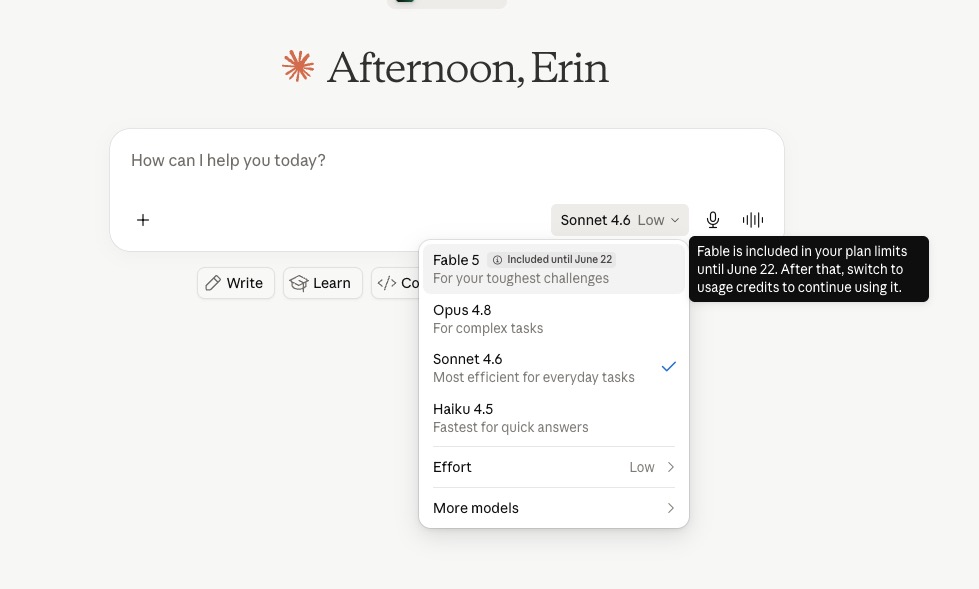
How to access Claude Fable 5
Claude Fable 5 is generally available across all of Anthropic’s main surfaces: Claude.ai (web and mobile), Claude Code, and Claude Cowork. It is also available through the Claude API, Amazon Bedrock, Google Cloud Vertex AI, and Microsoft Foundry.
The bottom line: matching the right Claude model to your needs
Claude Fable 5 is a genuinely significant release, but alas “significant” doesn’t mean “right for everyone.” For most small businesses, the model to reach for daily is Sonnet 5, with Opus 4.8 as the upgrade for anything where reliability matters more than cost. Fable 5 earns its place on tasks that are genuinely large, long-running, and autonomous: the kind of work where a skilled contractor completing a project unsupervised over several days is the right mental model.
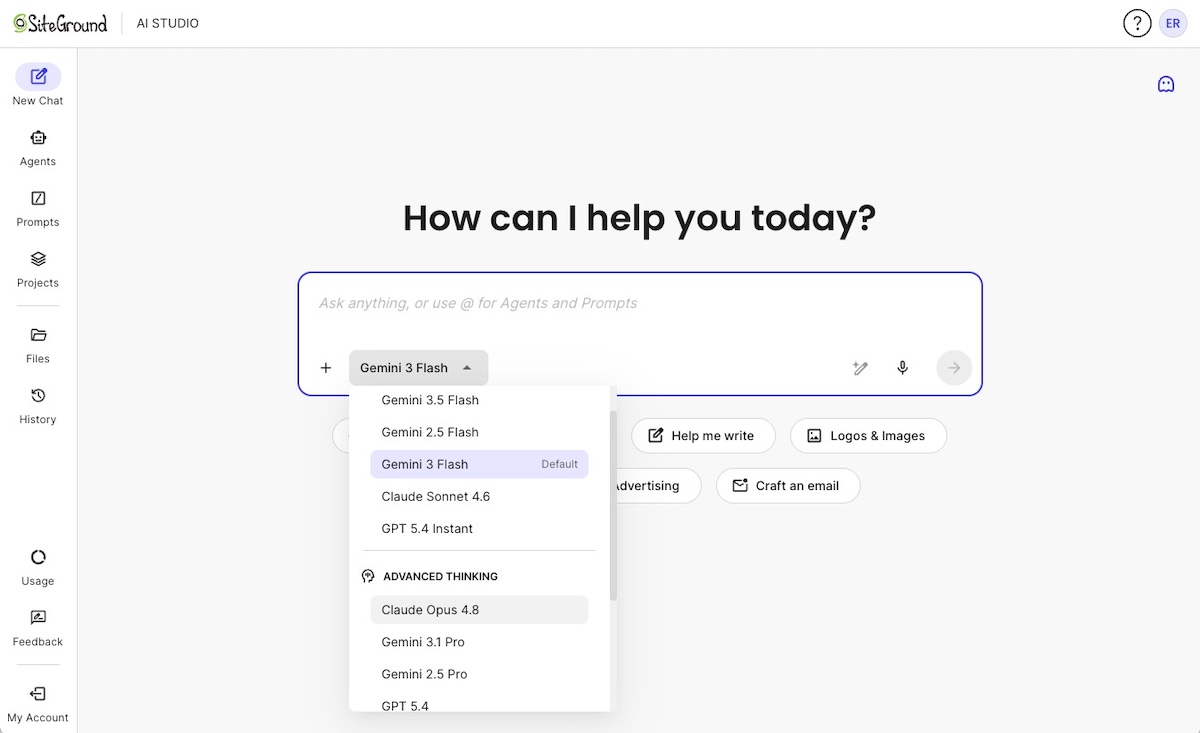
For the day-to-day work that makes up most of a small business’s AI needs, SiteGround AI Studio gives you access to ChatGPT, Claude, Gemini, and more than 15 specialized AI agents for SEO, social media, email marketing, and WordPress — all in one workspace, under one subscription.
[97]
Frequently asked questions
Fable 5 and Mythos 5 are the same underlying model with one key difference: Fable 5 includes safety classifiers that block and reroute requests in restricted categories: cyberattack tooling, dual-use biology and chemistry, and frontier AI model development.. Mythos 5 operates without those classifiers and is available only to vetted partners through Anthropic’s Project Glasswing program. For general business use, Fable 5 offers the same capabilities.
Fable 5 comes with a temporary usage allowance on Claude Pro, Max, Team, and select Enterprise plans, rather than being included at no cost indefinitely. Check Anthropic’s usage credits page for the current terms. It’s not available on the free tier. Via the API, it costs $10 per million input tokens and $50 per million output tokens.
For the majority of small business tasks (content creation, research, email drafting, customer support) Claude Sonnet 5 offers the best balance of quality and cost, and now handles a fair amount of agentic work like coding and tool use too. Claude Opus 4.8 is the better choice when the work is high-stakes enough that reliability matters more than cost, things like long-form analysis or document-heavy projects where a mistake is expensive. Claude Fable 5 is worth considering only for genuinely large, autonomous, multi-step tasks where the extended run capability justifies the higher cost.
Fable 5 includes classifiers that monitor for requests in restricted categories: detailed cybersecurity exploits, dual-use chemistry or biology content, and frontier AI model development. If a request triggers a classifier, the model declines and automatically reroutes to Claude Opus 4.8. Anthropic reports this affects fewer than 5% of sessions. For normal business work, refusals are rare. Shortly after launch, some false positives were reported on benign prompts; Anthropic has acknowledged this and is actively addressing it.
No. Fable 5 is available directly through Claude.ai on web, mobile, and desktop without any technical setup. If you are on a paid Claude plan, you can start using it today from the model selector in the interface. Developer access via API does require technical knowledge, but for everyday business use the standard Claude interface is all you need.