
If your open rates are dropping and you’re not sure why, the answer is usually in your sent folder. One content type, sent on repeat, trains subscribers to stop paying attention. This guide covers the six types of email marketing content that fix that, and a simple framework for putting them together so your email marketing actually gets somewhere.
Key takeaways:
- A varied content mix keeps subscribers engaged between promotions and protects your sender reputation
- Welcome emails have the highest open rates of any email type — most businesses underuse them
- Sending only promotions trains your list to ignore you
- 1–2 emails a week works well for most small businesses, but content type matters more than send frequency
- Different subscribers need different emails — where they are in the relationship should drive what you send
What is email marketing content?
Email marketing content is the message inside your email: what you actually say to your subscribers and why. It can serve different purposes: introducing your brand, teaching something useful, sharing a story, promoting an offer, or bringing inactive subscribers back. Together, these different content types cover the full customer journey, from the moment someone joins your list to the point they become a loyal buyer.
Why your content mix matters more than your send frequency
Sending frequency gets a lot of attention in email marketing, but what you send matters more than how often you send it. When every message is a promotion, subscribers learn to treat your emails as noise. They stop opening, stop clicking, and eventually stop caring.
A varied content mix changes that dynamic. When subscribers get something useful or interesting between offers (a tip, a story, a resource) they stay engaged. And email engagement matters beyond the relationship: inbox providers evaluate senders based on spam complaint rates and overall subscriber behavior.
According to Validity’s 2026 Email Deliverability Benchmark Report, keeping spam complaint rates below 0.1% is now the desired threshold. A list that only hears from you when you’re selling is more likely to generate spam complaints and a damaged sender reputation takes dedicated effort to recover, not just time.
Give different emails different jobs and keep reading to see what those jobs look like.
6 types of email marketing content and what each one does
Before reading about the six content types, do this one thing: pull up your last 10 sent emails and sort them into two piles:
- Emails that asked for something
- Emails that gave something
Count each pile. If you have seven promotional emails and three of everything else, that ratio is your problem, not your open rates, not your subject lines, not your send time. Write the numbers down. Then keep reading, because the rest of this guide is about fixing them.
Here are the six content types that make up a balanced email mix: what each one does, and when to reach for it.
Welcome emails
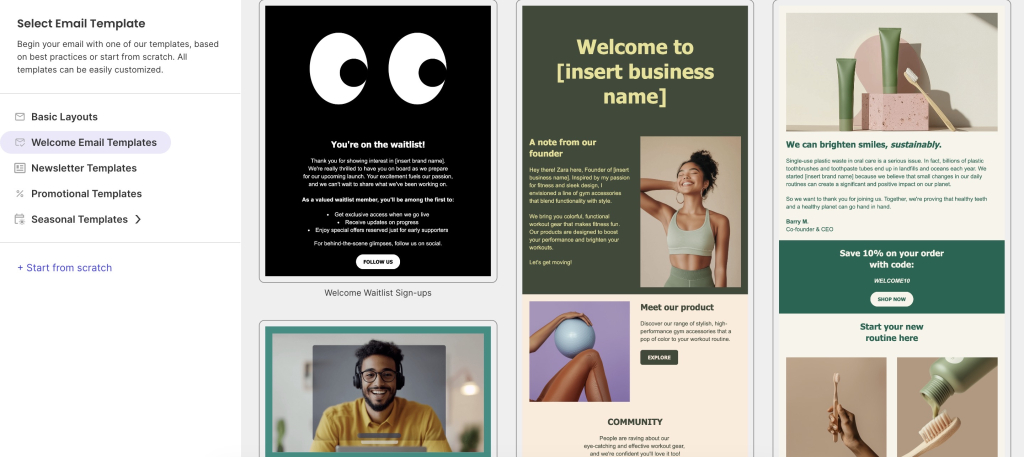
A welcome email is the first message a subscriber receives after joining your list, and statistically, the one they’re most likely to open. Its role in the mix is to set the tone before any ask is made: who you are, what they can expect, and why staying subscribed is worth their while. Send it immediately after signup, every time, without exception. Everything else you send builds on the foundation this email either creates or fails to create.Not sure where to start with your welcome email? SiteGround Email Marketing comes with a gallery of ready-made templates (including welcome emails) so you’re not staring at a blank canvas wondering how to introduce yourself.
Educational content and how-to emails
Educational emails are the workhorses of a healthy content mix. Their job is to build the kind of authority that makes your promotional emails land better when you do send them. Think of every educational email as a deposit: you’re building a track record of usefulness that subscribers will draw on when deciding whether to trust your recommendations. They work best when they’re specific: one concrete problem, one clear answer rather than broad topic overviews that could have been written by anyone.
Мake educational emails more interesting: before you write, finish this sentence — “After reading this email, my subscriber will know how to ___.” If you can’t complete it in one line, the topic is too broad.
Then write the email like you’re explaining it to a friend over coffee, not presenting to a boardroom.
Newsletters
A newsletter job isn’t to teach or to sell — it’s to show up. Consistently, on a predictable schedule, with enough personality that subscribers recognize your voice the moment they open it. Think of it like that friend who checks in every few weeks. Not always with big news, but reliably there. That consistency is what keeps you familiar between purchase moments, and familiar is what makes people buy from you when you do have an offer.
The newsletters people actually look forward to: a recognizable voice. Read your newsletter back and ask yourself if it sounds like you or like a brand. If you’d never say any of it out loud, rewrite it until you would.
Promotional emails
Promotional emails are the ones you’ve probably already been sending — a discount, a launch, a limited-time offer. They’re the most direct content type in the mix and the most effective at driving immediate action, but only when the relationship behind them is already warm. A list that hears from you exclusively through promotions stops treating them as offers and starts treating them as noise. The other five content types on this list exist, in part, to make this one work.
Another quick tip: Read your promo back and count how many sentences start with “we,” “our,” or your business name. Then rewrite them to start with “you” instead. The offer doesn’t change. The way it feels to the reader does.
For example: “We’re launching our new skincare range this Friday” becomes “Your skin’s about to get an upgrade — our new range drops Friday.” Same information, completely different feeling.
Stories and behind-the-scenes
Behind-the-scenes emails are the easiest to skip when you’re busy; they don’t have an obvious ask, a clear conversion goal, or a deadline driving them. But they’re consistently the ones subscribers remember and respond to the most.
They don’t lead with a lesson or a pitch. They show the person behind the business through a real moment, a decision, a mistake. The teaching happens on the way, not as the point. For small businesses, this is a structural advantage: your story, your voice, your mistakes are yours alone. One honest email about a decision that nearly went wrong will do more for subscriber loyalty than ten polished newsletters.
A trick for writing these when you’re stuck: if you’re staring at a blank screen, start with the moment you almost got something wrong. A decision that nearly went sideways, a launch that nearly didn’t happen, a lesson that cost you something. That’s where the interesting email lives — not in the win, but in what happened just before it.
Re-engagement emails
Every list has subscribers who’ve gone quiet: they signed up at some point, stopped engaging, and have been silently inflating your list size ever since. A re-engagement email’s job is simple: find out who can be won back and let go of the ones who can’t. Do it intentionally, every 90 days or so, before deliverability quietly suffers.
Skip “we’ve missed you.” It’s the subject line equivalent of a form letter. “Still interested?” or “Should we break up?” gets opened. And often gets a reply.
Cheat sheet: nail every email element to your content type
Now that you know what each type does, here’s how they should actually feel when you’re writing them, from subject line to closing line:
| Subject line | Body | CTA | Closing | |
| Welcome | Delivers on the signup promise | Who you are, what you offer + one immediate piece of value | One soft next step (a link to a resource) | What’s coming next and when |
| Educational | Problem-first, no hype | One problem, one answer, one example | Optional link to go deeper | “Try this today” |
| Newsletter | Conversational, like a text from a friend | A few updates or resources tied to one theme or moment | Light, contextual | Consistent personal sign-off |
| Promotional | Outcome-focused, reason to act now | Offer in the first two sentences, outcome before price | One button, nothing competing with it | Restate the deadline or key benefit |
| Story / BTS | Honest, slightly unfinished-feeling | One specific moment + the tension behind it | Reply invitation or a soft link; not a hard sell | Leave it open — invite a response |
| Re-engagement | Direct and self-aware | Acknowledge the silence + one reason to stay | Stay or unsubscribe: both equally easy to find | “Either way, no hard feelings” |
How to plan your email content mix
Knowing what each content type does is the easy part. The harder part is sitting down on a Monday morning and actually deciding what to send this week. These six steps take that decision off your plate, covering everything from where your subscribers are in the customer journey to what your metrics are telling you about your mix.
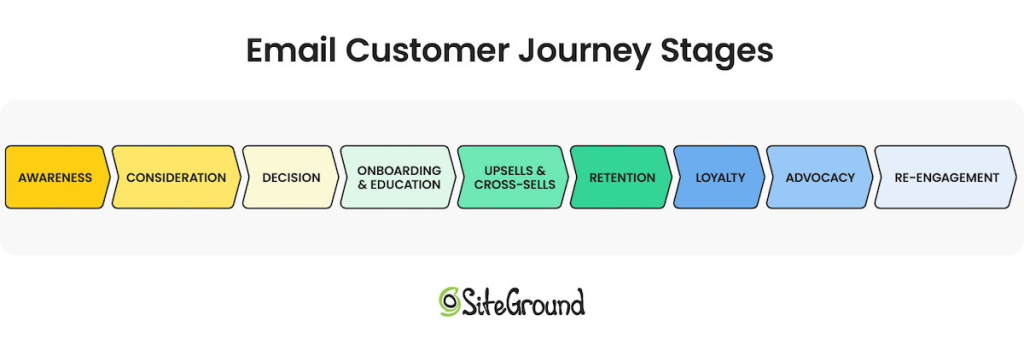
The steps below follow the customer journey: from the moment someone joins your list to the point they become a loyal, engaged buyer.
1. Start with one goal per email
Before you pick a content type or open your email editor, decide on your email marketing goal: what do you want this email to do? Inform? Build trust? Drive a purchase? One email, one job.
This single habit is what separates a content strategy from a random send schedule.
2. Match the content type to the relationship stage
Not everyone on your list needs the same email right now. Someone who signed up yesterday needs something different from someone who’s been opening every email for six months — and something very different from someone who hasn’t clicked anything in three.
Here’s how to match what you send to where they are.
| Where they are | What to send | Why |
| Just joined your list | Welcome email, educational content | Build familiarity before making any ask |
| Opening emails but not buying yet | Newsletters, how-to emails, stories | Deliver consistent value, establish personality |
| Clicking, engaging, buying occasionally | Mix of value content and occasional offers | Keep trust high while converting it into revenue |
| Bought from you before | Behind-the-scenes, early access, rewards | Deepen the relationship with the people already sold on you |
| Haven’t opened in 90+ days | Re-engagement email | Find out who’s still interested before your deliverability suffers |
3. Send the right email to the right part of your list
You don’t need complex segments to send more relevant emails. For a small business sending 2–4 emails a month, one split does most of the work. For instance, you can differentiate customers vs. non-customers using Groups in SiteGround Email Marketing.
- Existing customers: lead with loyalty, exclusivity, and product depth; they already trust you
- Non-customers: lead with education and value; they’re still deciding whether you’re worth their attention
That single split immediately makes every email feel more relevant to the person receiving it.
In SiteGround Email Marketing, you can organise your contacts into Groups and send separate campaigns to each one. If you’re running a WooCommerce store, the easiest way to build your customer segment is through the subscribe checkbox at checkout — anyone who buys and opts in can be assigned to a Customers Group from there. If you’re not on WooCommerce, a one-time CSV import of your existing customer list gets you set up. It’s not fully automated, but you only need to do it once.
Once you have your Groups set up, you’ll occasionally run into this: sometimes a subscriber will sit in more than one Group — a loyal customer who’s also gone quiet lately, or someone who bought once but never really engaged. Don’t overthink it. Educational emails and newsletters go to everyone regardless.
For promotions, use your best judgement. Send to your most engaged Group first, then broaden if the offer is relevant to everyone. When in doubt, ask yourself what this person most needs to hear from you right now. That usually settles it.
4. Repurpose the content you already have
The most common reason small business owners fall off their content calendar isn’t lack of time — it’s running out of things to say. The fix is already sitting in your existing content.
Your blog posts, social media tips, podcast episodes, and videos are all email content waiting to happen:
- Pick one piece of existing content: a blog post, a tip you shared on Instagram, a question a customer asked last week
- Pull out one takeaway; not a summary, one specific immediately useful point
- Write 200–300 words around it: enough for subscribers to get value without clicking anywhere, then link to the original for anyone who wants more
A 1,500-word blog post yields one solid educational email. A five-tip Instagram carousel yields five. You don’t need a new idea every week — just a different format for one you already have.
5. Decide on your content ratio, not just your frequency
For most small businesses, 2–4 emails a month is a sustainable starting point. But how often you send matters less than what you send across those emails.
A simple rule of thumb (and one that’s been around long enough to have earned its place): the 80/20 rule. Roughly 80% of your emails should give subscribers something genuinely useful: education, a story, a newsletter, a resource. The remaining 20% can ask for something in return. In practice, for every promotional email you send, aim for two or three that aren’t selling anything.
A concrete monthly mix might look like this:
| Week | Content type | Selling anything? | Example |
| Week 1 | Educational email | No | “3 things that are hurting your skin barrier (and what to use instead)” |
| Week 2 | Newsletter | No | A roundup of what you’ve been testing, a customer tip you loved, one thing coming up next month |
| Week 3 | Promotional email | Yes | 20% off your bestsellers, this week only |
| Week 4 | Story / BTS | No | “We almost scrapped our bestselling moisturizer before launch” |
📅 Planning around seasonal moments
Your subscribers think in seasons before they think in weeks. Black Friday, the January reset, spring launches, back-to-school — these moments are already on their radar, which makes them the perfect anchors for your content calendar.
The way to use them without blowing your 80/20 ratio: map one promotional email to each seasonal peak, then plan the two or three value emails that lead into it. The content type you lean on in the build-up depends on the moment:
Back-to-school: lead with educational emails — your audience is in problem-solving mode and receptive to practical advice
Black Friday: lead with stories and BTS — people want to know who they’re buying from before they spend
January: lead with newsletters — everyone’s in reset mode and looking for useful, low-pressure content
Spring launches: lead with educational or how-to content — new season, new goals, high motivation to learn something
The promotion lands at the end of that sequence, on a list that’s been warming up for weeks rather than one that hasn’t heard from you since October. Think of the seasons as your content calendar skeleton — fill in the value content around the promotions and the planning part largely takes care of itself.
6. Track what’s working and adjust
Good news: your subscribers tell you exactly what they want to read. You just have to know where to look. Every open, click, and unsubscribe is a vote. Аnd read across a month or two of sends, those votes add up to a pretty clear picture of what’s working in your content mix and what isn’t.
After each send, check three email metrics:
- Open rate is your relationship health check. A gradual drop over time isn’t a subject line problem. It’s your list telling you they’ve stopped expecting something worth opening.
→ If the open rate is trending down, check your ratio: more than 25% promotional sends is usually the culprit.
- Click-through rate (CTR) is your content quality check. If people open but don’t click, the email didn’t deliver on what the subject line promised. For educational emails especially, a healthy CTR means the content was genuinely useful — not just opened and forgotten.
→ If your CTR is dropping, narrow your next educational email to one specific problem and make sure the subject line matches what’s actually inside.
- Unsubscribes are your most honest feedback. A spike after a promo means the value content around it wasn’t doing enough work. A spike after an educational email means the topic missed.
→ If unsubscribes spiked after a promo, count how many value emails went out in the four weeks before it. If the answer is one or fewer, that’s your answer.
These three numbers won’t tell you everything, but they’ll tell you enough to know what to adjust in your mix. For a full breakdown of what those numbers mean and what to do about them, see our email marketing ROI guide.
Now go send some email marketing content worth reading
If you’ve made it this far, you already know more about email content strategy than the majority of small business owners sending emails right now. The ones who treat their list like a billboard — show up when there’s something to sell, go dark the rest of the time — are leaving a lot on the table. Not just revenue, but the kind of subscriber relationships that make email actually enjoyable to do.
Pick one content type you’re not sending yet and write that email this week. Don’t wait for a full content calendar or a slower month — that month isn’t coming. Start with one email and build from there.
Your list is already there. They signed up because they thought you’d be worth hearing from. Go prove them right.
SiteGround Email Marketing gives you the templates, AI writing tools, and send infrastructure to put everything in this guide into practice, without needing a marketing team behind you.
[58]
Frequently asked questions about email marketing content
The six core types are welcome emails, educational content, newsletters, promotional emails, behind-the-scenes stories, and re-engagement emails. Each serves a different point in the subscriber relationship — welcome and educational emails build trust early, newsletters maintain presence, promotions convert that trust into revenue, stories build brand personality, and re-engagement emails clean your list of inactive subscribers.
The most practical approach is to treat your blog post as the source and write a shorter version for email that delivers one key takeaway — not a summary of the whole post. Give subscribers enough to get value from the email itself, then link to the full article for readers who want to go deeper. A 1,500-word blog post typically yields one solid educational email.
For most small businesses, 2–4 emails per month is a sustainable starting point. Frequency matters less than consistency and content ratio — four emails of mixed types (educational, newsletter, promotional, story) will outperform four promotional emails at the same cadence.
A clear purpose before you write it, content matched to where the subscriber is in the relationship, one call to action, and a subject line that earns the open without overpromising. The emails that perform best are the ones that give subscribers something worth their time before asking for anything in return.
Because it’s the difference between a list that buys and a list that ignores you. A subscriber who only hears from you when you’re selling something learns to tune you out. One who regularly gets useful, interesting emails stays engaged — and when you do have an offer, they’re already paying attention.